
TL;DR
- FHLBank homeownership set-aside grants reach buyers through member financial institutions. The federal framework does not confirm an Austin lender or buyer award.
- Treat lender-mentioned assistance as unconfirmed until the lender identifies the applicable program and explains availability, transaction-specific requirements, permitted use, and timing.
- Budget without unconfirmed aid. If the purchase only works with assistance, resolve that funding question before relying on it in an offer or cash-to-close plan.
If you are buying an Austin-area home and a lender mentions an FHLBank Affordable Housing Program grant, it is worth checking. Applicable assistance could reduce the cash you need for the purchase. But a program name alone does not establish money you can use at closing.
The practical answer: treat this as a lender screening question. Keep the unassisted purchase budget until the lender confirms the assistance is applicable and available for your transaction. Otherwise, you could plan an offer around funds that never arrive.
What the FHLBank set-aside route actually means
The Federal Home Loan Banks, or FHLBanks, have an Affordable Housing Program, commonly shortened to AHP. Its Homeownership Set-Aside Program is a route through which FHLBanks make grants available to their member financial institutions. Those institutions provide funds for down-payment, closing-cost, or counseling assistance to homebuyers, according to the Federal Housing Finance Agency (FHFA).
That delivery route matters: the member financial institution connects the assistance to the buyer. Reading about the federal program does not establish that your lender offers it or that your purchase qualifies.
FHFA also says establishment of a homeownership set-aside program is elective for each FHLBank. Although each FHLBank must establish an AHP, the set-aside route is not automatic. The FHFA framework, checked November 7, 2026, does not verify current Austin-area participation, available funds, or an award for a particular household.
A possible grant can leave a real cash gap
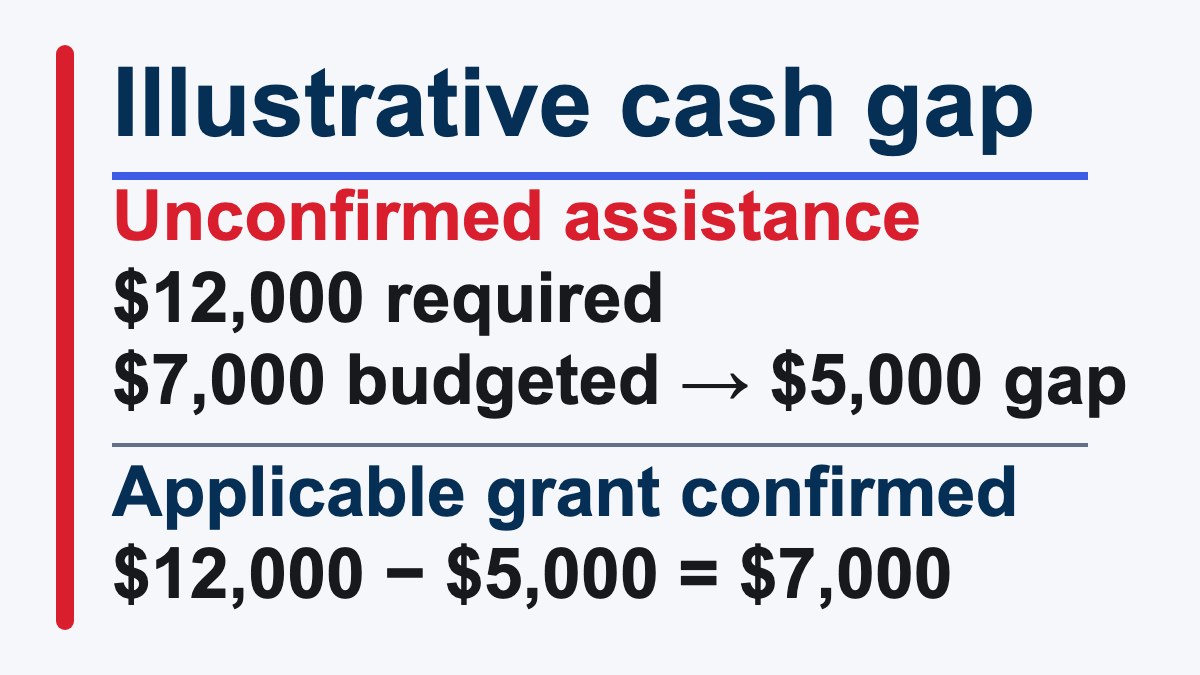
Consider an illustrative purchase with verified cash to close of $12,000 before assistance. Cash to close means the amount the buyer must bring to complete the purchase. A lender has mentioned a possible $5,000 grant but has not confirmed it. These are hypothetical figures, not an AHP award amount or evidence of Austin availability.
- Buyer A budgets $7,000, assuming the possible grant will cover the rest. If it is not confirmed, the buyer still needs $12,000 and has a $5,000 gap.
- Buyer B budgets the full $12,000 until the lender confirms the assistance is applicable and available. If the lender later confirms $5,000 that can be applied to those closing funds, the remaining amount becomes $7,000: $12,000 minus $5,000.
Both buyers could receive the same benefit if the assistance comes through. The difference is whether their purchase plan depends on an unresolved funding question. This example holds the purchase and loan costs constant; it does not model monthly payments, moving costs, or money kept for expenses after closing.
If you can cover the unassisted amount while retaining the money you need after the move, you can assess the grant as a possible improvement to an otherwise workable plan. If you cannot cover it, waiting for confirmation or considering a purchase with lower verified cash requirements is more workable than treating the gap as solved.
What an Austin-area buyer should have the lender confirm
Use the following questions to turn a general mention into a decision you can act on:
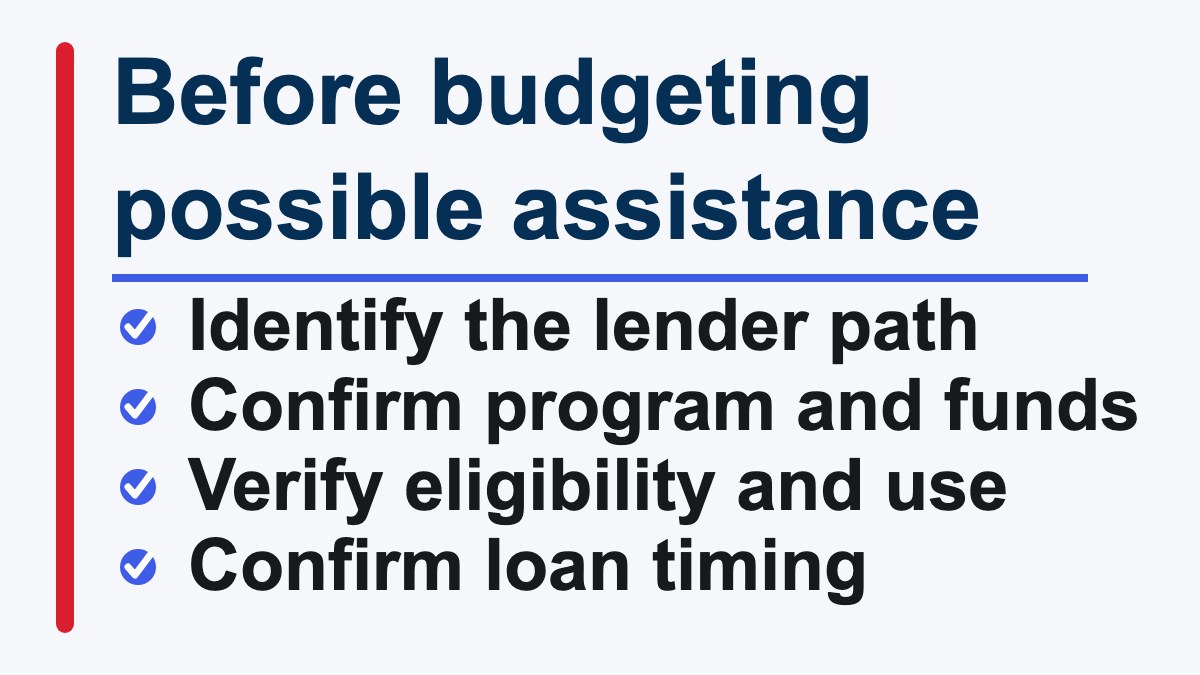
- Which program and member financial institution would serve this purchase? Ask the lender to name the applicable FHLBank/member path. Without that identification, you do not yet have a specific assistance option to compare.
- Are the program and funds available for this transaction? Ask what must happen before funds can be treated as available for your closing. An answer that funding is still uncertain means keeping the unassisted budget.
- What transaction-specific eligibility and documentation apply? Have the lender explain the household income and property requirements, and the documents needed to establish eligibility. A general description cannot resolve your household’s or property’s fit.
- What is the permitted use? Have the lender identify which costs the assistance can cover in your transaction. Funds for counseling should not be assumed to reduce the down payment.
- What underwriting and timing remain? Underwriting is the lender’s review of whether the loan meets its approval requirements. Ask which assistance and loan steps remain, who completes them, and whether they fit the proposed closing date.
Use your actual lender-confirmed figures before making an offer or setting a cash-to-close plan. When browsing the Home search, keep your price range tied to those figures. An Austin-area listing’s location or price alone does not establish that this lender-mediated assistance applies.
Decide whether the full financing arrangement fits
Confirmed assistance can reduce the upfront cash burden, but that benefit does not by itself establish that the accompanying loan is your best choice. Compare the lender’s actual loan terms, payment, fees, assistance conditions, and closing timetable with a workable alternative. Do not assume this grant makes the monthly payment lower or that every lender can deliver the same package.
Also ask for the written terms governing what happens after closing, including whether any occupancy, sale, refinance, or repayment conditions apply. This guide does not establish those terms for a particular program. If an obligation would conflict with your plans, that could change the choice even when the upfront assistance is attractive.
Pursuing this route makes sense when the lender confirms a usable program and the complete financing arrangement fits your budget and timing. Proceeding without it can make sense when the unassisted purchase is affordable and the alternative loan terms work better for you. If neither plan works without uncertain funds, pause that purchase plan rather than commit based on a possible grant.
Frequently asked questions
Can I combine a set-aside grant with other down-payment assistance?
The verified federal overview does not establish whether a particular combination is allowed. Give the lender the names and terms of both proposed programs and request confirmation that they can be used together, including how each would be applied. Do not add their advertised amounts together as available closing funds before that review.
Does this program also cover work on a home I already own?
FHFA describes rehabilitation assistance to homeowners as another use of homeownership set-aside funds. That is a different question from assistance for a purchase. The federal overview does not confirm a local rehabilitation program or your project’s eligibility; a member institution would need to identify an applicable program and its requirements.
Sources
- Federal Housing Finance Agency: Affordable Housing Program — national framework for member-institution delivery and elective homeownership set-aside programs; checked November 7, 2026. It does not establish Austin availability or individual eligibility.
Recommended reading
- Austin Down-Payment Assistance: Compare Saving Time and Housing Costs
- Austin Down-Payment Assistance: When a Bigger Grant Can Mean a Bigger Decision Later
Bring your lender-confirmed cash-to-close estimate and any unresolved assistance requirements to Vladimir Baibus · ATXCasa, LPT Realty, for help matching your Austin-area home search and offer timing to the funds your lender has verified.