

TL;DR
- A fixed interest rate does not freeze property taxes or homeowners-insurance premiums. If your payment includes escrow, those costs can change the total.
- Compare principal and interest, ongoing tax-and-insurance escrow, and any shortage-repayment amount separately.
- Paying an escrow shortage does not itself lower the projected costs ahead. Confirm available repayment options and the resulting monthly payment before committing cash.
If you own an Austin-area home and your mortgage bill just increased, start by finding which charge changed. A larger total does not, by itself, mean your interest rate went up. The Consumer Financial Protection Bureau (CFPB) recommends checking the statement’s itemized charges; taxes or insurance premiums can change an escrowed payment independently of the rate. Getting this distinction right helps you budget—and avoid paying a lump sum expecting your old payment to return. CFPB explains the possible causes.
A higher payment with unchanged principal and interest
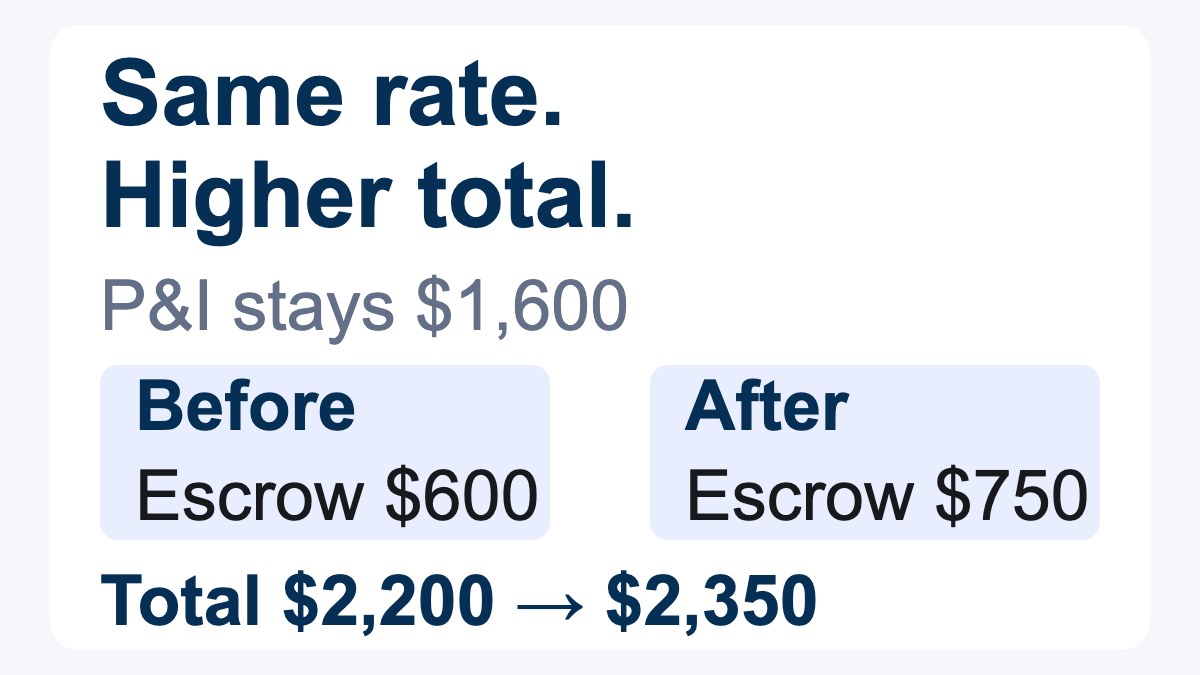
Consider this hypothetical monthly payment. These are illustrative amounts, not an Austin cost estimate or an actual lender statement. Principal and interest—the amount applied to the loan balance and the charge for borrowing—stays at $1,600. Ongoing escrow for taxes and homeowners insurance changes from $600 to $750.
| Monthly component | Before | After |
|---|---|---|
| Principal and interest | $1,600 | $1,600 |
| Ongoing tax-and-insurance escrow | $600 | $750 |
| Total of these components | $2,200 | $2,350 |
The total rises $150 per month with no change to principal and interest. These totals exclude shortage repayment, mortgage insurance, fees, and any other charges. If your actual bill also includes shortage recovery, identify that amount separately.
The practical consequence: even after a separate shortage is resolved, this example still requires $2,350 per month for principal, interest, and ongoing escrow, assuming those components remain unchanged. Budgeting for a return to $2,200 would leave the higher ongoing cost unaccounted for.
Ongoing escrow and a shortage answer different questions
Escrow is an account your mortgage servicer—the company handling your payments—uses to pay covered bills such as property taxes and homeowners insurance. An escrow analysis calculates the upcoming year’s monthly escrow payments and checks the account balance for a shortage, surplus, or deficiency. For covered federally related mortgage loans, the servicer must conduct an analysis at the end of the escrow computation year and submit an annual escrow statement. Regulation X describes these requirements and their scope.
Ongoing escrow asks: What needs to be collected for the costs ahead? A shortage asks: How far below its target is the current account balance? Regulation X defines a shortage as the amount by which the current escrow account balance falls short of the target balance at the time of escrow analysis. It is a balance comparison, not simply another name for a higher insurance premium. See the regulation’s definitions.
Both can affect the same payment. Resolving the balance shortfall does not, by itself, reduce the projected annual tax or insurance cost. Likewise, the existence of a shortage does not prove that every figure in the analysis is correct.
Compare the documents before choosing a response
Put the old and new mortgage statements beside the escrow analysis, your property-tax bill, insurance renewal, and loan documents. For an Austin-area homeowner, these property-specific records are more useful for explaining a changed payment than a general headline about taxes or insurance. This is an application of national guidance; the evidence does not establish an Austin-area cost trend.
- Check principal and interest first. If this amount changed, verify the loan type and payment terms. An escrow explanation alone does not explain a change in the loan-payment component.
- Match projected escrow costs to the bills. Identify the tax and insurance amounts and periods the servicer used. If they differ from your records, ask the servicer to reconcile the difference. This reveals whether the budget change reflects the costs projected for your property or a figure that needs clarification.
- Locate shortage recovery. Ask how much of the new payment replenishes the account balance and how much funds future bills. If the statement combines them, request the breakdown.
- Confirm the timeline. Ask when the new payment starts, when any shortage-repayment amount ends, and what monthly payment would remain under the current projections. That last amount is the useful starting point for your ongoing budget.
The servicer’s itemized escrow analysis and your own loan documents determine the account-specific answer. Regulation X permits additional deposits for shortages or deficiencies subject to its limitations; individual loan documents, state law, account facts, and applicable exceptions can matter. It does not guarantee a particular repayment arrangement. Review the federal escrow rule.
If repayment options are available, compare cash now with payments later
If the servicer confirms that your account allows both a lump-sum shortage payment and repayment through monthly payments, compare the resulting bills before choosing. A lump sum may suit you if it removes the confirmed shortage-repayment charge and still leaves enough cash for upcoming household expenses. Its cost is having less cash available immediately.
Repayment through monthly payments may fit better when keeping cash available matters more and you can afford the higher bill during the repayment period. Its cost is the added monthly obligation while repayment continues. Ask the servicer to confirm the amount, duration, and any terms for each available option.
In either case, keep the higher ongoing escrow projection in your budget unless the servicer confirms a revision. After shortage repayment ends, future escrow analyses can still change the payment as projected costs and the account balance change. A lower payment later is conditional, not a promise.
Frequently asked questions
What if the changed charge is not escrow?
The CFPB lists other possible causes, including a temporary buydown ending, principal payments beginning on certain loan types, changed private mortgage insurance, fees, or an error. An adjustable-rate mortgage can also have a rate change. A temporary buydown reduces what the borrower pays for an introductory period; its end need not mean the underlying interest rate changed. Match the changed line to your actual loan terms rather than assuming every increase has the same cause. See CFPB’s payment-change guidance.
What if calling the servicer does not resolve an apparent calculation error?
If an apparent calculation error is not resolved by calling the servicer, CFPB says a borrower can send a notice of error or an information request to the address designated for those requests. Use that designated address when taking this step. CFPB describes this next step.
Sources
- CFPB: Why did my monthly mortgage payment go up or change? Consumer guidance last modified May 21, 2026; verified November 23, 2026.
- CFPB: 12 CFR § 1024.17, Escrow accounts. Federal escrow mechanics and definitions; verified November 23, 2026.
Recommended reading
- Just Bought an Austin Home? Your Homestead Exemption Checklist
- Texas Home Insurance Premium Up? Compare the Cause and Coverage Before You Shop
If the confirmed ongoing payment changes whether keeping your Austin-area home fits your budget, contact Vladimir Baibus · ATXCasa, LPT Realty for help comparing staying with a potential move using that updated housing cost.