

Downtown Austin condo inventory is rising, but “more choices” is not the same as “automatic bargain.” The Downtown Austin Alliance reports that the condo market added 550 units since 2024—a 14% increase in inventory. That can improve a buyer’s negotiating position. It can also expose buildings and unit types that are harder to finance, rent, maintain, or resell than the view suggests.
My short answer: a downtown condo is a bargain only when the purchase discount survives an all-in cost test and a building-level document review. Compare the unit with true substitutes, calculate the mortgage plus HOA dues, taxes, insurance, parking, and reserves, then inspect the association’s budget, insurance, assessments, litigation, leasing rules, and major building systems. If the deal only works because the price per square foot looks lower than it did two years ago, the buyer has not finished the analysis.
Why this question is timely in 2026
The Downtown Austin Alliance’s 2026 report says eight downtown projects totaling 3.94 million square feet were delivered in 2025, while six projects totaling 2.94 million square feet remained under construction. It also notes that the broader development pipeline has contracted, giving recently delivered projects time to be absorbed.
Those figures describe supply, not the value of a specific condo. A resale unit in an established tower, an unsold developer unit, a compact investor-oriented one-bedroom, and a larger owner-occupied unit may compete with different alternatives. Even two identical floor plans can diverge because of floor, orientation, parking, noise exposure, view protection, or condition.
Citywide data also needs context. Unlock MLS reported a 1.4% year-over-year decline in the City of Austin median price in July 2026, 4.5 months of inventory, and an average close-to-original-list-price ratio of 93.9%. Those numbers support a more negotiable market, but they do not tell a condo buyer which building has healthy reserves or which unit line has ten close substitutes.
Three buyers can see the same “deal” very differently
The owner-occupant choosing between buying and renting downtown
This buyer values walkability, a short commute, security, amenities, and predictable control of the unit. The right comparison is not just purchase price versus rent. It is the five-year cost of ownership versus the five-year cost and flexibility of renting a genuinely comparable unit.
The investor who expects the rent to carry the unit
This buyer must verify that leasing is allowed, whether a cap or waitlist exists, what minimum lease term applies, and what similar units actually leased for. A lower price can still produce weak cash flow when HOA dues, taxes, insurance, vacancy, management, and interior repairs are included.
The future seller buying into a crowded unit type
This buyer should count competing units with the same bedroom count, view direction, parking arrangement, and approximate monthly carrying cost. If several nearly identical units are available, the future resale may depend on being the best-priced or best-positioned option. Developer incentives can also compete with resale pricing even when the advertised prices look different.
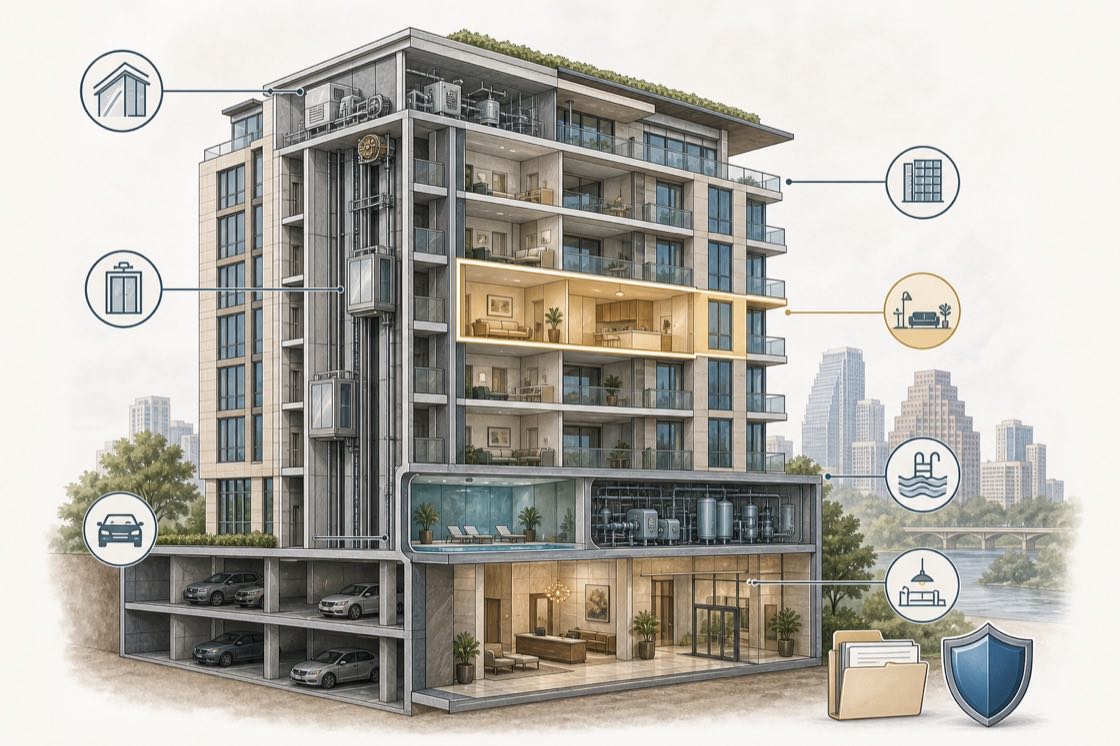
Test the all-in monthly cost before celebrating the discount
Start with a line-by-line ownership budget:
All-in condo cost = principal and interest + property taxes + unit insurance + HOA dues + parking/storage fees + interior maintenance reserve + any known assessment
Freddie Mac reported a national average 30-year fixed mortgage rate of 6.66% on August 27, 2026. An individual borrower’s rate will differ, but the current rate environment makes the financing line material.
A hypothetical downtown Austin example
Assume a $575,000 condo with 20% down and a $460,000 30-year loan near 6.66%. The principal-and-interest payment is roughly $2,955 per month. Add hypothetical amounts of $900 for property taxes, $850 for HOA dues, $175 for condo-unit insurance, and $50 for parking or storage. The all-in total is about $4,930 per month before utilities and interior repairs.
| Illustrative monthly item | Amount |
|---|---|
| Principal and interest | $2,955 |
| Property-tax allowance | $900 |
| HOA dues | $850 |
| Condo-unit insurance | $175 |
| Parking or storage | $50 |
| Illustrative total | $4,930 |
These are not typical or quoted costs; they are a demonstration of the method. Replace every line with the unit’s actual loan quote, tax history and estimated future taxes, association dues, insurance quote, and included services. Then compare the result with a similar rental and with other condo buildings—not with an average apartment several miles away.
HOA dues are not automatically “bad.” A higher fee may cover staff, insurance, water, amenities, maintenance, and reserves that an owner would otherwise pay separately. The question is whether the fee buys services and financial stability that matter to the buyer, and whether future increases are supportable.
The building can matter more than the countertops
Texas condominium ownership combines a private unit with a shared interest in common elements. The Texas Uniform Condominium Act, Property Code Chapter 82, governs condominium associations and resale certificates. The chapter requires associations to maintain detailed financial records and meeting records, and it addresses the resale-certificate process. The exact contract rights and review periods are transaction-specific, so a buyer should use the current contract and professional guidance rather than relying on a generic checklist.
For a serious purchase, request and review the available association package, including:
- Current budget and recent financial statements: Are recurring expenses covered by recurring income, or is the building leaning on one-time charges?
- Reserve information and capital planning: What is expected for elevators, facade, roof, garage, pool, mechanical equipment, and other large common systems?
- Recent board and owner meeting minutes: Do they show repeated leaks, mechanical failures, security issues, staffing changes, disputed repairs, or an assessment under discussion?
- Master insurance policy and deductible: What does the association insure, what is the deductible, and where does the unit owner’s responsibility begin?
- Pending assessments, litigation, or major contracts: Could an announced project change the ownership cost after closing?
- Declaration, bylaws, and rules: Do leasing, pets, renovations, move-in procedures, parking, and storage match the buyer’s plan?
- Unit-specific resale certificate: Does it disclose amounts due, current assessments, and other material association information for the transaction?
The Texas Department of Insurance explains that condo-unit coverage and the association’s master policy cover different property and responsibilities. Ask an insurance professional to compare the unit policy with the declaration and master policy. A cheap unit with a large coverage gap is not cheap.
Five signs the discount may be real
- The price is lower than recent comparable closed sales after adjusting for floor, view, parking, size, and condition.
- The association finances are understandable. The budget, reserves, insurance, and planned capital work tell a coherent story.
- The all-in monthly cost fits the buyer’s actual use. The buyer values the location and included services enough to justify the premium over alternatives.
- The unit is not dependent on a fragile exit. It remains usable if rents soften, a job changes, or resale takes longer than expected.
- Financing and insurance are confirmed early. The building and unit qualify for the buyer’s intended loan and coverage.
Five signs it may be an expensive trap
- The sales pitch focuses on the old asking price rather than recent closed sales.
- The buyer cannot explain what the HOA fee covers or what the reserves are designed to fund.
- The rental plan ignores lease restrictions, management, vacancy, taxes, or interior maintenance.
- Several nearly identical units are competing while new units offer concessions.
- The deal requires fast appreciation to compensate for negative monthly cash flow.
How I would compare two downtown condo options
I would build one page for each unit with the same fields:
- negotiated price and financing terms;
- five-year all-in ownership cost;
- HOA services, reserves, planned projects, and assessment history;
- master-policy deductible and unit-insurance quote;
- parking, storage, move-in fees, and special charges;
- same-building and same-line closed sales;
- active competition and developer incentives;
- leasing rules and realistic rent range, if relevant;
- noise, orientation, view risk, elevator dependence, and daily route;
- the buyer’s likely exit: owner-occupant resale, long-term rental, or long hold.
That makes it possible to compare a $550,000 unit with an $850 monthly HOA against a $590,000 unit with a $600 HOA and stronger reserves. The lower sticker price is not automatically the lower-cost choice.
Buyers can browse current Austin condo and townhouse listings, then narrow the comparison to real substitutes. For broader negotiating context, see why easier negotiation does not always mean easier affordability.
Frequently asked questions
Are downtown Austin condo prices falling in 2026?
Inventory has increased, but a single downtown price trend can hide large differences by building, unit type, view, condition, and developer competition. Use same-building and closely matched closed sales before calling a unit discounted.
Is a high HOA fee a reason to avoid a condo?
Not by itself. Compare what the fee covers, the association’s reserves and capital plan, the building’s insurance and staffing, and the cost of receiving those services elsewhere. An unexplained fee with weak reserves is more concerning than a well-supported fee.
What documents matter most before buying a Texas condo?
Start with the resale certificate, declaration, bylaws and rules, current budget and financial statements, recent meeting minutes, insurance information, reserve or capital-planning materials, and notices of assessments or litigation. Contract deadlines and document rights vary, so review them promptly with the appropriate professionals.
The bottom line
Rising downtown Austin condo inventory creates selection and negotiation leverage. It does not remove building risk. The best opportunity is a unit whose price, monthly carrying cost, association finances, rules, insurance, and resale competition all support the same plan.
If you are comparing specific downtown units, contact Vlad Baibus at ATXCasa. I can help organize the unit-level comparable sales, active competition, and building questions before a view becomes an expensive assumption.
Examples in this article are hypothetical and for planning education. Association documents, contracts, financing, taxes, insurance, and legal obligations vary by property and transaction; confirm them with the appropriate licensed professionals.