
A builder’s below-market mortgage rate can be a real financial advantage, but it is not proof that the new home is the better deal. The only useful comparison is the whole package: negotiated price, permanent or temporary rate, points, cash to close, property taxes, HOA or special-district costs, included upgrades, inspection risk, and the home’s likely resale competition.
My rule for Austin-area buyers is simple: do not compare an advertised builder rate with a resale home’s asking price. Compare two actual properties and two written Loan Estimates on the same day, using the same loan type, down payment, and lock period. Then ask which option still works if you keep the home for five years and never refinance.
Why this question is showing up now
Buyers are seeing enough incentive offers that the rate can dominate the conversation. In August 2026, the National Association of Home Builders reported that 63% of surveyed builders were using sales incentives, while 35% reported cutting prices. A separate NAHB release said mortgage-rate buydowns were among the incentives being used to support new-home sales.
At the same time, Freddie Mac’s national average for a 30-year fixed mortgage was 6.66% on August 27, 2026. That makes a builder’s advertised rate in the fives look powerful. Recent first-time-buyer discussions are full of the same question: is the low rate a bargain, or is its cost hidden elsewhere in the transaction? Those conversations are anecdotal, but the confusion is real.
Central Texas buyers also have negotiating room beyond new construction. Unlock MLS reported 4.7 months of inventory across the Austin-Round Rock-San Marcos metro in July 2026 and an average close-to-list-price ratio of 93.7%. That does not mean every resale seller will discount a home, but it does mean the builder offer should be compared with a negotiated resale result—not automatically with list price.
First identify what the builder is actually offering
“Low rate” can describe several different structures. Ask the builder’s lender to name the structure in plain language and show it on a written estimate.
- Permanent rate buydown: money is used to pay discount points so the note rate stays lower for the loan’s life. The Consumer Financial Protection Bureau explains that points must appear on page 2, Section A of the Loan Estimate and be connected to a discounted rate.
- Temporary buydown: the payment is subsidized for an initial period and then rises to the full note-rate payment. A 2-1 buydown, for example, usually steps up after year one and again after year two.
- Closing-cost credit: the builder or lender covers eligible costs, reducing cash needed at closing. That may be more useful than a rate buydown for a buyer who needs reserves after the move.
- Price, lot, or upgrade incentive: the value comes through a price reduction, lot premium, appliances, blinds, landscaping, or design-center package rather than financing.
A permanent rate, temporary payment, and closing-cost credit solve different problems. Treating them as interchangeable is how buyers end up comparing the wrong numbers.
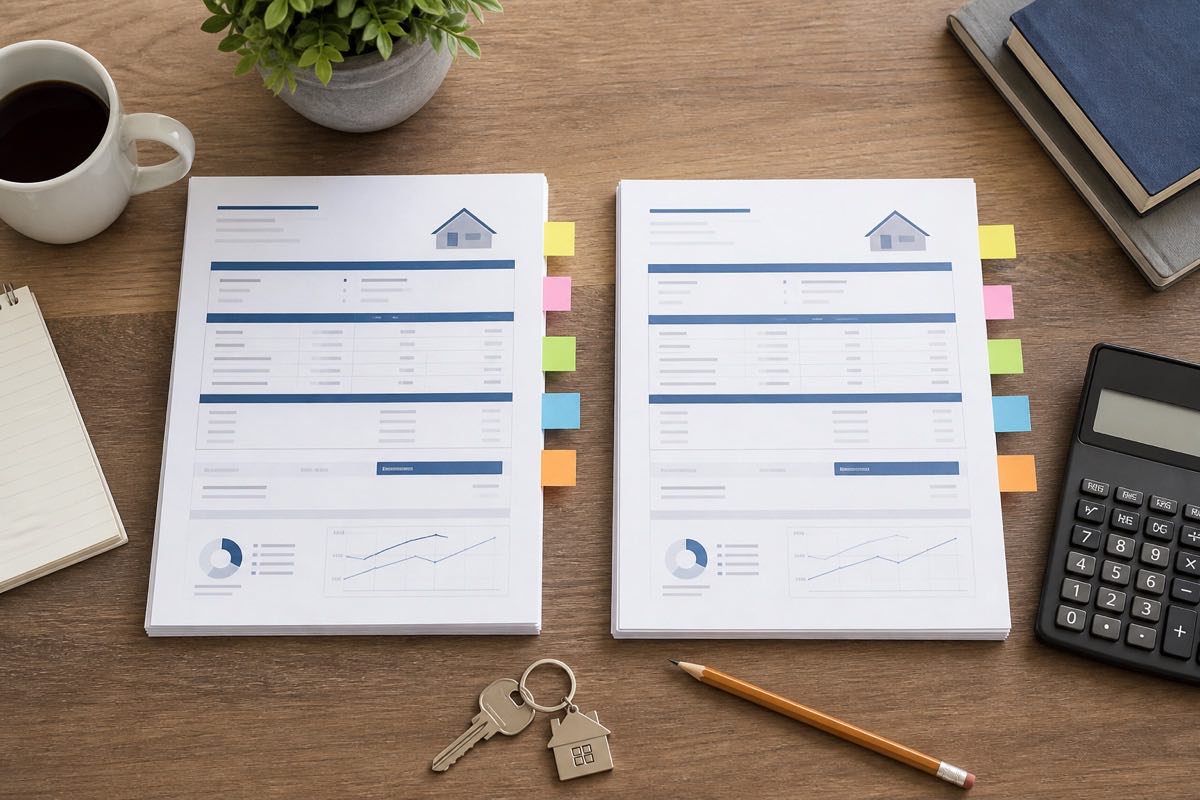
The five-column comparison that prevents a rate-driven mistake
Build one page for the new home and one for the resale. Use these five columns.
1. Contract price and true property substitutes
Compare the builder home with recent closed sales and active alternatives of similar size, lot, location, and finish—not simply with the builder’s previous price. For a resale, compare the likely negotiated price and repair credits, not just list price. If the builder home costs $25,000 more than comparable resales, part of the financing incentive may be compensating for that premium.
2. Loan structure and five-year borrowing cost
Request the formal Loan Estimate from the builder’s lender and at least one outside lender. The CFPB recommends comparing offers with the same amount of points or credits. Page 3 contains an “In 5 years” line; subtracting the principal paid from the total paid gives a five-year interest-and-fee comparison.
Also request a second builder-lender scenario with the points or temporary buydown removed. That reveals the base financing rather than only the advertised version.
3. Cash to close and cash left after closing
One offer may require less cash because credits cover eligible closing costs. Another may produce a lower payment but consume the entire incentive in points. Compare the money required at closing and the emergency reserve left afterward. A buyer who spends every available dollar to win a lower rate may be poorly positioned for blinds, landscaping, moving costs, appliances, or an early repair.
4. Recurring costs the rate does not reduce
Check the parcel’s estimated property taxes, homeowners insurance quote, HOA dues, and any Municipal Utility District or Public Improvement District assessment. New communities can have cost layers that are not obvious in the sales-center payment illustration. Use the specific lot and taxing entities; never assume the current owner’s bill or a generic tax percentage will match the first full year after purchase.
5. Property and resale risk
A new home may offer lower maintenance, a warranty, current layouts, and efficient systems. It may also compete with future builder inventory and incentives when you sell. A resale may have established trees, a larger lot, completed window coverings and landscaping, and a clearer sales history. It may also need near-term systems or cosmetic work. Put those costs and benefits into the comparison instead of treating “new” or “resale” as automatically superior.
A hypothetical Austin-area example
Assume a buyer is comparing a $450,000 new home with a builder-funded permanent rate of 5.50% against a negotiated $430,000 resale financed at 6.66%. Both examples use 20% down and a 30-year fixed mortgage. The figures below show principal and interest only; they intentionally exclude taxes, insurance, HOA costs, and closing costs so those items cannot hide inside the payment.
| Illustrative item | New home | Resale home |
|---|---|---|
| Purchase price | $450,000 | $430,000 |
| Loan amount | $360,000 | $344,000 |
| Illustrative fixed rate | 5.50% | 6.66% |
| Approximate monthly principal and interest | $2,044 | $2,211 |
| Immediate observation | Higher price, lower financing payment | Lower price, higher financing payment |
The new home’s payment is roughly $167 lower before other costs. That is meaningful. It still does not answer the decision. The buyer must add the actual tax estimate, HOA or special-district costs, insurance, upgrades, inspection items, and cash to close, then compare five-year cost and likely resale competition. If the new home carries $250 more per month in taxes and assessments, the rate advantage may disappear. If the resale needs $30,000 of immediate work, the builder package may become stronger.
This is an illustration, not a quote. Rates, points, credits, qualification, taxes, and property costs vary by borrower, lender, community, and day.
Temporary buydowns require a payment-step test
A temporary buydown can make the first payment look dramatically lower. On a hypothetical $360,000 loan with a 6.66% note rate, principal and interest is about $2,313. A two-percentage-point first-year subsidy would make the payment roughly $1,858, and a one-point second-year subsidy roughly $2,080, before it reaches the full payment in year three.
The practical question is not whether the first-year payment feels comfortable. It is whether the buyer can carry the full note-rate payment plus taxes, insurance, and HOA costs without relying on a future refinance, raise, or bonus. Refinancing may become available; it is not a guaranteed exit.
Questions I would ask before a client chooses the incentive
- Is the advertised rate permanent, temporary, adjustable, or tied to a specific closing date?
- How many dollars and points are being used to create it?
- What would the builder offer if we used a different lender or removed the buydown?
- Can we see a same-day Loan Estimate with the same loan type, down payment, and lock period from an outside lender?
- What is the five-year interest-and-fee cost on each estimate?
- What are the parcel-specific tax entities, HOA dues, and MUD or PID assessments?
- Which appliances, window coverings, landscaping, fencing, and upgrades are included?
- What independent inspections can be performed, and how are warranty requests handled?
- How much competing builder inventory may still exist when the buyer could need to resell?
- After closing, how much cash remains for the move and unexpected expenses?
Buyers can browse Austin-area new-construction options and compare them with current resale listings. For a broader affordability framework, read why easier negotiation does not always make an Austin home easier to afford.
Frequently asked questions
Do I have to use the builder’s lender?
You can ask outside lenders for quotes, but a particular builder incentive may be conditioned on using the builder’s preferred or affiliated lender and meeting its deadlines. Compare the preferred-lender offer with an outside Loan Estimate after matching the loan type, down payment, points, credits, and lock period.
Is a permanent rate buydown always better than a closing-cost credit?
No. A permanent rate buydown may benefit a buyer who expects to keep the loan long enough to recover the upfront cost. A closing-cost credit may be more useful when preserving cash matters more. Compare the five-year cost, break-even period, and cash left after closing.
Should I choose the lowest monthly payment?
Not by itself. The lowest principal-and-interest payment can accompany a higher price, more points, temporary payment relief, or higher taxes and assessments. Compare the entire property and financing package.
Can I negotiate a price reduction instead of a rate incentive?
You can ask. Whether the builder will substitute price, closing costs, upgrades, or another concession depends on the home, community, sales pace, financing program, and timing. Request the alternatives in writing so they can be compared.
The bottom line
Austin builder incentives are worth taking seriously in 2026. They are also easy to overvalue when the advertised rate becomes the whole story. The better deal is the property and loan combination with the stronger five-year cost, manageable full payment, sufficient post-closing reserves, defensible price, and acceptable resale risk.
If you are comparing a builder package with a resale home, contact Vlad Baibus at ATXCasa. I can help organize the property comparison and the questions to take back to your lender before the rate banner makes the decision for you.
This article provides general real-estate education, not lending, tax, legal, or financial advice. Loan terms and incentives vary. Confirm written figures with licensed lenders and other appropriate professionals.