
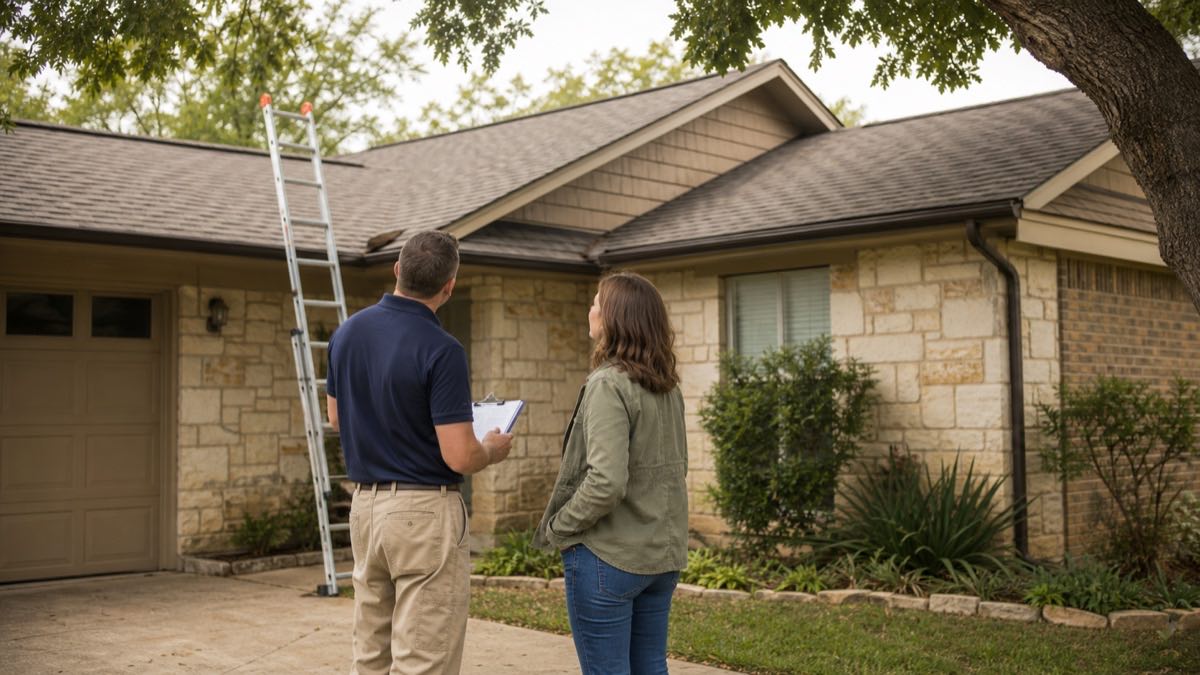
If you are considering a 1970s, 1980s, or 1990s house in Austin, the insurance quote belongs beside the inspection report—not at the bottom of a closing checklist. The short answer is to obtain an address-specific quote early enough to act on it, then compare the annual premium, the wind-and-hail deductible in dollars, how the roof would be paid after a loss, and whether flood coverage must be purchased separately.
Why? A house can pass a general inspection and still produce insurance terms that change your monthly budget or leave you responsible for much more cash after a storm. This is not a reason to avoid older homes. It is a reason to price the risk while your contract deadlines still preserve useful choices.
Three Austin buying situations where the quote can change the decision
A South Austin house with an older roof: the roof may not be leaking, but the policy could pay roof claims at depreciated value rather than replacement cost. That difference matters when the deductible is also large.
A home outside a high-risk flood zone: the lender may not require flood insurance, yet a standard homeowners policy generally does not cover flood damage. The buyer still has to decide whether the separate exposure and premium fit the plan.
Two quotes with similar annual prices: the cheaper-looking policy may carry a percentage-based wind-and-hail deductible or narrower water-damage terms. Comparing only the annual premium can hide the bigger cash obligation.
The inspection and the insurance quote answer different questions
A home inspector evaluates visible condition and systems. The insurer evaluates what it is willing to cover, how a covered loss would be paid, and at what price. Those conclusions can overlap around the roof, electrical system, plumbing, prior claims, and the home’s general condition, but one does not replace the other.
The Texas Department of Insurance says a company may inspect a roof when someone applies for coverage and may charge more or decline coverage based on what it sees. TDI also notes that a company may shift an aging roof from replacement-cost coverage to actual-cash-value coverage, which subtracts depreciation. In plain language: a roof can be serviceable today while the policy still transfers more of the next loss to the homeowner.
Convert the deductible into dollars
Do not leave a percentage deductible as a percentage. Ask the insurer to show the dollar amount using the dwelling coverage limit in the quote.
TDI’s own example uses a home insured for $200,000 with a 2% deductible, which equals $4,000. For a hypothetical $10,000 covered roof loss, TDI shows replacement-cost coverage paying $6,000 after that deductible. Its illustration of a 20-year-old roof under actual-cash-value coverage values the roof at $4,000 before the same $4,000 deductible—leaving no insurer payment in that example. Your property, limit, roof age, depreciation schedule, and policy will differ, but the mechanism is the point: coverage method and deductible must be read together.
Ask what “water damage” excludes—and price flood separately
“Water damage” is not one coverage bucket. A policy may treat a sudden pipe leak differently from a long-running leak, sewer backup, foundation movement, or rising outdoor water. Ask the insurer to identify the exclusions, limits, and optional endorsements that apply to the actual home.
Flood is the clearest distinction. TDI states that homeowners insurance does not cover flood damage and that a separate flood policy is needed. A lender generally requires flood insurance in a designated high-risk zone, but that requirement is not the same as a complete risk assessment. TDI also notes that more than half of the homes flooded by Hurricane Harvey were outside designated flood zones. For a Central Texas property, use the map and drainage context as a starting point, then obtain a separate quote when the exposure matters rather than assuming “not required” means “not useful.”

A five-step insurance check before the option period ends
- Request quotes for the exact address. Provide accurate roof age, construction, updates, occupancy, and other requested facts. A metro-wide estimate is not a substitute for underwriting the property.
- Compare the policy, not only the premium. Record the dwelling limit, annual premium, every deductible, roof payment method, water-damage terms, and important exclusions. TDI’s home-insurance shopping guide explains the terms to compare.
- Ask for the claims history. TDI advises buyers to ask the insurer or property owner for the home’s CLUE report, which shows claims filed during the prior seven years. A prior claim is not automatically a defect, but it can reveal damage and repairs that deserve follow-up.
- Match the quote to the inspection. If the inspector flags roof wear, drainage, electrical, or plumbing concerns, ask whether those exact findings change eligibility, premium, exclusions, or required repairs.
- Recalculate the decision before the deadline. Add the premium to your monthly housing cost and compare the largest deductible with the cash you would realistically keep after closing. If the result no longer works, discuss available contractual and negotiation choices with your agent and appropriate licensed professionals before acting.
What ATXCasa would use this information to decide
The most useful question is not “Is this an old house?” It is “Do this home’s condition and insurance terms still support the price and cash plan?” A clean answer can support moving forward. A costly answer can support a different offer structure, a repair conversation, a different insurer, a larger reserve, or a different property.
This also belongs in the broader affordability calculation. A seller concession may reduce cash due at closing, but it does not erase a recurring premium or a large storm deductible. Read the related ATXCasa guide on negotiation versus true affordability, then browse Austin-area homes with the insurance check built into the comparison from the start.
Frequently asked questions
When should an Austin buyer request homeowners-insurance quotes?
Start as soon as a property becomes a serious candidate and obtain an address-specific quote early enough to compare it with the inspection and act before applicable contract deadlines.
Does a homeowners policy cover flood damage?
Generally no. Texas Department of Insurance guidance says homeowners policies do not cover flood damage, so flood coverage is normally purchased separately.
Is replacement-cost roof coverage always better than actual cash value?
Replacement-cost coverage generally pays without subtracting depreciation, while actual cash value does subtract depreciation. The right choice depends on the complete policy, premium, deductible, property, and buyer’s ability to absorb loss; compare actual written terms.
Planning an Austin-area purchase? Contact Vlad Baibus at ATXCasa to build inspection, insurance, and total-cost checks into the home search before the deadlines become urgent.