

Austin buyers have more room to compare and negotiate than they did during the frenzy years. That does not automatically make a home affordable. The useful question is not simply, “Are prices lower?” It is: “Can I buy this particular home, carry it comfortably, and keep it long enough for the decision to make sense?”
That distinction keeps surfacing in Austin’s public conversation. A recent AskAustin discussion asked whether buying has become easier; people quickly split the question into two parts: finding and negotiating a home versus paying for it month after month. The discussion is anecdotal, but the problem is real.
The short answer: easier to shop, not automatically cheaper to own
In July 2026, the City of Austin had 4.5 months of inventory, a $577,000 median sale price, and an average close-to-list ratio of 93.9%, according to Unlock MLS. Those figures describe a market in which buyers can often evaluate more carefully and negotiate on homes that are not perfectly positioned.
But financing remains expensive. Freddie Mac’s national weekly survey put the average 30-year fixed mortgage rate at 6.66% on August 27, 2026. Your quote will depend on your credit, down payment, loan type, points, and timing, but the average is a useful reminder: a negotiated purchase price is only one line in the budget.
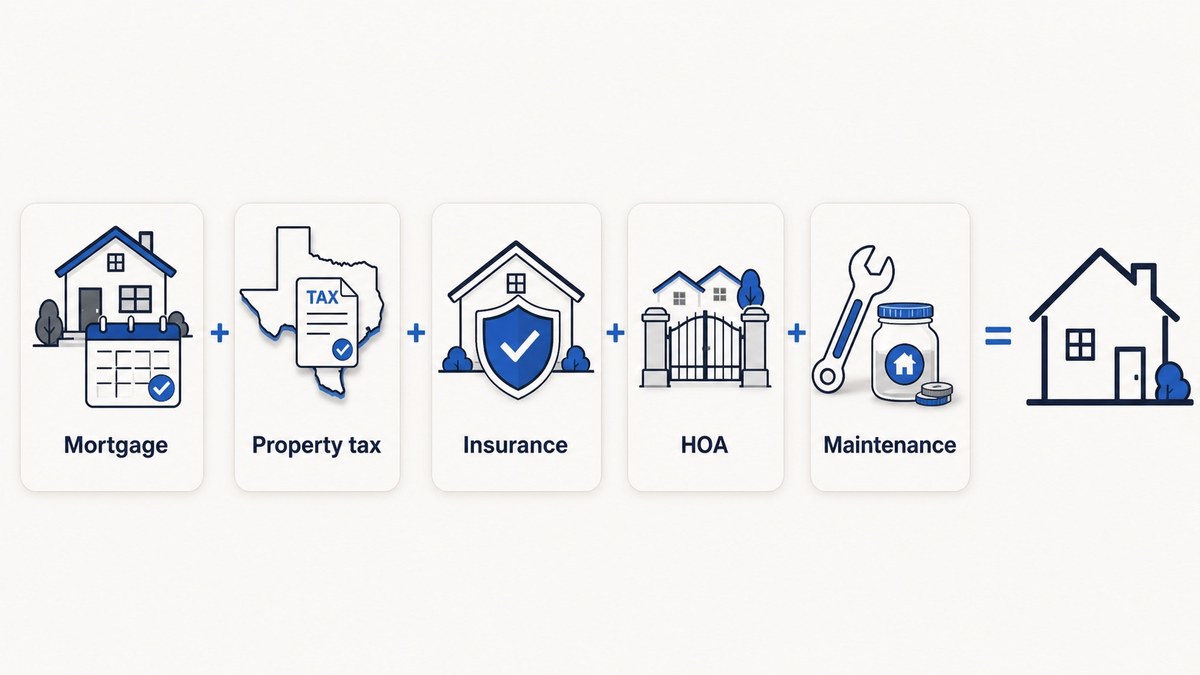
A concrete example: the $435,000 home that does not cost $2,236 a month
The Austin–Round Rock–San Marcos metro median price was $435,000 in July. For illustration, put 20% down and finance $348,000 for 30 years at 6.66%. Principal and interest would be about $2,236 per month.
That is not the cost of owning the home. It excludes property taxes, homeowners insurance, any HOA dues, utilities, and maintenance. It also assumes an $87,000 down payment and says nothing about closing costs or the cash you should keep after closing. The Consumer Financial Protection Bureau’s Loan Estimate guide makes the same distinction: principal and interest are usually only the main components, while the estimated total monthly payment can also include taxes, insurance, mortgage insurance, and assessments.
In Texas, there is no state property tax; local taxing units set and collect property taxes. That means two similarly priced Austin-area homes can carry meaningfully different tax bills. Insurance quotes can also vary with the roof, construction, claims history, coverage, and other property-specific factors. A buyer who compares only prices can miss the more important comparison.
The four numbers I would compare before deciding to buy
1. The realistic total monthly housing cost
Ask the lender for a property-specific worksheet or Loan Estimate. Add principal, interest, projected property tax, homeowners insurance, mortgage insurance if applicable, and HOA dues. Then add a separate maintenance reserve. Do not use the principal-and-interest figure as a substitute for the total.
Example: Home A and Home B both cost $500,000. Home A has an older roof and no HOA. Home B has a newer roof but a $160 monthly HOA. The correct comparison is not “same price.” It is the total monthly payment plus the likely near-term work for each home.
2. Cash remaining the day after closing
Down payment and cash to close are not the whole liquidity question. If closing empties the account, a water heater, insurance deductible, move, or tax adjustment can turn a manageable purchase into immediate stress. Decide on a minimum post-closing reserve before touring homes, not after falling in love with one.
3. The value of a concession in your actual loan
A price reduction, seller-paid closing costs, and money used to reduce the interest rate do different jobs. One may lower the loan balance, another may preserve cash, and another may reduce the payment. Ask the lender to price the alternatives on the same day, with the same loan assumptions. Then negotiate for the structure that solves your constraint—not the concession that sounds largest.
4. The shortest realistic time you may own the home
Buying and later selling both involve costs. If there is a serious chance you will relocate, need a different school setup, or outgrow the home in two or three years, do not assume appreciation will rescue the decision. There is no universal break-even period, but a shorter expected stay gives you less time to absorb transaction costs and market movement.
How to compare two Austin homes without getting lost
Use one row per property and keep the assumptions consistent:
- negotiated price, not list price;
- loan amount, rate, points, and principal-and-interest payment;
- projected property tax, insurance, mortgage insurance, and HOA;
- estimated cash to close and cash remaining afterward;
- repairs likely in the first two years;
- the concession structure you would request; and
- the shortest realistic ownership period.
This is also where an experienced buyer’s agent should add value. The work is not merely opening doors. It is identifying which listings have negotiating leverage, obtaining property-specific documents, helping you frame inspections and concessions, and coordinating with your lender so the offer supports your budget.
Who may benefit from the 2026 Austin market—and who should slow down
Buying may be more workable now if your income is stable, you can keep a meaningful reserve after closing, your expected ownership period is long enough to tolerate market swings, and you are willing to compare imperfect homes rather than chase the same turnkey listing as everyone else.
Waiting or renting may be the stronger choice if the realistic payment leaves no buffer, you are likely to move soon, or the down payment would consume nearly all available cash. More negotiation does not fix a household budget that is too tight.
If you want to test the numbers against actual properties, start with current Austin-area listings, then read the companion explanation of what 4.5 months of Austin inventory means. I can help you compare the monthly cost and negotiation options for a short list before you spend weekends touring homes.
Frequently asked questions
Is it a buyer’s market in Austin in 2026?
Buyers generally have more time and negotiating room than during the peak frenzy, but conditions vary by price, property, and neighborhood. “Buyer’s market” does not mean every seller will accept a large discount or that every home is affordable.
Should I ask for a lower price or seller-paid closing costs?
It depends on whether your constraint is monthly payment, cash to close, or long-term loan balance. Have the lender model the options with the same assumptions before choosing a negotiation strategy.
What should I calculate before touring Austin homes?
Set a ceiling for the total monthly housing cost, a minimum cash reserve after closing, and the shortest period you realistically expect to own the home. Those three limits will make the property search far more useful.