

If an Austin down-payment-assistance option puts more money toward closing, do not assume it is automatically the better deal. First compare what happens at sale, refinance, or early move; then compare the first-mortgage rate and fees. The largest upfront amount can come with a longer affordability commitment or a share of future equity, while a smaller forgivable second loan may fit a shorter ownership plan better.
This matters for buyers who can make a monthly payment but are short on closing cash—a tension visible in recent Austin first-time-buyer conversations. Austin’s city program and Travis County’s Hill Country Home program are real opportunities, but they are not interchangeable. Eligibility, geography, loan structure, and the eventual exit all matter.
Three buyers who should not make the same choice
Buyer one needs a small closing-cost bridge and expects to stay for years. A standard deferred-forgivable assistance loan may be worth investigating if the forgiveness period and repayment triggers fit the plan.
Buyer two needs more help to make the purchase work. A shared-equity option may supply more upfront assistance, but it deserves a written explanation of the lien, resale rules, purchase option, right of first refusal, and how any equity share is calculated.
Buyer three is shopping across Austin and the rest of Travis County. A countywide option may cover a wider search area, but its paired first mortgage, program fee, assistance percentage, and second-loan terms must be compared with a conventional loan quote. A program that works in one geography or loan type may not work for another property.
The useful question is not “How much help?”
Ask instead: “What do I receive now, what do I pay or give up later, and what must happen before the obligation is forgiven?”
Austin Housing says its Down Payment Assistance program can help eligible first-time buyers with down payment, closing costs, and pre-paid expenses. The public program page lists assistance up to $40,000, a home-price limit of $440,000, homebuyer education, and a purchase inside Austin’s full-purpose city limits. The City’s fiscal-year action plan describes two structures: Standard DPA, generally $1,000 to $14,999 with a five-year affordability period, and Shared Equity DPA, generally $15,000 to $40,000 with a 10-year affordability period.
The same City document says the shared-equity structure can include a lien, a purchase option, a right of first refusal, and an equity-gain share tied to the City’s original portion of the sales price. Those terms do not mean the program is unsuitable. They mean a buyer should understand the exit before treating the assistance as a simple cash gift.
Travis County’s Hill Country Home program describes a different model: a participating lender pairs an eligible first mortgage with a 0% interest, 10-year forgivable second mortgage. The assistance is expressed as a percentage of the initial principal balance, and the County notes that the program fee can change net assistance. Its page also says the buyer chooses that program loan rather than another 30-year fixed loan that may carry a lower rate without assistance.
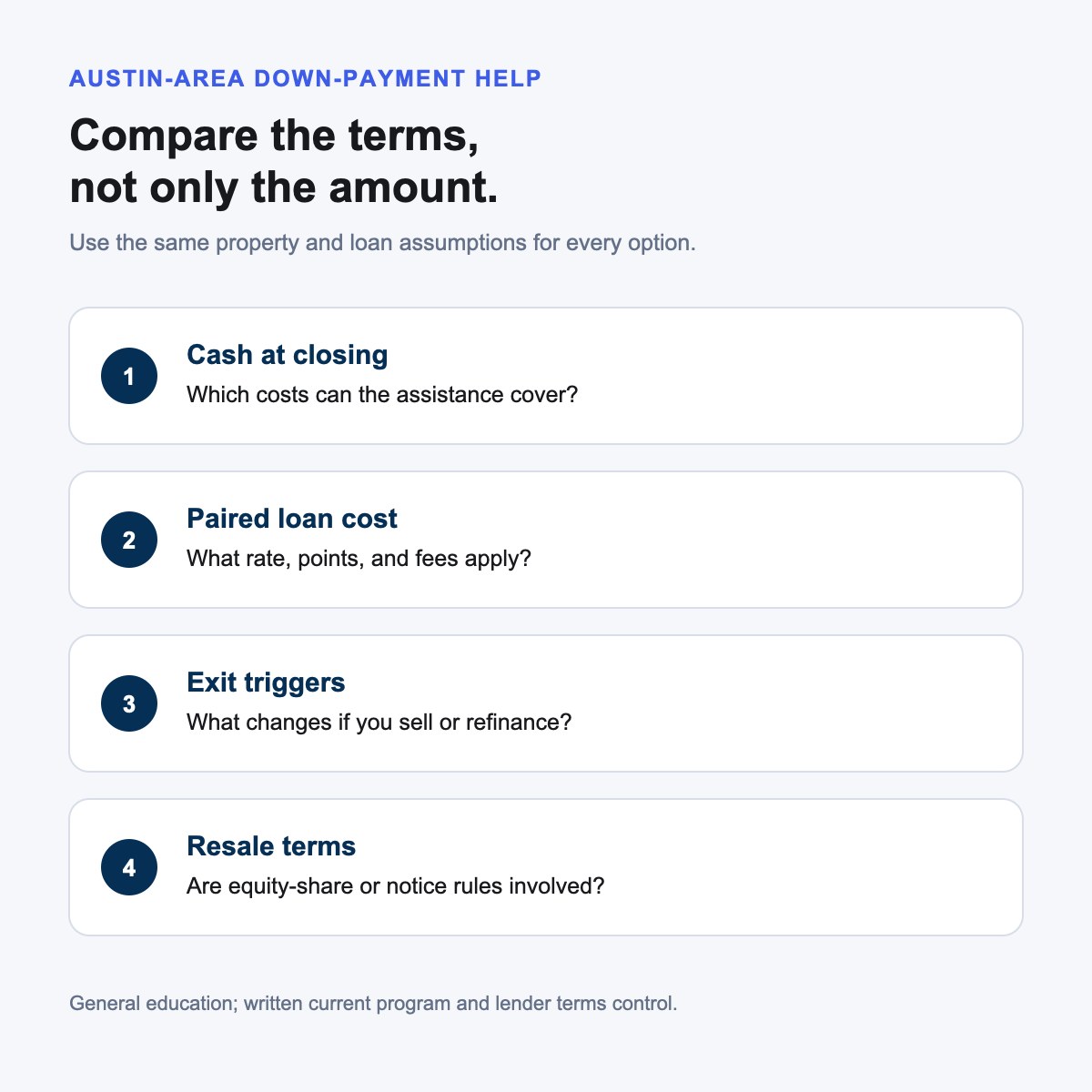
A four-column comparison to request before making an offer
| Ask for this | Why it changes the decision | Example of a useful answer |
|---|---|---|
| Upfront assistance and eligible uses | Down payment, closing costs, and pre-paids can affect different cash needs. | “$X may be used for these listed costs on this property.” |
| First-mortgage rate, points, and fees | Assistance can be paired with a loan whose cost differs from another available loan. | “Here is the Loan Estimate beside a no-assistance alternative with the same lock period.” |
| Forgiveness and repayment triggers | A sale, refinance, rental conversion, or move can change what is owed. | “Here are the conditions, dates, and payoff calculation in writing.” |
| Resale and equity terms | Shared-equity, purchase-option, and right-of-first-refusal provisions can affect timing and proceeds. | “Here is how the future sale is handled and who must be notified.” |
Do not compare only monthly payment. Use the same purchase price, down payment, lender credits, points, loan type, and rate-lock period for every quote. Then ask the lender and program administrator to identify what changes if you sell or refinance before the end of the affordability period.
A simple planning example—not a payoff estimate
Imagine a buyer can choose either $12,000 in standard assistance or $30,000 in shared-equity assistance. The second option may make closing possible with less cash. But if the buyer expects a job-related move in four years, the decision cannot stop at the $18,000 difference. The buyer should obtain the written early-sale and refinance terms, compare the paired first-loan cost, and decide whether the expected ownership period matches the program’s conditions.
Conversely, a buyer planning to remain in the home beyond the applicable period may reasonably value the larger assistance differently. The correct answer is property- and program-specific; it is not a universal rule that one assistance type is “free” or “too restrictive.”
Check eligibility before you narrow the home search
For the City program, verify that the home is inside Austin’s full-purpose city limits rather than assuming an Austin mailing address is enough. The City also lists first-time-buyer status, income at or below 80% of median family income, homebuyer education, and specific documentation requirements. The County program describes a Travis County geography, owner-occupancy requirement, participating-lender process, and loan-program eligibility.
That distinction can change a search strategy. If a buyer needs City assistance, confirm the jurisdiction before investing in inspections or negotiations. If a buyer is comparing homes in Austin, Pflugerville, or unincorporated Travis County, ask which program each address can actually use. Do not assume a program is portable just because the property is nearby.
How ATXCasa would use this before an offer
The practical sequence is: define the buyer’s cash gap; confirm an address is eligible; collect a program-specific written term sheet; compare it with a no-assistance or lower-assistance Loan Estimate; and model the likely ownership horizon. The offer decision should reflect the real all-in financing choice, not an assistance headline viewed alone.
For a buyer deciding between a smaller home now and a larger one later, that comparison may also change the target price. A program can improve access to a purchase without making every payment, repair, HOA obligation, or future move more affordable.
Frequently asked questions
Is Austin down-payment assistance a grant?
Some assistance can be deferred or forgivable, but the structure varies. Austin’s published materials describe both standard and shared-equity options; the County program describes a forgivable second mortgage. Obtain the current documents for the program and property you are considering.
Can I use the City program anywhere with an Austin address?
Not necessarily. The City page says the home must be in Austin’s full-purpose city limits. Check the City’s jurisdiction map and verify the specific address with the program administrator.
Does a bigger assistance amount always lower my lifetime cost?
No. Compare the first-mortgage terms, fees, forgiveness schedule, repayment triggers, and any shared-equity or resale provisions. More cash at closing may still be the right choice, but it needs a full comparison.
Who should explain the final terms?
Ask the participating lender and the program administrator for the written documents. For legal, tax, or financial consequences of a particular sale, refinance, or ownership change, use the appropriate licensed professional.
Buying in Austin or Travis County and comparing assistance options? Message Vlad Baibus at ATXCasa to put the property, eligibility map, full payment, and program terms side by side before you make an offer.
This article provides general real-estate education, not lending, legal, tax, or financial advice. Program terms, funding, income limits, loan availability, and property eligibility can change. Confirm the current written terms directly with the applicable program and lender.