

Austin-area home sales improved in July 2026, but that is not a pricing instruction for one house. Before you choose a listing price, compare the home with the alternatives a buyer can actually tour now—and with the options likely to reach the market during your first few weeks. A metro report can tell you whether the backdrop has changed. It cannot tell you whether a particular kitchen, commute, condition, lot, or school assignment earns a premium.
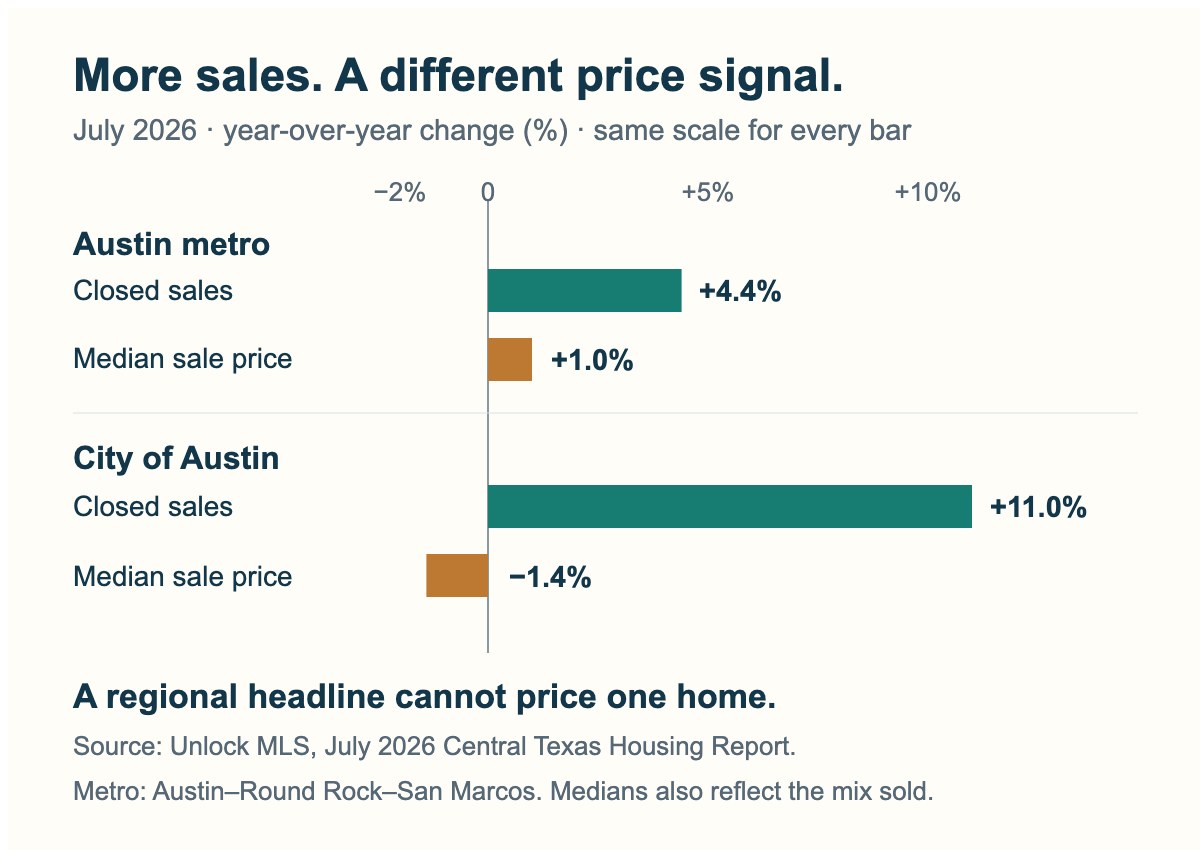
Unlock MLS reported 2,739 residential sales across the Austin-Round Rock-San Marcos metro in July, up 4.4% from a year earlier. The metro median price was $435,000, up 1.0%, while months of inventory fell to 4.7. Those are useful signals of a more active regional market. They do not convert a seller’s target number into a buyer’s willingness to pay.
Start with the right question
The question is not “Did Austin sales go up?” It is: “If my home goes live this week, what will a buyer compare it with before deciding whether to tour, offer, or wait?” That comparison must be local and specific.
Consider two hypothetical, otherwise similar South Austin homes. Yours is listed at $510,000; the competing home is $500,000 with a newer roof. A 1% rise in the metro median does not explain why a buyer should pay your extra $10,000 and take on an earlier roof expense. A larger lot, better condition elsewhere, or a location the buyer values could justify a premium, but the comparison needs to show it. For condos, make the same comparison within the relevant building and include dues, parking, and assessments.
What July’s report can—and cannot—tell you
The July report is valuable as context. It showed 13,796 active metro listings, down 9.9% year over year, and 2,833 pending sales, up 4.1%. In the City of Austin, it reported 1,005 sales, up 11.0%, while the city median price was $577,000, down 1.4%. Those figures show why one headline cannot settle a listing decision: activity and price can move differently across a region and its submarkets.
Use the report to avoid two shortcuts. First, do not assume more sales mean every seller can start high and wait. Second, do not assume a lower local median means every well-prepared home needs a price cut. The report describes completed transactions across many property types and locations; it does not reveal the buyer’s next-best alternative for your home.
Build the comparison a buyer will make
Before going live, put your home beside a short group of current and very recent comparable choices. The group should match the buyer’s actual search, not just a broad neighborhood label. Record the list price, condition, size, location tradeoff, days on market, fees or incentives, and what a buyer gets for the money.
- Active alternatives: These determine whether your opening price earns a showing today.
- Pending and recently sold comparables: These help explain which features and price ranges have recently won a buyer’s commitment.
- New-build or concession competition: A resale price is not the whole comparison when another option includes rate help, closing-cost help, appliances, or a warranty.
- Your constraint: A seller moving for work, a school change, or a purchase deadline may value certainty differently from a seller who can wait.
This is not an appraisal and it is not a promise of a sale price. It is the practical test for whether a buyer has a clear reason to choose your home rather than postpone the decision or choose the next listing.
Use the first response as information, not a verdict
Early activity can be useful, but it needs interpretation. A listing with showings and consistent feedback about one fix may call for a presentation or repair decision. A listing that is repeatedly compared with cheaper, better-equipped alternatives may have a price-positioning problem. A quiet first few days during a holiday, weather event, or unusual launch window is not automatically a market verdict.
Ask for a written comparison after the first defined review point: which active alternatives received attention, what buyers and agents said, whether the home reached the right audience, and what change would materially improve its position. That turns “wait” or “reduce” into a decision with evidence.
Do not confuse the sale price with the net decision
Price is one lever, not the only one. A buyer may value a repair credit, a closing date, a possession agreement, or a concession differently from a headline reduction. But each option changes the comparison differently. A smaller price reduction may preserve a buyer’s loan structure; a repair credit may solve a known condition concern; a longer closing may help a seller coordinate the next move. The right choice depends on the buyer pool and the seller’s actual deadline.
For a seller who needs to buy next, the useful worksheet is: expected net proceeds, likely time to contract, likely closing date, and the effect of each pricing or concession option. A higher list price that delays the move can be worse than a lower number with a clear path to the next decision.
Price against the homes buyers can choose now
July’s better sales pace is a reason to do a current local comparison, not to skip one. The strongest listing plan explains why this specific home belongs ahead of the choices a buyer can make this week. If that case is not clear, revise the price, preparation, or terms before asking the market to solve the ambiguity.
Deciding how to price your Austin-area home? Contact Vladimir Baibus at ATXCasa with your address and target move date. I can help identify the homes your buyer would tour instead and compare the price, preparation, and timing choices before launch. ATXCasa can help organize the property-level comparison before you commit to a launch plan.
Frequently asked questions
Does more Austin-area home sales activity mean I should list above the comparable homes?
No. Higher regional sales activity is context, not a property-specific premium. Compare the home’s condition, location, terms, and active alternatives before choosing the opening position.
Why can City of Austin sales rise while the city median price falls?
A median summarizes the middle of many completed transactions. The mix of homes sold can change, and different neighborhoods or property types can move differently. It does not establish the value of one home.
Should I reduce the price immediately if the first weekend is quiet?
Not automatically. First compare the launch conditions, buyer feedback, and active competition. A change should address a specific reason a buyer may be choosing another home or waiting.