

For an Austin-area purchase, compare itemized closing charges and negotiate who pays: Texas regulates premiums for equivalent title coverage. Under Rate Rule R-5, the lender’s policy premium is $100 when the policies are issued simultaneously, have the same date, cover the same land, list the insured mortgage lien as an exception in the owner’s policy, and the loan-policy amount does not exceed the owner-policy amount. That is the eligible policy’s premium, not the amount saved or the entire title bill.
TL;DR:
- The state’s fixed premium structure means the title insurance cost for the same coverage remains consistent across all Texas licensed companies.
- The owner’s policy protects the owner against covered title losses, subject to policy limits and exceptions. The lender’s policy protects the lender’s interest and may cost $100 when the simultaneous-issue requirements are met.
- For $300,000 of owner’s coverage, the basic premium is $1,768 under the March 1, 2026 schedule. An eligible simultaneous lender’s policy adds $100 before endorsements, guaranty fees and separate closing charges.
- Put the negotiated payer for each policy in the contract, then check that the closing statement reflects that agreement.
- Request separate line items for applicable endorsements and the TTIGA guaranty fee. Regulated endorsement pricing does not mean every endorsement is mandatory.
Table of Contents
- How Texas Sets Title Insurance Rates and Calculates Your Premium
- Who Pays Title Insurance in Texas?
- Owner’s Policy vs. Lender’s Policy: What Each One Actually Covers
- Discounts, Endorsements, and State Fees That Move the Final Number
- Worked Examples: What You’d Actually Pay at Closing
- Other Closing Costs Bundled With Your Title Bill
- How to Estimate Your Title Insurance Cost Before Closing Day
- Austin Market Notes: Negotiation Tips That Actually Move the Needle
- The Part Buyers and Sellers Consistently Get Wrong
- Get local closing guidance
- Where to Verify These Numbers Yourself
- Sources
- FAQ
How Texas Sets Title Insurance Rates and Calculates Your Premium
Texas regulates title-insurance premiums statewide. The Texas Department of Insurance sets the rate structure licensed title companies must use. Compare quotes using the same policy amounts, coverage and applicable rate adjustments. The regulated premium should match for equivalent coverage, but separately billed charges can differ. Compare those charges alongside service and responsiveness.
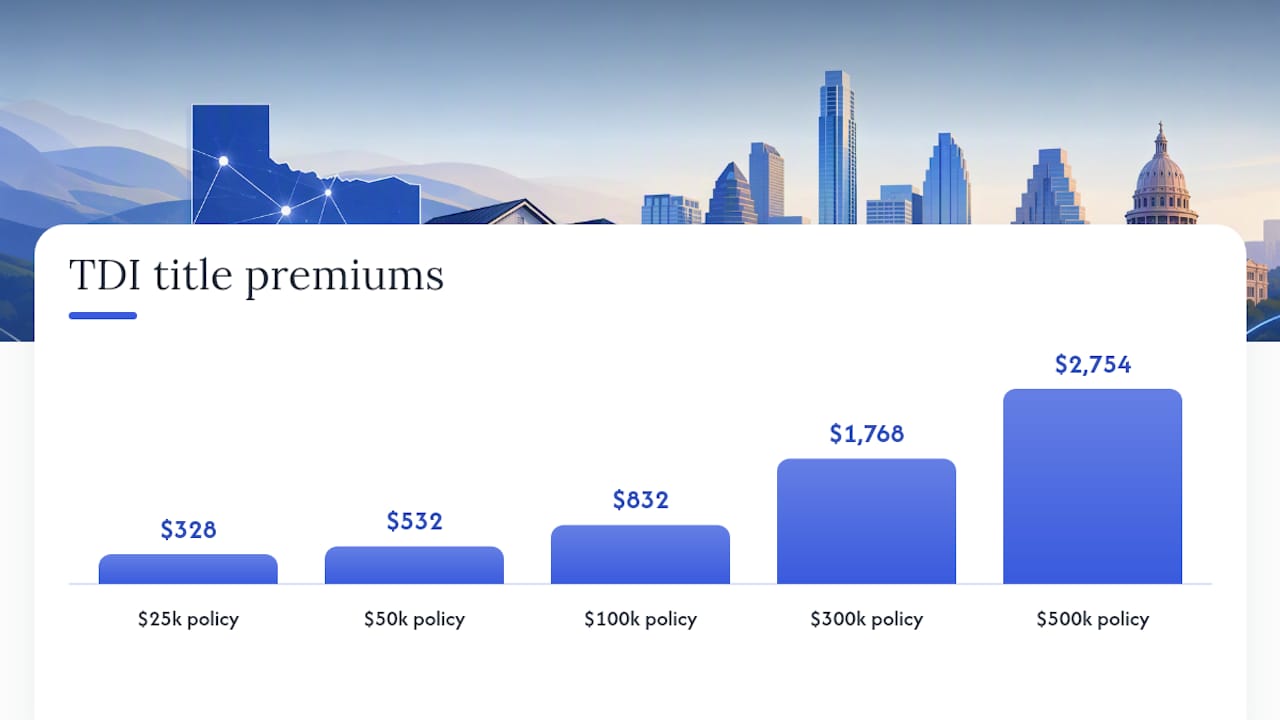
For policies at or under $100,000, use the TDI rate table effective March 1, 2026: a $25,000 policy costs $308, a $50,000 policy $465, and a $100,000 policy $780. Above $100,000, use the formula for the applicable coverage tier. Older consumer summaries may still show superseded premiums.
For coverage between $100,001 and $1,000,000, the premium calculation is:
(Policy Amount − $100,000) × 0.00494 + $780
For coverage between $1,000,001 and $5,000,000, the formula shifts to:
(Policy Amount − $1,000,000) × 0.00406 + $5,226
| Policy amount | Premium |
|---|---|
| $25,000 | $308 |
| $50,000 | $465 |
| $100,000 | $780 |
| $300,000 | approximately $1,768 |
| $500,000 | approximately $2,756 |
These statewide basic rates became effective March 1, 2026. Use TDI’s Texas Title Insurance Basic Premium Rates schedule for numeric estimates; its consumer FAQ includes older illustrative prices. The basic premium excludes endorsements, guaranty fees and separately billed closing charges.
Pro Tip: Check the basic premium before your Closing Disclosure arrives. Follow TDI’s instruction to round the multiplication result to the nearest dollar before adding the tier’s base amount. If the quote differs, ask for a written breakdown showing the policy amount, applicable rate adjustment and additional charges.
Who Pays Title Insurance in Texas?
Buyer and seller can negotiate who pays the title premium. The contract should state the allocation rather than leave it to custom. A possible arrangement is:
- The seller pays for the owner’s title policy, which protects the buyer’s equity.
- The buyer pays for the lender’s title policy, which protects the mortgage company’s interest.
- Escrow, recording and other closing charges are allocated according to the applicable contract terms; do not assume they are split equally.
The policy-premium split is negotiable. If a buyer offers to pay the owner’s premium, that shifts the expense from seller to buyer without reducing the regulated premium. If the seller agrees to pay it, the buyer’s share decreases instead. Compare the proposed allocation with your available closing funds before agreeing to it; a broad market label does not determine what this contract says.
If you’re negotiating a contract, spell out exactly who covers each title-related line item rather than assuming custom will hold. When your Closing Disclosure arrives, check that the payor listed for the owner’s policy and lender’s policy matches what you agreed to in the contract. Title companies occasionally default to the standard allocation even when the contract says otherwise, and catching that early saves an awkward conversation at the closing table.
Owner’s Policy vs. Lender’s Policy: What Each One Actually Covers
These are two separate products with different beneficiaries, different durations, and different price tags.
- Owner’s policy: Protects the owner against covered title losses, subject to policy limits, exclusions and exceptions. Coverage generally continues while the insured owns the property; the policy defines any continuing coverage after a transfer.
- Lender’s policy: Protects the lender’s interest in the insured mortgage, not the buyer’s ownership interest. Coverage and termination follow the loan policy’s terms.
- Coverage gap: Without an owner’s policy, the lender’s policy does not insure you against your own title losses. An owner’s policy covers specified risks, not every possible title problem.
The two policies insure different interests. The reduced simultaneous-issue loan premium comes from the applicable rate rule; it should not be interpreted as a proportional comparison of each policy’s protection.
Under Texas Rate Rule R-5, the owner’s policy carries the basic premium and an eligible loan policy costs $100. The policies must be issued simultaneously, have the same date and cover the same land. The owner’s policy must list the insured mortgage lien as an exception, and the loan-policy amount must not exceed the owner-policy amount. A larger loan-policy amount requires a different R-5 calculation. Ask the title company to confirm eligibility and show the resulting premium in its quote.
Discounts, Endorsements, and State Fees That Move the Final Number
The following adjustments and charges affect the amount you budget beyond the owner’s basic premium.
- Simultaneous-issue discount: When all the R-5 conditions above are met, the resulting loan-policy premium is $100. Ordering both policies alone does not establish eligibility.
- Endorsements: Add-ons like a survey deletion endorsement or a T-19.1 restrictions endorsement often add a percentage of the basic premium or a flat incremental charge, depending on the endorsement type.
- TTIGA guaranty fee: The Texas Title Insurance Guaranty Association collects a small per-policy fee from purchasers, and that fee is increasing to $3 starting October 1, 2026.
Regulated does not mean mandatory. Some endorsements are optional, while a lender may require particular coverage. Ask which endorsements are included, why they are needed and how their charges are calculated. The applicable TTIGA guaranty fee is a separate per-policy charge. Request itemized amounts rather than accepting an unexplained lump sum.
Worked Examples: What You’d Actually Pay at Closing
Here is a hypothetical purchase using TDI’s basic rates effective March 1, 2026. The example separates the owner’s basic premium from the conditional lender’s premium; neither includes endorsements, guaranty fees or separate closing charges.
For a $300,000 home, the owner’s policy calculation is:
($300,000 − $100,000) × 0.00494 + $780 = $988 + $780 = $1,768
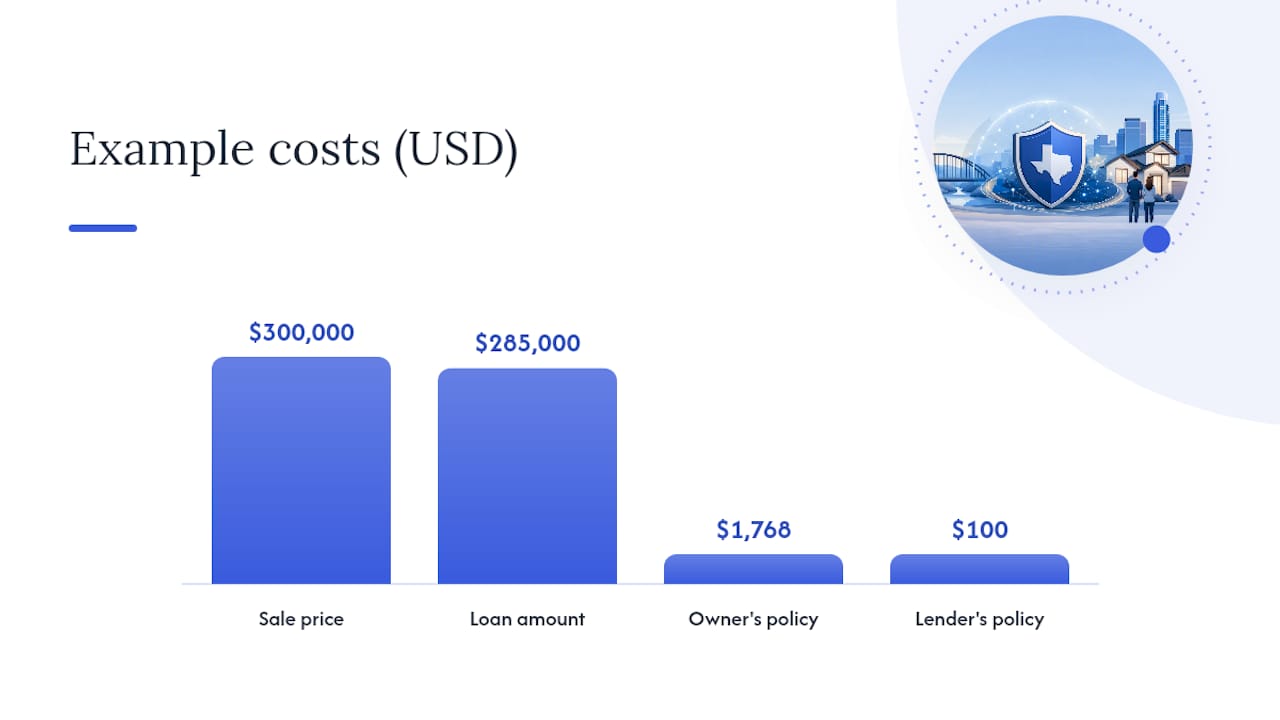
Assuming a 5% down payment and no financed additions, the loan is $285,000. If the loan policy insures that amount and all the R-5 conditions above are met, its premium is $100. The loan amount meets the coverage-amount condition, but the title company must also confirm the issuance, date, land and lien-exception requirements. This premium excludes endorsements and the per-policy guaranty fee.
To reproduce these numbers yourself or check a quote:
- Confirm the sale price from your contract, the loan amount from your lender and both proposed policy amounts with the title company.
- Calculate the owner’s basic premium using the applicable TDI schedule, then have the title company confirm the loan-policy premium under R-5 if eligible. Do not automatically add two full basic premiums.
- Add itemized charges for endorsements you select or your lender requires, with an explanation of the coverage and applicable rate.
- Include a guaranty fee for each owner’s and lender’s policy issued, and ask the title company to confirm the amount applicable to the policy date.
- Include separately quoted closing charges, then ask the title company to reconcile the itemized quote with your Closing Disclosure and contractual payer allocation.
Pro Tip: The most common calculator mistake isn’t math error, it’s omission. Buyers frequently forget to add endorsement costs or the TTIGA fee, then wonder why their actual closing bill runs $50 to $150 higher than their back-of-envelope estimate.
Other Closing Costs Bundled With Your Title Bill
Your title company collects more than just the insurance premium at closing. Common companions include:
- Escrow or settlement fee (covers the closing process itself)
- Recording fees (paid to the county to record the deed and mortgage)
- Tax certificates (confirming property tax status)
- Courier or delivery fees
- Notary fees
TDI says the title premium includes the title search, title examination and closing the transaction. Its consumer guidance also identifies escrow fees, tax certificates, recording fees and delivery expenses as possible extra charges that vary by agent. Request a separate description and price for each additional service so you can distinguish the regulated insurance premium from the rest of the closing bill and compare itemized quotes.
Pro Tip: If a line item on your settlement statement isn’t self-explanatory, ask the title agent for a written breakdown before you sign. Vague charges like “processing fee” or “administrative fee” deserve a specific explanation.
How to Estimate Your Title Insurance Cost Before Closing Day
You don’t need to wait for a Closing Disclosure to get a reasonably accurate number. Here’s the sequence:
- Gather your expected sale price and loan amount, then confirm the proposed owner-policy and loan-policy amounts with the title company.
- Calculate the owner’s basic premium using the applicable TDI schedule. For the loan policy, confirm the R-5 requirements: simultaneous issuance, the same policy date and land, the mortgage lien listed as an owner-policy exception, and a loan-policy amount no greater than the owner-policy amount. If eligible, use the $100 loan-policy premium; otherwise, request the applicable calculation.
- Add itemized charges for selected or required endorsements and the applicable guaranty fee for each policy issued.
- Request an itemized written quote from the title company showing premiums, rate adjustments, endorsements, guaranty fees and any separate escrow, tax-certificate, recording or delivery charges. Ask who pays each item under the contract.
- Compare settlement agents using equivalent coverage and rate adjustments. Review their separately billed charges, communication and escrow handling, then reconcile your chosen quote with the Closing Disclosure when available.
| What to gather | Why it matters |
|---|---|
| Final sale price | Determines owner’s policy tier |
| Loan amount | Determines lender’s policy tier |
| Desired endorsements | Adds to base premium |
| Closing date | Confirms which rate schedule applies |
Bring these figures to your title company early so differences in policy amounts, eligibility, added charges or payer allocation can be explained before closing.
Austin Market Notes: Negotiation Tips That Actually Move the Needle
Austin’s inventory swings hard between buyer’s and seller’s conditions, and that volatility shows up directly in who ends up paying for title coverage. When listings sit longer, buyers gain room to ask sellers to cover the owner’s policy per local custom. When competition heats up, that same request can cost you the deal, and some buyers absorb both policies just to make an offer stand out.
Request an itemized title quote early rather than waiting for the final disclosure. For covered mortgage transactions, you must receive the Closing Disclosure at least three business days before closing. CFPB notes exceptions, including reverse mortgages, HELOCs, certain manufactured-housing loans and certain subordinate homebuyer-assistance loans. When your disclosure arrives, check the contractual payer allocation and applicable R-5 pricing. For an Austin-area closing, compare separate settlement charges and ask who will resolve quote or allocation questions before signing.
The Part Buyers and Sellers Consistently Get Wrong
An owner’s policy and a lender’s policy serve different purposes. The lender’s policy protects the lender’s insured mortgage interest; it does not protect the buyer’s equity. An owner’s policy protects the owner against covered title losses, subject to its limits and exceptions. Review the commitment and policy terms rather than treating either policy as a guarantee against every ownership problem.
The negotiation mistake I see most often isn’t about the premium itself, since that’s fixed by TDI regardless of who you ask. It’s buyers and sellers failing to put the payor split in writing, then discovering at the closing table that the title company defaulted to standard custom instead of what they’d actually agreed to verbally. Get it in the contract. Confirm the simultaneous-issue discount actually applied to your lender’s policy. Request an itemized statement instead of accepting a lump sum. None of that takes more than twenty minutes, and it’s the difference between a clean closing and a last-minute dispute over a few hundred dollars.
— Vladimir
Get local closing guidance
This local guide gives Austin-area buyers and sellers something a generic title calculator can’t: local context on how contract negotiations, market timing, and settlement agent choices actually play out in this market, drawn from questions typical clients ask.
Beyond the title cost breakdown here, Atxcasa’s Austin real estate guides cover the closing-adjacent questions buyers and sellers ask most, from insurance checks before you waive an option period to how mortgage rate quotes affect your loan amount and, by extension, your lender’s title policy tier. If you’re budgeting for a purchase, the guide to Texas first-time homebuyer assistance programs is worth reading alongside this one. Visit the Atxcasa blog to find a closing-cost checklist and connect with a local agent who can walk your specific contract through these numbers before you sign anything.
Where to Verify These Numbers Yourself
Confirm current rates directly at TDI’s title premium calculation page, consult TLTA’s consumer FAQ for plain-language explanations, and check TTIGA’s guaranty fee notice for the latest fee schedule.
Sources
FAQ
Is Title Insurance Worth the Money in Texas?
An owner’s policy can provide valuable protection against covered title losses for a one-time premium. Review the policy limit, exclusions and exceptions when deciding; a lender’s policy does not protect your ownership interest. Texas regulates the premium for equivalent coverage.
Who Usually Pays for Title Insurance in Texas?
Custom in Texas has sellers paying for the owner’s policy and buyers paying for the lender’s policy, but this is negotiable contract language rather than a legal requirement. Market conditions in your specific area, including Austin’s shifting inventory, can change what buyers and sellers agree to.
Do I Need Title Insurance in Texas?
Texas does not require an owner’s policy, although lenders generally require a loan policy to protect their interest. An owner’s policy is issued by a title insurer, not guaranteed by TDI, and covers specified title risks subject to its terms. Without it, the lender’s policy does not insure your own losses.
How Do You Calculate Title Insurance in Texas?
For policies up to $100,000, you use TDI’s lookup table. Above that, the formula is (Policy Amount − 100,000) multiplied by 0.00494 plus 780 for amounts up to 1,000,000, with a different formula and constants applying above that threshold.
How Much Does Title Insurance Cost in Texas for a $300,000 Home?
An owner’s policy on a $300,000 home costs $1,768 under the current TDI formula. A lender’s policy issued at the same closing typically adds roughly $100 more under the simultaneous-issue discount.