

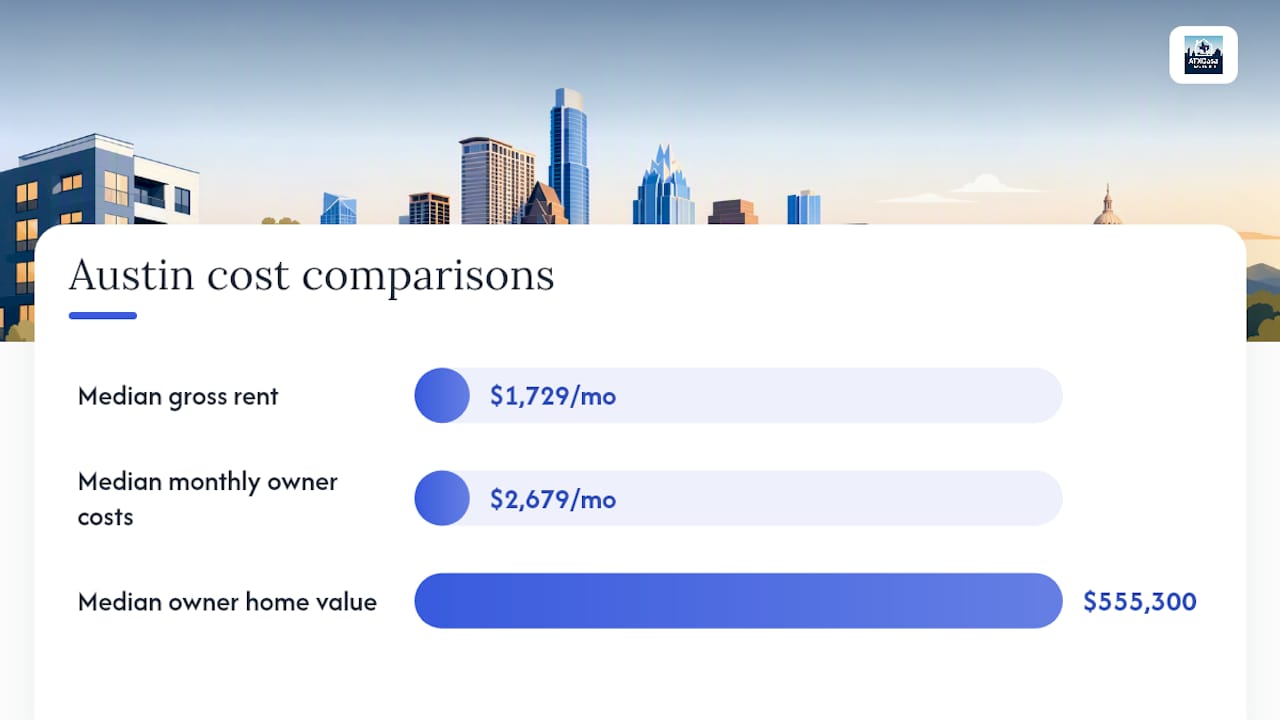
Planning an Austin move in 2026? Start with the housing quote for your address and a complete household budget. The title’s $1,729 figure is Austin city’s median gross rent for 2020–2024, not a 2026 asking rent or a minimum budget. Census reported median monthly owner costs with a mortgage of $2,679 for the same period. Both measures already include specified utilities. These figures provide context, but your lease terms, financing, childcare needs and other bills determine whether a move leaves room for savings and unexpected expenses.
TL;DR:
- Austin city’s 2020–2024 medians were $1,729 for gross rent and $2,679 for monthly owner costs with a mortgage. Both include specified utilities; neither is a current quote.
- Use the address’s utility history and applicable rate schedule. For buyers, estimate taxes using all applicable taxing units and your own exemption eligibility.
- The examples below are partial budgets, not estimates of typical spending. Replace each housing benchmark with your own quote and add omitted costs before deciding what you can afford.
- Budgeting should involve obtaining actual utility bills, reviewing tax history, and accounting for local utility tariffs, especially in peak summer months.
- Separate temporary relocation expenses from ongoing housing costs. An event does not itself change an existing fixed lease payment or fixed mortgage principal-and-interest payment.
Table of Contents
- What Does the Cost of Living in Austin Actually Look Like?
- How Much Do Utilities and Property Taxes Add Each Month?
- What Do Groceries, Transportation, and Childcare Cost in Austin?
- What Do Sample Monthly Budgets Look Like in Austin?
- How Do You Build Your Own Austin Budget?
- What Does Atxcasa’s Local Data Say About Moving Here?
- How Much Does School Choice Add to Your Austin Budget?
- How Does Austin Compare to Texas and National Averages?
- Is Austin Getting More or Less Affordable Over Time?
- Do SXSW and Other Events Change Your Monthly Costs?
- When Does Austin Make Sense, and When Should You Be Cautious?
- How To Plan Your Austin Move
- Sources
- FAQ
What Does the Cost of Living in Austin Actually Look Like?
Renters and owners face different math, and both get distorted if you only look at one citywide number.
The Census Bureau’s most recent estimate cited here covers 2020–2024: Austin city’s median gross rent was $1,729 a month, and median selected monthly owner costs with a mortgage were $2,679. Gross rent includes estimated renter-paid utilities and fuels as well as rent. Owner costs include mortgage debt payments, property taxes, insurance, utilities and fuels, plus applicable association-related fees. Routine maintenance is not included. These are historical citywide medians, not prices offered to a household moving in 2026.
The HUD FY2026 Fair Market Rent schedule lists $1,562 for one bedroom, $1,852 for two bedrooms and $2,347 for three bedrooms in the Austin-Round Rock-San Marcos metropolitan area. That area covers Bastrop, Caldwell, Hays, Travis and Williamson counties. Fair Market Rents estimate gross rent at the 40th percentile for standard-quality units and support federal housing programs; they are not listing quotes. HUD also notes FY2026 revisions effective May 21, 2026, so confirm the applicable table before using a figure for a program decision. Differences from the Census city median cannot isolate the effect of location: the geography, bedroom grouping, measurement period and statistical measure differ.
Before signing anything, run through a short list:
- Confirm which utilities are included in rent and which you’ll pay separately.
- Ask whether parking is included and request the amount of any separate charge.
- Check deposit amounts, lease length, and any administrative or application fees.
- Request a representative recent utility bill for that specific unit, not a building average.
When comparing renting with buying, list what each quote includes before adding costs. A principal-and-interest mortgage estimate needs separate allowances for property taxes, insurance, utilities, applicable homeowners association dues and maintenance. If the estimate already includes a charge, count it only once. The Census owner-cost median includes several of these expenses, but it does not include routine maintenance or describe a new buyer’s financing terms.
How Much Do Utilities and Property Taxes Add Each Month?
There is no single utility allowance that fits every Austin address. Check the service provider, the home’s usage history and the rates that will apply when you move.
For electricity, request the exact unit’s bills, including summer months, and identify the provider and billing plan. A prior occupant’s bill is useful evidence of that home’s costs under their usage, but it is not a promise of your bill. Check whether the rate schedule has changed and whether your expected occupancy and air-conditioning use differ.
MIT’s Travis County model, updated February 15, 2026, estimates basic-needs earnings of $23.69 an hour for one adult with no children and $40.05 for one adult with one child. These household-specific estimates are a cross-check for your budget, not a utility allowance or a guarantee of comfortable living.
Austin Water lists FY2025–26 residential rates effective November 1, 2025, and FY2026–27 rates effective October 1, 2026. Match the schedule to your service dates, usage, meter and applicable fees. Its impact fees finance growth-related infrastructure and depend on factors including plat dates and fee zones. Those are connection or development charges, not a normal monthly utility expense; for new construction, ask whether any such charge is assigned to you in the contract.
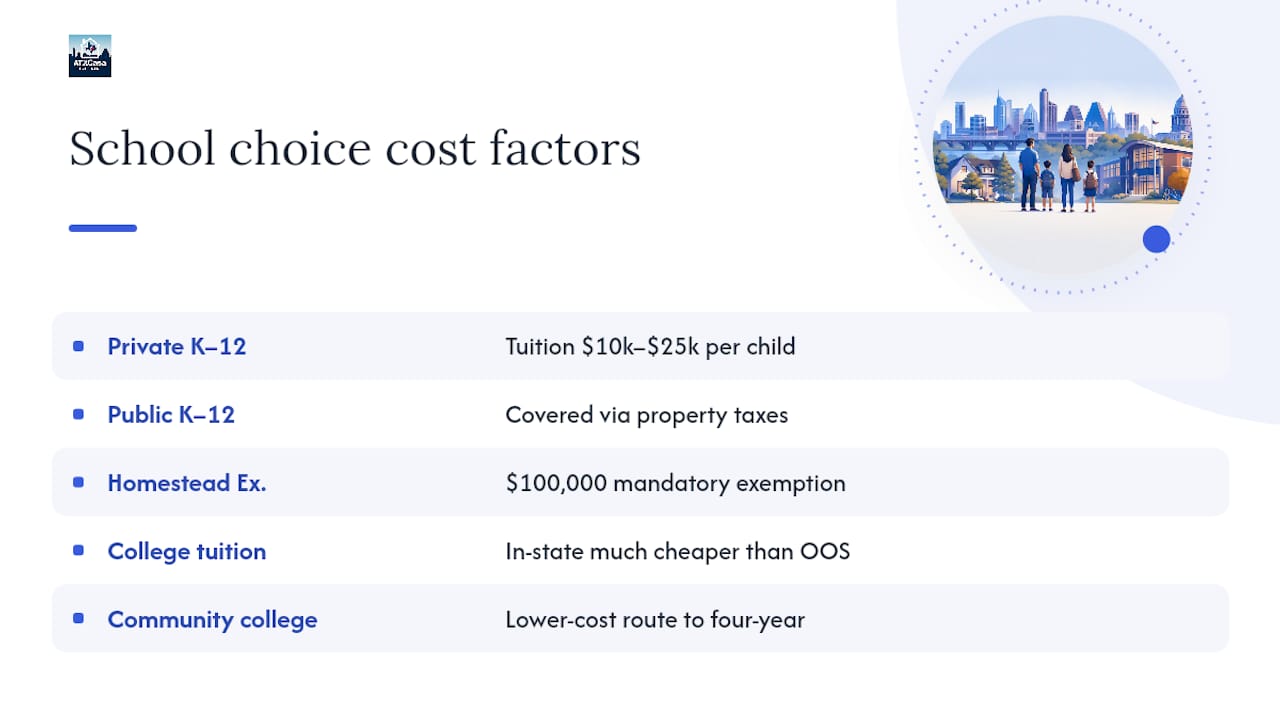
Property taxes require a buyer-specific estimate. The previously cited mandatory $100,000 school-district homestead exemption is outdated: the Texas Comptroller lists a $140,000 school-district exemption for a qualifying residence homestead. Ownership and use as your principal residence matter; confirm eligibility, application requirements and timing with the appraisal district. The exemption reduces taxable value rather than subtracting that amount from the tax bill. The city’s own rate is only one component of the bill. Include the county, school district and any other applicable taxing units. A seller’s bill is useful history, but your taxable value, exemptions and applicable rates may differ, so it is not your future tax estimate.
Before you lease or make an offer:
- Request the last 12 months of utility bills for the exact unit.
- Review the parcel’s tax history, then obtain an estimate using your expected taxable value and exemption eligibility.
- Confirm the address’s utility providers, service classification and applicable rate schedules; do not infer them from an Austin mailing address.
What Do Groceries, Transportation, and Childcare Cost in Austin?
MIT’s living-wage figures model the full-time hourly earnings needed to cover basic needs for a particular household. They are not a local wage survey or a recommended salary. Its expense categories include medical costs, taxes, internet and mobile service, which can be easy to miss in a housing-focused budget.
For two working adults with no children in Travis County, the modeled requirement is $15.74 an hour per worker in the MIT Living Wage Calculator, updated February 15, 2026. Choose the household configuration that matches your situation. A figure for two workers cannot stand in for a household relying on one income, and a scenario without children does not establish a childcare budget.
Build these monthly lines from your own spending and quotes:
- Groceries: use recent receipts and account for the people, dietary needs and meals your budget must cover.
- Transportation: include payments, insurance, fuel, maintenance and any parking or toll costs associated with your expected trips.
- Childcare: request a quote for each child’s age and required schedule, including fees, and confirm availability before relying on it.
The claim that the Bureau of Labor Statistics doesn’t publish an Austin-specific expenditure table is not established by this linked Dallas–Fort Worth release. That release describes a different metro area and cannot establish your Austin spending. Use your own bills and address-specific quotes instead of importing another metro’s expense shares.
What Do Sample Monthly Budgets Look Like in Austin?
These partial monthly examples combine the historical Census or listed FY2026 HUD housing benchmarks with explicitly hypothetical non-housing amounts. They demonstrate budgeting, not typical spending or available housing. Specified utilities are already inside the housing benchmarks, so no separate utility allowance is added. The subtotals exclude healthcare, income taxes, internet and mobile service, debt payments, discretionary spending and savings. Deposits and moving expenses require separate upfront cash.
- One adult, renting a one-bedroom. Use the listed HUD one-bedroom gross-rent benchmark of $1,562, plus hypothetical monthly groceries of $350, transportation of $600 and a $150 contingency. The subtotal is $2,662. This includes the utilities covered by gross rent, but it is incomplete until you add the excluded expenses and replace the housing benchmark with an actual quote.
- Two adults sharing a two-bedroom. Use the listed HUD two-bedroom gross-rent benchmark of $1,852, plus hypothetical monthly groceries of $600, transportation of $900 to $1,200 and a $200 contingency. The household subtotal is $3,552 to $3,852 before the excluded expenses. These are household amounts, not per-person costs; decide separately how you will share them.
- Family of four, owning with a mortgage. Use the 2020–2024 Census owner-cost median of $2,679, plus hypothetical monthly groceries of $900, transportation of $1,000, childcare of $1,200 for exactly one child and a $300 contingency. The subtotal is $6,079. Property taxes, insurance and specified utilities are already in the owner-cost benchmark. Replace that benchmark with your financing and property-specific costs, and add a maintenance allowance, any additional childcare and the excluded expenses.
For a decision example, suppose the one-adult household finds a unit whose rent plus the utilities covered by gross rent totals $2,000 monthly. Keeping groceries, transportation and contingency unchanged raises its subtotal from $2,662 to $3,100, an increase of $438. If the household has set a hypothetical $2,900 limit for those same categories after reserving money for all excluded expenses, that unit exceeds the limit. A lower housing quote or a supported reduction elsewhere could change the answer; the HUD benchmark alone cannot make the unit affordable.
How Do You Build Your Own Austin Budget?
A four-step method turns these public benchmarks into a number specific to your household.
Step 1: Define your household and income assumptions. Use the matching MIT household scenario as a basic-needs cross-check, then build your spending plan around expected take-home income, required bills and savings. Do not compare an hourly earnings requirement directly with take-home pay without accounting for taxes.
Step 2: Gather real listing or mortgage numbers. Request an itemized rent quote or mortgage estimate and mark which costs it includes. Obtain utility history for the exact unit. For a purchase, use the parcel’s records to identify taxing units, then obtain a buyer-specific estimate instead of carrying forward the seller’s tax bill.
Step 3: Map utility tariffs to your actual usage. Confirm the provider, service classification and rate schedule for the address and your move date. Use the home’s summer and cooler-month bills to see how usage changes; a bill under an older schedule may need adjustment.
Step 4: Add recurring non-housing costs plus a buffer. Include groceries, transportation, childcare, healthcare, debt payments and savings. Count applicable association dues and other housing charges once, and budget for maintenance when buying. Keep deposits, moving expenses and other upfront cash separate from recurring monthly spending so a manageable monthly payment does not conceal an unaffordable move.
- Confirm the exact billing address before assuming a rate tier applies.
- Request 12 months of utility bills when available, including summer; a few consecutive cooler months may miss your largest seasonal expense.
Pro Tip: Ask for actual utility statements for the unit, with personal account details redacted. Match the usage shown to the applicable rates. A bill shows what the previous occupant paid under that schedule; your usage and the rates in effect after your move may differ.
What Does Atxcasa’s Local Data Say About Moving Here?
ATXCasa’s linked guides provide context through neighborhood-level analysis and explanations of how 2026 city budget changes affect homeowner costs.
For an Austin housing decision, the useful comparison is between specific homes with the same expenses counted. Put rent or financing, utilities, taxes where applicable, transportation and required childcare beside each address. Use Census and HUD figures as background. A lower advertised housing payment is less useful if the remaining required costs push the complete budget beyond what you can spend.
How Much Does School Choice Add to Your Austin Budget?
Treat school costs as a separate household decision. Choosing private school does not replace a homeowner’s applicable property taxes: tuition belongs in the budget alongside the housing tax bill. For either choice, identify the school arrangement you can actually use before committing to an address.
Obtain the school’s current tuition and fee schedule for your child’s grade, plus any transportation, meal and after-school costs. Do not rely on a general Austin tuition range to decide whether a home fits your budget. For a qualifying residence homestead, the $140,000 school-district exemption reduces taxable value; it is not a tuition credit or an automatic elimination of school taxes.
For college expenses, request the institution’s cost estimate and a determination of the student’s tuition residency status before assuming a move qualifies them for a particular rate. If you are considering a community-college transfer path, confirm which courses transfer and compare the full cost of completing the intended degree. Use those answers to set the education budget before choosing a housing payment.
Check which education expenses any cost-of-living calculator includes. Add your household’s remaining school costs explicitly so they do not disappear inside a general estimate.
How Does Austin Compare to Texas and National Averages?
The Austin figures cited here do not establish a ranking against Texas or national costs. A useful comparison needs matching periods, geographic boundaries and expense definitions; an Austin city median should not be compared casually with a different metro’s asking rents.
Austin city’s 2020–2024 median gross rent of $1,729 and median monthly owner costs with a mortgage of $2,679 describe different housing groups. They do not tell you what the same household would spend elsewhere or whether buying would cost less than renting. For your move, compare the homes you could actually choose, using quotes that include the same expense categories.
Compare non-housing costs separately rather than assuming they follow housing prices. Use your expected take-home pay in each location, then list transportation, healthcare, childcare and other required spending. A move offers a financial benefit only if the complete budget improves enough to justify its upfront cost and any compromises in space, travel or services.
Is Austin Getting More or Less Affordable Over Time?
The housing benchmarks in this guide cannot establish whether Austin is becoming more affordable month to month. A five-year Census median describes a period, while the HUD schedule serves housing programs. Neither predicts the rent available when you move or the terms offered at your next renewal.
The City of Austin lists an adopted property-tax rate of $0.579948 per $100 of taxable value for FY2026–27, compared with $0.524017 for FY2025–26. Holding taxable value unchanged, the higher rate increases the city portion of the bill. That is not the combined property-tax rate, and an individual household’s result also depends on taxable value, exemptions and the rates of its other taxing units.
For a multi-year stay, check what can change after the first lease term or first year of ownership. Revisit renewal terms, insurance quotes, taxable values and utility schedules as new information becomes available. Test whether your budget still works with higher required expenses, but treat that as a planning scenario rather than a forecast. If the move works only when costs fall, choose a less expensive option or delay the commitment until the numbers support it.
Do SXSW and Other Events Change Your Monthly Costs?
Separate the cost of arriving in Austin from the cost of living here. If you need temporary lodging or transportation during an event, use quotes for your actual dates instead of assuming those expenses match an ordinary week.
If your move overlaps South by Southwest, Austin City Limits or Formula 1, compare available lodging, parking and moving arrangements before selecting dates. An event does not itself rewrite an existing fixed lease payment or fixed mortgage principal-and-interest payment. That narrow point does not establish that events have no effect on every housing cost, future asking rent or relocation expense.
Changing your moving dates is sensible if actual quotes show a useful saving and the change does not add overlapping rent or other costs. Confirm availability and cancellation terms before booking. Keep those temporary expenses separate from your recurring budget, and estimate utilities from usage and applicable rates rather than treating them as fixed payments.
When Does Austin Make Sense, and When Should You Be Cautious?
A move makes financial sense when the complete address-specific budget fits your expected take-home income while preserving the savings and reserves you need. A lower housing payment can help, but a longer commute or additional childcare may use that saving. If the budget works only by omitting medical costs, maintenance or required care, compare less expensive homes or postpone the move. The number of earners alone does not determine affordability.
How To Plan Your Austin Move
Start with a housing quote you could accept, the utility history for that address and a list of required household expenses. For a purchase, add financing terms and buyer-specific taxes; for a lease, confirm included utilities and recurring fees. This turns broad Austin benchmarks into a decision about a particular home.

Whether you’re comparing a rent renewal against current market benchmarks, relocating from a higher-cost state like California, or trying to understand how property taxes differ across Cedar Park, Round Rock, Leander, and Georgetown, use ATXCasa’s guides to identify the costs and terms you need to compare. Browse the latest market insights, then connect with Vladimir Baibus at ATXCasa to compare housing options against your budget. Bring your target monthly spending, move date and household requirements so the conversation can focus on homes and cost questions relevant to your decision.
Sources
Census QuickFacts and the 2024 ACS subject definitions establish the 2020–2024 city medians and included housing costs. HUD supplies the FY2026 metro benchmarks and revision notice; MIT supplies the Travis County model updated February 15, 2026. The Texas Comptroller supplies homestead guidance, and the City of Austin supplies adopted city tax rates and Austin Water rate dates. Hypothetical budget inputs are identified in the examples.
- U.S. Census Bureau QuickFacts: Austin city, Texas
- HUD Fair Market Rents (FMRs) By State, County, and Metropolitan Areas
- Living Wage Calculator — Travis County, Texas
- Texas Comptroller — property tax exemptions
FAQ
Is Austin Expensive Compared to the Rest of Texas?
The figures cited here do not establish Austin’s ranking against the rest of Texas. Austin city’s 2020–2024 median monthly owner costs with a mortgage were $2,679, including specified utilities, taxes and insurance. To compare locations, use matching measures or actual housing quotes and the same household expense categories.
What Is a Good Salary to Live Comfortably in Austin?
There is no universal salary for comfortable living. MIT’s Travis County model, updated February 15, 2026, estimates basic-needs earnings of $23.69 an hour for one adult with no children and $40.05 for one adult with one child. These are modeled full-time earnings requirements, not comfort targets. Build your own plan from take-home income, actual housing and household costs, debt payments and desired savings.
How Much Should I Budget for Rent in Austin?
Use a current quote for a unit that meets your needs, including required fees and the utilities you must pay. The title’s $1,729 is Austin city’s 2020–2024 median gross rent, not a 2026 asking-rent estimate. The listed FY2026 HUD benchmarks are $1,562 for one bedroom and $1,852 for two bedrooms across the Austin-Round Rock-San Marcos metro. They are gross-rent program benchmarks; HUD also notes revisions effective May 21, 2026. Do not treat either source as a promise of available rent or add included utilities twice.
Do Property Taxes Really Add That Much to Homeownership Costs?
Property taxes are a recurring ownership cost that a principal-and-interest payment alone does not capture. The Texas Comptroller lists a $140,000 school-district exemption for a qualifying residence homestead. It reduces taxable value, not the bill dollar for dollar. Confirm ownership and principal-residence eligibility, application requirements and timing with the appraisal district. Estimate all applicable taxing units using your circumstances rather than assuming the seller’s bill will continue.
Does SXSW Affect Long-Term Rent or Housing Costs in Austin?
SXSW does not itself change an existing fixed lease payment or fixed mortgage principal-and-interest payment. That does not establish that events have no effect on future asking rents or every housing-related expense. If you are relocating during an event, compare actual quotes for temporary lodging, transportation and moving arrangements separately from your ongoing budget.