

For Austin buyers, homeowners insurance and a home warranty address different expenses. Insurance responds to losses covered by your policy, subject to exclusions, limits and deductibles. An optional home warranty is a service contract that may cover eligible appliance or system breakdowns from ordinary wear. Consider a warranty when its eligible repair benefits justify the plan price and service fees—and you can still pay uncovered expenses. Neither product substitutes for the other.
TL;DR:
- Homeowners insurance covers policy-defined losses; a home warranty is an optional service contract for eligible breakdowns from normal wear.
- Check the cause of damage and the applicable terms. Insurance deductibles and limits affect your expense; warranty service fees, exclusions and caps affect whether a breakdown receives useful coverage.
- Costly insurance lapses can lead to higher premiums through force-placed policies, while warranty costs accumulate through service fees and caps that may limit coverage on high-end appliances or systems.
- Before counting on a warranty, compare the inspection findings with the contract’s covered items, exclusions, reimbursement limits and replacement terms.
- A repair fund gives you money to pay bills directly; a warranty may reduce eligible repair expenses but still leaves fees and uncovered costs. Having savings alone does not establish whether a contract saves money.
Table of Contents
- Home Warranty vs Homeowners Insurance: The Core Difference
- What Homeowners Insurance Covers
- What a Home Warranty (Service Contract) Actually Covers
- Comparing Triggers, Costs, and Exclusions Side by Side
- Do You Need Both? A Decision Framework
- What Happens When You File a Claim
- What Sellers, Buyers, and Realtors Actually Do With Warranties
- What This Comparison Actually Tells You
- Atxcasa: A Local Resource for Insurance and Warranty Questions
- Sources
- FAQ
Home Warranty vs Homeowners Insurance: The Core Difference
Hypothetical example, not a quote: assume the same repair costs $1,200 with or without a warranty. A $600 annual plan with a $100 service fee leaves you paying $700 for the year if the repair is fully eligible, the provider pays the entire bill, and there are no other charges or claims. Paying directly costs $1,200, so the plan saves $500 in this scenario. Exclusions or a low reimbursement cap can reverse that result.
Homeowners insurance responds to covered causes of loss under your policy, subject to limits, exclusions, deductibles and settlement terms. See Texas Department of Insurance explanation for an example of a policy-covered loss. For homeowners considering a sale after fire damage, the selling decision is separate from what the policy covers. A home warranty is a service contract, not homeowners insurance. It may cover specified appliances or systems that fail from ordinary wear, according to FTC guidance on home warranties. That distinction matters for how disputes get resolved. Insurance complaints go through your state insurance commissioner. Warranty disputes often route through arbitration clauses buried in the contract, with far less regulatory oversight.
What Homeowners Insurance Covers
A standard policy bundles four or five distinct coverages, and each one has its own limit.
- Dwelling coverage pays to rebuild the structure itself after a covered loss.
- Other structures covers detached items like a fence, shed, or detached garage.
- Personal property reimburses you for belongings, furniture, electronics, clothing, damaged or stolen in a covered event.
- Liability protects you if someone is injured on your property or you accidentally damage a neighbor’s.
- Loss of use covers hotel bills or rent if your home becomes uninhabitable during repairs.
Standard policies exclude flood and earthquake damage, according to NAIC consumer guidance, which means Austin homeowners near flood-prone creeks or the Colorado River corridor often need a separate policy through the National Flood Insurance Program. Ask about Replacement Cost Value (RCV) versus Actual Cash Value (ACV) before you buy. RCV pays what it costs to replace an item today; ACV subtracts depreciation, which can leave you thousands short on an older roof or HVAC system.
Pro Tip: Confirm your policy pays RCV on the dwelling, not ACV. The difference on a roof replacement alone can run into five figures.
If your mortgage requires homeowners insurance, keep coverage active and provide proof when your servicer requests it. If the servicer has a reasonable basis to believe the required coverage is missing, it may arrange a force-placed policy on your behalf that is usually more expensive than insurance you obtain directly and may protect only the lender. For covered mortgage servicers, CFPB Regulation X requires an initial written notice at least 45 days before assessing a charge and a reminder at least 15 days before charging. Charges also depend on the servicer lacking evidence of continuous coverage meeting the loan’s requirements. If you receive a notice, send proof of existing coverage or obtain or reinstate coverage, then send the requested proof and request cancellation. Within 15 days after receiving adequate evidence, the servicer must cancel the force-placed insurance and refund or remove charges for overlapping coverage periods. Charges for an actual uninsured period may still apply. Before closing, use this Austin home insurance checklist to prepare your coverage questions; after closing, keep renewal records and respond promptly to servicer notices.
What a Home Warranty (Service Contract) Actually Covers
A home warranty covers only the items and failures specified in its contract. Check whether the proposed plan includes each of these systems or appliances, and whether additional coverage must be purchased:
- HVAC systems (heating and air conditioning)
- Plumbing lines and water heaters
- Electrical systems
- Built-in kitchen appliances like ovens, dishwashers, and garbage disposals
- Sometimes washers, dryers, and garage door openers as add-ons
When something breaks, you call the warranty company instead of hiring your own contractor. The company dispatches a vendor from its network, and you pay a service-call fee, typically $75 to $125, whether or not the technician fixes anything. The company then decides whether to repair the item or replace it, and that decision belongs to them, not you.
This is where most complaints start. Contracts frequently cap reimbursement or offer a base-model replacement rather than restoring what you had, according to the FTC. If your failed refrigerator was a high-end model, the warranty might only cover a builder-grade replacement or a limited cash payout, leaving you to cover the gap. Contracts also exclude damage tied to poor maintenance, pre-existing conditions, or code violations, and many include mandatory arbitration clauses that limit your ability to sue.
Pro Tip: Before signing, find the reimbursement cap and replacement terms for the system you are most concerned about. A covered item can still leave you with a bill when the contract limits what the provider pays.
In Texas, residential service companies offering home warranties must be licensed by the Texas Department of Licensing and Regulation (TDLR). TDLR advises buyers to check coverage limits, exclusions, service-call fees, repair-provider choice, timing and replacement terms. Licensing does not establish whether your particular breakdown qualifies under the contract.
Comparing Triggers, Costs, and Exclusions Side by Side
Start with what caused the problem, then check eligibility. Damage from a falling tree limb may fall under homeowners insurance if the policy covers the cause of loss. A water heater that fails from ordinary wear may qualify under an active warranty only if the item and failure meet its terms. Age alone does not establish coverage.
| Factor | Homeowners Insurance | Home Warranty |
|---|---|---|
| Claim trigger | Cause of loss covered by the policy | Eligible breakdown from normal wear |
| Typical coverage | Structure, belongings, liability, loss of use | Only systems and appliances listed as covered |
| Regulation | State-regulated insurance product | Texas residential service companies: licensed by TDLR |
| Cost structure | Annual premium plus a deductible per claim | Plan price plus contract-specific service fees |
| Payout approach | Cash settlement (RCV or ACV) for the loss | Repair or replacement subject to contract limits |
| Common exclusions | Flood, earthquake, gradual wear | Pre-existing issues, poor maintenance, code upgrades |
Insurance deductibles run from a few hundred dollars to several thousand on higher-value homes. Warranty service-call fees are smaller per visit but add up if multiple systems fail in one year, and replacement caps mean you could still owe the difference on an expensive appliance.
Do You Need Both? A Decision Framework
Meet your mortgage’s insurance requirements first. Then compare the optional warranty with paying for repairs directly. A warranty may be useful when the failures you are concerned about qualify, the potential payment justifies the plan price and service fees, and you can afford the remaining expenses. Paying directly may fit better when you can fund repairs and want control over the contractor, timing and replacement. Before buying a plan, decide whether its authorization process and possible claims delays are workable for you.
- Check your home’s age and system condition. A 20 year old HVAC system nearing the end of its life makes a warranty more attractive than a unit installed two years ago.
- Check existing warranty documents. Compare any manufacturer or builder coverage with the proposed service contract. Identify what additional repair expense the new plan would actually cover before paying for it.
- Ask providers direct questions: Does the contract cover the inspector’s documented issue? What exclusions, service fees and payment limits apply? Who chooses the repair provider and authorizes repair or replacement? What does the contract say about repair timing, replacement terms and cancellation? Get those answers before assigning the plan value in your purchase budget.
- Compare total costs and remaining repair expenses. In the hypothetical $600 plan example, a year with no claims still costs $600, while paying directly produces no repair bill if nothing breaks. Savings let you absorb expenses; they do not determine which choice costs less.
Pro Tip: Read the arbitration clause before you sign anything. It determines whether you can escalate a denied claim to small claims court or if you’re stuck with the company’s process.
Now change the hypothetical contract, keeping the same $1,200 repair, $600 annual price and $100 service fee. Suppose $200 of the repair is excluded and the provider’s contribution toward the remaining eligible work is capped at $400. Your annual outlay becomes $600 + $100 + $1,200 − $400 = $1,500, or $300 more than paying directly. Assume no other charges or claims. The warranty pays something, but its limited benefit does not recover your plan price and service fee. These figures illustrate contract effects; they are not market prices or predicted savings.
What Happens When You File a Claim
An insurance claim starts with a call to your agent or carrier, an adjuster inspection, and a settlement offer, usually within a few weeks for straightforward damage. A warranty claim starts with a call to the provider, who dispatches a vendor, often within 24 to 48 hours, and the vendor decides on repair versus replacement on the spot.
- Photograph damage immediately and keep repair receipts and maintenance records for both types of claims.
- Keep a separate record of the insurance deductible, warranty service fees and uncovered work so you can identify what you must pay yourself.
- Keep proof that your insurance meets your mortgage requirements and respond promptly if your servicer requests it. Confirm that the servicer received and accepted the evidence.
- For a Texas homeowners-insurance dispute, contact your insurer or agent first, then the Texas Department of Insurance (TDI) if unresolved. TDI cannot decide factual disputes such as storm damage versus normal wear. Texas home-warranty questions and complaints go to the Texas Department of Licensing and Regulation (TDLR); filing a complaint does not guarantee payment.
What Sellers, Buyers, and Realtors Actually Do With Warranties
I see sellers offer a one-year home warranty at closing fairly often. It’s less about coverage and more about smoothing the deal, giving buyers peace of mind about an older water heater or HVAC unit. A builder warranty on new construction is a different animal entirely, covering workmanship and materials, not mechanical breakdown, so don’t assume the two protect you the same way. Confirm any seller-paid warranty transfers in writing during closing, similar to reviewing HOA resale documents for coverage gaps.
What This Comparison Actually Tells You
I would compare the contract with the inspection findings before assigning a seller-paid warranty value in an Austin purchase. If the air-conditioning inspection identifies an existing fault, check that finding against the proposed contract’s pre-existing-condition exclusion and covered-item definition. If the fault is excluded, budget for that work directly when deciding whether the purchase is affordable. A warranty may still help with other eligible breakdowns, but I would keep repair money available for fees, excluded work and costs above its limits.
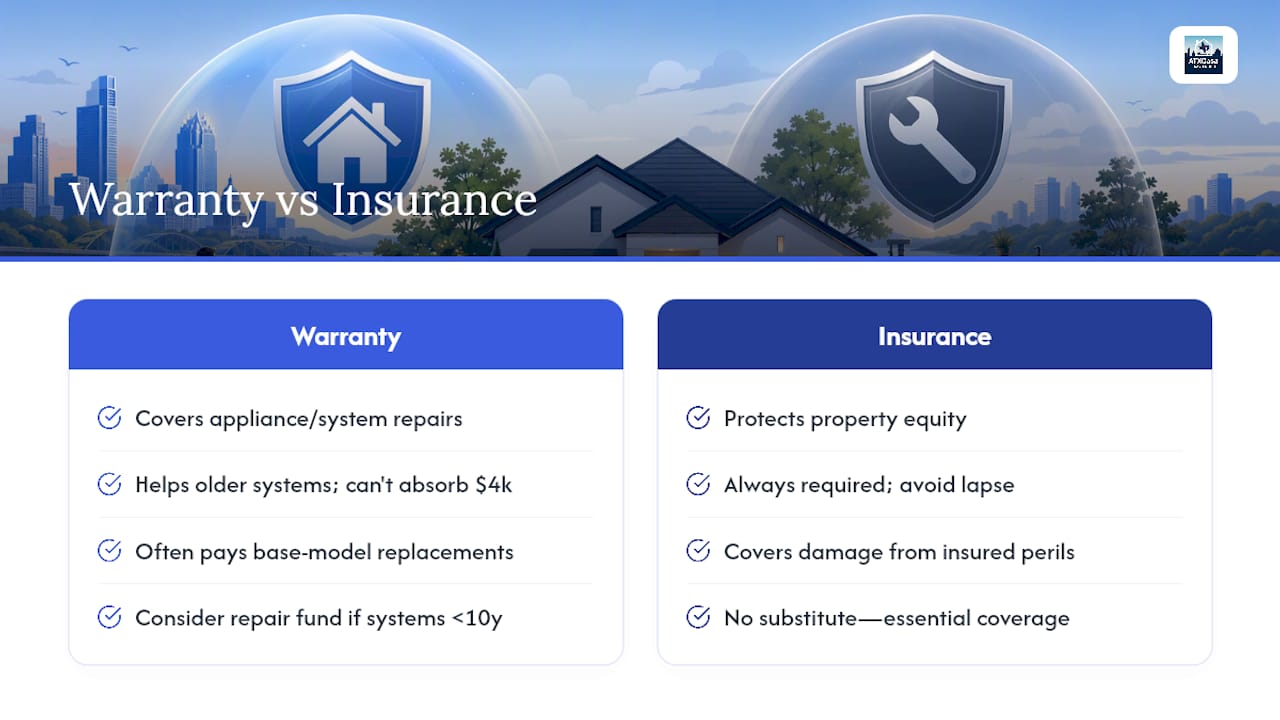
Where a warranty earns its cost is narrower than marketing suggests: older homes with aging HVAC and water heaters, or buyers who genuinely can’t absorb a surprise $4,000 repair. Insurance isn’t optional in the same way. It’s the coverage protecting your equity, and letting it lapse to save a few dollars a month is the single costliest mistake I see in transactions, given how force-placed insurance gets triggered. Prioritize the insurance conversation first. Treat the warranty decision as a math problem about your specific systems, not a blanket yes or no.
— Vladimir
Atxcasa: A Local Resource for Insurance and Warranty Questions
For an Austin-area purchase, bring the inspection report, proposed service contract and insurance quote into the same budget discussion. Match each identified repair to its possible coverage, then identify the expenses you would still need to fund. That comparison helps you judge a seller’s warranty offer and decide which repair questions need answers before closing.

If you’re buying in Cedar Park, Round Rock, Georgetown, or elsewhere in the Austin area and want help weighing a seller’s warranty offer against the inspection findings and your repair budget, start with Atxcasa and request a purchase consultation to identify the repair expenses and contract questions that could change your decision.
Sources
- CFPB: What is force-placed insurance?
- FTC: So what’s the deal with home warranties?
- NAIC consumer guidance on homeowners insurance coverage
FAQ
What Are the Downsides of a Home Warranty?
The biggest downsides are reimbursement caps, base-model replacements instead of full-value coverage, and service-call fees that add up if multiple systems fail in one year. Contracts also commonly exclude pre-existing conditions or damage tied to poor maintenance, according to FTC guidance.
Are Home Warranty Plans a Rip-Off?
Not universally, but they’re a poor value in specific situations, mainly newer homes with appliances still under manufacturer warranty. They tend to make more financial sense for older homes with aging HVAC, plumbing, or electrical systems where a major breakdown is likely within the contract term.
What Does Dave Ramsey Say About Home Warranties?
Dave Ramsey has publicly argued that home warranties are generally not worth the cost and recommends building a dedicated repair fund instead. That view aligns with FTC guidance suggesting consumers weigh the likely repair cost against self-insuring before buying a service contract.
What Is a Red Flag in a Home Warranty Contract?
A major red flag is vague or unlisted reimbursement caps, since some providers only disclose base-model replacement limits after you file a claim. Mandatory arbitration clauses that block you from small claims court are another warning sign worth reading closely before you sign.
Do I Need a Home Warranty if I Already Have Homeowners Insurance?
A home warranty is optional, even if you have homeowners insurance. Insurance responds to losses covered by the policy; a warranty may cover specified breakdowns from normal wear. Consider the warranty only if its eligible benefits justify its price and service fees, and you can pay expenses outside its limits. You can also fund repairs directly. A warranty does not replace insurance required by your mortgage.