
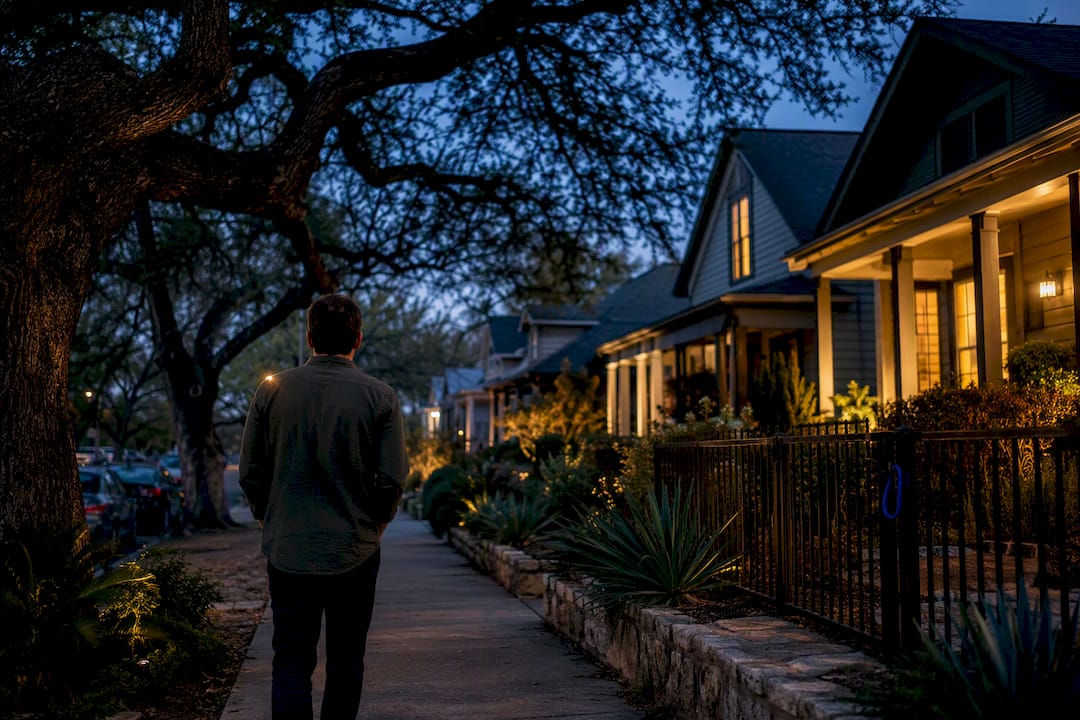
Travis Heights is a historic, walkable South Austin neighborhood best suited to buyers who want close-in access to downtown, a strong sense of neighborhood character, and a home in one of the city’s oldest residential districts. Prices here generally sit above the Austin-area median, and inventory tends to move quickly. If proximity to South Congress and Lady Bird Lake matters more to you than square footage, this is worth a closer look.
TL;DR:
- Home inventory is limited and prices tend to stay above the Austin median, leading to competitive and faster sales for well-priced updates.
- Before planning extensive exterior work, verify the property’s designation and contributing status and describe the proposed scope to the City. For contributing properties in National Register districts, historic review applies to specified exterior alterations, additions, permanent site work, and certain new construction.
- Older homes, especially pier-and-beam foundations, may need careful inspection of moisture, structural, and termite issues before purchase.
- Safety varies significantly by block; evaluating crime requires specific address research and neighborhood conversations rather than assuming neighborhood-wide safety.
- Urban amenities like South Congress and nearby parks create a walkable, community-oriented lifestyle with limited grocery options within the neighborhood itself.
Table of Contents
- Travis Heights at a glance: boundaries, commute, and everyday vibe
- What daily life feels like in Travis Heights
- Housing market snapshot: prices, inventory, and home types
- The historic district and what it means for renovations
- Schools, pools, and everyday city services
- Practical buying tips for Travis Heights homes
- Safety and crime rates in Travis Heights
- Who lives in Travis Heights: a demographic snapshot
- Where to shop and eat around Travis Heights
- How Travis Heights is likely to change in the coming years
- An honest read on the Travis Heights market
- Getting local guidance for your Travis Heights search
- Sources
- FAQ
Travis Heights at a glance: boundaries, commute, and everyday vibe
Travis Heights sits just south of downtown, bounded roughly by Lady Bird Lake to the north, Congress Avenue to the west, I-35 to the east, and Oltorf Street to the south, a footprint that keeps most of the neighborhood within a 10 to 15-minute drive of downtown Austin. Walkability is one of its defining traits: many residents walk or bike to South Congress for coffee, groceries, or dinner rather than drive.
A few quick cues for anyone sizing up the area:
- Tree-lined streets and rolling terrain give the neighborhood a distinct topography compared to the flatter grid of downtown.
- Architecture ranges from early-1900s cottages to mid-century ranch homes and newer remodels, often on the same block.
- South Congress retail and restaurants are typically a short walk or bike ride from most homes.
- Downtown Austin is close enough that many residents skip the car for weekday errands.
That mix of density, tree cover, and walkable access to South Congress is what sets Travis Heights apart from newer South Austin subdivisions.
What daily life feels like in Travis Heights
Daily life in Travis Heights revolves around a handful of small parks and a short list of nearby commercial strips, which keeps the pace unhurried compared to downtown or the South Congress commercial corridor itself. Big Stacy Pool, Little Stacy Park, and Blunn Creek Nature Preserve function almost like shared backyards for residents without large private lots.
- Big Stacy Pool and the adjoining Little Stacy Park draw families for swimming, picnics, and evening walks.
- Blunn Creek Nature Preserve offers a quieter trail experience for hiking or a slower morning run.
- South Congress delivers boutique shopping, sit-down dining, and live music within walking distance for much of the neighborhood.
- Community events, including seasonal markets and neighborhood association gatherings, add a recurring social rhythm.
Nightlife and music venues cluster along South Congress and nearby South First, so residents get urban energy without leaving their zip code. Bike lanes connect the neighborhood to the Ann and Roy Butler Hike-and-Bike Trail around Lady Bird Lake, which many use for commuting or recreation.
Pro Tip: Visit on a weekday morning if you want to see the neighborhood at its quietest, and swing by on a Saturday to catch farmers market foot traffic and gauge how busy South Congress gets on weekends.
Housing market snapshot: prices, inventory, and home types
Travis Heights consistently prices above the broader Austin median, a pattern confirmed in ATXCasa’s August 2025 Austin Market Recap for Travis and Williamson counties, which tracks close-in South Austin neighborhoods against surrounding submarkets. Inventory in Travis Heights tends to run tighter than in peripheral suburbs, reflecting steady demand for a limited supply of historic lots.
Home types vary more than in a typical planned subdivision:
- Early-1900s cottages and Victorians sit alongside 1930s-1950s bungalows and Craftsman-style homes.
- Mid-century ranch homes from the 1960s and 1970s fill in several blocks, often updated or torn down for new construction.
- Contemporary remodels and infill builds have become more common as older homes change hands.
- Many lots carry pier-and-beam foundations rather than slab construction, a detail that matters for inspections and renovation budgets.
Because inventory stays limited, buyers should expect competition on well-priced, updated listings and plan for a faster decision timeline than in outer suburbs. For a broader look at how neighborhood pricing patterns play out across the metro, ATXCasa’s analysis of what sold homes reveal offers useful context before you start touring.
The historic district and what it means for renovations
Travis Heights took shape through a series of early plats filed from the late 1800s through the early 1900s, which explains the patchwork of architectural styles still visible today, from Victorian cottages to Mid-Century Modern infill, as documented in the neighborhood’s own history. That variety earned the area recognition as the Travis Heights-Fairview Park Historic District, listed on the National Register of Historic Places on July 30, 2021.
The listing distinguishes between “contributing” properties, homes that reflect the district’s historic character and construction era, and “non-contributing” properties, typically newer builds or heavily altered structures. That distinction matters at the permit counter.
- Historic review is not a blanket rule for every property or project in a National Register district. The City’s process turns on the property’s designation or contributing status and the proposed work.
- For qualifying projects, the City says most smaller work can be approved by staff within 5 business days, while larger projects go to the monthly Historic Landmark Commission. Timing is project-specific; do not assume a universal 180-day review period. The linked City staff report is an address-specific example, not a general rule.
- Buyers planning exterior changes should confirm the property’s designation or contributing status and discuss the proposed scope with the City before assuming a permit timeline.
Schools, pools, and everyday city services
Travis Heights falls within Austin ISD, with Travis Heights Elementary serving much of the neighborhood, though families should confirm current zoning directly with the district before buying. For recreation, Big Stacy Pool at 700 East Live Oak Street offers free admission and sits at the heart of daily neighborhood life.
- Austin Parks & Recreation maintains a full park directory with hours and seasonal schedules for Big Stacy and nearby parks.
- Residents can report park maintenance issues or hours questions through the city’s 3-1-1 line.
- Basic city services, trash pickup, water, and code enforcement, run through standard City of Austin channels rather than a separate neighborhood utility.
Practical buying tips for Travis Heights homes
Older housing stock and historic-district rules mean Travis Heights rewards a more careful inspection process than a typical newer subdivision.
- Prioritize a foundation inspection given the number of pier-and-beam homes, checking specifically for moisture intrusion, leveling issues, and termite history.
- Have an electrician and HVAC technician evaluate systems separately if the home predates the 1990s, since older wiring and ductwork are common.
- Before budgeting for exterior renovations or additions, verify the parcel’s designation or contributing status and whether the specific scope requires historic review.
- Ask your agent to check drainage patterns around the lot, since the neighborhood’s rolling terrain can create runoff issues on some parcels.
Pro Tip: Before making an offer that depends on exterior work, verify the address’s historic status and the proposed scope with the City. Smaller qualifying projects may receive staff review, while larger projects may go to the monthly Commission, so do not build a plan around a fixed review window.
For a broader framework on inspection priorities and offer strategy across Austin, ATXCasa’s practical buying guide walks through the same due-diligence steps in more detail.
Safety and crime rates in Travis Heights
Travis Heights is generally regarded as one of the safer close-in Austin neighborhoods, a reputation tied partly to its walkability and active street-level presence. Residents out walking dogs, jogging along Blunn Creek, or heading to Big Stacy Pool create the kind of informal foot traffic that tends to deter opportunistic crime in residential pockets.
That said, no close-in urban neighborhood is free of property crime, and areas bordering busier commercial corridors like South Congress or I-35 can see more vehicle break-ins or petty theft than the quieter interior blocks. Buyers should treat safety as block-specific rather than neighborhood-wide: a home two streets off South Congress can feel noticeably different from one backing up to the interstate frontage road.
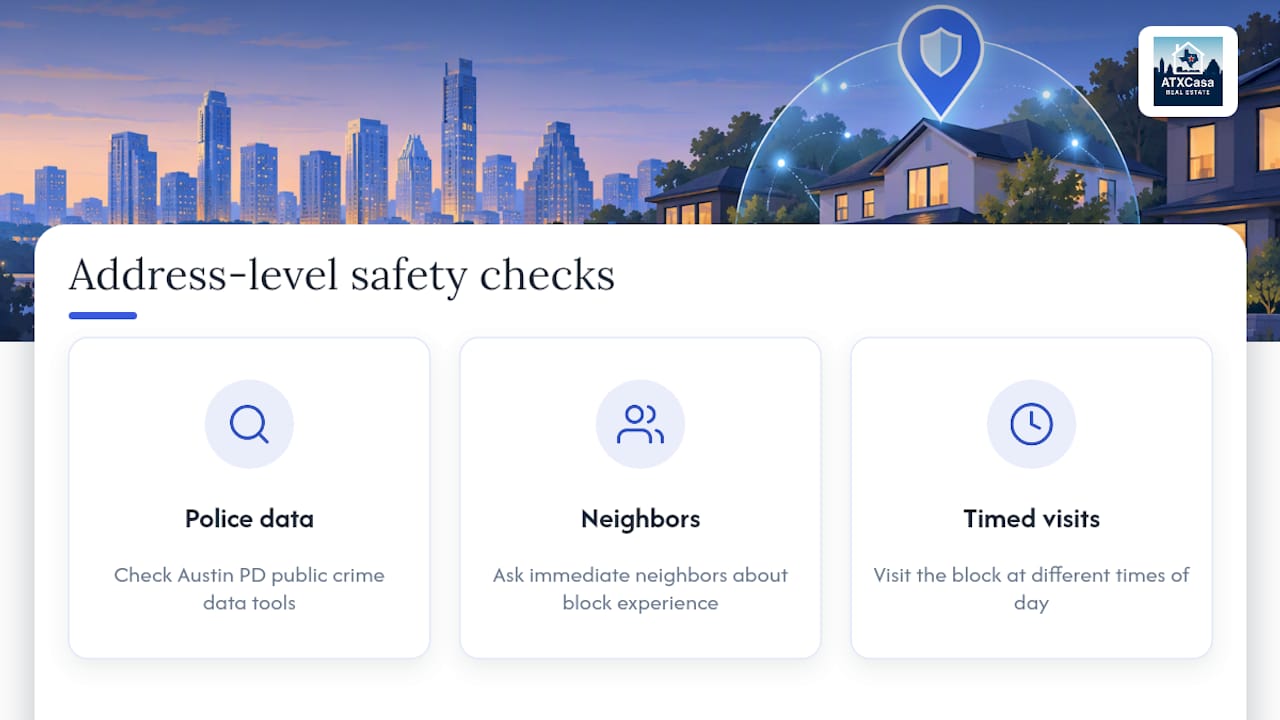
Practical steps for anyone evaluating a specific address include checking recent activity through the Austin Police Department’s public crime data tools and talking to immediate neighbors about their own experience on that block. Visiting at different times of day, as suggested earlier for gauging noise and foot traffic, also helps surface safety impressions that don’t show up in listing photos or generalized crime statistics.
Because Travis Heights functions more as a collection of small, tightly knit blocks than one uniform zone, the honest answer is that safety varies enough within the neighborhood that due diligence on the specific street matters more than the neighborhood’s overall reputation.
Who lives in Travis Heights: a demographic snapshot
Travis Heights attracts a mix of longtime homeowners, many with deep roots in the neighborhood’s preservation efforts, alongside younger professionals and families drawn to the walkable, close-in lifestyle. The result is a wider age range on a given block than you’d find in a newer, single-phase subdivision, where most buyers arrive in the same life stage at once.
Income levels in Travis Heights generally track higher than the Austin-area average, a pattern that follows from the neighborhood’s above-median home prices and its position among the city’s most sought-after close-in addresses. That said, the mix of smaller original cottages alongside larger remodels and new construction means household budgets and lifestyles vary more than the price tags alone would suggest.
Diversity in Travis Heights reflects Austin’s broader population shifts over the past few decades, though the neighborhood’s historic-district status and gradually rising prices have shaped who can afford to buy in versus who inherited or bought decades ago. Renters make up a meaningful share of the population as well, particularly in smaller duplexes and converted properties scattered among the single-family homes.
Anyone weighing a move here should treat these patterns as general context rather than a promise about any specific block, since Travis Heights spans enough architectural and price variety that no single demographic profile fits the whole neighborhood evenly.
Where to shop and eat around Travis Heights
South Congress functions as Travis Heights’ de facto downtown, and it delivers most of the retail and dining residents rely on day to day. Independent boutiques, home goods shops, and a steady rotation of restaurants line the corridor, giving the neighborhood a commercial strip most suburban subdivisions can’t match on foot.
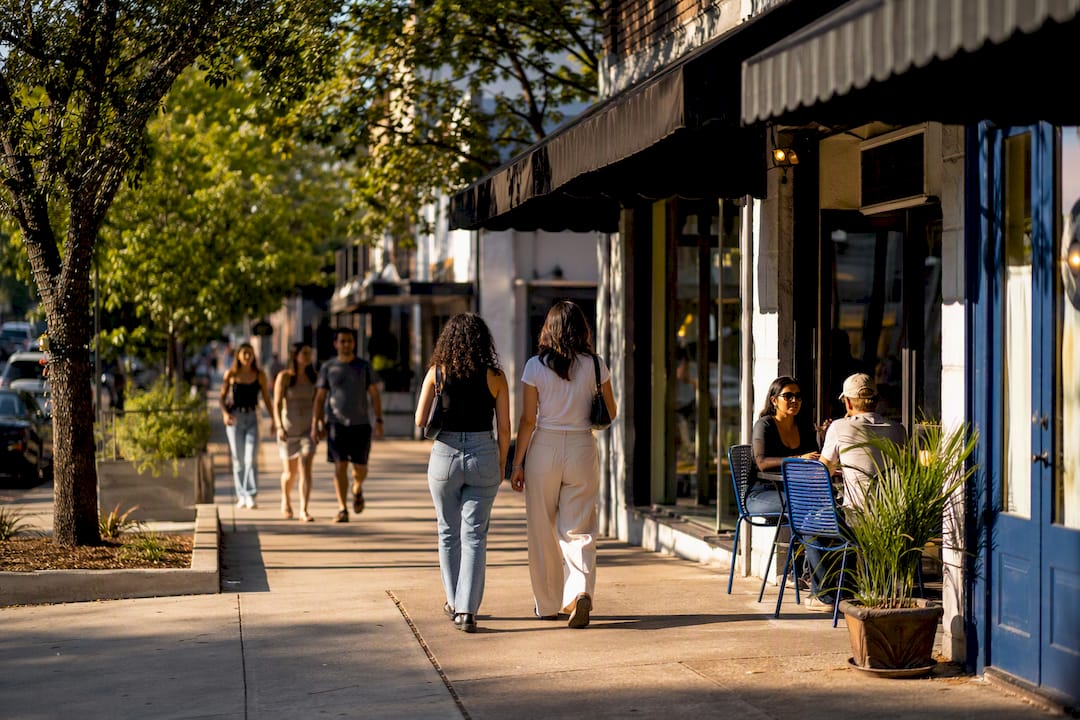
Grocery access sits a short drive or bike ride away rather than directly inside the historic core, so most residents combine a South Congress coffee run with a slightly longer trip for a full grocery haul. Farmers markets and pop-up vendors add a rotating layer of local shopping on top of the fixed storefronts, giving the neighborhood a different retail rhythm on weekends than on weekdays.
The mix leans toward independent and locally owned businesses rather than national chains, which fits the neighborhood’s overall preservation-minded character. That local-first retail identity is part of why many buyers cite lifestyle, not just square footage, as their main reason for choosing Travis Heights over a comparable-priced home farther from downtown.
How Travis Heights is likely to change in the coming years
Travis Heights’ historic-district status puts a natural ceiling on how much the core neighborhood can change, since contributing properties face extra review before major exterior alterations or demolition. That review process, running through the Historic Landmark Commission, tends to slow redevelopment compared to non-historic South Austin neighborhoods where teardowns and larger new builds move faster through permitting.
Growth pressure still shows up at the edges. Areas closer to I-35 and South Congress continue to see remodels, additions, and occasional new construction on non-contributing lots, since those parcels carry fewer restrictions than the district’s protected core. Buyers evaluating a specific block should ask whether nearby lots are contributing or not, since that answer says more about future construction risk than the neighborhood’s reputation as a whole.
The bigger long-term dynamic is scarcity: Travis Heights has a fixed, small footprint and a historic designation that limits how much new supply the market can add. That combination tends to support demand and pricing over time, which is part of why market tracking consistently shows close-in neighborhoods like this one holding a premium over peripheral suburbs. For readers comparing that trade-off against faster-growing suburban options, ATXCasa’s guide to Pflugerville Estates lays out what a lower-cost, higher-growth alternative looks like.
An honest read on the Travis Heights market
I track Travis Heights closely because it behaves differently than most Austin submarkets: limited lot supply, a historic-district overlay, and consistent demand from buyers who want walkability over square footage. That combination, detailed in ATXCasa’s August 2025 Market Recap, is why I tell clients to expect a faster, more competitive process here than in most of the metro.
My approach with nearly two decades of technology experience behind it means I build data-driven pricing strategies rather than guesswork, and I walk every Travis Heights client through the specific permit and inspection issues this neighborhood raises. If you’re weighing a purchase here, a direct conversation about your priorities and budget will tell you more than any general guide can.
— Vladimir
Getting local guidance for your Travis Heights search
Pricing, inventory, and permit issues in Travis Heights are tracked month over month, providing current, locally sourced answers instead of generic advice. A consult covers current market data for the specific block you’re considering, an honest read on neighborhood fit, and the inspection priorities that matter most for older Travis Heights housing stock.

If you’re ready to talk through a Travis Heights purchase or sale, reach out through ATXCasa to schedule a conversation.
Sources
Facts in this guide come from the National Register nomination record and Travis Heights-Fairview Park Historic District documentation, the Historic Landmark Commission’s permit review policy, the Austin Parks & Recreation listing for Big Stacy Pool, and ATXCasa’s August 2025 market recap.
- Big Stacy Pool | Austin Parks and Recreation
- Historic Landmark Commission permit examples and staff reports
FAQ
Is Travis Heights a good neighborhood in Austin?
Travis Heights is generally considered one of Austin’s most desirable close-in neighborhoods, prized for its walkability, historic character, and proximity to South Congress and downtown. It suits buyers who value location and community feel over maximum square footage, though homes here typically carry a price premium documented in ATXCasa’s August 2025 market recap.
What is the wealthiest neighborhood in Austin?
Austin has several high-income neighborhoods, including Westlake and parts of Tarrytown, and rankings shift depending on the data source and year. Travis Heights runs above the citywide median but is not typically cited among Austin’s single wealthiest areas.
What part of Austin to stay away from?
Safety varies block by block across Austin rather than by a single citywide answer, and no neighborhood is uniformly unsafe. Buyers should check current crime data for any specific address and talk to neighbors rather than relying on a neighborhood’s general reputation.
Where does Matthew McConaughey hang out in Austin?
Public reporting on specific celebrity habits in Austin is not consistently documented, so there’s no reliable, sourced answer to this question. Broader questions about Austin neighborhoods and lifestyle are better answered through resources like ATXCasa’s neighborhood and lifestyle guides.
What makes Travis Heights a historic district?
Travis Heights-Fairview Park earned its National Register of Historic Places listing on July 30, 2021, based on its concentration of architectural styles dating from the late 1800s through the 1970s. The designation distinguishes contributing properties from non-contributing ones and can trigger Historic Landmark Commission review for major exterior changes.