
TL;DR
- HUD says covered Build-to-Rent communities can receive the same treatment as traditional multifamily rental developments, subject to the Mortgagee Letter’s specific requirements.
- Screen new construction under Section 221(d)(4); screen acquisition or refinancing of recently developed rental communities under Section 223(f).
- For an Austin-area project, this national change warrants a financing review. It does not establish approval, loan terms or local lender availability.
If you are planning an Austin-area rental community, HUD’s new policy gives you a reason to revisit your financing shortlist. The useful next step is to match the property and transaction to the named FHA multifamily program, then have a qualified lender check the requirements before you rely on that financing in your project budget.
In its October 14, 2026 announcement, HUD describes the change as effective immediately. The opportunity is another financing path to evaluate; the trade-off is that an announcement cannot tell you whether your project qualifies or whether the resulting terms suit your plan.
What changed for Build-to-Rent communities?
Build-to-Rent means housing developed for rental use. For this policy, HUD identifies covered communities as multifamily rental properties consisting of single-family homes, duplexes or triplexes, including site-built and manufactured homes. HUD says those properties will be treated under the same terms and conditions as traditional multifamily rental developments, subject to the Mortgagee Letter’s specific requirements. HUD’s announcement is the source for that scope.
The distinction matters: a community can contain detached houses and still be considered under the announced multifamily financing policy. But a familiar building type is only the start of the screen. The announcement does not establish that every group of rental houses qualifies.
FHA here refers to the Federal Housing Administration’s mortgage-insurance programs. The decision is whether to evaluate an FHA-insured financing route for the rental development. It is not a homebuyer’s application for a mortgage on an individual residence.
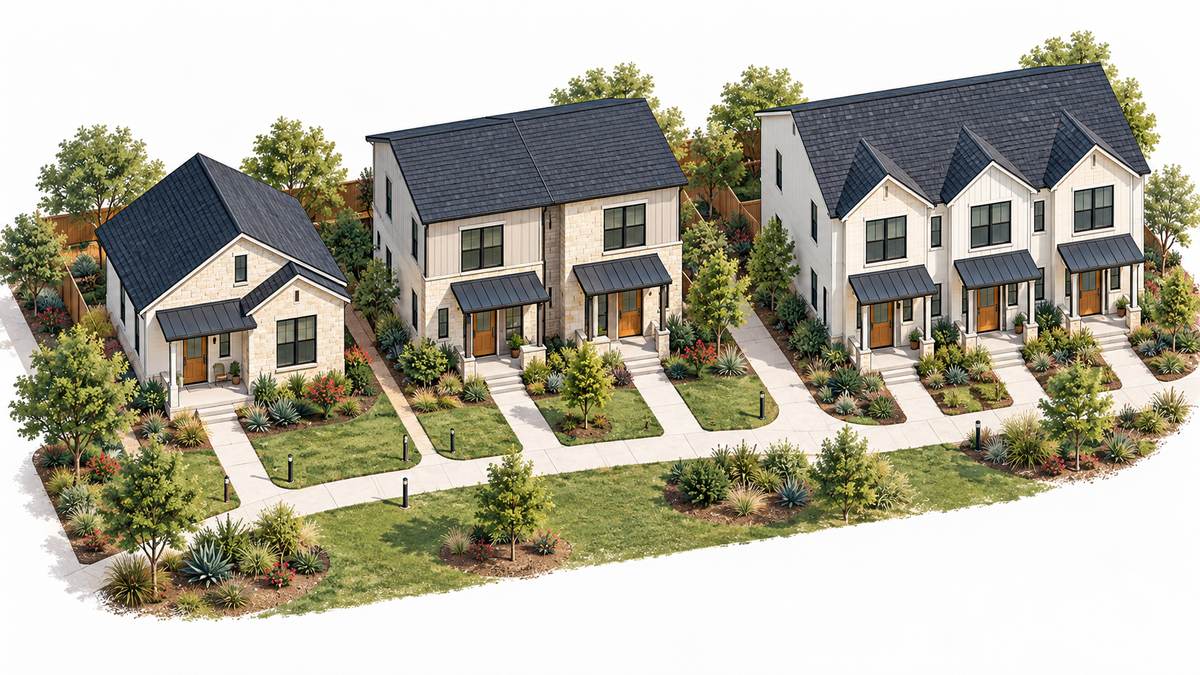
A hypothetical Austin project: matching structures is only the first step
Suppose a proposed Austin-area rental community contains 24 single-family rental homes, 6 duplexes and 2 triplexes. That is 42 rental homes: 24 + (6 × 2) + (2 × 3) = 42. This is an illustration, not an actual development or a program threshold.
Every assumed structure is one of HUD’s named property types. Because the project is new construction, the developer has a reason to ask a qualified FHA multifamily lender to evaluate it under Section 221(d)(4). The 42-home count itself proves neither eligibility nor financing availability; the developer must still verify the Mortgagee Letter and transaction-specific requirements.
If an owner later considers refinancing that same community, the original construction screen does not settle the next transaction. HUD identifies Section 223(f) for acquisition or refinancing of recently developed rental communities. The owner would need the lender to confirm that the community and proposed refinancing meet the applicable requirements at that point. The announcement does not define “recently developed” precisely enough to decide that question here. Both program paths appear in HUD’s announcement.
Choose the program screen before changing the capital plan
| Your planned transaction | Initial program screen | What remains unresolved |
|---|---|---|
| New construction of a covered Build-to-Rent community | Section 221(d)(4) | Whether the project satisfies the Mortgagee Letter’s specific requirements and program underwriting. |
| Acquisition or refinancing of a recently developed rental community | Section 223(f) | Whether the community and transaction meet the applicable requirements, including the relevant development timing. |
These are the transaction paths HUD names, not interchangeable financing choices. A construction proposal and a purchase of a recently developed community start with different program questions.
The potential benefit is a financing option worth comparing with your existing plan. The cost at this stage is the work of establishing fit and obtaining usable terms. The available evidence does not show that this route will be cheaper, faster or provide a larger loan than another option.
What an Austin-area developer should verify next
This is a national policy, not a special Austin rule. Its local relevance is a practical inference: an Austin-area developer or owner with the stated property types and transaction can use the new policy as a reason to request a program review. The evidence supplies no Austin-specific lender availability or market outcome.
Make that review concrete:
- Describe the property and transaction. Give the lender the structure mix, site-built or manufactured construction, development status, and whether the request concerns new construction, acquisition or refinancing. This establishes which announced path is relevant.
- Request the applicable Mortgagee Letter and a project-specific eligibility explanation. Have a qualified FHA multifamily lender confirm the Mortgagee Letter requirements and underwriting. For acquisition or refinancing, specifically establish whether the property fits the announcement’s “recently developed rental communities” scope.
- Compare usable financing terms. Ask what loan amount, rates, fees, timing and unresolved underwriting conditions the lender can support for this project. Until those are established, leave them as open items rather than assumed advantages in the budget.
A positive initial screen is a reason to continue diligence. Before committing to a financing direction, determine whether the remaining requirements and proposed terms work together for the project. Revisit the program fit when the transaction changes, including a later acquisition or refinancing.
Frequently asked questions
Does the policy include manufactured homes?
HUD expressly includes manufactured homes as well as site-built homes within the covered Build-to-Rent property types. That inclusion does not remove the Mortgagee Letter’s specific requirements or establish that a particular manufactured-home community qualifies. See HUD’s stated property scope.
Can I use this announcement to finance one house I want to rent out?
The announcement describes multifamily rental properties consisting of the named housing types. It does not establish eligibility for a standalone rental-house purchase. A single house being rented out is not enough information to apply this community-level policy; a lender would need to identify an applicable financing program for that property and transaction.
Does this mean Austin rents will fall?
No rent forecast follows from this evidence. The announcement provides no Austin-specific construction or rent outcome, so developers should not treat a local rent change as an established consequence.
Sources
- U.S. Department of Housing and Urban Development: “HUD Makes It Easier to Build More Housing”, October 14, 2026; verified evidence checked October 22, 2026. National policy announcement. Detailed Mortgagee Letter requirements were not available in the supplied evidence.
Evaluating an Austin-area rental-community acquisition or property search? Contact Vladimir Baibus at ATXCasa to discuss the property decision and organize the project facts for your lender’s financing review. Vladimir Baibus · ATXCasa · LPT Realty.