

An adjustable-rate mortgage (ARM) can offer a lower starting payment in exchange for uncertainty later. It may fit a buyer with a funded plan to pay off the loan before the first rate adjustment, or enough room in the budget to handle changing payments. A fixed-rate loan offers more certainty when you expect to keep the mortgage for many years.
For a hypothetical $400,000 mortgage over 30 years, an ARM starting at 5.5% costs about $2,271 a month in principal and interest. A fixed loan at 6.5% costs about $2,528. The ARM saves $257 a month initially. The decision is whether that saving is worth the payment changes you could face later.
The rates in this example are illustrations, not current offers or forecasts. Assume the ARM rate is fixed for its first 5 years, the upfront costs are equal, and there are no extra principal payments. Taxes, insurance, mortgage insurance, and HOA dues are excluded so we can see what the loan itself does.
Historical refinance opportunities are not your refinance plan
Redfin’s September 2026 analysis of Freddie Mac rate history estimates that 71.6% of ARM borrowers would have had an opportunity within five years to refinance into a 30-year fixed rate at least 0.5 percentage points lower. Its result describes past rate windows. It counts an opportunity when prevailing rates crossed a threshold; it does not establish that a specific homeowner would qualify, that a lender would approve a refinance, or that the savings would exceed closing costs.
That history can explain why buyers consider an ARM, but it cannot tell you where rates will be in 5 years. The analysis also uses assumptions about introductory ARM discounts where historical ARM data was unavailable. Treat a future refinance as an option that might become available, rather than money already built into your plan.
An ARM may adjust downward without a refinance if its benchmark and contract terms produce a lower rate. That is a potential benefit. Fixed-rate borrowers can also refinance if rates fall and they qualify, although that requires a new loan and a comparison of fees and savings. Expecting lower rates alone does not settle which loan is better.
Read the adjustment terms before comparing the first payment
The rate does not change just once. A 5/1 ARM typically keeps its starting rate for 5 years and can then adjust annually. A 5/6 ARM typically adjusts every 6 months after its first 5 years. On a 30-year loan, that can mean recurring changes throughout the remaining 25 years unless you pay it off or refinance. The loan documents establish the actual schedule.
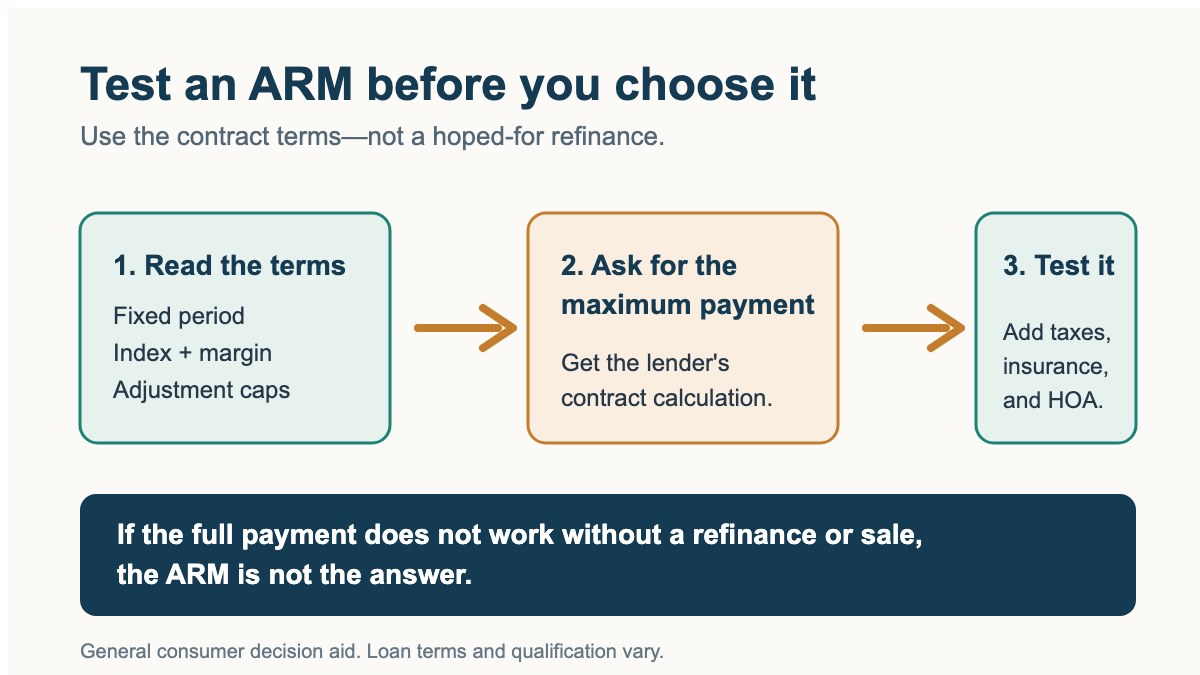
Here is what the main terms mean in practice:
- Fixed period: The introductory stretch before adjustments begin. Paying off the loan before that first adjustment can avoid later rate changes; paying it off sometime afterward leaves you exposed in between.
- Index and margin: The index is a benchmark that moves with market conditions. The margin is the lender’s added percentage. For example, a 4% index plus a 2.5% margin produces 6.5% before applying the contract’s caps, floor, and rounding rules.
- Adjustment caps: Limits on how much the rate can rise at the first adjustment, later adjustments, and over the loan’s life. A floor can also limit how far it falls. These boundaries do not predict the actual rate.
- Maximum payment: The largest principal-and-interest payment permitted by the loan’s terms. This is different from the first possible increase, and it does not cap taxes, insurance, or HOA costs.
An ARM can make sense when the introductory saving is meaningful and your plan can absorb the uncertainty. For example, a buyer with funds scheduled to become available before the first adjustment may plan to pay off the balance then. A planned sale can also support a shorter loan horizon, but allow for a delayed sale or lower proceeds. Compare any prepayment terms and keep a backup budget.
Use a three-column comparison for the loan decision
Use the same purchase price, down payment, and upfront costs to compare three points in time. Here is how our hypothetical $400,000 loan changes:
- Today: ARM at 5.5%: about $2,271 a month. Fixed loan at 6.5%: about $2,528. Initial ARM saving: $257 a month, or about $15,427 over the first 60 payments before any difference in fees.
- First adjustment: After 60 payments, the ARM balance is about $369,842 with 25 years left. If the contract allows a reset to 7.5%, the payment becomes about $2,733: $462 more than its starting payment. If it instead resets to 4.5%, it becomes about $2,056: $215 less. Either payment can change again at a later adjustment.
- Highest permitted payment: The 7.5% example is not the contractual maximum. Obtain that separate calculation for the actual offer, including the first-adjustment and lifetime limits. Compare it with the payment you could carry if your payoff or sale plan changes.
A fixed loan is often the clearer fit when you expect to keep it long term or a higher payment would strain the budget. Suppose $2,600 is your ceiling for principal and interest alone: the $2,528 fixed payment fits, while the ARM’s $2,733 rising-rate scenario does not. The ARM’s early saving would not remove that later monthly shortfall. A buyer who can comfortably carry the changing payment may weigh the same tradeoff differently.
Keep the home-search budget separate from the loan-rate headline
In an Austin-area offer, the mortgage structure is only one part of affordability. An insurance quote, property-tax estimate, HOA dues, and expected repairs can change the monthly cost that matters. Before removing a financing contingency or relying on a quoted payment, make the loan comparison part of the property-specific review. For a new build, that also means checking whether the property-tax estimate reflects the completed home; see our new-build property-tax checklist.
Likewise, an older home can create insurance costs or deductibles that are not visible in a lender’s principal-and-interest figure. The insurance-quote-before-the-option-period guide explains why that quote belongs in the same affordability decision.
The practical question to take to the lender
Bring the comparison to the lender with a specific request: “Show me these two loans with the same upfront costs, the ARM’s adjustment schedule, and its highest permitted payment.” Then connect the numbers to your own decision: how long you expect to keep the loan, how certain a payoff plan is, and how much payment variability you can handle.
Have questions about an ARM while buying around Austin? Reach out to me, Vladimir Baibus at ATXCasa, at vlad@atxcasa.com or +1 (847) 769-1847. I can help compare the homes, taxes, insurance, and timeline alongside your lender’s loan figures. Bring the two quotes and your expected move or payoff date so we can make the tradeoff concrete.
Frequently asked questions
Does a lower ARM rate mean I will be able to refinance before it adjusts?
No. A future refinance depends on rates, your qualification, the property value, loan terms, and costs at that time. Historical studies can show past rate windows, but they cannot promise your approval or savings.
What is the most important ARM number to ask a lender for?
Ask for the highest payment you may have to pay under the loan terms, then compare it with the fixed loan using the same purchase, down-payment, and cash-to-close assumptions.
Should I compare only principal and interest?
No. Use principal and interest to understand the loan itself, then add property taxes, insurance, HOA dues where applicable, and expected property costs to test the household budget.