
An assumable mortgage lets you take over a seller’s existing loan, including its interest rate and remaining term, instead of getting a new one. In Austin that mostly means FHA, VA and USDA loans that homeowners took out when rates were far lower. The rate is the appeal. The equity gap, the cash you owe the seller for everything above the loan balance, is the obstacle. I walk through both below, along with the approval steps, the fees, and how to confirm that a listing’s “assumable” label holds up. Our guide to assumable VA and FHA mortgages covers the basics if you want more background.
TL;DR
- FHA, VA and USDA loans may be assumable with servicer approval. Conventional loans generally are not available for an ordinary assumption.
- You keep the seller’s rate and remaining term, but you must qualify on credit and income and pay the difference between the price and the loan balance.
- That difference, the equity gap, is usually the deciding number in Austin, where many homes have gained value since the loan was made.
- Sellers should ask for a written release of liability, and VA sellers should also ask what happens to their VA entitlement.
- Confirm the loan type, balance and servicer’s assumption process before you write an offer, not after.
Table of Contents
- How an assumable mortgage works
- Which loans can be assumed
- The equity gap: the number that decides the deal
- Fees, timeline and approval steps
- What sellers need to know
- How to find and verify assumable homes in Austin
- My read on assumable loans in Austin
- Working with ATXCasa on an assumption
- FAQ
- Sources
How an assumable mortgage works
The Consumer Financial Protection Bureau explains that the buyer takes over the seller’s remaining balance on the original rate, remaining term and other loan terms. The buyer has to qualify for the assumption and pay the difference between the sale price and the assumed balance, with cash or with another mortgage. The CFPB also notes that qualification usually rests on a review of your credit and income, much like applying for a new loan.
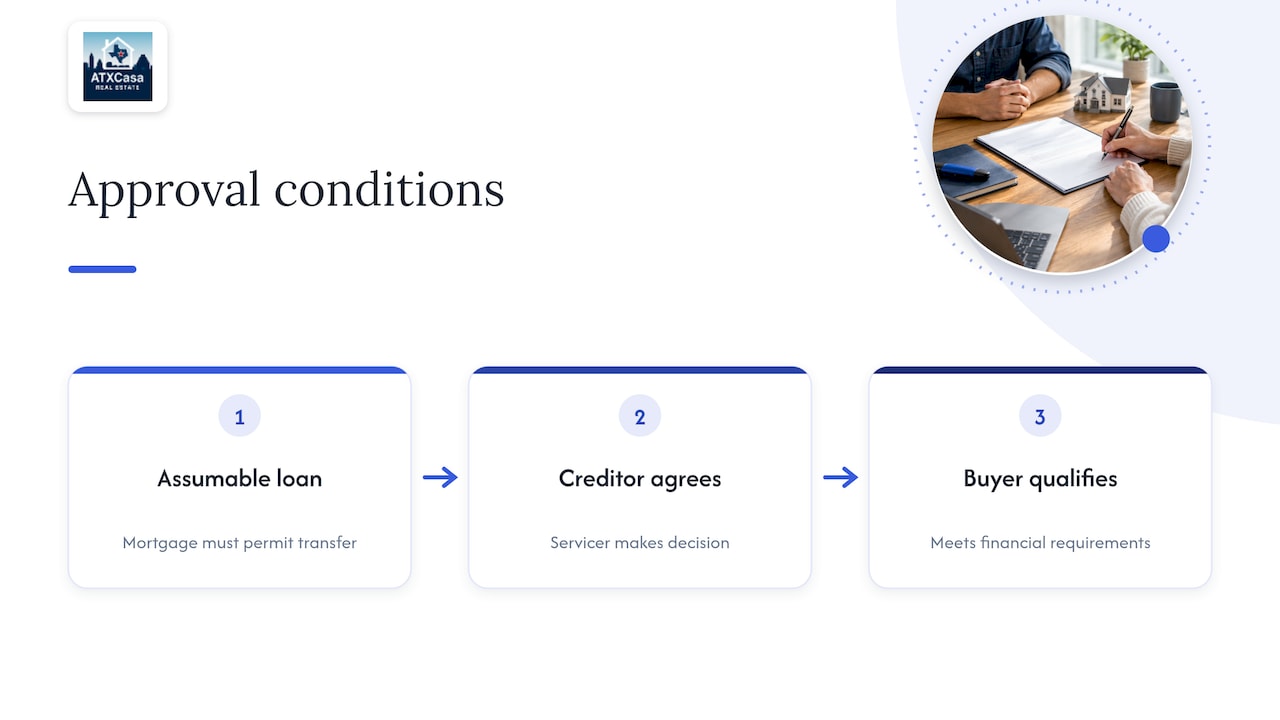
Legal references describe three conditions for a transfer: the mortgage must be assumable, the creditor must agree, and the buyer must meet its financial requirements. In practice, the seller’s servicer makes the decision, not the seller and not the agent.
The remaining term matters. If the seller is four years into a 30-year loan, you inherit about 26 years of payments, not a fresh 30. Your payment on the assumed balance reflects the old rate, but the total you need to bring to closing reflects today’s price.
Which loans can be assumed
FHA, VA and USDA loans may be assumable, subject to program rules and servicer approval. Conventional loans, the most common type, generally are not available for an ordinary arm’s-length assumption. That means your search in Austin starts with homes financed through a government program, often purchased during the low-rate years.
VA loans
VA assumptions come with specific rules. According to VA Circular 26-23-10, the loan must be current, the buyer must contractually assume the full obligation, and the buyer must be creditworthy under VA standards. The buyer does not have to be a veteran. VA’s lender guidance says a veteran buyer who wants to substitute entitlement must be eligible, have enough entitlement and meet occupancy requirements. If you are a veteran considering this route, our VA home loan guide for Austin explains eligibility and how VA loans compare with other options.
FHA and USDA loans
FHA assumptions go through a creditworthiness review by the servicer, as a new FHA loan would. USDA loans can also be assumed with agency and servicer approval. The details of each program change, so ask the servicer for its current assumption package before you commit to a price.
The equity gap: the number that decides the deal
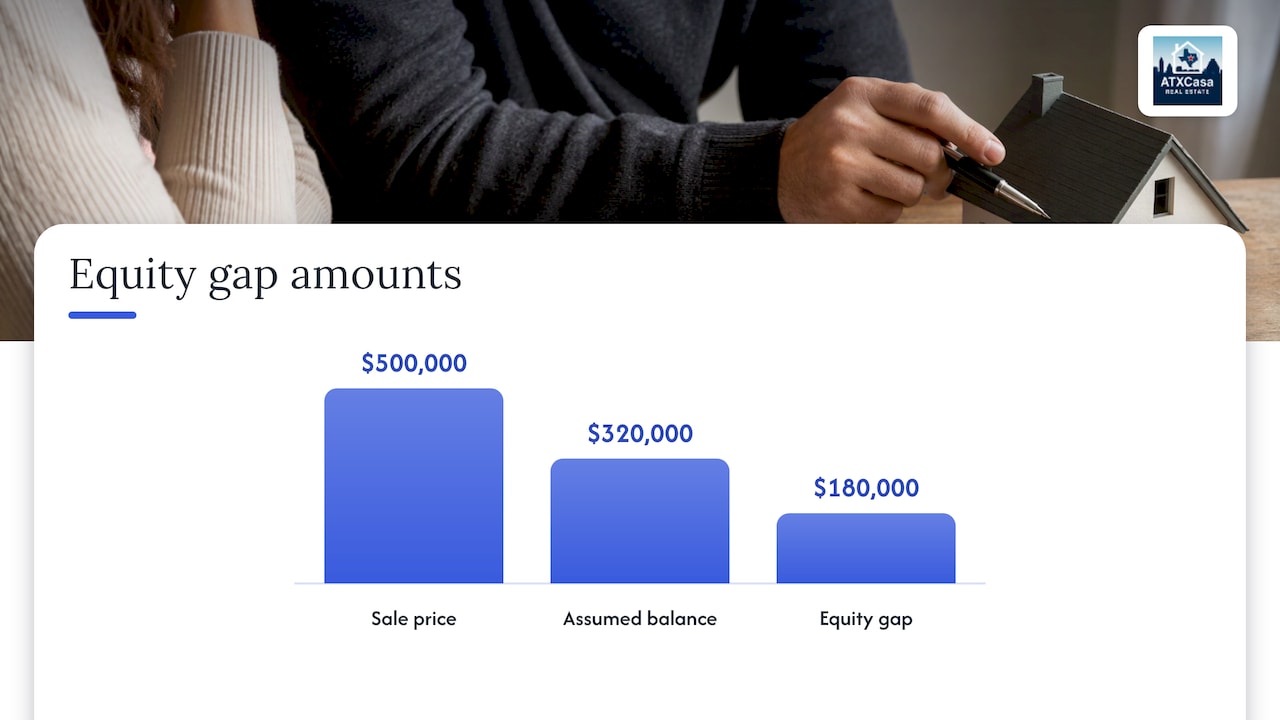
The equity gap is the sale price minus the assumed loan balance. The seller keeps that equity, so you owe it at closing. The Cornell Legal Information Institute points out that when the mortgage covers only part of the price, the buyer may need another mortgage for the rest, and a single new mortgage for the whole price can be cheaper and more practical.
Here is a simplified illustration, not a quote:
| Line | Example |
|---|---|
| Sale price | $500,000 |
| Assumed loan balance | $320,000 |
| Equity gap | $180,000 |
| Funding fee if a VA loan (0.5% of balance) | $1,600 |
| Servicer processing fee | Varies by program and servicer |
In this example you need about $180,000 plus fees and closing costs, either from savings or from a second loan, before the low rate pays off. You would then have a lower first-lien payment and a second payment on the gap financing. The right question is whether the blended cost of the two loans beats one new loan at today’s rate. A lender can run that comparison with your actual numbers, and our guide on mortgage rate headlines versus your personal quote shows how to read the figures you are given.
Second-lien and equity-based products have their own appraisal requirements, and an appraisal also affects how much a lender will allow. A home equity line appraisal guide explains how valuation drives borrowing limits, which is the same logic a lender applies when you finance part of a gap. Texas has its own rules for home equity borrowing, so ask your lender how a second lien would be structured on an Austin property.
When the gap works in your favor
- The home was bought recently, so the balance is close to the price.
- The seller put little down or has a large balance relative to value, as with many 2021 and 2022 purchases at high prices.
- You have cash set aside, for example from a prior home sale.
- The rate difference is large enough that the savings on the assumed balance outweigh the cost of the gap.
When it usually does not
In neighborhoods where prices climbed sharply after purchase, the gap can be six figures. If you would need a large second loan at a high rate, a new mortgage on the full price, possibly with a rate buydown or a low-down-payment program, may produce the lower total cost. Our comparison of Austin low-down-payment loans and mortgage insurance is useful for running that side of the math.
Fees, timeline and approval steps
The process runs through the seller’s servicer. These are the steps in order:
- Confirm the loan. Get the loan type, current balance, interest rate, remaining term and servicer name from the seller. Ask whether the loan is current.
- Run the numbers. Calculate the equity gap, your cash to close, and the payment on any financing for the gap.
- Get pre-qualified for the gap. If you plan to borrow for the difference, find out what a second lender will accept before you make an offer.
- Make a contract contingent on approval. The contract should state that the sale depends on the servicer approving the assumption and, for sellers, on release of liability.
- Submit the full application to the servicer. You provide credit, income, asset and employment documents, as for any mortgage.
- Wait for the decision. VA Circular 26-23-10 requires servicers with automatic authority to decide a complete application within 45 calendar days, and a denial can be appealed to VA within 30 calendar days. Real-world timelines can run longer, so build in time on your contract.
- Close and record. Fees are paid at closing, and the assumption documents are signed and recorded.
What it costs
For VA loans, the funding fee on an assumption is 0.5% of the loan balance, collected at closing and not financed into the assumed balance, unless you qualify for a waiver. For FHA loans, a policy update raised the maximum assumption processing fee from $900 to $1,800, effective August 19, 2024. Servicers set their own charges within program limits, so request a written fee schedule. Title, escrow and other closing costs apply as in any purchase.
What sellers need to know
A seller gets two separate protections to check, and they are easy to confuse.
Release from liability. Legal guidance notes that the seller may remain liable after the sale unless the creditors expressly release them. Insist on a written release as part of the approved assumption, and keep a copy.
VA entitlement. When a VA loan is assumed without entitlement substitution, the original veteran’s entitlement stays encumbered until the loan is paid in full. If an eligible veteran with enough entitlement assumes and substitutes theirs, the seller can receive restoration. The National Association of Realtors explains that a non-veteran can assume a VA loan, but the seller’s entitlement then stays tied to the property until payoff. A veteran who plans to buy again with a VA loan should settle this before accepting an offer, and should confirm the details with the VA or a VA-approved lender.
For sellers, an assumable loan can widen the pool of interested buyers, because a below-market rate is worth something. It also adds a servicer approval step to the timeline, so the offer terms need to reflect that.
How to find and verify assumable homes in Austin
There is no single reliable list. Most assumable loans are not advertised, and listing data can be out of date, so verification matters more than discovery.
- Search listing remarks. Agents can search the MLS for terms like “assumable,” “VA assumption,” or “FHA assumable,” and filter on the loan types and years of purchase that tend to carry low rates. Homes purchased in 2020 and 2021 are the typical targets.
- Ask on every showing. For homes you like, ask the listing agent whether the seller’s loan is FHA, VA or USDA, and whether the seller would consider an assumption.
- Look at the neighborhood. Areas with many recent purchases through government-backed programs are likelier to have candidates, including Cedar Park, Round Rock and Georgetown as well as Austin itself.
Before you rely on the label, check these details:
| Detail | Why it matters |
|---|---|
| Loan type (FHA, VA, USDA) | Determines which rules and fees apply |
| Current balance and rate | Sets your equity gap and savings |
| Remaining term | Tells you how long you carry the rate |
| Payment status | VA assumptions require a current loan |
| Servicer and its process | The servicer approves or denies |
| Escrow, taxes and insurance | Austin property taxes and insurance can change the payment even when the rate is low |
| Seller’s release terms | Protects the seller, and shapes the contract |
Remember that your monthly cost is more than principal and interest. Property taxes in the Austin area are a large part of the payment, and they do not come with the old loan. Look at the full monthly figure, not just the rate.
My read on assumable loans in Austin
We look at assumable loans the way we look at any pricing question: as a calculation, not a headline. A 3% rate is attractive, but the number that matters is your total monthly payment and your total cash to close after the equity gap is accounted for.
Our approach is built on data. We pull the loan details, work out the gap, and compare the assumption against a new loan at today’s rates, including the options with lower down payments. When the numbers favor the assumption, we help you structure the offer so the contract protects you while the servicer works. When they do not, we say so plainly and show you the alternative.
For sellers, we use the same transparent approach. We help you decide whether to market the loan’s low rate, and we make sure the release of liability and VA entitlement questions are addressed before an offer is accepted.
Vladimir
Working with ATXCasa on an assumption
ATXCasa is led by Realtor Vlad Baibus and focuses on helping clients buy, sell and invest across the Austin area, including Cedar Park, Round Rock and Georgetown. Vlad has nearly two decades of IT experience and uses data-driven pricing and AI-powered marketing, so a low-rate listing gets its value shown to the right buyers. Buyers get neighborhood guidance and help spotting hidden home pitfalls.

If you are weighing an assumption, start on atxcasa.com or browse our buying, selling and financing guides to see how we think through a purchase before you tour a home.
FAQ
Can I assume any mortgage in Austin?
No. FHA, VA and USDA loans may be assumable with servicer approval, while conventional loans generally are not available for an ordinary assumption. The servicer must also approve you based on your credit and income.
Do I have to be a veteran to assume a VA loan?
No. VA guidance says the buyer does not need to be a veteran. A veteran who wants to substitute their own entitlement must be eligible, have sufficient entitlement and meet occupancy requirements, and that substitution is what can restore the seller’s entitlement.
How much cash do I need?
You need the equity gap, which is the sale price minus the loan balance, plus fees and closing costs. You can pay the gap in cash or finance it with another loan if a lender approves it. A VA assumption adds a funding fee of 0.5% of the balance unless you qualify for a waiver.
How long does approval take?
For VA loans, servicers with automatic authority must decide a complete application within 45 calendar days. Other servicers and loan types can take longer, so set your contract deadlines with that in mind and ask the servicer for its current timeline.
Is the seller released from the loan after an assumption?
Not automatically. The seller may remain liable unless the creditors expressly release them in writing. For VA loans, entitlement restoration is a separate question and usually depends on an eligible veteran buyer substituting entitlement.
Sources
- Mortgage answers, Consumer Financial Protection Bureau
- Assumable mortgage, Legal Information Institute (Cornell Law School)
- VA Circular 26-23-10, Veterans Benefits Administration
- Assumptions, VA lender guidance
- When the Seller Says, Please, Take My Mortgage!, National Association of Realtors
- FHA Increases Maximum Allowable Assumption Fee
- Home equity line appraisal guide