

TL;DR
- A $100,000 gross household income produces a $2,500 monthly rent illustration under Zillow’s 30% guideline. It does not establish your personal spending limit or lease approval.
- Among Austin metro listings in Zillow’s $2,333–$2,500 monthly band, 44% were single-family homes; the median bedroom count was 3. That supports considering houses as well as apartments, without promising either.
- Before touring or applying, verify each candidate’s advertised rent, deposits, utilities, recurring fees, screening/qualification rules, and actual availability directly with the housing provider.
If your household earns $100,000 and you are starting an Austin-area rental search, you have a reason to compare houses and apartments. Zillow’s October 7, 2026 analysis shows both housing-type and space possibilities within its stated budget band. The useful next step is to choose what matters most—such as a house or a shorter commute—and test individual rentals against your actual budget.
The distinction matters: $2,500 in advertised rent is not necessarily $2,500 in monthly housing costs. And a metro-wide summary cannot tell you which home is available, where it sits relative to work, or whether you qualify. The figures below come from Zillow’s dated listing analysis, not live rental offers.
What Zillow’s Austin figures actually describe
Zillow illustrates a rent budget using 30% of gross household income, meaning income before taxes. For a household earning $100,000 annually, $100,000 × 0.30 ÷ 12 equals $2,500 per month. That is a budgeting illustration, not a housing provider’s screening rule or a recommendation to spend that much.
The report’s “Austin, TX” metro row gives a $1,480 median listed rent for January–August 2026. Its separate housing-type and space figures describe listings “at the top of a $100,000 household income budget, $2,333–$2,500/month”:
- Median size: 1,462 square feet.
- Median bedroom count: 3.
- Single-family homes: 44% of that cohort.
- One-bedroom-or-smaller units: 14% of that cohort.
Those are separate summary measures, not a description of one typical available home. In particular, 44% does not mean that share of today’s available rentals will be houses. Zillow’s table and methodology support an initial search direction; they do not establish neighborhood, commute, school, or property-condition results.
Try a house-first search and a commute-first search
Consider a hypothetical household with $100,000 in combined gross annual income. It can use Zillow’s $2,333–$2,500 band as a shared starting filter while comparing two priorities:
- House first: Search single-family homes if the property type matters most. Keep a candidate only if its actual space, location, costs, and lease responsibilities work. If suitable houses miss the commute or spending limit, broaden the property types rather than assuming the metro figures guarantee a match.
- Commute first: Start with addresses that could work for the household’s routine, then compare apartments and other rental types within that area. Check the actual trip at relevant travel times. This approach may mean accepting less space or a different property type; the report cannot tell you the trade-off at a particular address.
A rental inside the band can still exceed your budget
Continue with the same hypothetical household. Suppose it chooses $2,500 as its limit for total recurring housing costs after considering take-home pay, debt payments, savings, and other spending. That is the household’s own decision; Zillow’s illustration applies to rent alone.
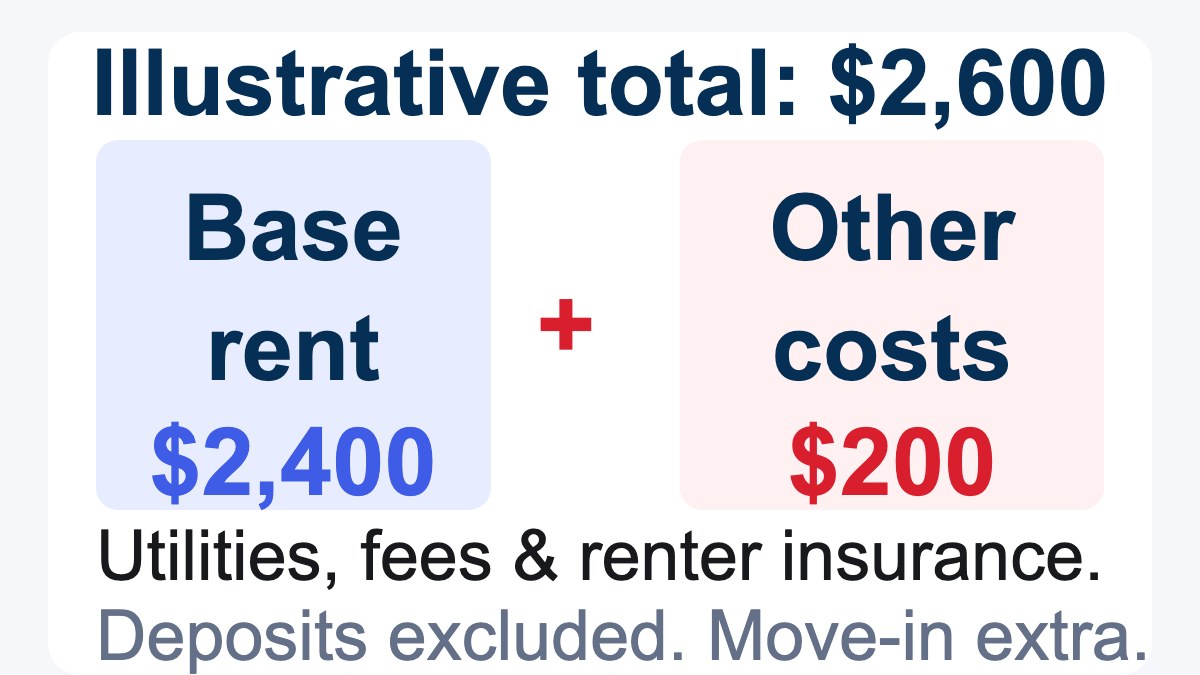
Now suppose either search produces a candidate with $2,400 in monthly base rent and an assumed $200 per month for utilities, recurring fees, and renter insurance combined. These are hypothetical inputs, not Austin price estimates or a provider’s quote.
The monthly total would be $2,600, excluding deposits and other one-time move-in costs. The base rent fits Zillow’s band, but the candidate exceeds this household’s chosen monthly limit. If the assumed $200 in recurring costs stayed the same, its base-rent ceiling would be $2,300.
That result changes the search: lower the advertised-rent filter, reconsider space or location, or select a candidate with verified lower recurring costs. Do not raise the spending limit simply to match the report. A different household budget or different property costs could support a different ceiling.
Turn each candidate into a decision before touring or applying
Before touring or applying, verify each candidate’s advertised rent, deposits, utilities, recurring fees, screening/qualification rules, and actual availability directly with the housing provider. Use the answers this way:
- Confirm the unit and timing. Ask which specific rental is available for your move-in date and lease term. A property-type match is not enough if the actual unit or timing does not work.
- Separate monthly costs from move-in cash. List base rent, recurring fees, utilities, and insurance. Identify which amounts are quoted and which remain estimates. Record deposits and other one-time charges separately so a manageable monthly payment does not hide an unaffordable move-in requirement.
- Check qualification before applying. Obtain the provider’s screening/qualification rules and how they apply to your household. The report’s gross-income illustration cannot answer that question.
- Read costs across the lease. Ask what you would pay throughout the initial lease, which charges can change under its terms, and what remains unknown at renewal. If an offer depends on a concession, compare the written payment schedule with your ongoing budget.
For every finalist, keep the base rent, quoted deposits, utilities, fees, and insurance alongside the confirmed screening rules and availability before treating it as affordable. If important costs remain unknown, the budget comparison remains unfinished. Neither a house nor an apartment should win solely because its headline rent fits the band.
Frequently asked questions
Why is the $1,480 median listed rent below the $2,333–$2,500 search band?
They answer different questions. The $1,480 figure summarizes Austin metro listed rents for January–August 2026. The higher band selects the listings used for the report’s $100K-earner housing-type and space comparison. You cannot attach that band’s size or bedroom medians to the $1,480 figure. See Zillow’s table footnote.
Does this report give me a reason to wait for cheaper rent?
It does not establish whether a particular rental will cost less later. If you can stay where you are, compare your actual renewal terms with verified alternatives and the cost of moving. If you need to move by a fixed date, use current provider information to build a workable shortlist; this historical snapshot cannot settle that timing decision.
Sources
- Zillow: What $100K rents, published October 7, 2026. Austin metro table, January–August 2026 median listed rent, and the stated budget-band methodology. Verified evidence checked October 14, 2026.
Recommended reading
- Austin Rent Renewal Going Up? Check Local Options, Not National Headlines
- Austin Renters: Ask About Concessions Before You Accept the Advertised Rent
Choosing between a house and an apartment in the Austin area? Contact Vladimir Baibus · ATXCasa with your move-in date, monthly housing limit, and must-have locations for help shaping a rental search around those priorities. LPT Realty.