
When an Austin listing says “ADU potential,” the seller is describing an idea—not handing you an approved second home. Austin’s HOME amendments expanded what may be possible on many SF-zoned properties, but a large backyard alone does not prove that another dwelling fits, can be served by utilities, clears private restrictions, or makes financial sense.
This matters because buyers can be asked to pay today for income, family space, or resale flexibility they may never be able to create. Recent Austin housing discussions about permits and electric-service planning show that people are discovering the difference between “the code allows more housing” and “this lot has a straightforward project.” The way to protect yourself is to price verified potential differently from marketing language.
First, what problem are we actually solving?
This guide is for a buyer considering a home marketed for an ADU, second unit, or multiple-unit opportunity—and for an owner deciding whether to explore one. It is not about replacing countertops or finishing a normal bedroom. It is about creating an additional dwelling: a space intended to function as a separate home, with the permits, address, building systems, and legal use that go with it.
A powered shed, detached office, garage, or guest room is not automatically a dwelling unit. Austin’s HOME guidance says the amendments did not change the requirements for accessory structures that are not dwellings. In plain English: the structure that exists and the use you want may be two different things.
Three versions of “ADU potential” that are not equal
Example 1: the big backyard
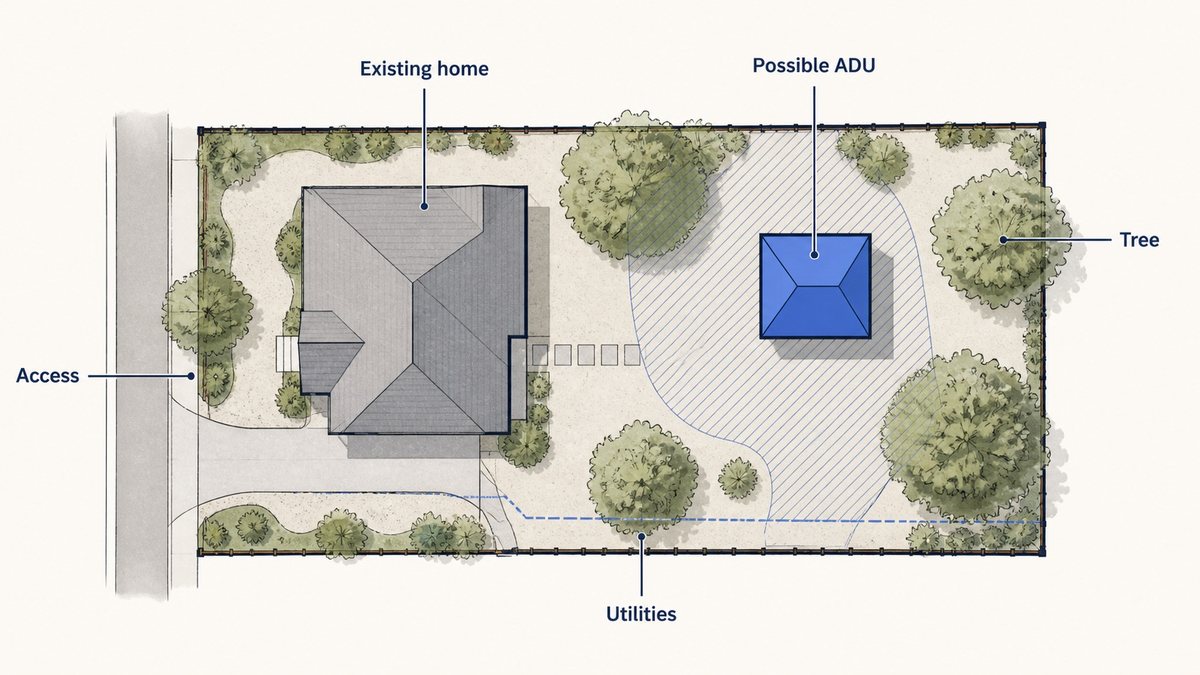
The yard looks large in listing photos, but the existing home may sit in the wrong place. Mature trees, utility routes, drainage, access, building coverage, impervious cover, and the shape of the buildable area can change the design. A 10,000-square-foot lot is not the same as 10,000 square feet of usable project space.
Example 2: the detached garage or office
The building already has electricity, so conversion feels easy. But the project may still need a recognized dwelling use, plumbing, life-safety work, structural changes, energy-code work, an address, and permit review. “Already built” is not the same as “approved to live in or rent as a separate home.”
Example 3: “HOME allows three units”
The City of Austin says HOME Phase 1 allows up to three housing units on SF-1, SF-2, and SF-3 property under specific two-unit and three-unit residential uses. It also says the new regulations do not simply apply to a project reviewed as single-family residential use. The headline is an expanded option, not automatic approval for every parcel and every design.
Five questions to answer before paying extra for the upside
1. What exact use do you want?
“ADU” can hide several goals: a long-term rental, a place for a parent, a private office with a bathroom, a future sale strategy, or multiple new dwellings. Those goals do not require the same building, financing, privacy, parking, or operating plan.
Ask yourself: Will someone live there as a separate household? Does it need a full kitchen? Do you expect separate utilities? Is rental income necessary for the purchase to work? Write down the intended use before asking whether the lot supports it.
2. Where could the additional dwelling actually go?
Do not point at the grass and stop. Ask for a survey and locate the existing house, lot lines, easements, trees, driveway, utility service, and drainage features. HOME has specific rules for floor area, building coverage, and impervious cover. A designer or other qualified professional can turn the survey and your program into a preliminary site test.
The practical output: a rough placement and size concept, plus a list of the conditions that still need confirmation. If nobody can sketch a plausible location without hand-waving away a tree, easement, or access route, do not pay a large “potential” premium.
3. What do addressing and electric service change?
Austin says each dwelling in a two-unit or three-unit use needs a unique address. Austin Energy says an Electric Service Planning Application is needed for permitting and power planning, and a separate ESPA must be filed for every address that will have an electric meter.
That does not mean every project needs a dramatic utility upgrade. It means “there is already power on the property” is not enough analysis. Ask early how the new unit would be addressed, metered, and served—and who is qualified to confirm that plan.
4. Can private restrictions stop a project the city code might allow?
Yes. The City specifically warns that deed restrictions or restrictive covenants may affect a proposed HOME project and that the applicant is responsible for verifying them. Review the title commitment, recorded restrictions, and HOA documents when applicable. A zoning possibility does not erase a private covenant.
5. Does the project still make sense without optimistic rent or resale assumptions?
Create three budgets: a preliminary feasibility budget, a design-and-permit budget, and a construction-plus-contingency budget. Then compare them with the value of the use you actually want. If the purchase only works with immediate construction, top-of-market rent, and no surprises, the “upside” is carrying too much of the deal.
What I would request before making an offer
- the current survey and any known easements;
- seller disclosures and permits for existing detached structures or additions;
- the title commitment, deed restrictions, and HOA documents if applicable;
- available utility and service information;
- any plans, feasibility studies, bids, or city correspondence the seller is using to support “ADU potential”; and
- permission and time for appropriate due diligence if the potential materially affects the offer.
If the seller has only a backyard photo and a statement from the listing remarks, treat the potential as unverified. If there is a current survey, a credible site concept, property-specific restriction review, and preliminary utility input, the idea has more substance. It still is not a permit, but you are no longer pricing a blank page.
How this changes the home search
Start by separating homes you like without an ADU from homes that only work if the additional unit is feasible. Then use Austin-area listing search to build a small set of candidates, not a giant list of anything with a deep lot. The goal is to spend due-diligence time on properties where the location, existing house, and likely lot constraints still fit your main life even if the second unit takes longer or changes form.
Frequently asked questions
Does Austin HOME automatically allow three homes on every single-family lot?
No. HOME expanded two-unit and three-unit residential options on certain SF-zoned properties, but the project still must fit the applicable use, site standards, technical codes, private restrictions, and permit review.
Is a detached garage or office already an ADU?
Not necessarily. An accessory structure is not automatically a legal dwelling. Verify its permits, approved use, building systems, address, and the work required for the intended residential use.
How much extra should I pay for ADU potential?
There is no responsible flat premium. The more the value affects your offer, the more property-specific evidence you should require. Unverified marketing language should be valued differently from a survey-backed concept with restriction and utility review.