

If you just bought an Austin-area home and it is now your primary residence, put the homestead exemption on your after-closing checklist—not next January’s. Texas allows a qualifying owner to apply after acquiring and occupying the home. For a purchase after January 1, the general residence homestead exemption may apply for the part of the year you qualify if the prior owner did not already receive that same exemption for that year.
The important distinction is that this is an appraisal-district filing, not something your lender or title company automatically completes. It can reduce taxable value for eligible taxing units, but it does not guarantee a particular dollar savings, replace an appraisal protest, or immediately put the 10% appraised-value limitation in place. For a Travis County property, start with the Travis Central Appraisal District (TCAD); the exact facts and timing can vary by property and exemption type.
First: make sure this is the right filing
The general residence homestead exemption is for a home you own and use as your principal residence. Texas says an applicant must have an ownership interest, occupy the home as a principal residence, and not claim another residence homestead in or outside Texas. A house, condominium, or qualifying manufactured home can be a residence homestead; the rules are not limited to a detached house.
Example one: you closed on a South Austin condo in August and moved in. If it is your principal residence, the right question is whether you qualify now—not whether you have to wait for the next calendar year. Ask TCAD what it needs for your specific record and submit the residence-homestead application when you meet the requirements.
Example two: you bought a home but are still renting it out while you finish a move. Do not assume closing alone creates eligibility. The owner-occupancy and principal-residence facts matter. Wait until the home actually qualifies, then use the appraisal district’s instructions.
Example three: you sold one Texas home and bought another. You generally cannot claim a general residence homestead exemption on two homes at once. That makes the move date, occupancy, and the prior home’s exemption status worth confirming rather than guessing from the closing statement.
What to do after closing
- Confirm the county and property record. Austin-area addresses can be in Travis County or a neighboring appraisal district. Use the district that appraises that parcel, not a generic statewide form page.
- Check the owner and mailing information. A recent closing can take time to appear in public records. If the record does not yet reflect the ownership change, follow the district’s process rather than filing conflicting information.
- Verify that the home is your principal residence. The application is not a tax deduction for any home you own. It is a property-tax exemption tied to the residence you actually occupy.
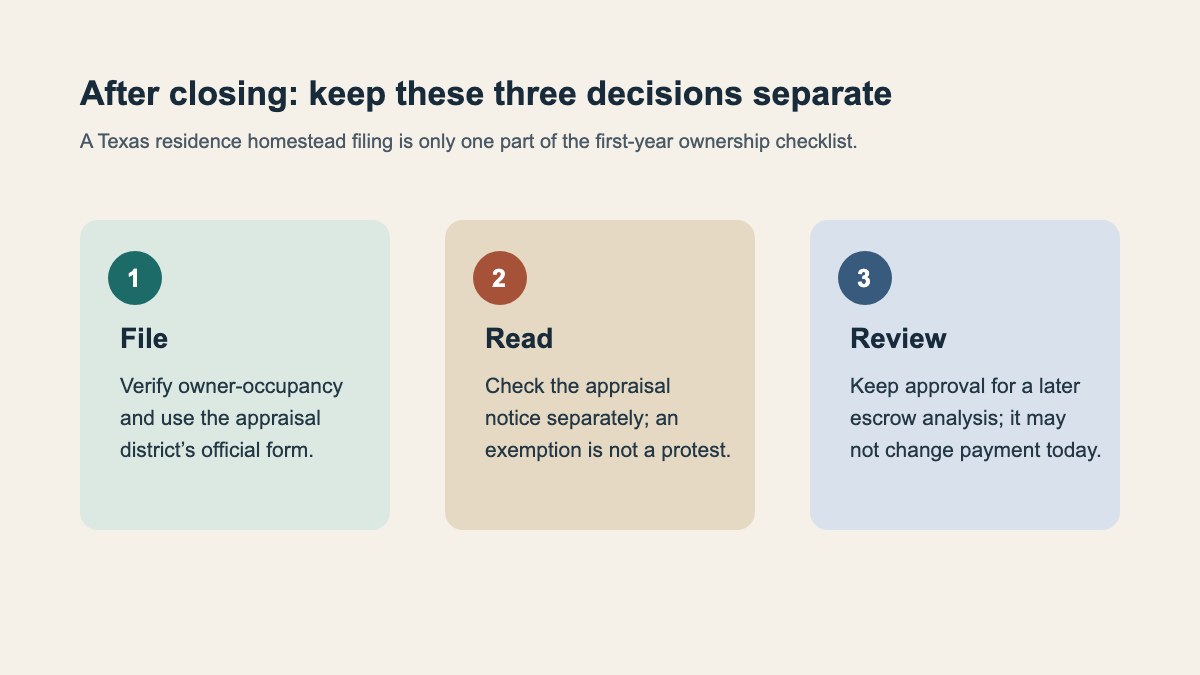
- Use the official residence-homestead application. TCAD provides its homestead instructions and directs owners to the Texas Comptroller form. Do not pay a third party merely to submit a basic application that the appraisal district accepts directly.
- Save confirmation and revisit escrow later. Approval affects the taxing process; your mortgage servicer’s escrow analysis is a separate process. Keep the approval record and compare it with a later escrow statement rather than assuming the monthly payment changed immediately.
What it can change—and what it cannot
A residence homestead exemption reduces taxable value where the applicable taxing unit offers the exemption. Texas gives school districts a mandatory general residence-homestead exemption, and local taxing units may offer additional exemptions. That means the result depends on the property’s taxing units and values; it is not a flat refund or a percentage off every part of a tax bill.
It also does not make an appraisal notice automatically correct. A homestead exemption and a protest of a property value are different tools. If an appraisal notice appears inconsistent with the property’s market evidence, a homeowner may need to evaluate the protest process separately and meet that year’s deadline.
The year-one surprise: the 10% limitation is not immediate
The 10% homestead limitation generally begins on January 1 of the tax year after the first year you qualify. If you first qualify in 2026, that generally means January 1, 2027. It limits appraised-value growth under the statutory formula, with new improvements treated separately; it is not a 10% ceiling on your tax bill or escrow payment. Confirm the qualification year on your property record rather than assuming the seller’s limitation transfers to you.
That does not mean the application is pointless. It means a buyer should keep two separate questions on the after-closing list: Did I file for the exemption I qualify for? and What does the current appraisal notice say, and is a protest deadline approaching? Combining those questions causes many of the avoidable surprises.
Two common misconceptions to avoid
“My lender will handle it.” A lender may estimate taxes for escrow, but the homeowner’s eligibility filing is with the appraisal district. Ask the lender what it will do with an approval notice, but do not substitute that conversation for the filing.
“The seller’s exemption stays with the house.” The exemption is tied to an eligible owner’s residence use, not a permanent discount attached to the address. This is why a buyer should verify their own qualification and why the prior owner’s status can matter for a prorated current-year result.
A practical Austin closing checklist
- Identify the appraisal district for the specific parcel.
- Confirm you own and occupy the home as your principal residence.
- Check whether another residence homestead is still claimed in your name.
- Submit the official application and keep the confirmation.
- Read the first appraisal notice and calendar any protest deadline separately.
- After approval, compare the next escrow analysis with the tax information instead of expecting an instant payment change.
How ATXCasa would use this in a buyer plan
For an Austin-area buyer, Vladimir would treat the homestead filing as one item in the transition from closing costs to real ownership costs. Before the offer, estimate taxes without assuming another owner’s exemption will continue. After closing, verify the district, ownership, occupancy, and filing path. Then keep the first appraisal notice and the lender’s escrow calculation as separate checkpoints. That sequence is more useful than promising a tax saving before the property-specific facts are known.
Buying or moving within the Austin area? Message Vlad Baibus at ATXCasa to build an after-closing checklist that connects the property record, estimated ownership costs, and your next housing decision.
This is general real-estate education, not tax, legal, or lending advice. Eligibility, deadlines, taxable value, exemptions, appraisal protests, and escrow adjustments are property- and household-specific. Confirm your situation with the appropriate appraisal district, tax professional, lender, or attorney.