

If your Austin home is getting showings but not a contract, do not treat a price reduction and buyer closing-cost help as interchangeable. A lower price changes the buyer’s loan amount and becomes the new public reference point. A concession can lower a qualified buyer’s cash-to-close or fund a rate buydown, but it does not fix a list price that buyers or an appraisal cannot support. The useful first move is to identify which obstacle is actually in the way: monthly payment, upfront cash, or the home’s position against competing listings.
This is a current seller decision, not a theoretical one. Realtor.com reported that 27.6% of Austin listings had a price reduction in August 2026 and that the typical Austin home spent 73 days on market. Unlock MLS reported 4.7 months of inventory across the Austin-Round Rock-San Marcos MSA in July. Those are market-wide measurements, not a prediction for one address; price band, condition, school area, and new-construction competition can change the answer.
Start with the symptom, not the tool
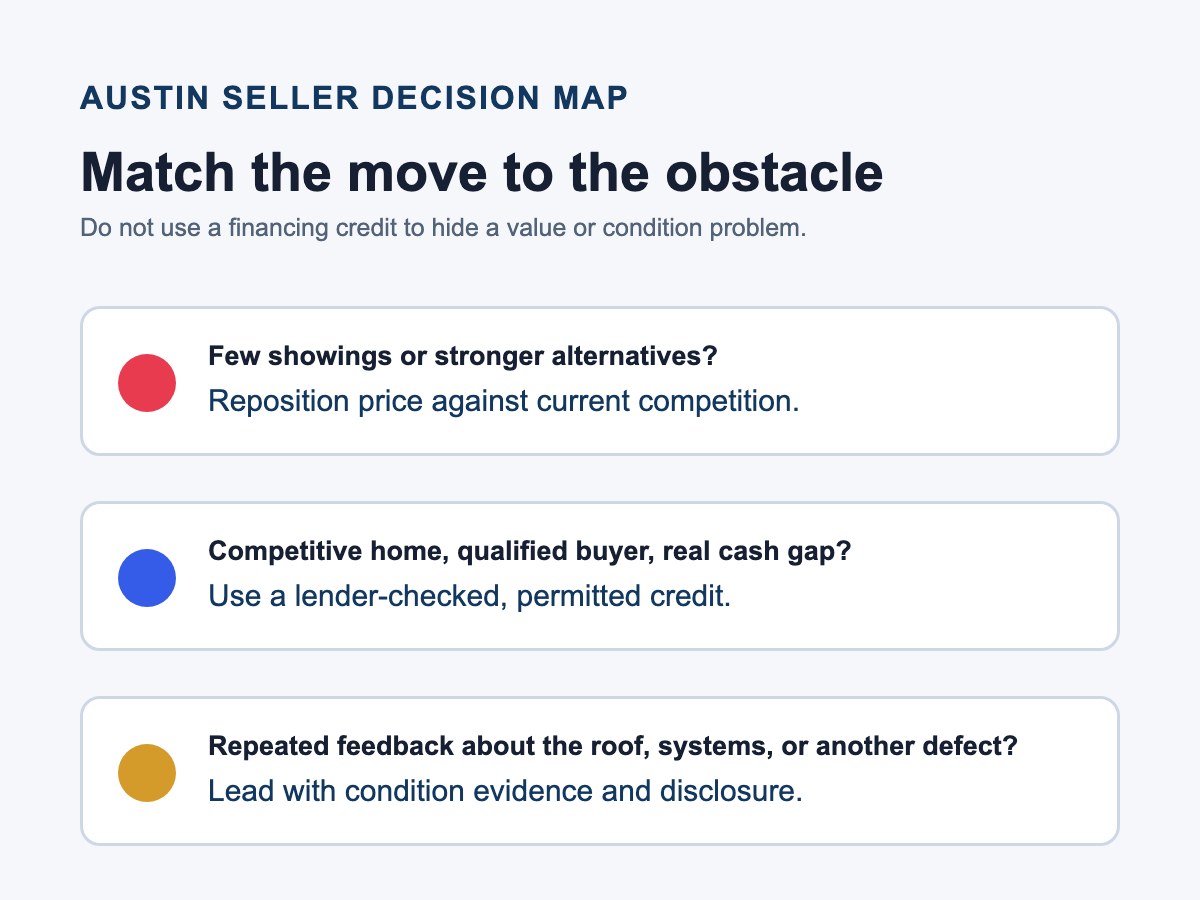
Use a price reduction when buyers are not choosing the home. If comparable homes receive more traffic, pending contracts, or stronger feedback at a lower effective price, the listing may be missing the market’s value range. A seller-paid credit cannot make an overstated price disappear, because buyers still compare the asking price, taxes, insurance, HOA dues, condition, and the likely appraisal.
Consider a closing-cost concession when the home is competitive but qualified buyers are constrained by cash or payment. A credit can be used only as the contract and lender allow. A buyer may apply it to eligible closing costs, prepaids, or a lender-approved rate buydown. It is not cash handed to the buyer, and it should be evaluated against the loan program’s limits and the buyer’s written Loan Estimate.
Pause and reassess when the feedback is about the house itself. Repeated comments about a roof, foundation symptoms, dated systems, layout, or a nearby competing new build are not automatically a pricing problem. Get the relevant condition evidence and compare the likely repair, disclosure, and pricing paths before announcing either incentive.
Three Austin sellers should make different choices
Seller one: the home has traffic but buyers say the payment is too high. If the price is supported by recent comparable closed sales and buyers are close to qualifying, a defined credit may be worth modeling. Ask for an offer showing the purchase price, credit, loan type, and exactly what the credit will fund. Compare the projected buyer payment and the seller’s net proceeds with a same-price, no-credit alternative.
Seller two: the home has few showings after the initial launch. That is usually a market-position question before it is a financing question. Review the newest comparable active, pending, and closed homes—not just old peak sales—and compare the home honestly on condition, lot, location, and incentives. If the effective alternative price is lower, a visible price adjustment may give buyers a clearer reason to revisit the listing.
Seller three: there is a real condition issue. A buyer credit may help with an ordinary closing-cost gap, but it cannot safely substitute for facts needed to evaluate a material repair issue. Obtain the appropriate inspection or contractor scope, decide what will be disclosed, and compare repairing before market, pricing for the condition, or negotiating a contract-specific solution. Do not promise a credit before the buyer, lender, and contract terms make the use clear.
Run the same net-proceeds comparison
Put the following options on one page using the same expected closing date, loan payoff, commission structure, taxes, and other transaction costs:
| Option | What changes for the buyer | What the seller must verify |
|---|---|---|
| Lower the list price | Loan amount and down payment may decline; the listing’s public price changes. | Whether the new price improves the home’s position against actual competition and still supports the seller’s minimum proceeds. |
| Offer a defined closing-cost credit | Eligible cash-to-close or a lender-approved buydown may improve; the purchase price stays the same. | Loan-program limits, appraisal support, the buyer’s written use of funds, and net proceeds after the credit. |
| Repair or price for condition | The buyer gets a clearer condition story rather than an unexplained incentive. | Scope, disclosure obligations, timing, and whether the repair changes the competitive comparison. |
For example, a $15,000 price reduction and a $15,000 credit do not produce the same buyer result. The reduction changes the financed amount only by the buyer’s financing structure; the credit may address an immediate cash-to-close need or a specific lender-approved buydown. But the credit also reduces seller proceeds dollar for dollar if it is actually used. The right comparison uses a lender-provided Loan Estimate and a seller net sheet, not a generic online mortgage calculator.
Do not hide the trade-off inside an inflated price
A higher contract price paired with a large credit can be legitimate when the home supports that value and the buyer’s loan permits the credit. It becomes fragile when the appraisal does not support the price or when the credit exceeds what the buyer may use. That can trigger renegotiation, a lower loan amount, or more cash required from the buyer.
The cleanest offer is often the one that makes the buyer’s need visible: a specific purchase price, a defined seller contribution, a stated permitted use, and a financing timeline. The lender—not the listing description—determines whether the credit fits the buyer’s loan.
Austin market data is a starting point, not a list-price formula
Unlock MLS’s July report showed 4.7 months of inventory across the Austin-Round Rock-San Marcos MSA and an average close-to-list ratio of 97.4%. Realtor.com’s August Austin data showed a longer 73-day typical marketing time and a higher share of listings with reductions. Those figures describe broad areas and different measurement methods. They do not prove that every seller should cut 2.6%, offer a credit, or wait 73 days.
Use them as a reason to be precise. A well-priced, well-prepared home in one micro-market can behave differently from a condo, a property near substantial new construction, or a home needing a major system update. The question is not whether buyers have “more leverage” in the abstract; it is what comparable buyers can obtain this week for the same monthly cost and condition risk.
A practical decision sequence before changing the listing
- Read the first round of feedback. Sort it into price, payment/cash, condition, and presentation—not vague “interest.”
- Refresh the competitive set. Compare active, pending, and recently closed homes by realistic effective cost, including visible builder incentives where relevant.
- Request two written scenarios. One should show a price reduction; the other should show a specific permitted credit. Use the same estimated closing date and seller costs.
- Check the appraisal and loan path. Before accepting a credit-heavy offer, confirm the lender’s rules and the buyer’s financing contingency.
- Choose one message. Either reposition the price, offer a narrowly defined contribution, or solve the condition issue. Stacking vague incentives can make buyers ask what is wrong.
How ATXCasa would use this in a listing strategy
Before changing a list price, Vladimir would separate the buyer’s problem from the seller’s. If the home is being passed over on value, the marketing and price position need to change. If the home is competitive but an otherwise qualified buyer needs legitimate financing help, a written, lender-checked concession can be more targeted. If condition is the sticking point, the plan starts with the evidence and disclosure, not a blanket credit.
Thinking about selling in Austin? Message Vlad Baibus at ATXCasa to compare the active competition, likely buyer payment, and net-proceeds scenarios before you change the listing.
This article is general real-estate education, not legal, tax, lending, or appraisal advice. Seller contributions, financing, contracts, disclosures, appraisal outcomes, and net proceeds are property- and transaction-specific. Confirm terms with the appropriate lender, title company, attorney, and other licensed professional.