

A suddenly higher Austin utility bill is a reason to separate the bill before you blame the house. For City of Austin Utilities customers, one statement can include electricity, water, wastewater, solid waste, drainage, and street service. The useful first move is to identify which section moved: electricity use, water use, or a charge that does not rise and fall with a single appliance or leak.
That distinction matters for both current owners and buyers evaluating an older home. A hot month, a running toilet, irrigation, a leaking service line, or a recurring charge can create very different next steps. Treating every high bill as “the AC is expensive” can send you toward the wrong repair—or make a house look worse than the evidence supports.
Three situations where the same total bill means different things
The electric portion rose while water use stayed ordinary. Start with the electricity usage and the comparable month, then ask whether cooling, a change in household use, or equipment performance explains it. This is an energy-use question, not automatically a plumbing question.
Water use rose sharply even though the household routine did not. Austin Water advises customers to compare current use with the same months of prior years and to check the meter for unusual use. A hidden irrigation, toilet, or private-side service-line leak can be more relevant than the total amount due.
The total changed, but the usage lines did not explain all of it. Look at the line items. The City says its utility bill may include services beyond electricity and water, including wastewater, solid waste, drainage, and street service. A fixed or property-based charge needs a different explanation than a sudden consumption jump.
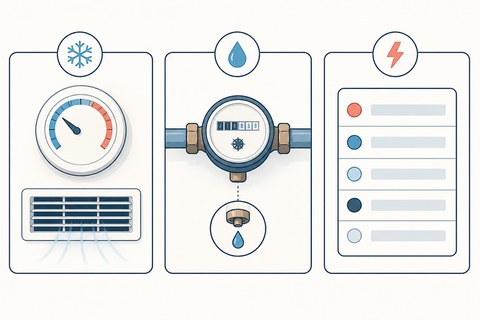
The three-part check
1. Compare usage before comparing dollars
Pull the current bill and the comparable bill from last year, then circle the usage measures first. For electricity, look at the billed usage and period; for water, look at water use rather than only the total. This does not diagnose an HVAC system or a leak by itself. It tells you which question is worth asking next.
If the increase tracks much higher electricity use, capture the billing period, weather context, thermostat habits, and any change in occupancy before paying for a broad inspection. Austin Energy says qualifying customers can use its Home Energy Savings process to receive a no-cost in-home energy assessment through a participating contractor. That is an option to evaluate a home’s efficiency; it is not proof that every high bill requires a major project.
2. If water use moved, test the meter before guessing
Austin Water’s guidance is unusually practical: review the utility bill for unusual use, write down the meter reading, then check it again a few hours later without using water in between. If the reading continues to move, a leak is likely. Austin Water also points customers to My ATX Water, which can provide daily water-use data and alerts for sudden increases.
This is especially useful after buying a home with irrigation, a pool, older plumbing, or a vacant period before move-in. The point is not to assume the seller hid a defect. It is to distinguish a measurable water issue from an electric-use issue while the evidence is still visible.
3. Read the charges that do not behave like usage
After the electricity and water lines, review the remaining services separately. Austin’s drainage charge, for example, is assessed on utility bills and is calculated by property characteristics including impervious cover—not by whether you ran the air conditioner that month. The City’s utility billing page also lists wastewater, solid waste, and street service among the possible components.
The practical result: do not use one month’s total utility bill as a shortcut for a home’s energy efficiency. A comparison is more useful when it separates consumption from the charges attached to the service address.
How buyers can use this during a home search
For a serious candidate, ask for recent utility history when it is available and compare similar months—not a mild spring bill with an August bill. Then separate questions that are often blended together:
- What does the home use? Electricity and water history can surface a question worth asking about HVAC, irrigation, occupancy, or a leak.
- What does the address carry? City services and property-based charges may follow the address even when a household’s consumption changes.
- What information already exists? For many qualifying homes in the Austin Energy service area and Austin city limits that are at least 10 years old, the Energy Conservation Audit and Disclosure (ECAD) ordinance requires seller disclosure before sale. Austin Energy recommends that buyers ask for the audit results or proof of a qualifying program when an audit is required.
ECAD is not a guarantee of a future bill, and it does not apply to every property. Neither does a past bill predict your household’s usage. But together, utility history and any applicable ECAD information can turn “this house seems costly to run” into a narrower question: is there a current consumption pattern, an address-level charge, or an efficiency item worth pricing before the offer decision?
If the water portion is unusually high, do not wait on the options
Austin Water says customers with a high bill should check for leaks and review water-saving options; if the bill still looks wrong, customers can ask City of Austin Utilities Customer Care to review usage. Its current rules also describe potential bill adjustments in some circumstances. For a water-leak adjustment, the City says a customer must submit the repair documentation and other required information within 90 days of the repair. Eligibility is fact-specific, so treat this as a prompt to document the issue—not a promise of a credit.
If you are still deciding whether to buy the home, a high water-use signal is information to investigate with the appropriate professionals and contract deadlines in mind. If you already own it, meter evidence and repair documentation are more useful than an assumption based on the total bill.
What ATXCasa would use this information to decide
A utility bill should be part of a total-housing-cost conversation, not a scare tactic or a one-line pass/fail test. We would separate recurring address costs from consumption, compare similar months, and use the result to decide what must be clarified before a buyer commits. That may support moving forward, requesting more information, pricing an efficiency or leak repair, or comparing another home with a clearer operating picture.
It is the same discipline that matters when comparing a seller concession with real affordability: a lower upfront cost does not answer every ongoing-cost question. Read ATXCasa’s guide to negotiation versus affordability, then contact Vlad Baibus at ATXCasa if you want a purchase comparison built around the numbers that will still matter after closing.
Frequently asked questions
Why is my Austin utility bill higher if I did not use more electricity?
The City of Austin says one utility bill may include electricity, water, wastewater, solid waste, drainage, and street service. Check the individual line items and usage measures; the total can change for reasons other than electricity consumption.
How can I check for a water leak at an Austin home?
Austin Water recommends checking the water meter and utility bill for unusual use. One practical meter check is to record the reading, avoid using water for a few hours, and see whether the reading continues to change.
Can a buyer rely on a seller’s old utility bills?
They are useful context, not a guarantee. Compare similar seasons, ask what changed in occupancy or equipment, and separate consumption from address-level utility charges. Use any applicable ECAD disclosure as another data point rather than a prediction of your own bill.
This article is general education, not a utility-billing, energy-audit, plumbing, or legal opinion. Service areas, tariffs, eligibility, and property conditions vary; confirm the current facts with the relevant utility and qualified professional.