

Austin builders are competing for buyers with money rather than lower sticker prices. The most common offers are closing-cost credits and mortgage-rate buydowns, and nearly all of them come with conditions: a specific lender, a specific home, a contract deadline. The offer is worth what survives those conditions. This guide shows how each incentive works, what Austin builders are advertising, and how to compare an offer with a lower price. It also covers what to get in writing before you sign.
According to the National Association of Home Builders, 66% of builders nationally reported using sales incentives in September 2026, and 38% cut prices that month. That survey is released monthly, so check the latest release for the current share. The pattern matters for Austin buyers: incentives are the normal tool, and you have room to compare them.
TL;DR
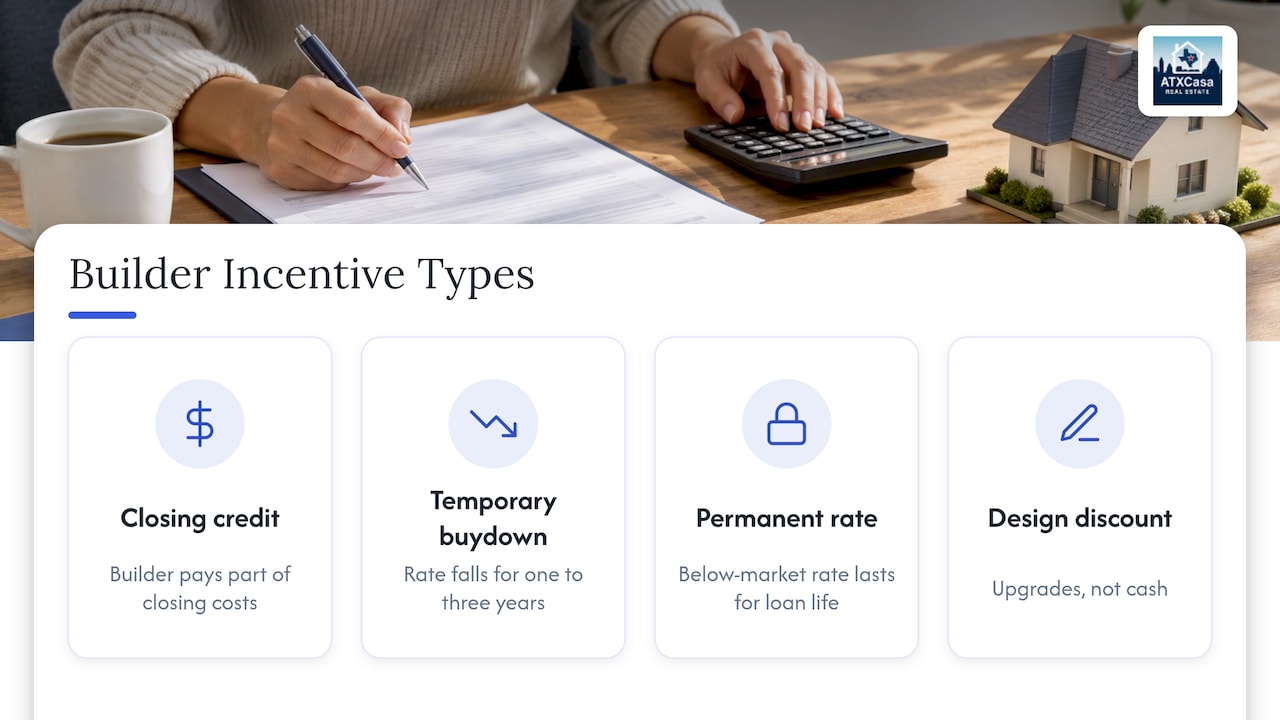
- The four common Austin builder incentives are closing-cost credits, temporary rate buydowns (such as 2-1), permanent below-market rates, and design-center upgrade discounts.
- Most advertised incentives require the builder’s affiliated lender, a specific home or community, and a contract and closing deadline.
- Compare the builder’s Loan Estimate with one from an outside lender on the same house, and look at cash to close and total interest, not just the monthly payment.
- Get every incentive written into the purchase contract, including what happens if construction runs late.
- Builder contracts favor the builder, so have a real estate attorney review yours before you sign.
Table of Contents
- The four incentives you will see most often
- Why builders offer credits instead of cutting prices
- The conditions attached to Austin offers
- How to compare an incentive with a lower price
- What to put in the contract
- Who benefits most from a builder incentive
- My read on new construction versus resale
- Perspective
- Work through an offer with ATXCasa
- FAQ
- Sources
The four incentives you will see most often
Across Austin-area builder promotion pages, the offers fall into a few types.
Closing-cost credit. The builder pays part of your closing costs, either as a flat amount or as a percentage of the price. Tri Pointe Homes’ Austin promotion page lists community-specific credits, from $35,000 on select Lariat homes to up to $40,000 at Edgewood.
Temporary buydown. The builder pays to lower your rate for the first one to three years. A 2-1 buydown lowers the rate by two points in year one and one point in year two, then it returns to the note rate. Drees Homes’ Austin Holiday Home Sale, for example, advertised a 2-1 buydown starting at 4.875% in year one, 5.875% in year two and 6.875% for years three through 30. For a longer explanation, see our guide to rate buydowns in Austin.
Permanent below-market rate. Some builders advertise a rate that lasts for the life of the loan. Tri Pointe lists a 4.99% rate (5.505% APR) plus up to $10,000 in closing credit in its Flora community. The annual percentage rate, or APR, folds fees into the rate so you can compare loans more fairly. Builders typically pay a forward-commitment fee of roughly 4% to 6% of the loan amount to offer one, according to the New Home Dispatch Incentive Tracker. On a $400,000 loan that is about $16,000 to $24,000. Knowing this explains why builders prefer rate offers to price cuts.
Design-center discounts. Drees’s Holiday Home Sale offered 50% off up to $100,000 in design-center options, with a maximum discount of $50,000, on build-to-order homes. These are upgrades, not cash, so they help only if you wanted those upgrades.

The offers above are examples from past and current promotions. Builders refresh them often, sometimes monthly, so treat them as the pattern and confirm the current terms on the builder’s page or with the sales office.
Why builders offer credits instead of cutting prices
A credit or buydown can leave the recorded contract price unchanged, but that does not mean an appraiser treats the comparable as unaffected. For Fannie Mae loans, comparable sales with sales or financing concessions must be analyzed for their effect, if any, and adjusted to reflect the market’s reaction.
For you, the consequence is practical. A credit does not lower your property tax value, but it does lower what you bring to closing. A lower price would reduce your loan balance and, depending on the county appraisal, your tax bill. We cover that side of the ledger in our Austin-area property tax comparison by city and in the new-build property tax escrow check.
The conditions attached to Austin offers
The fine print is where offers differ. These examples come from builders’ own pages.
| Builder | Lender requirement | Other terms stated |
|---|---|---|
| M/I Homes | Offer is through M/I Financial | The 2/1 buydown cannot be combined with the up-to-3% closing-cost incentive; FHA example assumes 3.5% down and a 640 minimum credit score |
| Ashton Woods | Velocio Mortgage | 620 minimum credit score, primary residence only, rate pool ends on a stated date or when depleted |
| Century Communities | Inspire Home Loans for the rate special and closing-cost offer | Incentive to use the affiliated lender may not exceed 3% of the sales price; closing-cost offer excludes prepaid taxes and insurance |
| Coventry Homes | Jet HomeLoans for the advertised incentives | Primary residences only; the buyer is not required to use the affiliate to purchase the home |
| Perry Homes | Crestmark Mortgage or Parkstone Mortgage | Designated build homes only; incentives capped at a combined 6% of the contract price |
Sources: M/I Homes, Ashton Woods, Century Communities, Coventry Homes, Perry Homes. Each page describes its own promotion period, so confirm the current version.
A few patterns stand out.
Affiliated lenders are the norm. Most of the best-advertised rates run through the builder’s own lender. That is not a problem by itself. It means the comparison in the next section is the step that protects you.
Loan type changes the math. Several headline rates are FHA examples built on a minimum credit score and a small down payment. If you are putting 20% down on a conventional loan, your rate and your credit may look different from the example. Drees’s example, for instance, assumes a $700,000 home, a 760 credit score and 20% down, and it excludes government and adjustable-rate loans from the buydown.
Expiration dates are short. Contract deadlines, closing deadlines and rate pools that run out are standard. Closing deadlines matter as much as the contract date, because a delayed build can push you past the end of the offer.
Exclusions change what a credit buys. Century’s terms exclude prepaid taxes, property and mortgage insurance, and mortgage installments from its closing-cost offer. Read the list of what the credit can pay for, then ask your lender to estimate the cash you will still need.
How to compare an incentive with a lower price
The aim is a single number you can compare: your total cost over the time you expect to own the home. Here is the process I use with buyers.
- Get the offer in writing for a specific home. An incentive on a flyer or a community page is not an incentive on the lot you want. Ask for the amount, the expiration, the lender or title conditions and whether it applies to that address.
- Request a Loan Estimate from the builder’s lender and one from an outside lender on the same house. The Loan Estimate is the standardized three-page form lenders must give you after you apply. Compare estimates issued close together for the same loan amount and product. Check lender-controlled origination charges, lender credits, the interest rate, total monthly payment and cash to close. On page 3, subtract principal repaid from the “In 5 years” total to compare five-year interest-and-fees costs; principal repayment reduces your debt rather than becoming a borrowing cost.
- Run a breakeven. Compare the credit you can actually use, lender-controlled costs, cash to close, payments over your expected holding period and the loan balance remaining at the end. Keep upfront cash needs separate from borrowing costs, and do not count principal repayment as a borrowing cost. For covered Fannie Mae loans, a temporary buydown subsidizes your payments without changing the permanent mortgage-note terms. You must be able to afford the full payment when the subsidy ends; include that payment in the comparison.
- Ask a buyer’s agent to model both. This is the step most buyers skip, and it is where the real figure appears.
The New Home Dispatch tracker advises the same sequence: written terms, Loan Estimates from the builder’s lender and an outside lender, and a check of the recorded sale price where it is available.
A worked example
Here is a hypothetical comparison of the same home: a $450,000 price with a $20,000 credit and a 6.5% loan, or a $15,000 price reduction to $435,000 with no credit and a 6.25% loan. Neither is an actual offer. Assume 20% down, 30-year fixed loans held for 7 years without refinancing or extra payments, $20,000 in eligible non-lender closing expenses under either option, and approval to use the entire credit. Set lender fees to $0 to isolate the comparison; actual fee differences must be added. The credit option requires $90,000 down, leaves a $360,000 loan and requires $90,000 cash to close after the credit covers those expenses. The lower-price option requires $87,000 down, leaves a $348,000 loan and requires $107,000 cash to close. Monthly principal and interest are $2,275.44 versus $2,142.70. Over 84 payments, the totals are $191,137.37 versus $179,986.45, with remaining balances of $325,498.48 versus $313,316.90. Subtracting principal repaid from those payment totals gives interest costs of $156,635.85 versus $145,303.35. To compare the full purchase-and-financing outlay at a sale after 7 years, add cash to close, payments made and the remaining debt to be paid off. Assuming identical sale proceeds, the lower-price option costs $6,332.50 less, while the credit option needs $17,000 less upfront. This avoids treating repaid principal as lost money. Figures use unrounded calculations and exclude taxes, insurance, other ownership and selling expenses, and returns on retained cash. The credit helps when cash to close is the constraint and the ongoing payment is affordable. The lower price wins this cost comparison if you can bring the additional cash. Different usable credits, lender fees, rates or holding periods can change the result.
The tracker also reports that, across the offers it follows, about $1 in every $5 of an advertised incentive never reaches the buyer, with a median advertised value of $20,000 against roughly $16,000 delivered. That is a reason to model the delivered number, not the advertised one.
What to put in the contract
The Better Business Bureau’s guidance on builder incentives is direct about this: get every incentive in the purchase contract, including conditions such as a required lender or a closing deadline. Before you sign, I would check these points.
- The incentive’s exact amount and what it can pay for. A credit toward closing costs differs from a price reduction.
- The lender condition. What happens to the incentive if your loan is denied by the builder’s lender, or if you choose a different one.
- The closing deadline. Ask what happens to the incentive if construction runs late and the closing date moves.
- Buydown type. Confirm whether the buydown is temporary, for the first one to three years, or permanent for the life of the loan.
- Escalation clauses. The BBB notes that builder contracts are often written to protect the builder, and recommends watching for cost-escalation clauses that let the builder raise the price if costs rise.
The BBB also recommends taking the contract home and having a real estate attorney review it, and asking for changes before signing. Once the contract is signed it is too late to request edits. This is a legal document, so the attorney review is the right step, and it is worth doing before you commit your earnest money.
If a deal falls apart on timing or terms, our note on what to check before signing, to avoid a cancellation lays out the signals to watch.
Who benefits most from a builder incentive
First-time buyers often benefit most from closing-cost credits, because cash to close is the hurdle. If you are also looking at assistance programs, read about Austin down payment assistance and choosing an experienced lender, since some programs have rules about how they combine with builder offers. Your lender can confirm that before you commit.
Families relocating to Austin gain from move-in-ready homes, where the closing date is predictable and the incentive is less likely to be disrupted by construction delays.
Investors should note that several of the advertised rates and credits are limited to primary residences. Ashton Woods and Coventry both state that on their pages, so an investor purchase may not qualify for the offer.
Sellers are affected too. If a builder across the street is paying buyers a credit, the effective competition for your listing is the price minus that credit. Pricing with that in mind is part of a data-driven listing strategy.
My read on new construction versus resale
Incentives make new construction look cheaper, but the right comparison is against resale homes in the same area at the same monthly cost. We cover that in Austin builder incentives versus resale homes. More on new construction is in our new construction and investment section.
Perspective
Our view is that an incentive is a data problem before it is a sales offer. Builders publish the headline number. The figure that matters is the one that remains after you subtract the lender conditions, the exclusions and the timing risk, and compare it with the same house at a lower price.
That is how I approach it as a Realtor with nearly two decades of IT experience: put the offers side by side, pull the local numbers, and let the comparison show which structure favors you. Our guides are built from the questions clients actually ask, so we focus on what a buyer has to verify, not on promoting any one community.
The buyers who do best go into the sales office with a Loan Estimate from an outside lender already in hand, a clear idea of their breakeven and the contract review scheduled. That keeps the conversation about the home and the numbers.
Vladimir
Work through an offer with ATXCasa
ATXCasa helps clients buy, sell and invest across the Austin area, including Cedar Park, Round Rock and Georgetown, with data-driven pricing and guidance that covers everything from neighborhood trends to hidden home pitfalls. If you are weighing a builder incentive against another home, we can help you read the offer and compare the numbers.

Start at ATXCasa and tell us which community you are considering.
FAQ
Can I negotiate a builder incentive in Austin?
Often, yes, but the structure matters. Builders tend to protect base prices and offer credits or rate programs instead, so the negotiation is usually about the size of the credit, upgrades or the closing date. Ask for the terms in writing for the specific home and have them added to the contract.
Do I have to use the builder’s lender?
For many advertised rate offers, yes. Perry Homes, M/I Homes and Ashton Woods tie their offers to named lenders. Coventry Homes states that you are not required to use its affiliate to buy the home, though the advertised incentives depend on it. Get a Loan Estimate from an outside lender to compare.
Is a temporary buydown the same as a lower rate?
No. A temporary buydown such as a 2-1 lowers your payment for the first one to three years, then the rate steps up to the full note rate. A permanent rate stays at the lower number for the life of the loan. The BBB advises checking which one your offer is.
Do builder incentives expire?
Yes. Offers usually have a contract deadline, a closing deadline and sometimes a limited pool of funds. Because builders update promotions often, confirm the current terms on the builder’s page and in your contract.
Sources
- NAHB: Builder Sentiment Falls on Higher Interest Rates and Costs (September 2026)
- Tri Pointe Homes: Austin promotions
- Drees Homes: Austin Holiday Home Sale
- M/I Homes: 2026 Great Rate, Greater Austin
- Ashton Woods: Austin 399 Rate
- Century Communities: 2026 Homes Worth Moving For, Austin
- Coventry Homes: Austin sales events
- Perry Homes: Austin New Year New Home offer
- New Home Dispatch: The Incentive Tracker
- Better Business Bureau: What to know about builder incentives