

Texas does not require a builder to give you a warranty on a new home. Whatever coverage you have comes from your purchase contract, a written warranty the builder chooses to offer, and a short list of rights the law gives you anyway. Most production builders in the Austin area do offer a written warranty, usually a one-year, two-year and structural structure, so the real question is what yours says and how to use it before it expires.
I wrote this guide for buyers of new construction in Austin, Cedar Park, Round Rock and Georgetown. It covers what the law does and does not guarantee, how a typical warranty is laid out, what to look for in the fine print, and how to get a repair made.
TL;DR
- No Texas law currently requires a builder warranty. The state commission that once set statutory warranties was abolished and its act expired on September 1, 2009.
- As a general pattern, the FTC describes 1 year of workmanship and materials coverage, 2 years for plumbing, electrical and heating and air-conditioning systems, and structural coverage of up to 10 years from some builders. Coverage varies by component; your contract and warranty set the actual terms.
- For covered residential-construction claims, Section 16.009 generally sets an outer 10-year period after substantial completion, or 6 years if the contractor being sued provided a written warranty meeting the statutory minimums. It also provides a 1-year extension for a written claim presented during the applicable period. Other legal deadlines and the warranty’s reporting terms may require earlier action.
- For a claim under the Residential Construction Liability Act (RCLA), the owner generally must give written notice at least 60 days before suit: certified mail, return receipt requested, to the contractor’s last known address, describing the defects in reasonable detail. Separately, report defects promptly under the warranty’s own instructions.
- TREC says it does not have jurisdiction over builders and recommends consulting a private attorney before possible warranties or other legal remedies expire.
Table of Contents
- Is a builder warranty required in Texas?
- How a typical 1-2-10 style warranty is structured
- What HB 2024 changed for your deadlines
- Protections you have even without a warranty
- How to make a warranty claim that holds up
- Inspections: the best time to find problems
- Questions to ask the builder before you sign
- Other costs that arrive with a new build
- Our perspective on builder warranties
- Buying new construction in Austin
- FAQ
- Sources
Is a builder warranty required in Texas?
No. From the 2000s until 2009, the Texas Residential Construction Commission administered statutory warranties and a dispute process for new homes. The Legislature let it lapse, and the commission was abolished with its act expiring on September 1, 2009. Since then, an express builder warranty is a matter of contract.
That has two practical consequences:
- The warranty is negotiable. What you receive is what the builder writes into the contract or a separate warranty booklet. Read it before closing, not after the first leak.
- A missing warranty is a signal. A builder that offers nothing in writing is asking you to rely on the limited protections described below. I would treat that as a reason to compare other builders or negotiate.
Buyers also search for “new home warranty” and mix up two different products, so it helps to separate them. The FTC’s consumer guidance on new-home warranties distinguishes a builder warranty, which accompanies new construction or a remodel and commonly concerns permanent home components, from a home warranty, a service contract that costs extra and can cover repairs or replacements for items such as appliances or air-conditioning systems. We cover the second type in our comparison of home warranties and homeowners insurance.
How a typical 1-2-10 style warranty is structured
Many builders and third-party warranty companies describe their coverage as a 1-2-10 structure. Top-ranking warranty providers describe it as one year for workmanship, two years for distribution systems and ten years for structural defects. Texas has also been called a “1-2-6” state, because the statutory minimums discussed below use six years for structure.
| Coverage layer | Typical period | What it usually addresses |
|---|---|---|
| Workmanship and materials | 1 year | Drywall cracks, trim gaps, doors that stick, paint defects, siding and flooring problems |
| Systems | 2 years | Plumbing, electrical and HVAC distribution components |
| Structural | 6 or 10 years, depending on the warranty | Foundation, load-bearing members and other major structural components |
Treat this table as a pattern, not a promise. Read the actual periods, exclusions and definition of “structural defect.” The FTC explains that many warranties are backed by the builder, while builders may also buy warranties from independent companies. Ask who issued and backs yours, and read its claim process.
What most warranties exclude
Every written warranty I see has a list of things it does not cover. Look for these:
- Normal settling and minor hairline cracking
- Damage from lack of maintenance, drainage changes or landscaping you install
- Appliances covered by a manufacturer warranty instead
- Cosmetic items not reported by a set date, often at a 30 or 60 day walkthrough
- Mold or water intrusion, depending on cause and wording
The structural definition matters most. Cosmetic problems found later do not automatically qualify as structural defects, a point TREC’s guidance on builder warranties makes in the context of buyers who assume otherwise.
What HB 2024 changed for your deadlines
This is the part many buyers misread. In 2023 the Legislature passed HB 2024, which amended Section 16.009’s statute of repose for covered residential-construction claims. A statute of repose sets an outer time limit measured from substantial completion. It is separate from claim-specific filing deadlines, which may expire earlier, and the warranty’s own reporting deadlines. Statutory extensions can also affect the outer limit. HB 2024 preserves prior law for causes of action commencing before its effective date and for later causes arising under contracts entered before that date.
- General outer limit for covered claims: 10 years after substantial completion under Section 16.009(a-2), subject to the Act’s applicability rules and statutory extensions. This does not mean every claim can wait that long.
- With a qualifying written warranty: if the contractor being sued provided a written warranty covering at least 1 year for workmanship and materials, 2 years for plumbing, electrical, heating and air-conditioning delivery systems, and 6 years for major structural components, Section 16.009(a-2) generally sets a 6-year outer period after substantial completion for covered claims. The Act’s applicability rules described above still control.
A qualifying warranty can therefore coincide with a shorter outer period for covered claims. The warranty also has its own coverage, exclusions and reporting process. Read it alongside the purchase contract, and seek legal advice promptly if a claim remains unresolved; a coverage period is not a promise that every legal remedy stays available for that long.
The statute also provides a 1-year extension for a written claim presented during the applicable repose period. Do not assume a repair log or routine request preserves every deadline. Closing date alone does not determine which law applies: HB 2024’s Section 2 looks to when the cause of action commences and whether the contract was entered before the Act’s effective date. A Texas attorney can review those facts, the contract and the warranty to identify the deadlines for an unresolved claim.
Where your contract’s dispute clause fits
The FTC says many new-home warranties offer or require mediation and arbitration. Check your actual warranty and contract for their dispute procedures, including who pays, where proceedings occur and whether you waive a jury. If the terms are unacceptable, raise them before signing.
Protections you have even without a warranty
Texas law still gives you some footing if your builder gave you nothing in writing, or if the written warranty has run out.
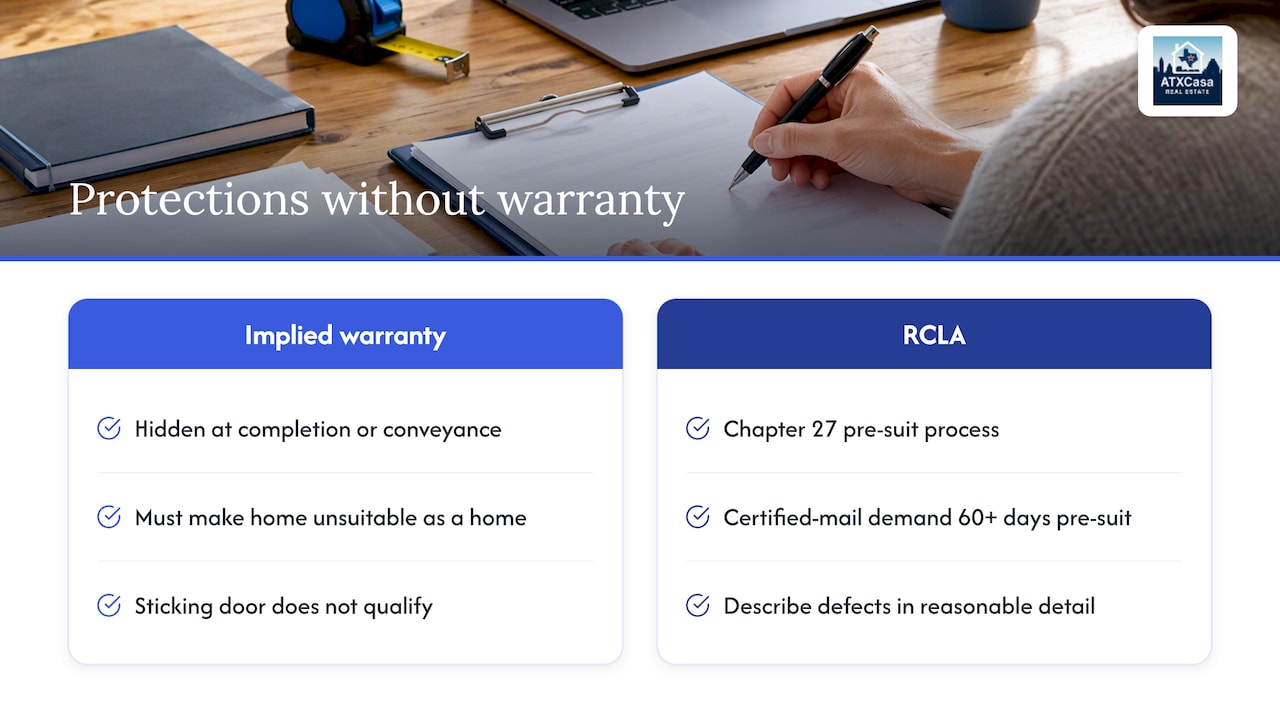
Implied warranty of habitability. To win on this theory, you must show the defect was hidden at the time of completion or conveyance and makes the home unsuitable for its intended use as a home. A sticking door will not qualify. A serious hidden water or structural defect might.
Residential Construction Liability Act (RCLA). Chapter 27 of the Property Code provides a pre-suit framework that may apply to a qualifying construction dispute. The Texas State Law Library’s construction defects guide explains that not every dispute qualifies. When the RCLA notice requirement applies, the written demand must go by certified mail, return receipt requested, to the contractor’s last known address at least 60 days before suit and describe the defects in reasonable detail. Obtain legal advice about whether the process applies to your dispute; a routine warranty request is not automatically sufficient statutory notice.
How to make a warranty claim that holds up
The warranty period is short, and builders get busy. Here is the sequence I recommend to buyers.
- Calendar the dates. Note your closing date, the start of warranty coverage, any 30 or 60 day walkthrough deadline, the 11-month mark and the 1-year and 2-year expirations.
- Report everything in writing. Follow the warranty’s required claim method, put repair requests in writing and keep copies of correspondence. Certified mail with return receipt requested can provide delivery evidence, but it does not replace the warranty’s stated procedure.
- Be specific. Give the room, the symptom, the date you noticed it and photos with timestamps. A detailed list is the same habit the RCLA expects later.
- Use a consolidated list as a follow-up. Report each defect promptly under the warranty’s required method and any item-specific deadline. Check the actual coverage expiration before scheduling a final list; do not wait for that list to report a problem you already know about.
- Keep a log of responses. Note who visited, what they promised and whether the repair was done.
- Escalate in writing. Follow the warranty’s dispute procedure, and obtain legal advice promptly about a potentially applicable RCLA claim. These are separate processes. If statutory notice is required, send the demand by certified mail, return receipt requested, to the contractor’s last known address, describing defects in reasonable detail, at least 60 days before suit.
- Hire an attorney if the builder refuses. This is a legal question, not a regulatory one.
TREC says it does not have jurisdiction over builders and recommends consulting a private attorney before possible warranties or other legal remedies expire. For an unresolved builder-warranty claim, seek a Texas attorney who handles construction defects.
Inspections: the best time to find problems
A purchase-stage inspection is a snapshot of one day. It does not predict how long a system will last, and it is not a substitute for a warranty. Still, it is your cheapest way to put defects on the builder’s list before you own the house.
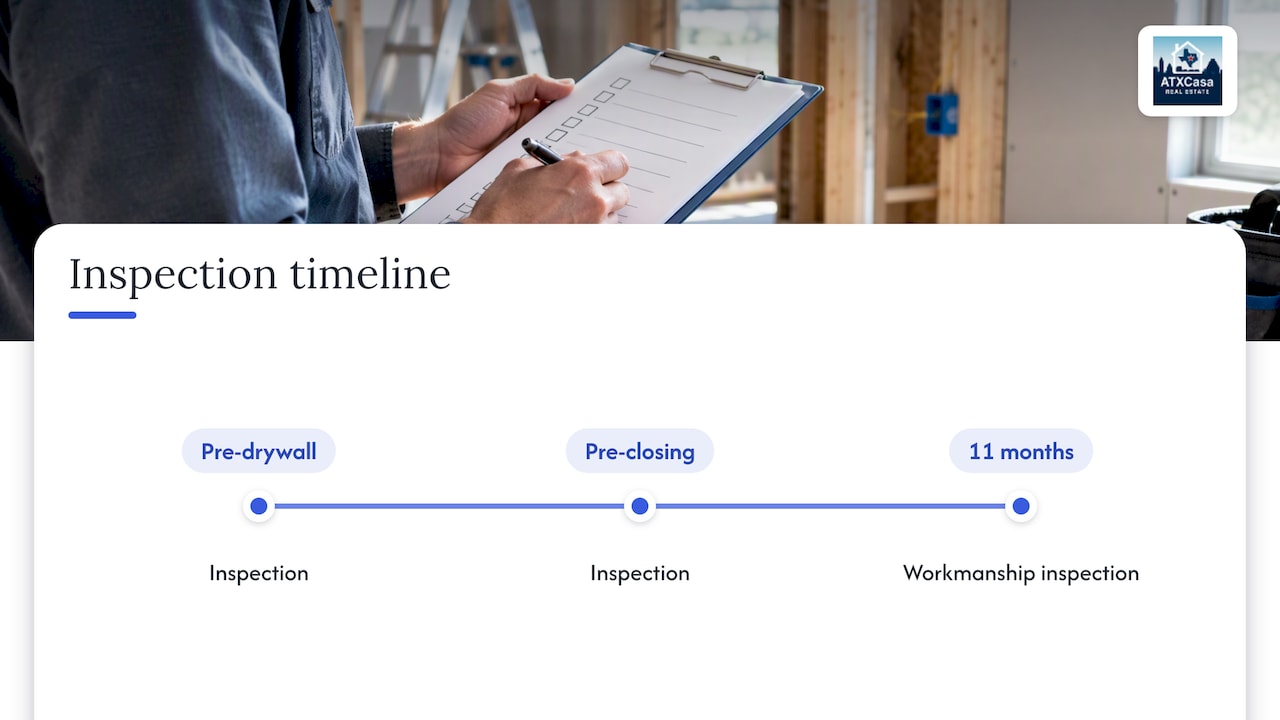
For new construction, I advise two inspections: one before the drywall goes up, and one before closing. We explain what each can see in our guide to pre-drywall and final inspection scope for Austin new builds. Schedule any pre-expiration inspection using the warranty’s actual coverage start and end dates; an 11-month inspection is useful only if it leaves time to meet the relevant reporting deadlines. Report findings promptly using the required method. Neither an inspection nor a claim log by itself preserves every contractual or legal deadline.
The current TREC New Home Contract for completed construction is another document worth reading if you buy a finished spec home, since it governs how the sale itself is set up. Your agent or attorney can explain how its terms relate to your builder’s warranty.
Questions to ask the builder before you sign
Use this list during contract negotiation:
- Is the warranty issued and backed by the builder alone, or insured by a third party?
- What are the exact periods for workmanship, systems and structure?
- How is “structural defect” defined, and what is excluded?
- Does the warranty meet the HB 2024 minimums, and does the contract say it is intended to shorten the repose period?
- How do I submit a claim, and how fast must the builder respond?
- Does the contract require mediation or arbitration?
- Is the warranty transferable if I sell?
- What happens if the builder goes out of business?
Builders in our market also use incentives such as rate buydowns and closing cost credits. If you are weighing those against a resale home, our comparison of builder incentives and resale deals in Austin helps you judge the real value. A larger incentive is a poor trade if the warranty is thin.
Other costs that arrive with a new build
Warranty is only one of the line items. Two others catch new-build buyers off guard:
- Property tax at closing. Escrow estimates for a new build often reflect land only, then rise once the improved value is assessed. See our new-build property tax escrow check.
- HOA rules and fees. Most newer Austin-area communities have an HOA, and its restrictions affect fences, exterior changes and rentals. Review the resale certificate and governing documents with our HOA resale certificate guide. Also remember that HOA architectural rules can limit some of the repairs and changes you make yourself, so check them before altering anything the warranty covers.
Our perspective on builder warranties
We work with buyers of new construction across the Austin area, and we see the same pattern. People spend weeks comparing floor plans and lot premiums, then read the warranty for the first time when something goes wrong. We would reverse that order.
Our background is in technology, and we apply the same habit to warranties as we do to pricing: put the data in one place. A simple spreadsheet with each defect, the date reported, the response and the expiration date turns a vague complaint into evidence. It costs nothing and makes a calm, professional conversation with the builder easier.
Service responsiveness is one consideration alongside written coverage, exclusions, duration, the claim process and whether the warranty is builder-backed or provided through an independent company. A prompt response does not automatically outweigh an exclusion that leaves a defect uncovered. Ask recent buyers how repairs went, then compare their accounts with the actual documents. We can help you organize that comparison and plan inspection and closing steps that leave a clear written record.
— Vladimir
Buying new construction in Austin
If you are comparing new builds in Austin, Cedar Park, Round Rock or Georgetown, we can help you review the contract and warranty terms, line up inspections and compare builder incentives with resale options. Start at ATXCasa, or browse our new construction and investment guides. Warranty wording and deadlines are legal matters, so for a specific dispute, speak with a Texas construction-defect attorney.
FAQ
How long does a builder have to warranty a house in Texas?
There is no state-mandated period, because Texas does not require a builder warranty. The length is set by your contract. A typical written warranty covers workmanship for 1 year, systems for 2 years and structure for longer. Separately, HB 2024 sets a 6-year lawsuit deadline when a qualifying written warranty exists, or 10 years otherwise.
Does a new home warranty cover everything?
No. The FTC says builder warranties usually do not cover household appliances, small cracks in brick, tile, cement or drywall, or components covered by a manufacturer’s warranty. Read your actual warranty’s coverage definitions, exclusions and claim deadlines to see which terms apply to the problem you find.
What if the builder will not make repairs?
Follow your warranty’s dispute procedure and promptly obtain Texas legal advice for an unresolved claim. If it applies, the RCLA requires notice at least 60 days before suit. The State Law Library guide specifies written notice by certified mail, return receipt requested, to the contractor’s last known address, describing the defects in reasonable detail. TREC says it does not have jurisdiction over builders; consult an attorney before possible warranties or legal remedies expire.
Is a home warranty the same as a builder warranty?
No. A builder warranty comes with new construction or a remodel and commonly concerns permanent home components. A home warranty is a separately purchased service contract that can cover repairs or maintenance for items such as appliances and air-conditioning systems. The FTC explains the difference. Compare the covered items, exclusions and costs before deciding whether a separate service contract would be useful.
Sources
- Texas Residential Construction Commission, Texas Sunset Advisory Commission
- Texas Builder Warranties & Coverage Plans, 2-10
- Warranties for New Homes, FTC Consumer Advice
- TREC: builder warranty and repairs
- HB 2024, enrolled bill text, 88th Legislature
- Texas Civil Practice and Remedies Code Section 16.009
- Texas Property Code Section 27.003
- Construction Defects, Texas State Law Library
- New Home Contract (Completed Construction), TREC