

Circle C Ranch is a master-planned community in far southwest Austin built around Austin Independent School District schools, HOA-managed pools and parks, and a mix of 1990s-to-2000s single-family homes. It suits buyers who want established landscaping, predictable HOA oversight, and a family-oriented pipeline into Kiker Elementary, Gorzycki Middle, and Bowie High School. Home prices span a wide range, and the HOA’s rules genuinely shape day-to-day life here, so understanding both before you write an offer matters more than in a non-HOA neighborhood.
TL;DR:
- Home prices in Circle C vary widely based on lot size, pool ownership, and proximity to greenbelt land, with gated community homes commanding the top market value.
- The neighborhood’s housing stock ranges from 1990s modest homes needing updates to renovated properties, influencing resale prices and market the favorability for buyers.
- Families pay a premium for homes zoned to Kiker Elementary, and verified school boundaries should be checked directly with AISD before making an offer.
- The HOA manages multiple pools, a community center, and trail access, with reservation policies requiring advance notice and fees for private events.
- Future development threats are limited inside the built-out core, but zoning and land use along the perimeter could change neighborhood dynamics over the long term.
Table of Contents
- Circle C Ranch’s Location and Neighborhood Snapshot
- What Homes Cost in Circle C Right Now
- Which Schools Serve Circle C Ranch?
- Pools, Parks, and Trail Access in Circle C
- How the Circle C HOA Runs the Community
- Buyer and New Resident Checklist for Circle C
- Community Events and Social Life in Circle C
- Is Circle C Ranch Safe?
- Who Lives in Circle C: A Demographic Snapshot
- Shopping, Dining, and Retail Near Circle C
- What’s Changing: Future Development Around Circle C
- How ATXCasa Helps Buyers Navigate Circle C
- Get a Personalized Circle C Market Briefing
- Sources
- FAQ
Circle C Ranch’s Location and Neighborhood Snapshot
Circle C sits roughly 12 to 15 miles southwest of downtown Austin, bounded loosely by Slaughter Lane to the north and MoPac (Loop 1) running along its eastern edge. That positioning puts residents close enough for a downtown commute without downtown density, and it explains why the community has held steady appeal since its early development phases decades ago.
The neighborhood grew as one of Austin’s larger master-planned communities, built out over multiple phases starting in the late 1980s and continuing through the 2000s. That staggered timeline is why housing stock varies so much block to block.
A few things define the physical character of Circle C:
- Single-family homes ranging from modest three-bedroom layouts to larger executive-style houses on quarter-acre-plus lots
- Several gated subcommunities within the larger footprint, each with its own architectural feel
- Mature tree cover and established landscaping, a contrast to newer Austin-area developments still growing into their plantings
- A layout organized around pocket parks and greenbelt access rather than a single central square
Buyers cross-shopping Circle C against other family suburbs often look at guides covering Austin suburbs worth considering to see how the trade-offs compare.
What Homes Cost in Circle C Right Now
Circle C’s housing market splits into three rough tiers, and where you land depends heavily on lot size, pool ownership, and how recently the home was updated.
Entry-level homes, typically smaller three-bedroom houses on standard lots, sit at the lower end of the neighborhood’s range. Mid-range properties, four-bedroom homes with two-car garages and moderate lot sizes, make up the bulk of what’s actively listed. Upper-tier listings, often in the gated subcommunities or with pool-and-greenbelt lots, command the top of the market.
Statistic Callout: Inventory levels shift seasonally, and the clearest way to judge whether Circle C currently favors buyers or sellers is to check months-of-supply data directly rather than rely on a single snapshot, since that figure moves month to month across Austin’s broader Travis and Williamson County market.
A few patterns show up consistently in current listings:
- Resale homes from the original 1990s and early-2000s phases tend to need kitchen or bathroom updates, which shows up in list price
- Newer or fully renovated resale properties close to asking price more closely than dated ones
- Homes backing directly onto greenbelt or park land carry a premium over interior lots
- Days-on-market varies widely by subcommunity, so a single “average” figure for all of Circle C can be misleading
Anyone comparing Circle C’s pricing against other parts of the metro benefits from looking at how sold prices break down across Austin neighborhoods before settling on a target range.
Which Schools Serve Circle C Ranch?
Circle C falls within Austin Independent School District, and most of the community feeds into a consistent three-school pipeline:
- Kiker Elementary School
- Gorzycki Middle School
- Bowie High School
That pipeline is a major reason families target this neighborhood specifically. Buyers consistently pay a premium for homes zoned to well-regarded elementary schools, and resale demand tends to hold up better in sections of Circle C confirmed to feed Kiker over adjacent areas with less certain zoning.
AISD says attendance areas determine a household’s assigned school and provides School Finder for address-level checking. Feeder patterns can split between levels, and transfer options may differ from the home-school assignment, so confirm the property’s current assignment directly with AISD during due diligence.
Pools, Parks, and Trail Access in Circle C
Circle C’s amenity package is one of its strongest selling points, and it splits between HOA-run facilities and city-owned parkland next door.
Circle C Aquatics provides the HOA’s current pool information. Pool operations can vary with seasonal schedules, capacity limits, and current facility rules. For the Community Center, the HOA says a reservation request must be complete, subject to availability, submitted at least 10 days ahead, and confirmed by the coordinator.
Beyond the HOA’s own facilities, Circle C Metropolitan Park anchors the neighborhood’s outdoor recreation, with trail connections feeding into the Violet Crown Trail system. Because the park is city-owned rather than HOA-managed, some scheduling and access rules follow Austin’s own parks policies rather than the HOA’s.
- HOA aquatics information with schedules and access conditions that should be checked before use
- A Community Center that accepts reservation requests subject to availability, required paperwork, notice, and confirmation
- Circle C Metropolitan Park with sports fields and open green space
- A City-described Violet Crown Trail project extending from Circle C Park toward Hays County; check the City’s current project status before relying on construction or access timing
- Nearby school parks operating under Austin’s joint-use policy with AISD, meaning hours outside the school day follow city rules
Pro Tip: Check the HOA’s current Community Center page and packet before planning an event: the HOA says requests require completed materials, availability, at least 10 days’ notice, and coordinator confirmation. Confirm current eligibility, rates, and rules for the intended date.
How the Circle C HOA Runs the Community
The Circle C Homeowners Association (CCHOA) is a non-profit governed by a seven-member board, and it holds meetings on a regular monthly cadence that includes a homeowners forum where residents can raise issues directly with the board.
Annual assessments get billed in two installments rather than a single lump sum, according to the HOA’s own New Homeowner Packet. The governing CC&Rs include a cap provision limiting how much assessments can increase in a given period, though the exact current dollar amount should always be confirmed directly with the HOA rather than assumed from an old listing sheet or a neighbor’s recollection.
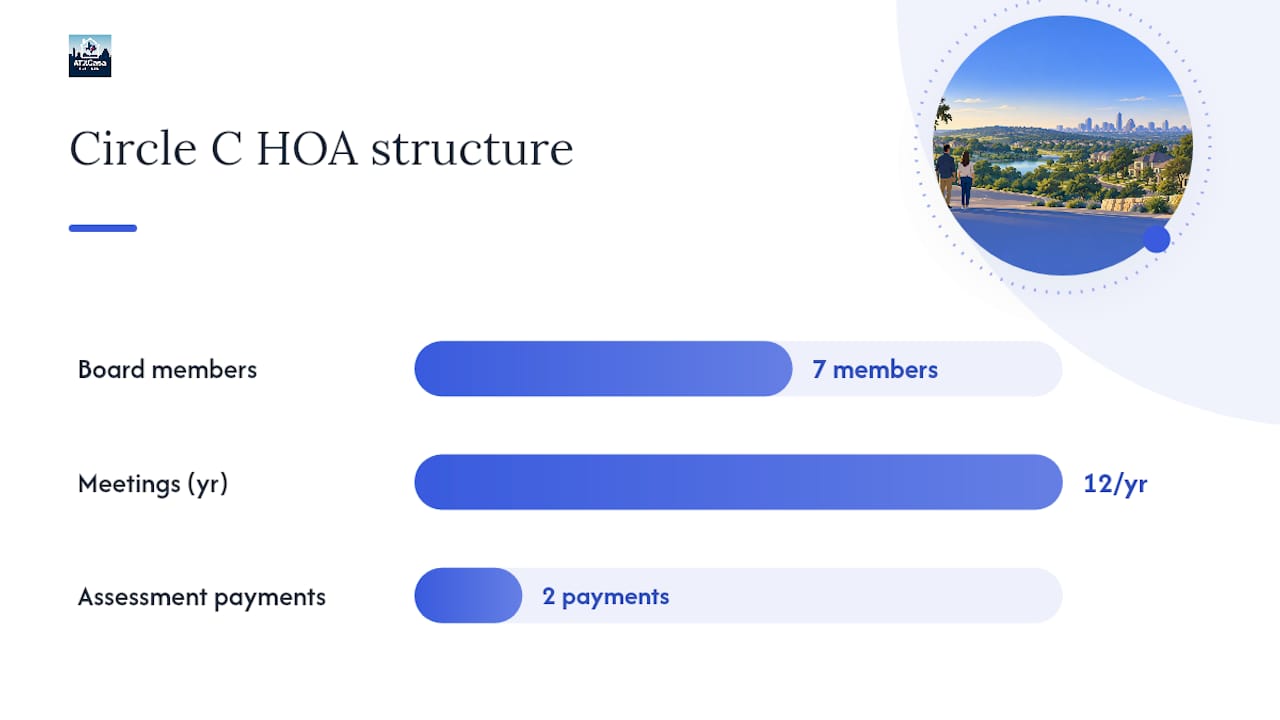
Statistic Callout: The CCHOA Annual Report documents the board’s structure and meeting schedule, giving buyers a way to see how active governance actually is before closing, not just how it’s described in marketing materials.
Practical HOA touchpoints buyers should expect:
- A resale certificate requirement before closing, generated by the HOA for a fee, per its resale certificate policy
- Community Center reservations require completed reservation materials, availability, at least 10 days’ notice, and coordinator confirmation
- Monthly board meetings open to residents, with a standing homeowners forum
- Governing documents (CC&Rs, bylaws, annual report) all published on the HOA’s own site
Buyer and New Resident Checklist for Circle C
Circle C’s HOA structure means a few extra steps beyond a typical Austin home purchase, and skipping them tends to cause headaches after closing rather than before.
Before contract or closing:
- Request the resale certificate early. The HOA needs lead time to produce it, and delays here can push back your closing date.
- Read the current CC&Rs and the last few months of board meeting minutes to catch any pending special assessments or ongoing disputes.
- Use AISD’s official School Finder to check the property address and distinguish the home-school assignment from any transfer option.
After closing:
- Register as a homeowner on the CCHOA website to get access to resident communications and amenity sign-ups.
- Set up pool and Community Center access if you plan to use either.
- If you plan an event, consult the current HOA Community Center reservation page before committing to a date; the HOA requires lead time, availability, completed materials, and confirmation.
Commute checklist:
- Drive your actual route to work at both 8:00 AM and 5:30 PM before you commit; MoPac and Slaughter Lane behave very differently at rush hour than midday.
- Test the drive on a Friday afternoon, historically the heaviest commute window in southwest Austin.
Pro Tip: Don’t rely on a map app’s estimated commute time alone. Circle C’s proximity to MoPac looks great on paper, but actual drive times during peak hours can run considerably longer than the app suggests.
Community Events and Social Life in Circle C
Circle C’s social calendar runs largely through the HOA and its aquatics programming, rather than a separate events organization. Swim team season brings regular meets and practices to the neighborhood’s pools each summer, and those events double as informal social gatherings for families with young kids.
The Community Center hosts resident-organized gatherings throughout the year, from holiday get-togethers to neighborhood meetings, though private events require booking through the HOA’s reservation process. The monthly board meetings themselves function as a recurring touchpoint for residents who want to stay current on neighborhood issues, and the homeowners forum built into that schedule gives residents a direct line to raise concerns or proposals.
Beyond HOA-run programming, much of Circle C’s social life happens informally: pool decks in summer, trail walks along the Violet Crown connections, and pickup sports at Circle C Metropolitan Park’s fields. Families with kids in the AISD pipeline also tend to build community through school events at Kiker, Gorzycki, and Bowie, which often draw heavily from the surrounding Circle C blocks.
If organized clubs or recurring meetups matter to you, ask current residents or check the HOA’s communication channels directly. The formal event calendar is thinner than in some newer developments built specifically around a lifestyle brand, but the pool and park infrastructure does a lot of the social heavy lifting on its own.

Is Circle C Ranch Safe?
Circle C consistently gets described by residents and local coverage as one of the lower-crime, family-oriented pockets of Austin, largely a function of its suburban layout, HOA oversight, and predominantly owner-occupied housing stock. Master-planned communities with active HOAs and consistent landscaping standards tend to see fewer of the visible signs of disorder that correlate with higher crime perception in denser urban areas.
That said, no single figure captures “safety” for an entire neighborhood this size, and Circle C spans enough territory that experiences vary by specific subcommunity. Buyers who want hard numbers rather than general reputation should pull crime data directly from the Austin Police Department’s public safety reporting tools for the specific zip codes covering Circle C, rather than relying on aggregated national safety-ranking sites that often use outdated or poorly geo-fenced data.
Practical safety factors worth weighing beyond raw statistics include street lighting, HOA-enforced landscaping (which limits hiding spots and blind corners), and the presence of gated subcommunities within the larger neighborhood, which some buyers value for an added layer of access control. If safety is a top priority, walk the specific streets you’re considering at different times of day, and ask your agent whether the property falls inside one of Circle C’s gated sections or the open-access portions of the community.
Who Lives in Circle C: A Demographic Snapshot
Circle C skews heavily toward families with school-age children, a pattern driven directly by the AISD school pipeline and the neighborhood’s abundance of family-sized homes on larger lots. The community’s age profile leans toward established households rather than young singles or empty-nesters, though pockets of longtime residents who bought during the original development phases still remain throughout the neighborhood.
Household incomes in Circle C tend to run above the Austin metro median, reflecting both the cost of homes here and the professional draw of southwest Austin’s proximity to major employers along the MoPac corridor. The neighborhood’s build-out over multiple decades also means it houses a mix of original buyers from the 1990s alongside newer arrivals who bought resale homes more recently, creating a blend of longtime community institutional knowledge and fresh perspective.
Because Circle C is large enough to contain multiple distinct subcommunities, demographic character can shift somewhat from one gated section to the next. Some pockets run younger, with more first-time buyers moving up from smaller Austin homes, while others retain a higher share of original owners whose kids have long since graduated from the Bowie pipeline. If a specific demographic mix matters to you, walking a few different subcommunities before choosing one gives a better sense of the range than treating “Circle C” as a single homogenous block.
Shopping, Dining, and Retail Near Circle C
Circle C residents don’t have to leave the neighborhood for most day-to-day errands. Retail anchors along the community’s edges cover grocery, pharmacy, and casual dining needs, and the broader southwest Austin corridor along Escarpment Boulevard and William Cannon Drive fills in the rest with additional shopping centers.
For bigger retail trips or a wider restaurant selection, residents typically head toward the Southpark Meadows shopping area a short drive south, which offers big-box retail and a denser concentration of chain restaurants than Circle C’s own commercial pockets provide. The absence of a dense, walkable retail core directly inside Circle C is a trade-off some buyers weigh against the neighborhood’s quieter, more residential feel.
Small local businesses, salons, dental offices, and independent restaurants, cluster mainly along the neighborhood’s commercial frontage roads rather than in a central town square, which is a different pattern than some of Austin’s newer mixed-use developments. Buyers who prioritize walkable retail access should factor this in, since most Circle C errands still involve a short drive rather than a walk.
What’s Changing: Future Development Around Circle C
Circle C itself is largely built out at this point, with most of its residential phases completed years ago, so major new construction inside the core neighborhood boundaries is limited. Most activity now involves infill development on remaining parcels rather than large-scale new subdivisions.
Zoning records for the area document the neighborhood’s original development cases and annexation history, useful reference points for anyone trying to understand how Circle C’s boundaries and land use were established over time through the City of Austin’s zoning documentation. Buyers concerned about future changes near the neighborhood’s edges should check current zoning cases directly with the city rather than relying on secondhand information, since undeveloped parcels along the community’s perimeter remain subject to Austin’s ongoing land use decisions.
The broader southwest Austin corridor continues to see commercial and multifamily development pressure as the metro grows, and Circle C’s location along MoPac makes its edges a natural target for future retail or mixed-use proposals. None of that changes the built-out residential core significantly in the near term, but it’s worth monitoring if you plan to hold a property here long-term and care about what gets built along the neighborhood’s boundary roads.
How ATXCasa Helps Buyers Navigate Circle C
Pricing a home correctly in a neighborhood this varied, spanning multiple decades of construction and a dozen distinct subcommunities, takes more than pulling a single average price per square foot. Some local real estate advisors combine current listing data with market analysis to help buyers understand which Circle C price band matches their target home, and to flag when a listing’s HOA disclosures need a second look before you write an offer.
Support can include practical document review, reading through CC&Rs and recent HOA minutes to catch pending assessments, confirming school zoning against AISD’s current boundaries, and guiding buyers through what a specific subcommunity’s gate rules or amenity access actually includes. Guides on other Austin suburbs and Pflugerville’s established neighborhoods can offer useful side-by-side context.
Get a Personalized Circle C Market Briefing
Reading HOA documents and comparing price bands online only gets you so far when the neighborhood spans multiple decades of construction and a dozen gated subcommunities, each with its own quirks. A local alternative to generic portal search can provide a Circle C briefing built from current inventory, HOA disclosure review, and an on-the-ground read of which subcommunities are moving fast right now.

That briefing covers the specific price band that matches your budget, flags any HOA assessment changes worth knowing before you tour, and confirms school zoning against AISD’s current maps rather than an outdated listing description. If you’re actively comparing Circle C to other southwest Austin options, Atxcasa’s neighborhood guide library adds useful side-by-side context too.
Reach out through Atxcasa’s contact page to schedule a personalized Circle C market briefing or set up a home tour built around your specific school zone and price range.
Sources
- City of Austin — School Parks (Austin Parks & Recreation)
- Circle C Aquatics — Circle C HOA
- Circle C Ranch — Wikipedia
FAQ
Is Circle C Ranch a good place to live?
Circle C works well for families prioritizing established AISD schools, HOA-maintained amenities, and mature landscaping over walkable urban retail. It suits buyers comfortable with HOA oversight and assessment obligations in exchange for managed pools, parks, and consistent community standards.
What are the HOA fees in Circle C Ranch?
The Circle C HOA bills annual assessments in two installments rather than a single annual payment, according to the HOA’s New Homeowner Packet. Exact current dollar amounts should be confirmed directly with the HOA or through the resale certificate process, since the CC&Rs include a cap provision that can adjust the figure over time.
What is Circle C Austin known for?
Circle C is best known for its family-friendly layout, its pipeline into Kiker Elementary, Gorzycki Middle, and Bowie High School, and its extensive HOA-run pool and park system. The neighborhood’s proximity to Circle C Metropolitan Park and the Violet Crown Trail adds significant outdoor recreation access.
Where does Sandra Bullock live in Texas?
Sandra Bullock has been publicly associated with Austin as her home base for years, though specific neighborhood details aren’t officially confirmed. Circle C is one of several southwest Austin communities where high-profile residents have owned property given its privacy-friendly gated subcommunities and proximity to central Austin.
How do I confirm my Circle C home’s exact school zone?
Use AISD’s School Finder for the property address. AISD says attendance areas determine household school assignments, while transfer options may be separate from that assignment.