

Buying in East Austin in 2026? Compare homes by what they will cost to own and how they fit your daily trips. A lower asking price in 78721 or 78722 does not establish better value: repairs, shared-property obligations and inconvenient routes can outweigh the initial saving. Start with homes that meet the same space needs, then compare condition, ownership terms and access to your actual destinations. The hypothetical example below shows how a cheaper home can become the more expensive choice before financing and recurring bills enter the comparison.
TL;DR:
- Compare purchase price plus necessary repairs before calling a home a bargain. Then compare financing, taxes, insurance and any shared-property charges separately; a ZIP code does not establish an entry price.
- If East César Chávez or East 6th Street is part of your routine, test the route from each home at the time you would use it. A neighborhood label cannot establish your walking conditions or commute.
- Use the neighborhood names below to organize a tour, then compare the actual homes, usable outdoor space and ownership documents. Do not assume each neighborhood has a single price tier or household type.
- TxDOT’s phasing graphic, marked tentative as of June 11, 2026, lists construction periods of 2025–2033 for Lady Bird Lake, 2025–2029 for drainage and 2027–2033 for downtown. These periods do not establish delays on a particular route; check current closures and the crossings you would use.
- Choose by your own priorities: test noise, crossings, park routes and travel times at each address. If school assignment matters, check AISD’s School Finder and review transfer or admissions requirements separately.
Table of Contents
- What Defines the East Austin Neighborhoods Map?
- Micro-Profiles: The Pockets Inside East Austin
- What Does Your Budget Actually Buy in East Austin?
- Where to Eat, Drink, and Spend a Saturday
- Getting Around: Walkability and the I-35 Question
- Schools, Families, and Checking Safety Block by Block
- A Practical Checklist for Touring East Austin Homes
- Who Lives Here: Demographics and Cultural Identity
- What Investors Should Know About Renting Here
- Where Development Is Headed Next
- ATXCasa’s Local Read: Where Opportunity and Caution Meet
- Get the Full East Austin Market Picture From ATXCasa
- Sources
- FAQ
What Defines the East Austin Neighborhoods Map?
This tour uses 78702, 78721 and 78722 as starting search filters and includes the neighborhood names below as comparison stops. It is not an official boundary map. Confirm each listing’s address and ZIP code, then mark the places you actually need to reach. That gives you a useful search area without assuming every home under the East Austin label offers the same access or price.
For each property, map the grocery store, workplace and other destinations you would use regularly. General descriptions of East Austin’s core corridors cannot establish whether a particular route has comfortable crossings, continuous sidewalks or the access you need. Walk the route before treating proximity as a reason to pay more.
If rail is part of your plan, CapMetro describes its Red Line as commuter service between Leander and downtown. Use its current trip planner, schedule and service alerts to check the complete journey from the home to your destination, including the walk to the station and the return trip. Do not substitute a ZIP-wide commute estimate for that check.
Micro-Profiles: The Pockets Inside East Austin
Use the following names to plan comparison stops. This broader tour includes several distinct micro-neighborhoods rather than a list confined to 78702. The useful question at each stop is which property meets your needs at an acceptable total cost.
- East César Chávez: If access to the primary dining and retail spine draws you here, walk from the specific home to your preferred destinations and return during the evening. Decide whether the access is worth any noise or parking compromise you observe.
- Holly: If lake access puts Holly on your shortlist, trace the route from the home to the public access point you would use. Being nearby on a map does not establish a convenient entrance or crossing.
- Cherrywood: On a Cherrywood tour, check street traffic, shade and the condition of the home’s major systems. If quiet is a priority, revisit at the hours you expect to be home.
- French Place: If your search includes trips to UT, test that journey from the actual address. Compare the outward and return routes, parking requirements and transit schedule before treating the location as convenient.
- Govalle and Johnston Terrace: If a listing appears to offer more yard for your budget, verify the usable area and your legal rights to it. Compare repair needs and daily routes before assuming the lower asking price is better value.
- Rosewood and Chestnut: If an older home or established trees attract you, examine the home’s condition and ask an appropriate specialist about tree health and maintenance. Appearance alone does not establish the work or expense you would inherit.
- Mueller: Include Mueller when comparing routes to parks, shops or other destinations on your list. For each home, verify ownership obligations and school assignment rather than inferring them from the community’s reputation.
Use the same tour questions at every stop: Does the home provide the space you need, can you afford the work it requires, and do the actual routes suit your routine? Keep notes by address so a neighborhood impression does not replace a property comparison.
What Does Your Budget Actually Buy in East Austin?
Consider a hypothetical comparison, not current East Austin listings or price tiers. Both homes meet the same bedroom and usable-yard needs, and both have acceptable daily routes. Home A costs $400,000 and needs an estimated $40,000 in repairs: $400,000 + $40,000 = $440,000. Home B costs $430,000 and needs an estimated $5,000 in repairs: $430,000 + $5,000 = $435,000. Home A’s purchase-plus-repair total is $5,000 higher. These dollar totals exclude financing, closing costs, taxes, insurance, association charges and future maintenance; they are not cash-to-close or monthly-payment estimates.
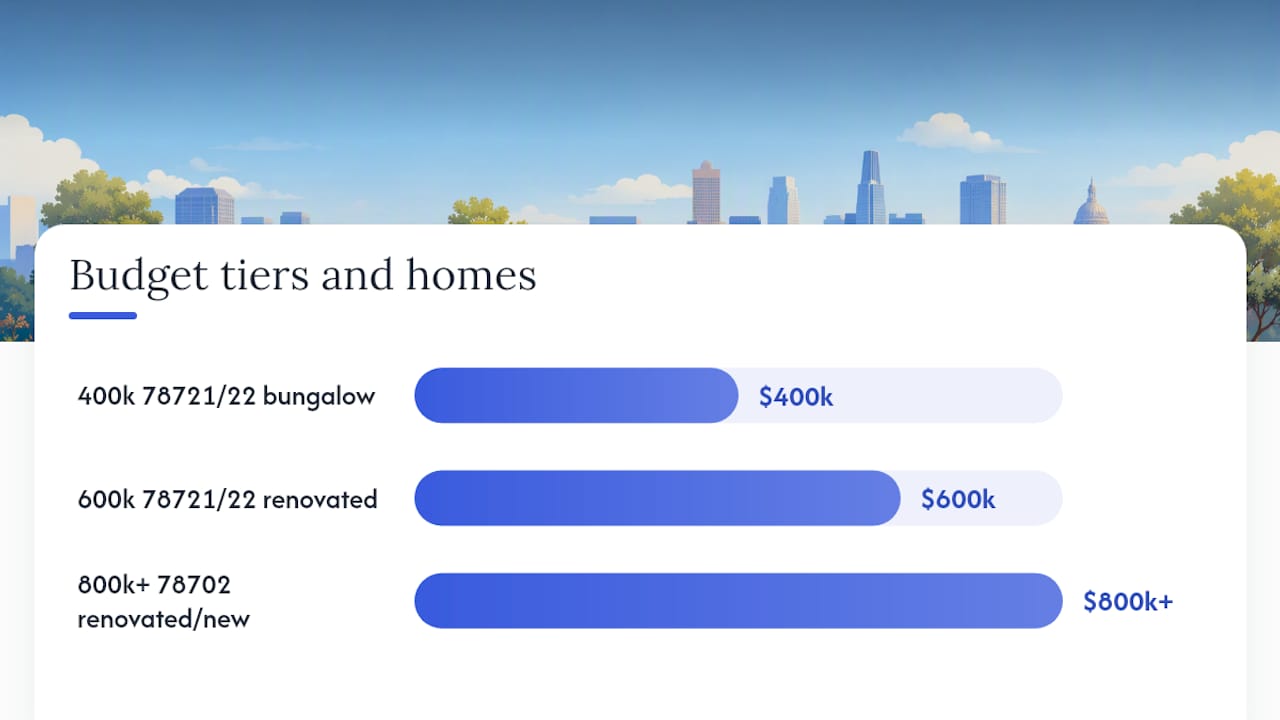
On those assumptions, Home B has the lower estimated purchase-plus-repair cost. Lower repair expense alone does not establish less work or disruption. Home A could become preferable if a negotiated price or a reliable, smaller repair scope changes the comparison, or if a feature you need justifies its added expense. Before choosing, confirm how and when repairs would be paid for, then compare recurring bills and ownership obligations. A shared-lot or condominium arrangement may divide responsibility for land, buildings or common areas; read the documents to learn what you would own, maintain and pay for. Repairs ending does not end those obligations.
Where to Eat, Drink, and Spend a Saturday
Build part of your tour around places you would actually visit. Use the existing dining and entertainment listings as ideas, then confirm opening hours and visitor information with the venue. A destination only adds practical value to your home search if the route and hours fit your routine.
- Choose a restaurant or music venue you would use regularly, then test the trip from the home and the return journey after dark.
- If Six Square or Huston-Tillotson University is on your itinerary, consult the institution’s own event and visitor information before planning a stop.
- For a visit to Lady Bird Lake, Festival Beach or the Boggy Creek Greenbelt, identify the entrance and activity you want. Check the route, public access and any posted restrictions rather than assuming every location supports the same activities.
- For a Thinkery visit or another scheduled activity, confirm current admission details and hours. Include the travel and parking experience in your property notes.
Getting Around: Walkability and the I-35 Question
Compare complete journeys rather than neighborhood scores. For walking or cycling, inspect crossings and the route you would actually take. For transit, use CapMetro’s trip planner with your destination and travel time, then check schedules and service alerts. Repeat the check for the return journey; a workable morning trip is not enough if service does not fit your evening routine.
For routes affected by the I-35 expansion, distinguish the project’s broad construction periods from conditions on your route. TxDOT’s phasing graphic, marked tentative as of June 11, 2026, lists construction for the Lady Bird Lake segment from Holly Street to SH 71/Ben White during 2025–2033, drainage during 2025–2029 and downtown during 2027–2033. These periods are subject to change and do not establish a particular home’s noise exposure or commute delay. Check current closures and test the crossings your routine depends on; repeat that check as construction phases change.

Schools, Families, and Checking Safety Block by Block
If a particular school is essential to your purchase, verify the exact address through AISD’s School Finder before relying on the assignment. AISD’s 2026–27 enrollment information distinguishes enrollment at a zoned school from transfers and admissions-based or magnet programs. General transfers require an Enroll Austin application, are limited by school capacity and are assigned by lottery; some programs require separate admissions steps. Check the applicable requirements, dates and availability. If a home only works with a transfer, an application alone does not establish that the home meets your school needs.
Describe the features you need instead of ranking neighborhoods by household type: a usable yard, a comfortable school route, manageable traffic or access to a particular park. Visit at relevant times to observe those conditions. If you consult crime data, check its date range, geographic coverage and what incidents it records. Neither a brief visit nor an incident map can guarantee future safety, and a neighborhood name is not a substitute for examining the specific conditions that concern you.
A Practical Checklist for Touring East Austin Homes
Before making an offer, turn your tour notes into conditions the property must meet. Use the same checks for each candidate so an attractive asking price does not hide a mismatch.
- Walk the route to a destination you would use regularly. If the crossings or evening conditions do not work for you, remove that access benefit from your reasons to pay more.
- Check usable yard space and the documents defining your rights to it. Confirm whether the area is yours to use exclusively or is shared before counting it toward your space needs.
- Check the address in AISD’s School Finder and review any separate transfer or admissions process. If an unconfirmed placement is essential, the home’s suitability remains unresolved.
- For new construction or added living space, compare the property with available permit and inspection records. For a condominium or shared-lot arrangement, request the governing documents and identify maintenance duties, charges, approval requirements and use restrictions.
- Revisit when you would normally arrive home. Check noise and legal parking options, including whether the property’s documented parking meets your needs.
If you see signs of water intrusion or drainage problems, obtain an assessment and a repair scope before accepting the price. If advertised living space includes an addition, garage conversion or detached unit, verify its documented use and approvals rather than treating it as a cosmetic update. If shared-property documents leave responsibility for a roof, driveway or drainage unclear, seek clarification before proceeding. An unresolved cost or restriction can justify a different offer—or choosing another home.
Pro Tip: Match permit records to the work you can see, especially additions, conversions, structural changes and detached living space. Ask about missing records or unresolved inspections. Permit documentation helps explain what was approved, but it does not replace an inspection of the home’s present condition.
Who Lives Here: Demographics and Cultural Identity
Approach neighborhood history through records and institutions that document it. A historic building can be a starting point for learning about a place, but its appearance alone does not establish its age, significance or the identities of nearby residents. Look for attributed histories, archival material and public programs rather than treating a real-estate description as a demographic account.

If demographic change matters to your understanding of an area, look for dated data with clearly defined geography. A ZIP-code statistic should not be presented as a description of everyone on a particular street. Likewise, architecture and asking prices do not establish residents’ ages, occupations, household types or length of residence.
For your housing decision, focus on observable needs while learning about the place on its own terms. Attend a public event, read an institution’s account of its history or explore a documented walking tour. Use that experience to understand what you value about the area, without making assumptions about who lives there or who belongs there.
What Investors Should Know About Renting Here
For an investment purchase, start with evidence for the specific property and intended lease. Compare recent, similar rentals by size, condition, ownership arrangement and location; distinguish asking rents from documented lease results. Proximity to a destination may help explain a property’s appeal, but it does not establish occupancy, achievable rent or future appreciation.
Compare expected rent with financing, taxes, insurance, maintenance, management and any association charges, allowing explicitly for vacancy and turnover. Test what happens if rent is lower or repairs are higher than expected. If the purchase only works with uninterrupted occupancy or resale gains, those dependencies should change your offer or eliminate the property. A neighborhood’s reputation cannot supply the missing income evidence.
Before relying on rental income, verify that the intended use is permitted under the property’s governing documents and applicable City requirements. For a condominium or shared-lot property, examine lease restrictions, approval requirements and responsibility for shared expenses. If the plan depends on short-term rentals, obtain current City of Austin licensing and code requirements for the specific property; do not assume owner occupancy alone settles eligibility. If the intended use is unavailable, evaluate another permitted use on its own economics or choose another property.
Where Development Is Headed Next
Evaluate nearby development by its documented stage: a proposal, an approved plan, funded work or active construction. Those stages carry different levels of certainty. Before giving a proposed amenity weight in your offer, identify what is committed, what remains contingent and whether the home still fits your needs if the project changes or arrives later than expected.
Use the same test for a home in 78721 or 78722: compare its present condition, permitted use, ownership costs and access with the alternatives you can buy now. Nearby construction does not by itself establish a bargain or future appreciation. A purchase that already meets your needs is less dependent on a hoped-for change in the surrounding area.
Keep the City’s Our Future 35 cap-and-stitch initiative separate from TxDOT’s highway construction schedule. Caps and stitches are planned spaces or connections over the highway. The City records a May 22, 2025 Council action authorizing negotiation and execution of an advance-funding agreement with TxDOT for specified roadway elements. That action does not establish completed public spaces, guaranteed amenities or a property-value benefit. Base today’s route comparison on available crossings, and revisit it as construction phases and access change.
ATXCasa’s Local Read: Where Opportunity and Caution Meet
My recommendation is to compare homes that meet the same needs before deciding which neighborhood offers better value. In the hypothetical example, the lower-priced home has the higher purchase-plus-repair total. I would favor the other home on those assumptions, then check recurring costs, ownership restrictions and repair timing before making that choice final. For an East Austin shortlist, I would also test the routes affected by I-35 work and verify any essential school assignment by address.
Change the recommendation when verified costs or a feature you need changes the comparison—not because a ZIP code is assumed to appreciate faster. For another way to organize your search, ATXCasa’s neighborhood breakdown is additional reading. Keep the decision tied to the properties in front of you: what they cost, what you can use and maintain, and whether their daily routes work.
— Vladimir
Get the Full East Austin Market Picture From ATXCasa
Want help choosing between East Austin homes? Ask Vladimir Baibus · ATXCasa to help compare your shortlist by repair needs, ownership terms and daily routes. Bring the listing addresses, your budget and the destinations you need to reach. The goal is to identify which property fits—and which unresolved cost or restriction needs an answer before an offer.

For related reading, start with ATXCasa’s market pattern analysis. The 2025 buyer opportunity piece provides an earlier-period perspective; do not treat its 2025 framing as evidence of current conditions. You can also browse the neighborhoods and lifestyle library or the ATXCasa blog for related articles. Use current property records, repair estimates and comparable transactions to support the offer itself.
Sources
The construction discussion draws on the phasing graphic on TxDOT’s Capital Express Central project page, marked tentative as of June 11, 2026; schedules remain subject to change. The cap-and-stitch discussion uses the City’s Our Future 35 record of the May 22, 2025 Council action. AISD’s 2026–27 enrollment information supports the school-assignment and application guidance, and CapMetro’s rail information supports the trip-planning guidance. These sources do not establish property prices, rental performance or appreciation. The purchase-and-repair comparison is explicitly hypothetical. The existing neighborhood links below are background reading, not verification of current market outcomes.
FAQ
What areas of East Austin are nice to live in?
Cherrywood, French Place, and Mueller consistently rank among the more livable pockets for families, thanks to quieter streets and closer park access. East César Chávez and Holly suit anyone prioritizing walkable dining and nightlife over quiet.
What part of Austin should I stay away from?
There’s no single part of East Austin to avoid outright; safety and upkeep vary block by block rather than by neighborhood name. Pull current Austin crime maps and walk the specific street you’re considering, since a strong block can sit right next to a weaker one.
What ZIP codes make up East Austin?
East Austin’s core spans ZIP codes 78702, 78721, and 78722. 78702 covers the most gentrified and walkable stretch near East César Chávez, while 78721 and 78722 extend farther east and offer more relative value.
What towns sit east of Austin, Texas?
Manor and Elgin are the closest towns directly east of Austin, both well outside the East Austin neighborhoods covered here. Within city limits, the district’s eastern edge blends into Springdale and Johnston Terrace before reaching those outlying towns.
Is 78702 a good investment right now?
78702 is a mature, already-gentrified market, so treat it as stable rather than a growth play. Investors chasing appreciation and lower entry prices tend to look toward 78721 and 78722 instead, where infill activity is still reshaping the market.