
Austin first-time buyers can compare City and state down payment assistance (DPA), but each program has its own rules. The City of Austin offers DPA of up to $40,000 for eligible buyers’ down payment, closing costs and prepaid expenses. TDHCA’s My First Texas Home is a separate statewide program with its own terms. Before relying on City funds, confirm that the property is inside Austin’s Full Purpose city limits and that your lender participates. Complete the required education, confirm program availability and seek help matching your home search to your financing.
TL;DR:
- City DPA requires an eligible first-time buyer, household income at or below 80% of median family income, and a single-family home or condominium inside Austin’s Full Purpose city limits. Buyers also need homebuyer education, an official completion certificate and mortgage approval from a City participating lender.
- My First Texas Home lists assistance of 2%–5% of the total loan amount, funding permitting, and a minimum middle FICO credit score of 620. Manual underwriting is permitted for FHA, VA and USDA loans with a maximum 45% debt-to-income ratio; the matrix also lists an FHA .25 loan-level price adjustment, whose effect on pricing your lender should explain.
- Closing costs typically run 2% to 5% of the purchase price, and buyers must receive the Closing Disclosure at least three business days before closing.
- Before relying on City DPA, check the City’s current income table, its displayed $440,000 sales-price ceiling and the property’s location. Confirm that your mortgage approval comes from a City participating lender; the displayed lender list is labeled FY ’23–’24, so verify participation directly.
Table of Contents
- What local assistance and programs are available in Austin
- Who qualifies and the paperwork you need to secure assistance
- Practical tactics to be competitive in Austin’s hot market
- Costs and timeline: what to expect at closing in Austin
- Where to get help: HUD counselors, local nonprofits, and required education classes
- ATXCasa: how our local expertise helps first-time buyers in Austin
- What the market actually rewards right now
- Ready to start? Request an ATXCasa consult
- FAQ
- Sources
What local assistance and programs are available in Austin
The City of Austin’s Down Payment Assistance program says eligible first-time buyers may qualify for up to $40,000 toward a down payment, closing costs and prepaid expenses. Its page lists a $440,000 sales-price ceiling and household income at or below 80% of median family income. The property must be a single-family home or condominium inside Austin’s Full Purpose city limits; an Austin mailing address alone does not establish eligibility. Buyers must complete homebuyer education, receive an official certificate and obtain mortgage approval from a City participating lender.
For state program information, see TDHCA’s My First Texas Home and My Choice Texas Home programs. The My First Texas Home matrix published August 17, 2026 covers FHA, VA and USDA loans: a 30-year fixed-rate mortgage repaid through scheduled payments, with assistance of 2%–5% of the total loan amount, funding permitting. Income and purchase-price limits apply separately from City rules. The assistance is a second mortgage, with distinct consequences: the 0% deferred option postpones repayment but becomes due upon sale, refinance, transfer or payoff of the first mortgage. The 0% forgivable option is fully forgivable after 36 months only if its conditions are met, including keeping the first mortgage current and the home as your principal residence. Compare the lender’s rate, fees and assistance terms before choosing; these terms should not be assumed to apply to My Choice Texas Home.
HUD-approved housing counselors sit alongside both programs rather than replacing them. A counseling session typically covers budgeting, credit review, and which assistance source fits your situation, City DPA, state DPA, or a combination where program rules allow it.
A few practical notes worth keeping in mind:
- Sales-price caps and income limits change periodically, so always verify current numbers on the official program pages before you count on a specific dollar figure.
- Participating lender lists are maintained separately by each program, and using a lender outside that list can disqualify your DPA application.
- FY26 proposals have discussed raising DPA caps, so check for updates before assuming the current maximum applies to your purchase.
Who qualifies and the paperwork you need to secure assistance
The City defines eligible first-time buyers as people who have not owned a home in the last 3 years and also includes displaced or divorced applicants. Its household income ceiling is 80% of median family income. My First Texas Home instead uses a rule about not having owned and occupied a primary residence in the prior 3 years, with listed exemptions for veterans and purchases in targeted census tracts. Separate income and purchase-price limits apply to that state program; the City’s income ceiling is not a blanket rule for both.
Here’s the paperwork sequence that keeps an application moving:
- Complete the education your selected program accepts and keep the certificate. The City requires a listed homebuyer education course and an official certificate before assistance; its page lists a $99 course fee plus a handbook. My First Texas Home requires each borrower to complete a pre-purchase HUD-Certified course and provide a certificate.
- Secure a full mortgage preapproval letter from a lender who participates in the City or TDHCA program you’re using.
- Gather the documents required by your selected program. My First Texas Home specifically requires a Texas Residency Affidavit at closing and occupancy as your principal residence within 60 days, along with its other transaction documents; confirm City documentation separately if using City DPA.
- Submit lender participation forms alongside your loan application so the DPA funds can be layered into your closing package.
Each of these steps has its own processing time, so starting the education course early avoids last-minute delays once you’re under contract.
Practical tactics to be competitive in Austin’s hot market
Assistance money only helps if your offer actually gets accepted. Local lender and credit union guidance consistently points to a few moves that matter more than price alone.
- Get a full mortgage preapproval, not a prequalification, since sellers and listing agents can usually tell the difference and weigh offers accordingly.
- Work with an agent who understands which neighborhoods fall inside Austin’s Full-Purpose limits and which lenders are already approved for your DPA program.
- Submit clean offers with minimal contingencies and flexible closing dates when your finances allow it.
- Widen your neighborhood search slightly. Areas just outside the priciest corridors often carry DPA-eligible price points without sacrificing commute times.
- Use earnest money strategically. A stronger deposit signals seriousness without requiring you to waive protections you actually need.
A personal appeal letter can help in a close call between similar offers, but it can also backfire if it reveals information a seller could use against you in negotiation, so keep it brief and focused on the transaction.
Pro Tip: Ask your lender for a same-day preapproval letter refresh whenever you submit an offer, since sellers often check the issue date.
Costs and timeline: what to expect at closing in Austin
Closing costs typically run about 2% to 5% of the purchase price, covering lender fees, title insurance, recording fees, and prepaid items like property tax and insurance reserves. Buyers must receive their Closing Disclosure at least three business days before closing, which gives you time to compare it line by line against your original Loan Estimate.
City assistance covers down payment, closing costs and prepaid expenses. My First Texas Home assistance is a second mortgage: its deferred option must be repaid upon sale, refinance, transfer or payoff of the first mortgage, while its forgivable option requires 36 months and the stated principal-residence and current-first-mortgage conditions. Have the participating lender confirm how funds may be applied and the final cash you must bring to closing. Less cash needed now does not necessarily mean less to repay later.
The typical sequence runs:
- Offer accepted and earnest money deposited.
- Inspection period, followed by any negotiated repairs.
- Appraisal and underwriting review.
- For covered mortgage loans, the lender must provide the Closing Disclosure at least 3 business days before closing so you can compare final terms and costs with the Loan Estimate. CFPB lists exceptions, including reverse mortgages, home equity lines of credit, certain manufactured-housing loans not secured by real estate and certain homebuyer-assistance programs.
- Closing and funding.
Where to get help: HUD counselors, local nonprofits, and required education classes
HUD-approved housing counselors are a free resource for navigating program rules, and the CFPB’s counselor search tool makes it straightforward to find one near you. City of Austin-approved nonprofit providers run the required homebuyer education course, and your completion certificate gets submitted directly to the DPA administrator as part of your application.
- Before relying on City DPA, use the City of Austin Jurisdictions Web Map to verify that the property is within Austin’s Full Purpose city limits. This checks the City program’s location requirement; it does not determine eligibility for every state assistance option.
- Enroll in a HUD-approved education class as soon as you start house hunting, since certificates can take days to process.
- Schedule a counseling session early. Many buyers use it to sort out which combination of City and state assistance actually fits their file.
- Request mortgage preapproval in parallel with counseling so you’re ready to act the moment you find a qualifying property.
ATXCasa: how our local expertise helps first-time buyers in Austin
We focus on providing detailed information first-time buyers in Austin actually need: which blocks sit inside Full-Purpose limits, which lenders are approved for DPA, and which listings are worth a competitive offer. Using marketing techniques and local data helps flag eligible properties quickly rather than after they’ve already gone under contract.
Clients typically receive:
- Neighborhood analysis matched to budget and DPA eligibility.
- Coordination with participating lenders so preapproval lines up with program requirements.
- Offer strategy built around current Austin inventory rather than generic national advice.
Our team leverages significant IT experience to track listings and pricing data for buyers across Austin and nearby areas like Cedar Park, Round Rock, and Georgetown.
What the market actually rewards right now
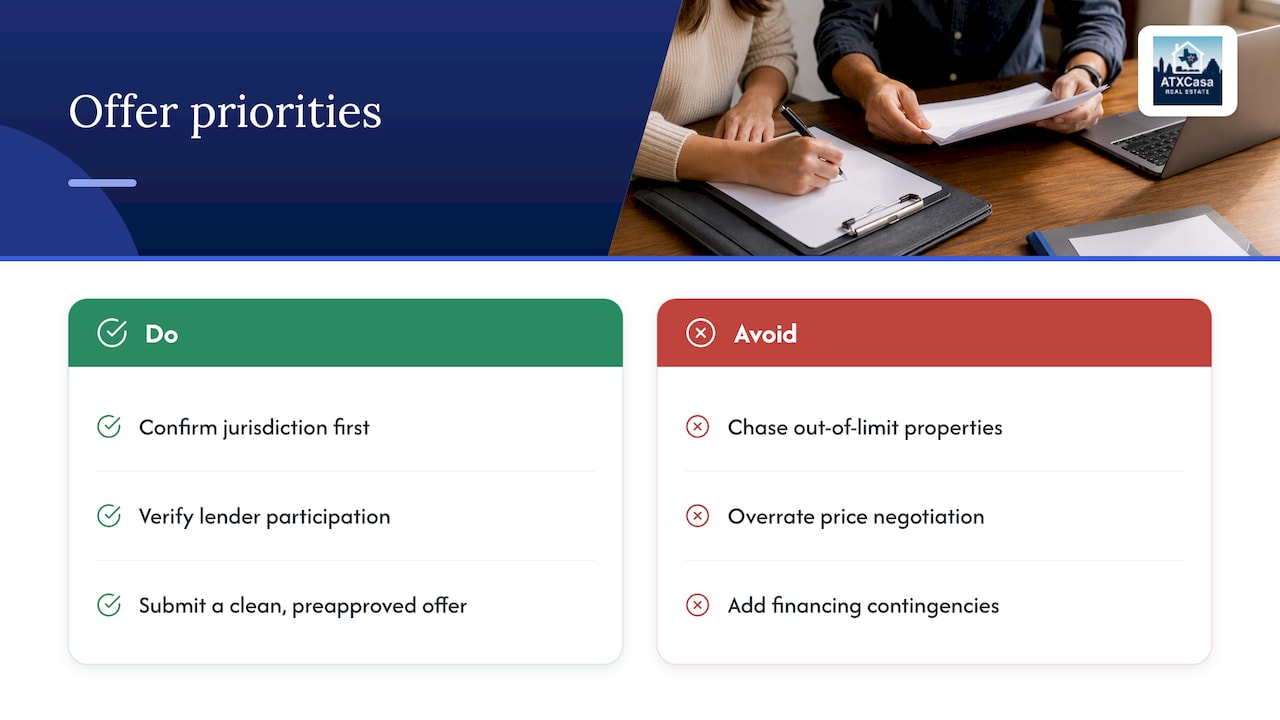
Most generic advice tells first-time buyers to “get preapproved and find a good agent,” which is true but incomplete. The real leverage in Austin right now sits in the overlap between DPA eligibility and jurisdiction mapping: plenty of buyers lose weeks chasing a property that looks affordable until they discover it sits outside Full-Purpose limits and disqualifies their down payment assistance entirely.
If I were advising a friend who planned to use City DPA, I’d start by confirming that the address is inside Austin’s Full Purpose city limits and the lender participates. Those checks establish whether the purchase meets these City requirements before the buyer relies on the funds. I would shape the offer around the buyer’s financing, necessary protections and a closing timeline the lender can support. No offer structure guarantees acceptance, and moving quickly is useful only when the buyer can meet the terms.
— Vladimir
Ready to start? Request an ATXCasa consult
We offer a free consult to check your DPA eligibility, confirm a property’s city-limits status, and review your preapproval before you write an offer.
Start your Austin home search with us and get a clear next step today.
FAQ
Is it a good time to buy property in Austin?
Market timing depends on your personal readiness more than broader conditions, and DPA eligibility and interest rates matter more to your individual outcome than short-term market swings. Getting preapproved and confirming program eligibility now lets you act whenever the right property appears.
Does Texas have a first time home buyer program?
Yes. TDHCA’s My First Texas Home matrix for FHA, VA and USDA loans lists assistance of 2%–5% of the total loan amount, funding permitting, alongside a 30-year fixed-rate first mortgage. Its 0% assistance is a second mortgage: the deferred option becomes due upon sale, refinance, transfer or first-mortgage payoff; the forgivable option requires 36 months and compliance with its principal-residence and current-first-mortgage conditions. Separately, City DPA may provide up to $40,000 for eligible buyers of qualifying homes inside Austin’s Full Purpose city limits. That City boundary does not govern the statewide TDHCA program.
How much do I need to make to afford a $400,000 house in Texas?
Affordability depends on your down payment, interest rate, property tax rate, and other debts, so there’s no single income figure that applies to everyone. A paycheck calculator can help you estimate your take-home pay in Austin and work backward into a realistic monthly payment before you start house hunting.
What salary is needed to live comfortably in Austin, TX?
Comfortable living costs in Austin vary by household size, debt load, and housing choice, so there’s no universal salary threshold. Reviewing your expected take-home pay against local housing costs, including closing costs of roughly 2% to 5% of your purchase price, gives a clearer personal benchmark than a general number.
Sources
- Austintexas
- Texas Department of Housing and Community Affairs (TDHCA) welcomehome portal
- Consumer Financial Protection Bureau — Preparing to buy a home
- CFPB Your home loan toolkit (HUD counseling guidance)