

Your mortgage quote is higher than the rate in the headlines. Before choosing a lender or locking a rate for an Austin-area home purchase, should you push back—or accept that your offer is different?
Use the national average as context, then judge your quote against comparable written offers. A higher rate deserves an explanation, but the headline alone cannot establish whether your loan is expensive. A lower rate may also require more money upfront.
Freddie Mac’s September 10, 2026 Primary Mortgage Market Survey, or PMMS, reported a national 30-year fixed mortgage average of 6.76%. That is a dated benchmark, not an Austin rate or an offer available to every borrower. The practical question is what each lender would charge you for the same loan, at the same time.
A lower rate can require more cash upfront
Consider this hypothetical purchase: a $500,000 home with 20% down and a $400,000 mortgage. Both offers are conventional, owner-occupied, 30-year fixed loans issued on the same day, with the same rate-lock period. All other costs and assumptions are identical.
Offer A uses the benchmark’s numerical rate only to illustrate the comparison; neither offer is an actual lender quote. Discount points are an upfront charge for a lower interest rate. One point equals 1% of the loan amount.
| Loan detail | Offer A | Offer B |
|---|---|---|
| Interest rate | 6.76% | 6.5% |
| Discount points | $0 | $4,000 |
| Other lender fees | $1,200 | $1,200 |
| Points plus lender fees | $1,200 | $5,200 |
| Monthly principal and interest | $2,597.05 | $2,528.27 |
These payments cover repayment of the loan and interest only. They exclude property taxes, homeowners insurance, any mortgage insurance and other housing expenses. The upfront figures exclude the down payment and non-lender closing costs.
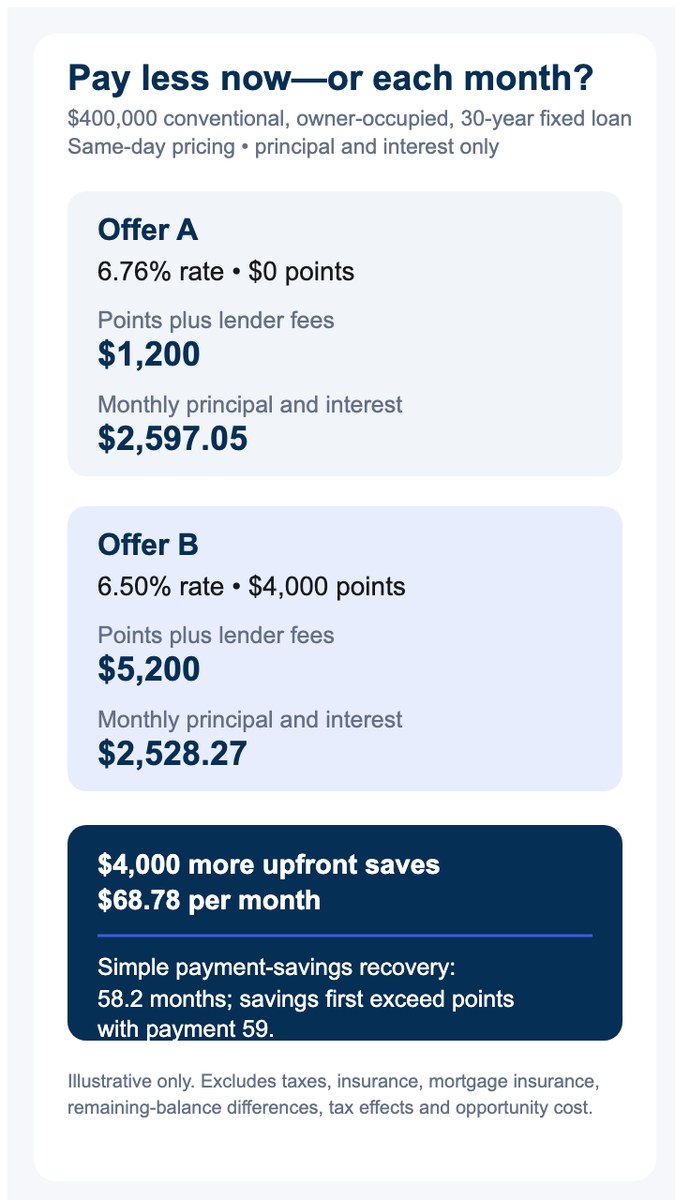
Offer B saves $68.78 per month in principal and interest but requires $4,000 more upfront. Dividing that extra cost by the monthly savings gives a simple recovery period of 58.2 months: the accumulated payment savings first exceed the points cost with the 59th monthly payment.
If you expect to sell or refinance before that point, Offer A preserves cash that Offer B’s payment savings would not yet have recovered. If you expect to keep the mortgage beyond that point and can comfortably pay the extra $4,000, Offer B may be worth considering. After the recovery point, its lower principal-and-interest payment continues for as long as you keep the loan under these assumptions.
This is a payment-savings screen, not a complete economic break-even calculation. It excludes differences in remaining loan balances, tax effects and what your cash could earn elsewhere. Keeping the home is also different from keeping the mortgage: refinancing ends this comparison. Either borrower might later refinance, but future rates and eligibility are uncertain.
Why the headline cannot settle the comparison
Freddie Mac builds PMMS from thousands of mortgage applications submitted by lenders nationwide through its Loan Product Advisor system. Its stated sample covers selected purchase applications for conventional, single-family loans within conforming loan limits—the loan-size limits for that category. It does not represent every borrower or mortgage product.
The weekly figure averages rates offered during the preceding Thursday-through-Wednesday application window. Your quote may reflect different timing and loan assumptions.
There is another important gap: Freddie Mac does not publish average points and fees because lenders do not always report them. You therefore cannot tell from 6.76% alone what upfront costs accompanied the rates in the average. The benchmark is useful context, but it cannot rank complete offers.
Make lenders price the same request
For a specific purchase, compare written offers using the same property, borrower information, loan amount, down payment, occupancy, loan type and term. Ask for quotes at the same time and with the same lock period—the length of time the quoted rate would be held. Confirm whether each rate is actually locked.
Then separate the comparison into these questions:
- What loan am I getting? A fixed-rate loan and an adjustable-rate loan have different future payment behavior. Resolve that difference before ranking their starting rates.
- What am I paying for the rate? Compare discount points, other lender fees and any lender credits. Ask each lender to price a zero-point option if you want to see the cost of keeping more cash upfront.
- What will the home cost each month? Compare principal and interest separately from taxes, insurance and any mortgage insurance. A smaller estimate for insurance does not establish that the mortgage itself is cheaper.
- What could change later? Identify possible rate or payment changes and the assumptions behind the estimates before committing.
The Consumer Financial Protection Bureau recommends requesting and comparing Loan Estimates from multiple lenders after a home offer is accepted. A Loan Estimate is a standardized form showing the estimated rate, payment, closing costs, taxes and insurance, along with possible future rate or payment changes. Using the same form makes differences easier to locate.
For the purchase mortgages discussed here, the lender must provide a Loan Estimate within 3 business days of receiving an application. The form is not a loan approval. Before you have a specific property, preliminary written quotes can help you plan, but their assumptions still need to match.
If a lender’s offer remains more expensive after you align the assumptions, ask: “What explains the difference in rate or lender costs, and what would change your offer?” A clear explanation lets you decide whether the difference is acceptable. If equivalent offers provide the same loan on the same timing, lower costs favor the cheaper offer; a national average alone cannot supply that comparison.
Use the comparison to set your Austin home budget
For an Austin-area purchase, my recommendation is to connect the loan comparison to the property you intend to buy. Use the same property-specific tax and insurance assumptions across lender offers. Otherwise, one estimate can appear easier to afford simply because it allows less for expenses outside the loan.
If you are considering an older home, obtaining an insurance quote helps replace an allowance with information about that property. Our guide, Buying an Older Austin Home? Get the Insurance Quote Before the Option Period Ends, addresses that next step. Neither the national benchmark nor this hypothetical example establishes your actual Austin-area housing payment.
Choose based on comparable costs and how long you reasonably expect to keep the mortgage. Paying points can fit a longer holding period; keeping cash upfront can fit a shorter or uncertain one. If either choice leaves too little money for your planned move and property expenses, reconsider the purchase budget before committing.
Contact Vladimir Baibus at ATXCasa for help connecting your lender’s payment estimate with an Austin-area home search and identifying the property-cost questions to resolve before you choose. Your lender can confirm the available loan terms; we can help you use that information in the housing decision.
Vladimir Baibus · ATXCasa · LPT Realty