
A virtual tour is the best way to screen Austin homes before you spend a Saturday driving between Cedar Park, Round Rock and Georgetown, but it only answers part of the question. It shows layout, room sizes and flow. It does not show condition, noise, smell, drainage or what sits behind a closet door. Use the tour to decide which homes deserve a visit, check the numbers against public records, and treat an inspection as a separate, limited visual survey and basic performance evaluation. Review its scope and arrange appropriate further evaluation for concerns outside it.
That is the approach I take with buyers, investors and sellers alike. Below I cover the types of tours you will see on Austin listings, how to read one for useful information, what to verify before you make an offer, and how sellers can make a tour work in their favor.
TL;DR
- “Virtual tour” is used for three different things: an interactive 3D or 360 walkthrough, an edited video, and a photo slideshow. Ask which one a listing actually offers.
- Use a tour to check layout, room sizes, natural light and how rooms connect, then compare the listed square footage with county records.
- A tour can reveal visible clues but cannot provide a reliable condition assessment. Under TREC’s inspection standards, an inspection is a limited visual survey and basic performance evaluation of accessible systems and components, not a comprehensive investigation. Plan for an inspection and seller disclosures.
- Request a live video walk-through of any home you plan to bid on from a distance, and ask the person on the call to open closets and point the camera where you want.
- Sellers get more from a tour that scans every room, including garage, closets and outdoor areas.
Table of Contents
- What a virtual tour of an Austin home actually is
- How to read a virtual tour like a buyer
- What buyers and investors are doing with tours
- What a virtual tour cannot show you
- What to check alongside the tour
- Why a tour does not replace an inspection
- If you are selling: making a tour work for you
- Our perspective
- Working with ATXCasa
- FAQ
- Sources
What a virtual tour of an Austin home actually is
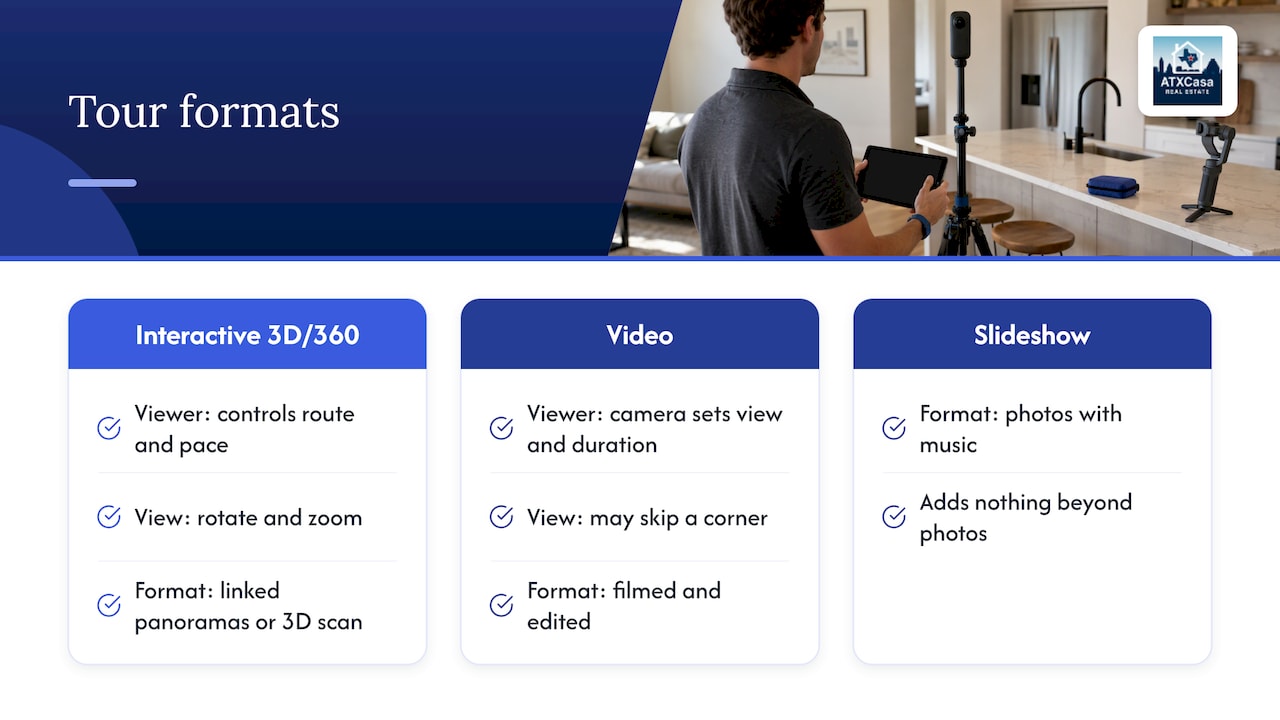
Listing agents use the phrase loosely, so the first step is knowing what you are looking at. There are three common formats.
Interactive 3D or 360 tour. This is a set of linked 360-degree panoramic photos or a 3D scan. You click or tap hotspots to move room to room, rotate the view and zoom into features, so you control the route and the pace.
Video tour. A video is filmed and edited, so the camera operator decides what you see and for how long. It can be well made and still skip the corner you care about.
Slideshow. Some listings call a set of photos with music a virtual tour. It adds nothing beyond the photos.
Agents call all three a virtual tour, which is why I tell buyers to ask which one a listing has before they plan their search around it.
Matterport-style 3D tours and what they include
Many Austin 3D tours are built on Matterport, a scanning system that produces a walkable model. According to one Austin tour studio, a hosted, shareable tour link can be used in the MLS where allowed, in email, text and social media. Where scan conditions allow, the package can also include a dollhouse view, which is a zoomed-out cutaway of the whole floor plan, and measurement tools.
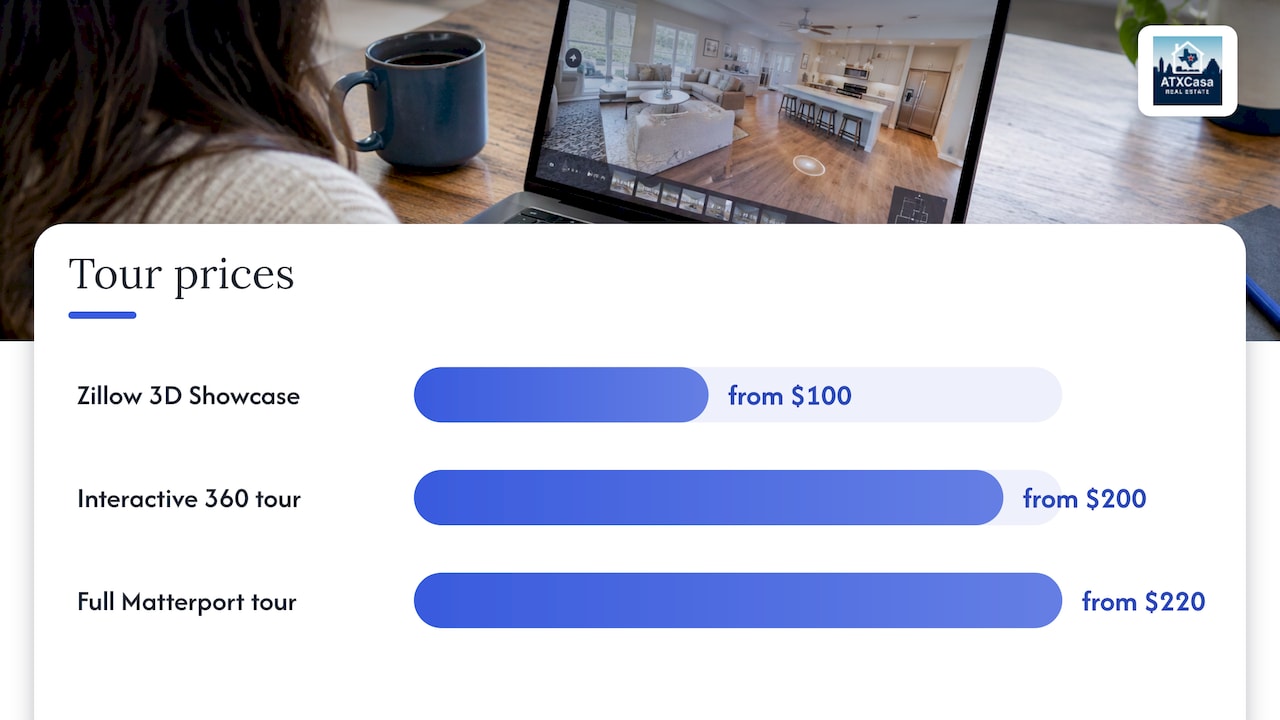
The formats differ by what they offer. An Austin photography company lists a Zillow-hosted 3D Showcase from $100, an interactive 360 tour from $200 without a dollhouse view, and a full Matterport tour with dollhouse view and measurements from $220. Those are that company’s starting prices for listing agents, and I include them because they show a practical point: the cheaper formats may not have the measurement tools you want as a buyer. If a listing’s tour lacks a dollhouse view or measurement mode, treat any room dimension you read from it as a rough estimate.
How to read a virtual tour like a buyer
I suggest going through a tour twice. The first pass is for impressions. The second is for facts, with a notepad open.
Pass one: layout and flow
Walk from the front door as you would on a real visit. Note where the kitchen sits relative to the living area, how far the primary bedroom is from the secondary bedrooms, and whether the main living space has a clear place for a sofa, a dining table and a TV. For families moving to the area, the bedroom arrangement and the distance from the garage entry to the kitchen are often the details that decide a home. Interactive tours let you move between floors and view floor plans, which helps with two-story homes common in Austin suburbs.
If you are comparing layouts that include a detached suite or casita, a guide on how to choose the right layout for homes with guest houses covers the room relationships worth checking.
Pass two: measurements and features
Where a tour has a measurement mode, you can use it to test whether your furniture and appliances fit. Matterport’s case study on a large national brokerage reports that buyers can zoom for detail and use measurement mode to fit furniture and appliances. Take these steps:
- Compare the room dimensions in the listing with the floor plan view in the tour. If they disagree by more than a few inches, ask why.
- Estimate ceiling height by comparing it with a standard door, which is 6 feet 8 inches tall. This is a tip from a home buying guide on checking virtual tours.
- Judge outdoor spaces against familiar objects, such as a parked car, rather than trusting a wide-angle view.
- Look at windows in each room. Note which direction they face using the listing’s lot map, because afternoon sun matters in Central Texas.
- Note the age and condition of visible items: flooring transitions, cabinet hardware, light fixtures, the water heater if it appears. Write down what you want to see in person.
Pass three: build a short list of questions
Put every doubt on a list for the showing or for your agent: a stained ceiling corner, a closet that never appears, a back fence that looks close to the house. A tour is most useful when it turns a vague feeling into a specific question.
What buyers and investors are doing with tours
Virtual viewing is now ordinary. Matterport reports that on one national portal, average monthly 3D walkthroughs rose more than 600% since March 2020, and in a 2020 survey 71% of buyers said they would buy sight-unseen with a 3D tour. The same survey found that 78% worried listing photos had been altered. Those two numbers sit together for a reason: buyers want to see more, and they also want to trust what they see.
For investors, a tour is a fast screening tool. You can rule out a layout that cannot be rented well, such as a bedroom reached only through another bedroom, without leaving your desk. You still need the numbers. For price context, our guide to price per square foot in Austin shows how to turn a listed size into a comparison, and that comparison is only as good as the square footage behind it.
What a virtual tour cannot show you
A tour is a controlled view. Someone chose the scan points, the lighting and the furniture. Several limits are worth knowing.
Gaps in the scan
Some tours do not have enough scan points, and some leave out spaces such as garages, closets and front and back yards, according to a report on what virtual tours show buyers and what they don’t. The same report notes that some 3D images look pixelated compared with professional listing photos. Those are production limits, not home defects, so a blurry room is not a reason to rule a house out. It is a reason to ask for a closer look.
You cannot direct the camera
An executive of a virtual-showing company put the limit plainly: you can’t ask the person on the other end to open a closet, walk over to the window, or point the camera at something that catches your eye. A recorded tour answers only the questions its maker anticipated. A live video walk-through lets you direct it.
Photos can be edited
A consumer report from August 2026 notes that AI tools can alter listing photos to hide damage, change finishes or make features appear that are not there. The experts quoted recommend checking county records for square footage, comparing photos with street-level or satellite imagery, asking for a live video tour before you make an offer or send money, and including an inspection contingency in your contract. A broker quoted in the same report points out that photos can be posed or edited but county-record measurements cannot.
A 3D scan is generally harder to doctor than a still photo, but the habit is the same for any format: confirm the facts that matter outside the listing.
What to check alongside the tour
This is the checklist I give buyers once a tour has earned a home a place on the shortlist.
| Check | Where to look | Why it matters |
|---|---|---|
| Square footage | County appraisal district record, then the listing | Listed size and recorded size can differ, and price per square foot depends on it |
| Lot and surroundings | Street-level and satellite imagery | Shows nearby roads, power lines, commercial uses and the true yard size |
| Seller disclosures | Seller’s disclosure notice in the contract package | Records what the seller knows about the property |
| Permits | City of Austin permit records | Confirms additions and remodels were permitted |
| Property tax | Appraisal district and your lender’s estimate | Taxes affect monthly payment more than many first-time buyers expect |
| Neighborhood at different hours | In-person visit on a weekday evening and a weekend morning | Traffic, noise and parking cannot be scanned |
If you are looking at a new build, the tour is often of a model home or a rendering, not your unit. Our guide to pre-drywall and final inspection scope on Austin new builds explains what each stage covers, and the property tax escrow check for new builds helps you avoid a surprise at closing.
Why a tour does not replace an inspection
The Texas Real Estate Commission’s online Real Estate Inspector Standards of Practice (§535.227) describe a home inspection as a limited visual survey and basic performance evaluation. Ask your inspector which systems and components will be present, visible and accessible at the time of inspection. The City of Austin link attached to that phrase leads to a housing-program document, not TREC’s inspection standards. Under TREC’s standards, accessible areas exclude those requiring furnishings to be moved, specialized equipment or procedures, disassembly, damage or unsafe access. Do not treat a standard inspection as verification of code compliance.
TREC’s standards set minimum inspection requirements, not a comprehensive investigation. The general required scope excludes hidden, buried, latent and concealed items and does not require specialized equipment or procedures, such as a drain or sewer camera. Ask what your inspector’s service includes and arrange further evaluation when a concern falls outside that scope. An inspection is one layer of diligence; the tour is an earlier, lighter one.
Plumbing is a good example, because the most expensive problems are underground and invisible on any tour. A guide on inspecting plumbing before closing explains why drain and sewer lines deserve attention before you commit. Ask your inspector what is included in the scope and whether a separate specialist inspection makes sense for the home’s age and lot.
Two further Texas details are worth understanding before you tour anything. Buyers who work with an agent should know what a buyer agreement means before a home tour, because the rules on representation apply when you start touring. And if someone else is paying for the inspection, read who gets the inspection report in Texas.
If you are selling: making a tour work for you
Buyers use tours to decide which homes to see, so a tour that leaves out rooms costs you showings. A report on tour quality says buyers notice gaps in scan coverage, so these steps help:
- Cover every space. Garage, closets, laundry and both yards are where gaps appear. A buyer who cannot see them may assume the worst or move on.
- Prepare before the scan. Clear counters, open blinds, turn on lights and remove personal items. A scan captures everything at once.
- Make the tour easy to find. A hosted link that works in the MLS, email, text and social media gets more use than a file buried on a page.
- Pair it with accurate numbers. If your listed square footage differs from the county record, buyers who check will notice. Our guide on using Austin sold-home data to price your home shows how to price from comparable sales.
A marketing company’s guide reports, citing NAR research, that listings with 3D tours sell up to 31% faster and draw 60% more online views than photo-only listings. Treat that as a reason to include a tour, not a promise about your sale: price and condition still decide the result.
Our perspective
I come to this from nearly two decades in IT, and I like data-driven tools. A good virtual tour is one of them. It lets a family relocating from another state narrow forty listings to six without a flight, and it lets an investor reject a poor floor plan in two minutes.
What I have learned to say clearly is that a tour is a screening tool. It answers the layout question and leaves the condition question open. We build our guides around the questions clients actually ask, and the one I hear most is some version of whether a tour is enough to make an offer. Our answer is that it is enough to decide what to see next, and that the county record, the seller disclosures and an inspection are what you decide an offer on.
For sellers, the same logic applies in reverse. We use an AI-powered approach to marketing listings so they get maximum exposure, and we price from local data. A complete tour supports that work because it answers a buyer’s first questions before they ever call.
My advice to buyers: tour online, write down your questions, and bring them to the showing. My advice to sellers: show every room.
Vladimir
Working with ATXCasa
If you are buying, selling or investing in the Austin area, including Cedar Park, Round Rock and Georgetown, ATXCasa can help you turn a tour shortlist into a plan. Vlad Baibus pairs local market insight with an AI-powered approach to marketing and data-driven pricing, and clients receive personalized guidance that covers everything from neighborhood trends to hidden home pitfalls. Start at atxcasa.com to tell us what you are looking for.

For more guides on the Austin market, browse our Austin real estate guides and market updates.
FAQ
Can I buy an Austin home after only seeing a virtual tour?
Some buyers do, especially when relocating. In a 2020 survey cited by Matterport, 71% of buyers said they would buy sight-unseen with a 3D tour. If you do, ask for a live video walk-through first, keep an inspection contingency in your contract and check square footage against county records.
What is the difference between a 3D tour and a video tour?
A 3D or 360 tour lets you choose where to go and what to zoom into. A video is filmed and edited, so the camera operator controls the route. Ask the listing agent which format the home has.
How accurate are the measurements in a virtual tour?
Tours with a measurement mode can give useful estimates, and floor plan views let you cross-check room sizes. Treat them as a screening aid and confirm the numbers that matter, such as total square footage, against the county record and your inspection.
Does a virtual tour replace a home inspection in Texas?
No. A Texas inspection covers components that are present, visible and accessible at the time of inspection, and a tour shows even less. Use the tour to choose homes, and the inspection to learn about condition.
What should I ask during a live video tour?
Ask the person on the call to open closets and the garage, run taps, show under sinks, walk the yard edges and point the camera at any ceiling or wall that looked unclear in the recorded tour. Ask about noise from roads and neighbors too.
Sources
- Virtual Tour Real Estate: Complete Guide for Agents
- Austin 3D Tours for Real Estate: Matterport and 360
- Matterport 3D Tours in Austin, TX
- Redfin Uses Matterport to Open Doors Across the Country
- What to check on virtual tours before in-person visits
- Consumer News: AI is taking house-fishing to a new level
- What Virtual Tours Show Buyers and What They Don’t
- TREC inspection report form, City of Austin records