
The most commute-friendly Austin neighborhoods fall into two groups. Central ones (Downtown, East Austin, Hyde Park, Bouldin Creek, Mueller) give you short trips and several ways to get around. Northern suburban ones (Avery Ranch, Anderson Mill, Lakeline in the Cedar Park area) give you more house for the money and a fast drive to the Domain and the north-side employers, but a longer trip downtown. Which group suits you depends on where you work, not on which neighborhood ranks highest. I help buyers sort that out with data, and this guide gives you the same method.
TL;DR
- Start from your workplace address, then test each neighborhood against that one trip at your real departure time.
- Central neighborhoods win on walking, biking and short bus rides. Mueller has strong walkability and trails, though transit there is thinner than Downtown.
- Cedar Park-area neighborhoods suit north-side jobs. Estimated rush-hour trips to downtown run roughly 25 to 55 minutes depending on the starting point.
- Count tolls, parking and fuel next to minutes. A faster toll route is not free.
- Walkability scores are reported by census block group, so they do not describe every street. Check the specific address you are considering.
Table of Contents
- How to define a commute-friendly neighborhood
- Central neighborhoods: short trips and more than one way to travel
- Northern suburbs: Cedar Park, Avery Ranch, Anderson Mill and Lakeline
- Central versus suburban: what you trade
- Count the full cost of the trip, not just the minutes
- Why prices and commutes are linked
- A checklist for testing a neighborhood
- Perspective
- Plan your search around your commute
- FAQ
- Sources
How to define a commute-friendly neighborhood
A neighborhood is commute-friendly for you if three things line up: the trip is short at your actual hours, it has a backup option when the main route fails, and the monthly cost of the trip fits your budget. Distance on a map tells you very little in Austin. Interstate 35, MoPac and the toll roads behave differently at 7:30 a.m. than at noon.
Before you compare neighborhoods, write down:
- Your destination. Downtown, the Domain, a campus, a tech employer in the north or southwest. Austin has several job centers, and a neighborhood that is close to one can be far from another.
- Your hours. A 9 to 5 schedule and a 6:30 start produce very different drive times.
- Your days in the office. With a hybrid schedule, a longer trip two or three days a week can be a reasonable price for a larger yard or lower price per square foot.
- Your household’s second trip. School drop-offs and a partner’s job often matter as much as your own commute.
Central neighborhoods: short trips and more than one way to travel
If you work downtown or at the university, the central neighborhoods are the easiest to defend. You are buying time and options, usually at a higher price per square foot and on smaller lots.
Downtown, East Austin and East Cesar Chavez
The walkability scores here describe selected areas, not a citywide ranking. The Austin Transit Partnership’s 2025 environmental study appendix reports EPA National Walkability Index scores by census tract and block group in Table A-8 for its light-rail study area. It lists 18.8 for Downtown census tract 11.0, block group 1, and 19.3 for East Cesar Chavez census tract 9.2, block group 4.
The appendix reports values by census tract and block group, and scores can differ across the listed block groups. Check the specific street you are considering rather than relying on the neighborhood name.
Hyde Park, West University and Hancock
The same appendix reports scores of 18.0 for Hyde Park, 18.3 for West University and 18.8 for Hancock in the areas it measured. These neighborhoods sit near the University of Texas and the central business district, so a bike ride, a bus or a short drive can all work. They are older, established areas with mid-century and earlier homes, which is part of why inventory is limited and buyers should expect to compete on well-priced listings.
Bouldin Creek, Travis Heights and South Congress
South of Lady Bird Lake, these neighborhoods give you a short trip into downtown without living in a condo tower. An older Neighborhoods.com overview from 2019 put the Bouldin Creek downtown commute at about 10 minutes by car or 20 minutes by bus, and South Manchaca at 10 to 15 minutes by car but about 40 minutes by CapMetro bus. Treat those as a rough shape rather than a schedule: the road trip is short, and the bus trip depends heavily on which part of the neighborhood you live in. Bus routes and frequencies change, so check CapMetro’s route maps for the street you are considering.
A broader look at how north and south Austin differ on price, schools and highway access is in our north versus south Austin buyer tradeoffs.
Mueller
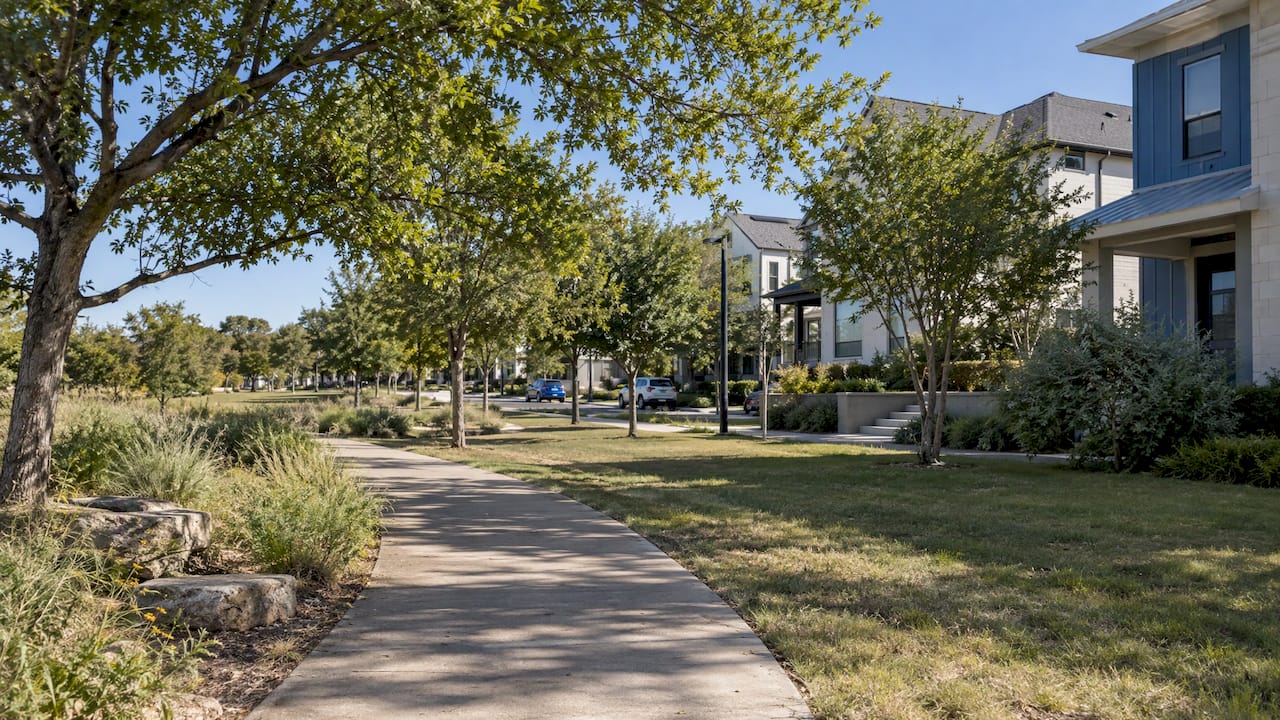
Mueller is a planned community on the site of the former airport. Its official community site describes about 700 acres, roughly three miles from downtown, with 12 miles of trails, 140 acres of parks, homes, retail and restaurants. That mix lets many daily errands happen on foot or by bike, and the downtown drive is short. If you plan to rely on a bus or train for the whole commute, test the route first, because transit service there is thinner than in the urban core.
Mueller also has a notable housing mix. I cover its affordability rules in our Mueller neighborhood breakdown and its history and layout in the Mueller neighborhood guide.
Northern suburbs: Cedar Park, Avery Ranch, Anderson Mill and Lakeline
North-side buyers often care less about downtown than about the Domain, large employers along US 183 and the 183A toll road, or Round Rock. For those jobs, the Cedar Park area works well.
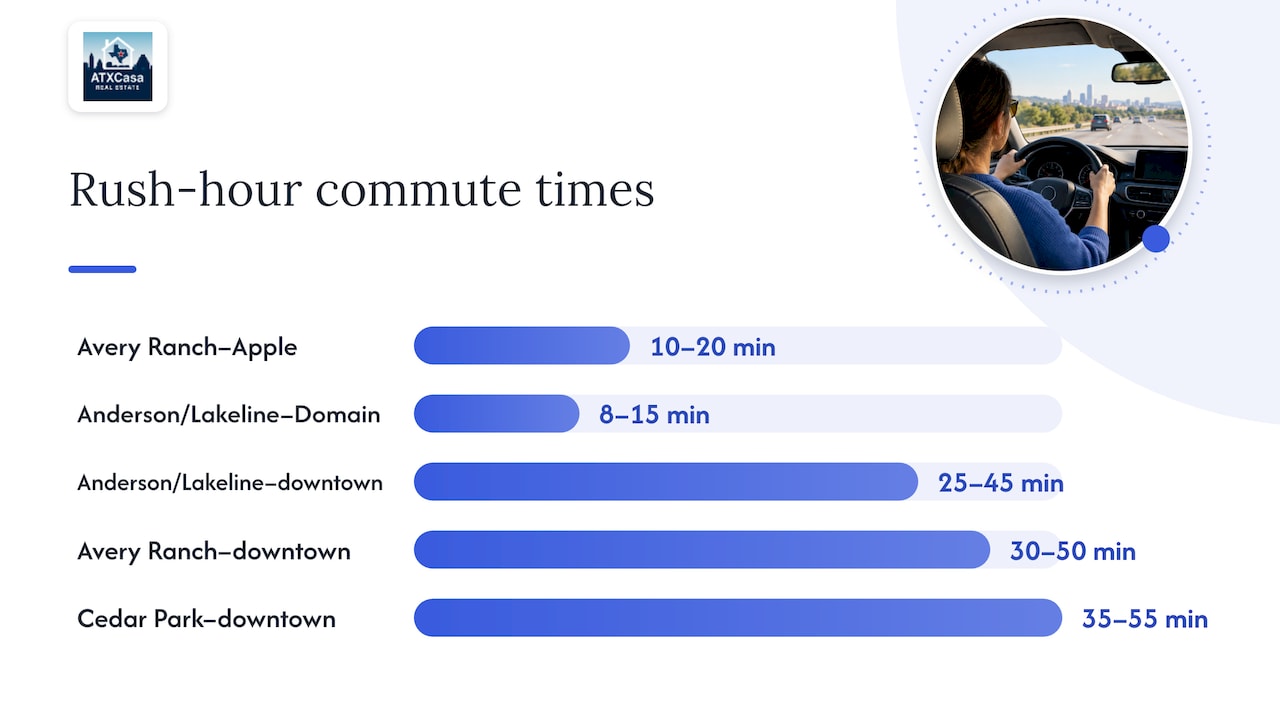
A Cedar Park commute guide published in June 2025 gives rush-hour estimates, assuming toll roads where they apply:
| Trip | Estimated rush-hour time |
|---|---|
| Avery Ranch to Apple (north Austin) | 10 to 20 minutes |
| Anderson Mill or Lakeline to The Domain | 8 to 15 minutes |
| Anderson Mill or Lakeline to downtown | 25 to 45 minutes |
| Avery Ranch to downtown | 30 to 50 minutes |
| Cedar Park core to downtown | 35 to 55 minutes |
The same guide says off-peak trips run 5 to 15 minutes shorter. These are estimates by a local apartment publisher, not guarantees, so use them to rank neighborhoods against each other and then drive your own route at your own hour.
If you want the suburb comparison at a wider scale, including Georgetown and Liberty Hill, see our Georgetown vs. Liberty Hill suburb guide.
Taking the train from the north
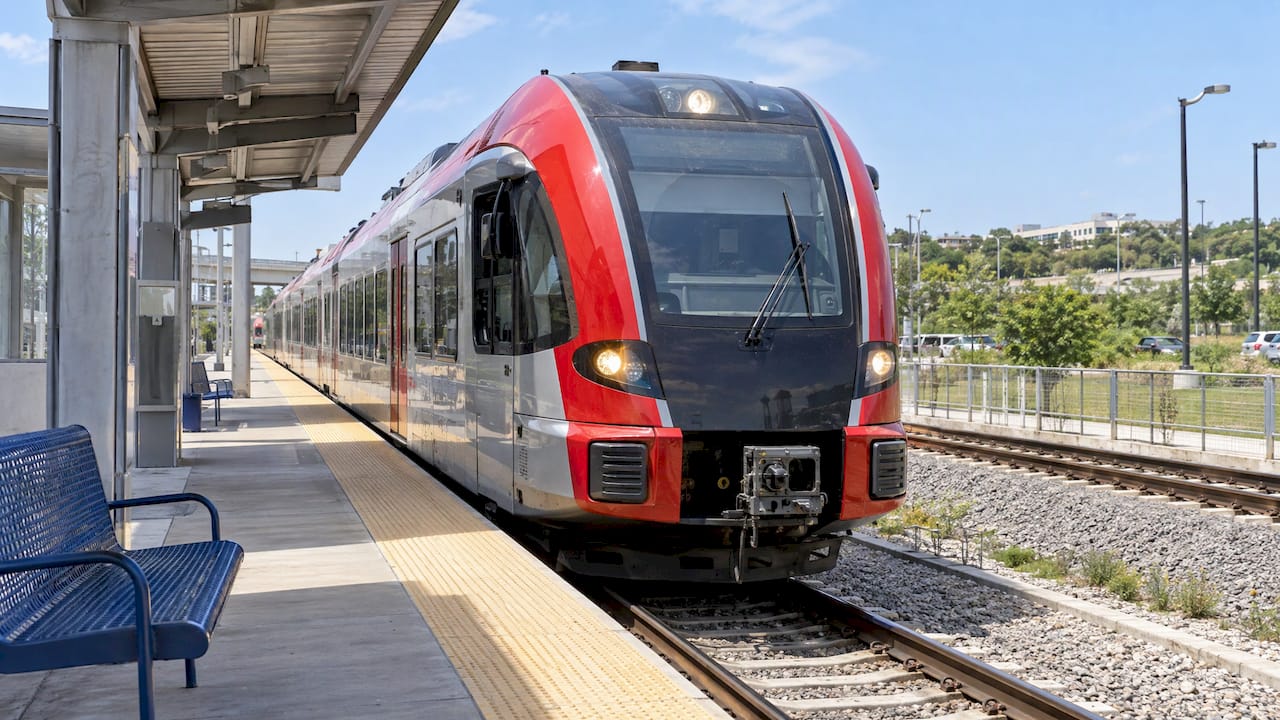
CapMetro’s Red Line is the commuter rail line between Downtown and Leander, with 10 stations. A transit guide for Cedar Park from a Leander community says it runs Monday through Saturday and not on Sunday, with trains roughly every 15 to 30 minutes. A 2026 Cedar Park transit guide estimates 50 to 60 minutes from Lakeline to The Domain, including a 10 to 20 minute transfer wait, and 70 to 80 minutes from Leander.
That is workable for a downtown job with set hours and a parking cost to avoid. It is slow for most other trips. The same 2026 guide lists CapMetro commuter fares of $3.50 per ride, $7.00 per day and $96.25 per month. Fares can change, so confirm them on CapMetro’s site.
Central versus suburban: what you trade
| Factor | Central (Downtown, East, Hyde Park, Bouldin) | Northern suburbs (Cedar Park area) |
|---|---|---|
| Trip to downtown | Short; walk, bike, bus or drive | Longer; mostly drive or rail |
| Trip to The Domain or north jobs | Moderate | Short |
| Home type | Older homes, condos, smaller lots | Newer subdivisions, larger lots |
| Parking | Often limited or paid at the destination | Usually easy at home, paid downtown |
| Backup if the car is out | Bus, bike, rideshare | Limited outside rail hours |
The point is not that one side is better. A central address buys time and flexibility. A suburban address buys space and, for north-side jobs, a shorter daily drive.
Count the full cost of the trip, not just the minutes
A toll road can save 10 to 15 minutes each way and still cost more per month than the extra mortgage payment on a closer home. The Cedar Park transit guide notes that its toll-road drive estimates are faster than the free-road ones, and that its driving comparison leaves out fuel and downtown parking. Add those yourself.
Here is a simple worked example for a household choosing between two homes:
- Home A is closer and costs more. Home B is farther and costs less.
- Estimate round-trip tolls, fuel and parking per workday for each.
- Multiply by the number of office days per month.
- Convert the extra minutes into hours per month. At 20 extra minutes each way, five days a week, that is roughly 14 extra hours a month.
- Compare the monthly cost difference and the hours lost against the monthly payment difference between the two homes.
The cost side of commuting decisions is covered in a guide on weighing commute tradeoffs from a different metro, but the logic of comparing travel time, tolls, parking and fuel against price applies the same way in Austin.
Why prices and commutes are linked
In Austin, a shorter trip to a job center usually shows up in the price. Sold-home data is the best way to see how much. Our neighborhood price patterns analysis looks at what homes actually sold for across the metro, which is a better guide than list prices. If you are a first-time buyer trying to narrow a map, our starter home geography guide shows how to focus the search. If you are drawn to the west side, see our West Austin neighborhoods guide.
For investors, commute access is a rental demand question. Renters near Downtown, the university and the Domain tend to value short trips and transit, so check where the tenant pool works before you underwrite a property. Mueller’s official rental page says about half of its planned 6,900 residences are rentals, a sign of how much of that area is built for renters.
A checklist for testing a neighborhood
- Drive the trip twice, once at your morning rush and once on the way back, on a Tuesday or Wednesday.
- Check the toll on your route and what it costs with and without a tag.
- Look up parking at the destination, or the CapMetro route and fare if you will ride.
- Walk the block. The ATP walkability scores apply to census block groups. Walk the specific street you are considering to the nearest stop, grocery store and park.
- Ask about construction and road projects that could change the route during the years you will own the home.
- Plan for resale. Commute convenience that you value is usually valued by the next buyer too.
Perspective
My read: buyers often start with a list of neighborhoods and only later check whether the commute works. We suggest reversing the order. Put your workplace on the map first, test two or three routes at your real hours, and only then look at homes.
We built ATXCasa around local, current data and practical guides drawn from the questions clients actually ask, because generic portal rankings rarely say how a neighborhood works on a Tuesday morning. That is where our background in technology helps: we look at sold prices, inventory and travel patterns together instead of one at a time.
How I would use this guide: pick a primary destination, shortlist one central and one suburban option, then compare the full monthly cost of each trip next to the mortgage payment. The right answer is usually clear once those numbers sit side by side.
Vladimir
Plan your search around your commute
ATXCasa helps buyers, sellers and investors across the Austin area, including Cedar Park, Round Rock and Georgetown. If you tell us where you work and what your schedule looks like, we can narrow the neighborhoods to the ones that fit your commute and budget, and use local market data to price what you buy or sell.

Start at atxcasa.com, or browse our Austin real estate guides and market updates first.
FAQ
Which Austin neighborhoods have the shortest commute to downtown?
Downtown itself, East Austin, East Cesar Chavez, Hyde Park, West University, Bouldin Creek and Travis Heights are the closest, and many trips can be done on foot, by bike or by a short bus or car ride. Mueller is about three miles out. Your exact street matters as much as the neighborhood name.
Is Cedar Park a good place to live if I work at the Domain?
It can be. A June 2025 local guide estimates rush-hour drives of about 8 to 15 minutes from Anderson Mill or Lakeline to The Domain, assuming toll roads. Drive the route at your own hours before you decide.
Can I commute downtown by train from the suburbs?
Yes, if you live near a Red Line station. The line runs between Downtown and Leander with 10 stations, Monday through Saturday. A local guide puts trips from Lakeline to The Domain at 50 to 60 minutes with a transfer, so it suits downtown jobs better than north-side ones.
Should I pay more for a shorter commute?
Compare the monthly cost of the extra mortgage against the tolls, fuel, parking and time you would save. If you commute five days a week, a 20-minute saving each way adds up to about 14 hours a month. With a hybrid schedule, the math often favors a larger home farther out.
Sources
- Austin Transit Partnership, 2025 Attachment A and B (neighborhood walkability tables)
- Mueller Austin, community website
- Mueller Austin, rental information
- CapMetro, Rail services (Red Line)
- Cedar Park commute guide, June 2025
- MetroRail and public transit guide for Cedar Park, 2026
- Commute from Travisso to Austin
- Best neighborhoods in Austin, Neighborhoods.com (2019)
- Guide to commute tradeoffs and proximity