
For 2026, a conventional loan on a one-unit home in Austin is a jumbo loan once it goes above the applicable $832,750 baseline limit. That is the conforming loan limit FHFA announced on November 25, 2025, and Travis, Williamson, Hays, Bastrop and Caldwell counties all use it. The limit applies to the mortgage amount, not the price of the house, so your down payment decides whether a given home needs a jumbo loan. I wrote this for buyers, sellers and investors who want to see where the line falls on their own numbers.
TL;DR
- The 2026 conforming limit for a one-unit home in Austin and the surrounding counties is $832,750, up $26,250 from $806,500 in 2025.
- Texas has no listed 2026 high-cost area. A conventional one-unit loan above the $832,750 baseline is jumbo.
- The limit is about the loan, not the price. With 20% down, jumbo territory starts near a $1,040,938 purchase price. With 10% down, it starts near $925,278.
- Jumbo loans do not require 20% down in every case. Down payment, credit score and reserve rules are set by each lender.
- Two-, three- and four-unit properties have higher limits, which matters if you are buying an investment property.
Table of Contents
- The 2026 jumbo loan limit in Austin
- Why Austin has no separate high-cost limit
- Limits by number of units
- The limit applies to the loan, not the price
- Where jumbo loans show up in Austin
- What lenders ask for on a jumbo loan
- How to check whether your purchase is jumbo
- Our perspective
- Talk to us before you commit to a loan structure
- FAQ
- Sources
The 2026 jumbo loan limit in Austin
A jumbo loan is a mortgage larger than the conforming loan limit. Fannie Mae and Freddie Mac, the two government-sponsored companies that buy most U.S. home loans from lenders, can only buy loans up to that limit. Anything above it stays with private lenders and investors, who set their own rules.
The Federal Housing Finance Agency (FHFA) sets the limit each year. It updates the limit at the end of each November, and the new figure takes effect January 1. The 2026 baseline rose because the FHFA House Price Index rose 3.26 percent between the third quarters of 2024 and 2025, and federal law ties the limit to that index.
Here is how the one-unit limit has moved:
| Year | One-unit limit in Austin / Travis County |
|---|---|
| 2025 | $806,500 |
| 2026 | $832,750 |
The change is $26,250. Because the limit changes each January, a pre-approval or contract written late in one year can fall under a different limit than one written in the next. The 2026 limits apply to loans delivered to Fannie Mae in 2026, even if the loan was originated earlier. Freddie Mac’s Guide Bulletin 2025-16 applies the same figures to mortgages with settlement dates on or after January 1, 2026. If you are closing near the turn of a year, ask your lender which limit applies to your file.
Why Austin has no separate high-cost limit
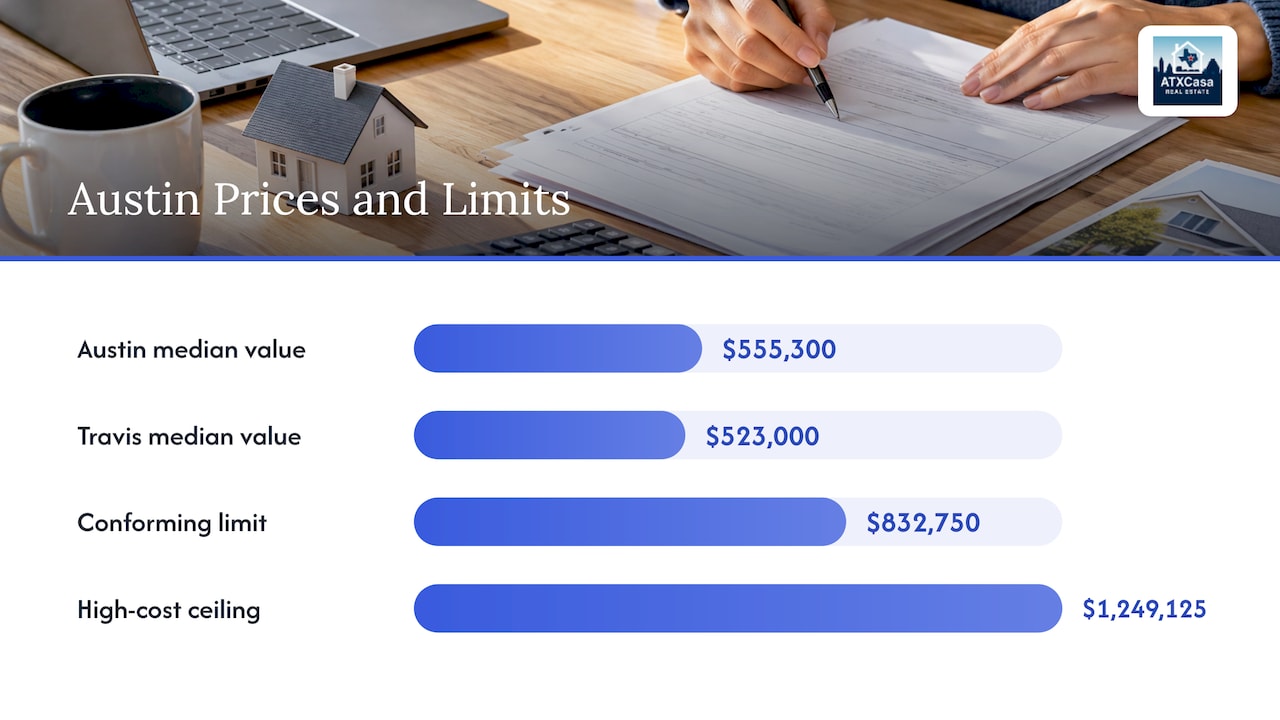
Some expensive metros get a higher conforming limit. FHFA sets those at 115 percent of the highest county median home price in the metro area, capped at 150 percent of the baseline. For 2026 that cap is $1,249,125 for a one-unit home, according to Fannie Mae’s loan limits page.
Austin does not reach that tier. Texas has no high-cost county, so every county in the state uses $832,750 for a one-unit home. Median prices explain why: one local lender’s data puts Austin’s median home value at $555,300 and Travis County’s at $523,000, both well under the limit.
The practical result is that a buyer in Austin, Round Rock, Cedar Park or Georgetown faces the same line. A buyer in a high-cost metro such as San Francisco or New York faces a higher one. Do not compare your options to numbers from those markets.
Limits by number of units
For two- to four-unit properties the conforming limit steps up. This matters to investors who buy a duplex or fourplex, and to owner-occupants who live in one unit and rent the others. The 2026 baseline limits, which apply in the Austin area, are:
| Property type | 2026 conforming limit (Austin area) |
|---|---|
| One unit | $832,750 |
| Two units | $1,066,250 |
| Three units | $1,288,800 |
| Four units | $1,601,750 |
These figures match Freddie Mac’s Guide Bulletin 2025-16. A $950,000 conventional loan on a single-family home is jumbo. A $950,000 duplex loan is within the 2026 two-unit baseline size limit, but it must still meet applicable lender and Fannie Mae or Freddie Mac eligibility requirements. Before you rule a property in or out because of loan size, check how many units the lender counts.
The limit applies to the loan, not the price
For conventional loans delivered to Fannie Mae, the applicable limit concerns the original loan amount. FHFA explains that the conforming limit restricts the size of loans that Fannie Mae and Freddie Mac can purchase, not the price of homes. The boundary is the original loan amount. A one-unit loan of $832,750 is at the limit, and $832,751 is above it.
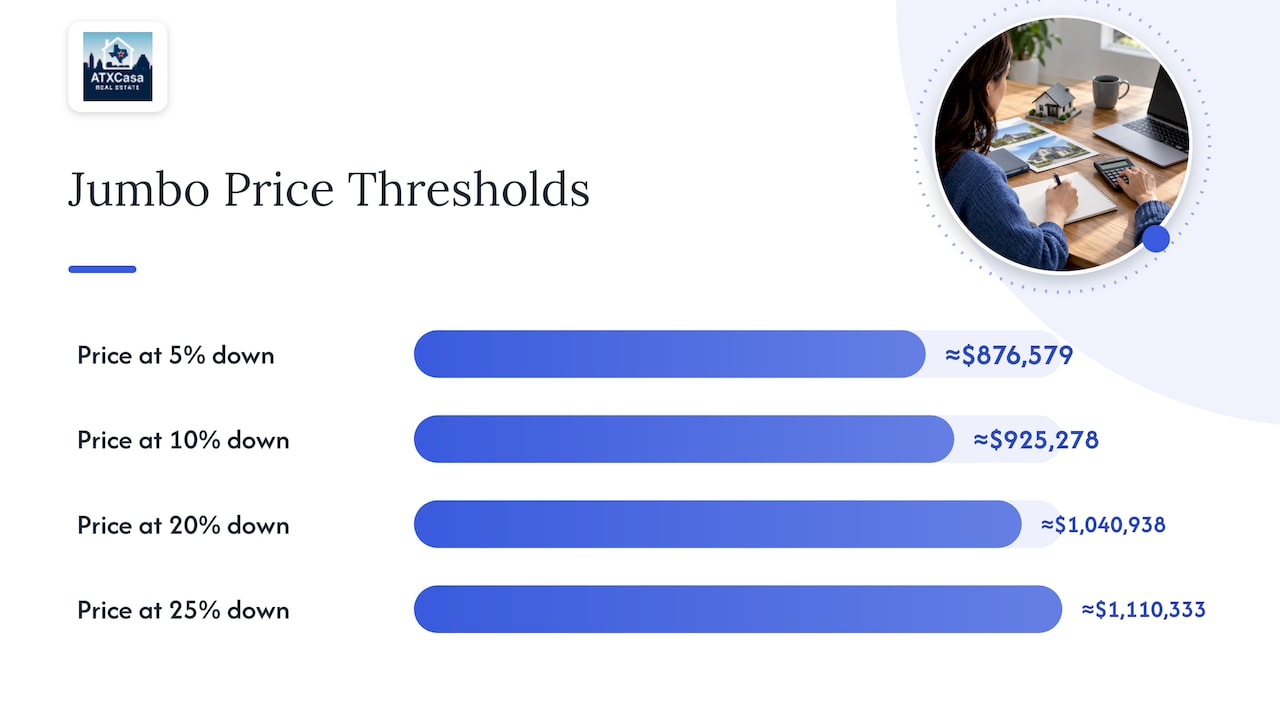
So the price at which jumbo starts depends on how much you put down. The calculation is the limit divided by the share of the price you borrow:
| Down payment | Loan as share of price | Approximate price where the loan reaches $832,750 |
|---|---|---|
| 5% | 95% | about $876,579 |
| 10% | 90% | about $925,278 |
| 20% | 80% | about $1,040,938 |
| 25% | 75% | about $1,110,333 |
Consider a hypothetical $950,000 home purchase in Tarrytown. With 20% down, you borrow $760,000, below the limit. With 10% down, you borrow $855,000, which is $22,250 above the limit and generally requires jumbo financing for a conventional loan. Starting from 10% down, adding $22,250 brings your total down payment to $117,250 and your loan to $832,750. Meeting the size limit does not guarantee eligibility. Compare written quotes for the same property, borrower, loan term and rate-lock period: rate, points, mortgage insurance where applicable, monthly payment, closing costs and required reserves left after closing. A larger down payment reduces borrowing but leaves less cash available. Keeping jumbo financing can make sense if its quoted costs or the value of retaining cash outweigh the benefit of moving within the conforming limit.
The table is arithmetic, not a quote. The down payment you need, any mortgage insurance and your rate come from your lender.
Where jumbo loans show up in Austin
With a median price near $555,000, most Austin purchases never approach the limit. Jumbo loans cluster in neighborhoods where prices regularly pass $1 million. One local lender lists Westlake Hills, Tarrytown, Lake Travis, Barton Creek and Rob Roy as examples.
Three groups of readers should check the line early:
- Move-up buyers and relocating families coming from higher-priced markets, who may assume that a bigger budget is automatically a jumbo loan. In Austin, it often is not if the down payment is large.
- First-time buyers looking at new construction in the $900,000 range with a small down payment. They can land just over the limit without expecting it.
- Investors buying small multifamily properties, where the unit-count limits above can keep a larger loan conforming.
Sellers should care too. If your home sits near $925,000 to $1,050,000, many buyers will be right at the edge of the line. Some will need jumbo financing and some will not. That affects how many buyers can bid and what terms they bring. We look at this when we advise on list price.
What lenders ask for on a jumbo loan
Because Fannie Mae and Freddie Mac do not buy jumbo loans, private lenders and investors set their own credit, income, asset, reserve and property rules. That is why two lenders can give you different answers for the same loan.
No single standard applies, but some typical numbers help you plan:
- Down payment. A 20% minimum is common but not universal. One national lender’s typical requirements list at least 20%, possibly more for larger loans. Another bank says to expect at least 10% as a rule of thumb, with some lenders requiring 25% or 30%.
- Credit score. The same Wells Fargo page lists 720 or higher as typical, and lenders vary.
- Debt-to-income ratio (DTI). This is your monthly debt payments divided by your gross monthly income. The Wells Fargo page lists 43% or lower as typical, but the permitted ratio depends on the lender and the program.
- Cash reserves. These are liquid savings left after closing. Lenders may require 6 to 30 months of expenses, and some ask for at least 12 months of mortgage payments.
- Appraisal and closing costs. Chase notes that jumbo loans may require two appraisals, which doubles the appraisal fee.
Second homes and investment properties often need larger down payments and more reserves than a primary residence. If you plan to rent a property out, tell your lender at the start so the quote reflects it.
How to check whether your purchase is jumbo
- Find the loan amount you are likely to need. Take your target price and subtract your planned down payment. Use the table above as a rough guide.
- Confirm the unit count. A duplex, triplex or fourplex has a higher limit than a single-family home.
- Compare the loan to $832,750 for a one-unit home. If you are over it, price the jumbo option. If you are within about $25,000 to $50,000 of it, price the conforming option with a bigger down payment too.
- Get written quotes on the same terms. A rate headline rarely matches a personal quote, which depends on your credit, down payment and property. Our guide to mortgage rate headlines versus your quote shows how to compare them.
- Ask about reserves and appraisal. Ask which liquid assets must remain after closing to meet reserve requirements, and request itemized appraisal charges. Reserves are assets you retain; appraisal charges are costs you pay. Compare both when deciding how much cash to put down.
- Confirm the applicable limit with your lender near year-end. For loans intended for Fannie Mae, its 2026 limits apply to loans delivered to Fannie Mae in 2026, including loans originated earlier. Your consumer closing date alone does not determine which limit applies.
For a conventional one-unit loan with 5% down, the calculation reaches the $832,750 size limit at a purchase price of approximately $876,579. That price is rounded; check the actual loan amount. A loan equal to the limit is not above it, and eligibility still depends on program and lender requirements. For a smaller down payment, our comparison of low-down-payment loans and mortgage insurance is the more useful read. For buyers who qualify through service, we cover the VA loan path in Austin. If you need help with cash to close, see our page on Austin down payment assistance.
Our perspective
Most Austin buyers who ask us about jumbo loans are actually asking a different question: how much do I need to put down to avoid one, and do I want to? The answer is a number, and it takes about two minutes to calculate. I ran those numbers many times before I became a Realtor, and I still do them for every client who is near the line.
My background is nearly two decades in IT, so I look at this the way I would look at any system with a threshold: find the threshold, then test the inputs on either side of it. For a $950,000 home, a $22,250 change in down payment crosses the line. That is a data question, and we answer it with local numbers, not with a national headline.
We also use the same data-driven approach for sellers. If your home sits in the band where buyers split between conforming and jumbo financing, we price and market it with that in mind. We try to give our clients the full picture, including the details that don’t show up in a listing.
Vladimir
Talk to us before you commit to a loan structure
If your target price is near the line, or you are weighing a duplex against a single-family home, we can run the numbers with you for your property and neighborhood across Austin, Round Rock, Cedar Park and Georgetown. We cover buying, selling and investing, and our guidance ranges from neighborhood trends to the pitfalls that can hide inside a home. Start at ATXCasa.
For more local guidance on financing, see our buying, selling and financing guides.
FAQ
What is the jumbo loan limit in Austin for 2026?
The limit is $832,750 for a one-unit home in Travis County and the surrounding counties. A conventional loan above that amount is generally jumbo. Two-, three- and four-unit properties have higher limits of $1,066,250, $1,288,800 and $1,601,750.
Do you need 20% down for a jumbo loan?
Not always. Lenders set their own rules, and down payment options generally range from 10% to 30% depending on loan amount and term. Some lenders offer less than 20% for qualified borrowers. Smaller down payments can mean a higher rate and higher monthly payments.
Does the jumbo limit apply to the home price?
No, it applies to the loan amount. With 20% down, the one-unit loan reaches $832,750 at a purchase price of approximately $1,040,938; with 10% down, the approximate price is $925,278. These are rounded prices, not exact ceilings. Check the actual loan amount: a loan equal to the limit is within the size limit, though other eligibility requirements still apply.
When does the limit change?
FHFA announced the 2026 limits on November 25, 2025. Its announcement page gives the 2026 values. For Fannie Mae, the 2026 limits apply to loans delivered in 2026 even if originated earlier. Confirm the applicable limit with your lender; your consumer closing date alone does not determine it.
Sources
- FHFA Announces Conforming Loan Limit Values for 2026
- FHFA Conforming Loan Limit FAQs
- Fannie Mae Loan Limits
- Freddie Mac Guide Bulletin 2025-16
- 2026 Conforming Loan Limits by County
- Conforming Jumbo Mortgages Austin, TX
- Jumbo Home Loans in Austin TX
- Jumbo Loan Austin: 2026 Conforming Limit
- Jumbo Loan | Wells Fargo
- Jumbo Loan Down Payments | Chase
- Jumbo loan guide | Rocket Mortgage
- 2026 Jumbo Loan Limits and Requirements | Rate.com