
Project Connect is Austin’s voter-approved transit program, and its housing impact comes through three channels: a property tax increase that every city homeowner pays, a $300 million anti-displacement fund aimed at areas near transit, and new zoning rules that push affordable housing into projects near the planned light rail. For buyers, sellers and investors, the practical question is which corridors those three forces touch and how soon. This guide sorts the confirmed facts from the projections so you can use them in a real purchase or listing decision.
TL;DR
- Voters approved $7.1 billion for Project Connect in November 2020, including $300 million for anti-displacement work focused near transit lines.
- Homeowners inside the City of Austin pay for it through Proposition A: the city estimated $284 a year on a $325,000 home and $438 on a $500,000 home.
- Light rail is scheduled to begin construction in 2027, so the biggest price effects are still ahead, while zoning and affordability rules near the route are already changing.
- Corridors such as South Congress, North Lamar, Riverside, Stassney and William Cannon have seen the steepest rent growth in the transit study area.
- Developers near light rail now face on-site affordable housing requirements, which shapes what gets built and where.
Table of Contents
- What Project Connect is, in plain terms
- How Project Connect is paid for, and what it costs a homeowner
- What happens to home values and rents near transit
- The anti-displacement fund and where the money goes
- New zoning rules near light rail
- What has and has not happened yet
- How to use this in your own decision
- Our perspective
- Talk through your own address with us
- FAQ
- Sources
What Project Connect is, in plain terms
Project Connect is a regional transit plan covering light rail, new bus service, and related infrastructure. Voters approved it on November 3, 2020. The plan has been trimmed since then. A recent news summary describes a 9.8-mile first light rail line with 15 stops and construction starting in 2027. That is smaller than the original vision, and the route and timing can still change, so treat any station location as a planning assumption until the Austin Transit Partnership (the agency delivering the rail) publishes final designs.
For your housing decision, the key point is the gap between announcement and opening. Transit changes the neighborhoods around it in stages: expectations first, then zoning, then construction, then service. Each stage affects buyers, sellers and renters differently.
How Project Connect is paid for, and what it costs a homeowner
Proposition A dedicated 8.75 cents of the City’s operations and maintenance property-tax rate to the program. In its historical FY2020/21 estimate, the City projected that the total all-jurisdiction rate would rise from $2.16 to $2.25 per $100 of value, about 4%. The table below shows the City’s estimated added annual tax using FY2020/21 assumptions and taxable home value after exemptions; it is not a current tax estimate:
| Home value | Estimated added annual tax |
|---|---|
| $250,000 | $219 |
| $325,000 | $284 |
| $500,000 | $438 |
| $750,000 | $656 |
These figures are based on the FY2020/21 rate and a 2020 median home value after homestead exemption, so your own number depends on your appraised value, exemptions and current rates. The tax is structured as a share of revenue, not a one-time bump: KUT’s July 2026 explainer reports that Project Connect receives 20.789% of the city’s adjusted operations and maintenance property tax revenue each year, expected to bring in $185.8 million in fiscal year 2026.
If you are comparing Austin with suburbs, this matters. Our breakdown of Austin-area property taxes by city shows how Cedar Park, Round Rock, Leander and Georgetown compare, and our look at the 2026 Austin city budget’s effect on homeowners covers the property tax and utility side in more detail.
What happens to home values and rents near transit
The general research finding is that quality, frequent rail raises nearby values. Streetsblog, citing a transit industry study, reported that lines like those proposed for Austin have raised home values by an average of 24%. That is an average from other cities, not a forecast for a specific Austin street. Distance to the station, the walk, zoning and what else is built nearby all change the result.
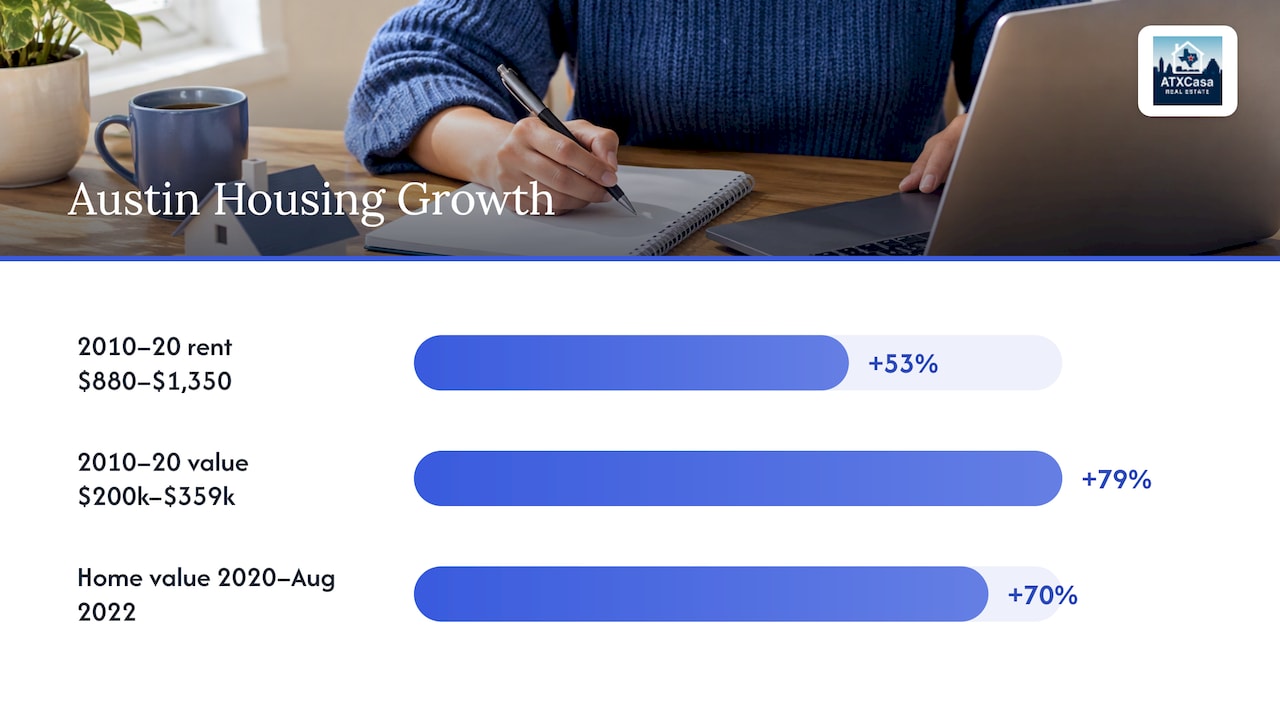
Austin’s starting point is already expensive. CapMetro’s 2023 Equitable Transit-Oriented Development (ETOD) study found that between 2010 and 2020 median rent rose 53%, from $880 to $1,350, and median home value rose 79%, from $200,000 to $359,000. Zillow data cited in the same report showed values up another 70% from January 2020 to August 2022.
The study’s conditions analysis adds corridor detail. Over ten years the study area added nearly 14,000 multifamily units, a 52% supply increase, while average rents still rose more than 46%. South Congress saw the steepest increase at 8% a year, with North Lamar, Riverside, Stassney and William Cannon each around 5% a year. About 3,600 units were under construction corridor-wide, over 1,000 of them in Montopolis.
The same analysis reports for-sale homes in the study area averaging a last list price of $588,000 over the past year, with condos at $627,000, townhouses at $609,000 and single-family homes at $540,000. Prices ranged from under $400,000 in Metro Center and Slaughter to over $750,000 in Waterfront, Lakeshore, Auditorium Shores and SoCo.
Two takeaways follow. New supply did not stop rents from rising, so do not assume construction alone will make a corridor cheaper. And the corridors with the fastest rent growth are the ones where demand already reflects transit expectations.
The anti-displacement fund and where the money goes
The $300 million anti-displacement fund is the part of Project Connect most directly about housing. The City of Austin’s schedule spreads it across 13 years: $23 million in FY2020-21, $42 million in FY2021-22, $35 million in FY2022-23, then $20 million a year through FY2032-33. The 2026-2028 tranche of $60 million allocates $46.5 million to affordable housing development, preservation and land acquisition, and $9 million to immediate-needs programs.
KUT’s July 2026 report on what has been done so far says the city had acquired four properties for $42.7 million, awarded $32.9 million in grants to affordable housing projects and awarded $29 million to community groups. The acquisitions include City View at the Park, 2908 South Congress Avenue, Midtown Flats and a site of nearly 125 acres along Riverside Drive and Grove Boulevard next to a planned light rail stop.
Why this matters to you:
- Buyers near these sites may see more income-restricted housing nearby, which can change the mix of neighbors and the supply of homes at different price points.
- Investors should know that public land acquisition near stations takes some parcels out of the private market, while the city’s affordability tiers shape what a private project can pencil.
- Sellers near planned stations are often asked what the rail will do for value. The honest answer is that the effect depends on distance, timing and zoning, and it is best shown with recent comparable sales.
The program’s reach is large. KXAN reported that the city’s displacement-risk map within a mile of Project Connect covers 302,000 people and 135,000 households, with 61% of the areas being communities of color and 67% low income.
New zoning rules near light rail
The rules that touch private property most directly are the density bonus and ETOD requirements. In September 2026, the City Council unanimously approved changes requiring developers who use the citywide density bonus program near light rail stations to include affordable housing on-site rather than pay a fee to build it elsewhere.
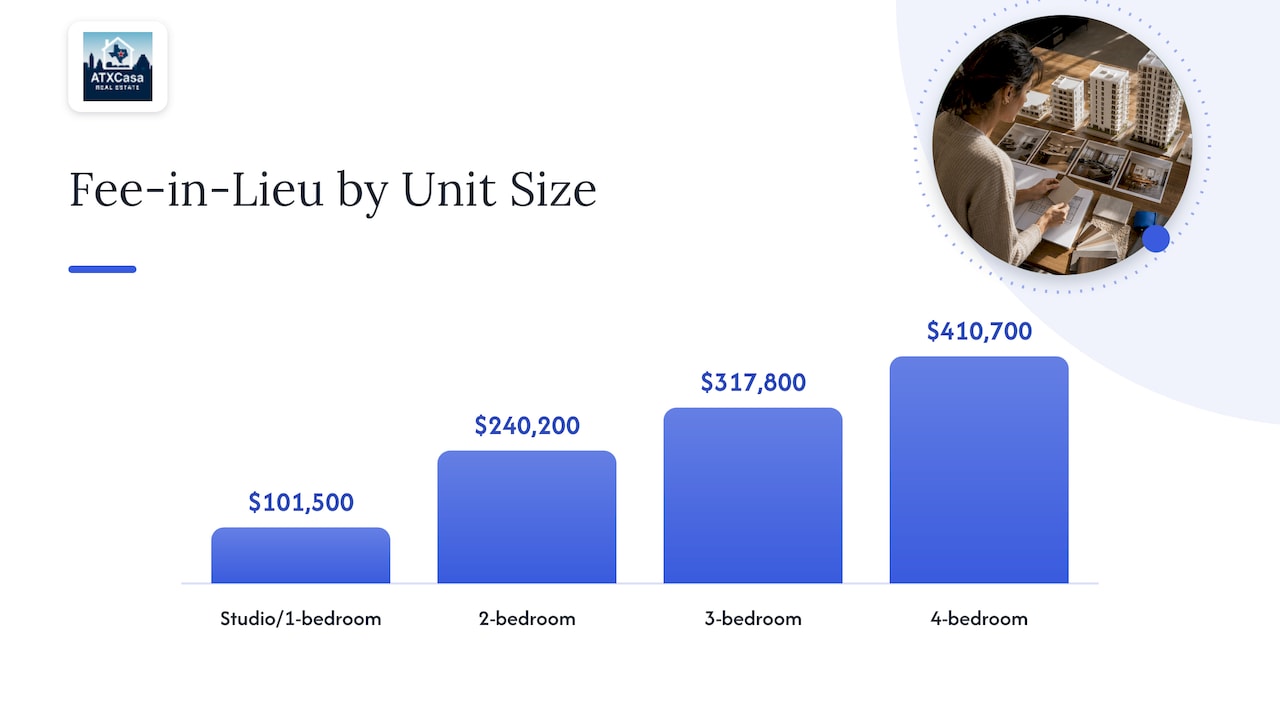
A July 2026 city staff memorandum explains the reasoning: keeping affordable units in transit-rich, high-opportunity areas. It proposed fee-in-lieu rates effective October 1, 2026 of $101,500 for a studio or one-bedroom rental unit, $240,200 for a two-bedroom, $317,800 for a three-bedroom and $410,700 for a four-bedroom, and recommended limiting the fee option within half a mile of Light Rail Phase 1 and its priority extensions. The same memo notes the city reached just over 4% of its annual goal of 2,000 units for households at or below 30% of median family income (MFI), the benchmark the city uses to describe affordability.
A staff report for a July 2026 zoning case shows how the tiers work. A 60-foot building must set aside 10% of rental units at 60% MFI. A 90-foot building must set aside 12% at 60% MFI or 10% at 50% MFI. Ownership projects can set aside 12% of units at 80% MFI. Heights of 90 or 120 feet depend on distance from the Phase 1 alignment. An earlier overlay proposal described towers up to 120 feet, roughly nine stories, near light rail with affordable housing, plus requirements for tenants when existing apartments are redeveloped.
What this means in practice:
- A lot within half a mile of the alignment may carry more development potential, which can show up in land value and in offers from builders.
- Building near rail now carries on-site affordability costs, which investors should model before bidding on a parcel or a small multifamily property.
- Older apartment buildings near stations may be redevelopment candidates, which affects renters and the investors who own those buildings.
If you are weighing small multifamily or infill, our checklist on the Austin three- and four-unit code proposal is a useful companion, and our new construction and investment articles cover due diligence on builds.
What has and has not happened yet
As of KUT’s July 2026 report, the Green Line was essentially dormant, with no construction funding, environmental review or timeline, and five of 15 planned Pickup zones had launched. If you are looking at a property on a line that is not part of the first phase, do not price in a rail premium.
The Austin Transit Partnership’s 2025 Annual Management Report says its displacement prevention team will work with the Community Advisory Committee in 2026 to set priorities for the next three years of anti-displacement funding. It also says vision plans for the North Lamar and South Congress Transit Centers were adopted in spring 2025 to create affordable housing opportunities near those CapMetro-owned sites. Funding priorities and the distance limits for the fund (the advisory committee has recommended one mile from light rail) can shift, so check the city’s anti-displacement page before relying on a specific boundary.
Because the route and schedule can still change, a sound rule is to separate what is already in effect (the tax, the density bonus rules, the fund) from what is projected (rail service and the value effect that follows).
How to use this in your own decision
If you are buying a first home or relocating a family. Start with the monthly cost, not the rail story. Use the property’s full applicable property-tax estimate, accounting for exemptions. The City says the Project Connect portion becomes part of its property-tax rate each year, so do not add that share again if your payment estimate already includes the full City levy. Then compare the neighborhoods you like by commute, school zone and total property tax. If you are weighing Austin against a suburb, a transit-adjacent home may suit a household that wants one fewer car. Our transportation checks for carless condo buyers show how to test that against a real address.
If you are an investor. Look at the corridor-level rent growth above, then underwrite two cases: one where rail opens on the current schedule and one where it slips. Rent growth is already high on South Congress, so a rail premium may be partly priced in. Model on-site affordability if you plan to build, and for existing rentals, check how your renters’ lease terms line up with any redevelopment interest nearby. Our guide to comparing your real rent renewal options shows the benchmark renters use, which helps you anticipate their choices.
If you are selling. Do not market a rail premium you cannot support. Use recent sales within the same distance band from the planned stations and say plainly what is confirmed and what is projected. Buyers in Austin read the same news you do.
Our perspective
I came to real estate after nearly two decades in IT, and I look at Project Connect the way I look at any system with moving parts: separate the inputs you can verify from the outputs someone is forecasting.
The verified inputs are the tax, the fund and the zoning rules. You can read them in city documents and put numbers on them. The forecast is the value effect of light rail, which depends on a schedule that has already changed once.
My read is that the best decisions near a planned line come from data at the block level: recent closed sales, days on market, the list-to-close ratio, and the actual zoning of the lot. That is how we approach pricing and marketing for the Austin-area clients we work with, and it is why we publish local, sourced guides instead of general transit promises.
How I would use this report: pick two or three streets you are considering, look up their distance to the planned alignment, and ask what has to be true for the rail to matter to your timeline. If the answer is a decade away, buy or sell on the fundamentals today.
Vladimir
Talk through your own address with us
ATXCasa helps clients buy, sell and invest across the Austin area, including Cedar Park, Round Rock and Georgetown, with AI-powered marketing and data-driven pricing strategies. If you want to see how Project Connect rules and the tax affect a specific neighborhood or property, start at ATXCasa.
For neighborhood-level reading before you call, our neighborhoods and lifestyle section covers areas across the region.
FAQ
Will Project Connect raise my property taxes?
If your home is inside the City of Austin, Proposition A added a Project Connect share to the city rate. The city estimated about $284 a year on a $325,000 home, and your own bill depends on your appraised value, exemptions and current rates. Homes outside city limits, such as in Round Rock or Cedar Park, are not subject to the city’s rate.
Will light rail raise home values near stations?
Studies of similar lines in other cities have found average increases of about 24%, but that is an average, not a promise for any one street. Austin’s first line is scheduled to begin construction in 2027, so most of the effect, if it comes, is still ahead. Distance to the station, zoning and surrounding supply all matter.
What is the anti-displacement fund?
It is $300 million set aside to help people stay near new transit, spread over 13 years by the City of Austin. So far it has funded property acquisitions, grants to affordable housing projects and awards to community groups, as detailed above.
How do the new rules affect developers near light rail?
Developers using the density bonus program near light rail stations must now include affordable housing on-site instead of paying a fee to build it elsewhere. The affordability tiers depend on building height and the share of median family income served, so a project’s numbers should be modeled with them from the start.
Sources
- Project Connect Anti-Displacement Funding, City of Austin
- 2020 Mobility Elections Proposition A, City of Austin Financial Services
- What is the status of Austin’s light-rail project? KUT
- KUT report on anti-displacement acquisitions and grants
- Can Austin Supersize Transit Without Supercharging Gentrification? Streetsblog USA
- CapMetro Equitable Transit-Oriented Development Study
- CapMetro ETOD Conditions Analysis, Real Estate
- How will Project Connect’s $300M help people stay near new light rail? KXAN
- City of Austin staff memorandum, July 24, 2026
- Zoning and Platting Commission staff report, 4106 Medical Parkway
- Austin pushes for affordable housing near light rail, Austin Current
- Council Wants More Housing Near Project Connect Stations, Austin Chronicle
- Austin’s first light rail line takes shape, MySanAntonio
- Austin Transit Partnership 2025 Annual Management Report