

If you are under contract for an Austin-area home with a mandatory homeowners association and the resale certificate may arrive after your inspection or option period, do not treat the document as closing paperwork. It can reveal assessments, transfer charges, property violations, lawsuits, repair responsibilities, and restrictions that change the deal.
The practical move is to align the HOA document deadline with the contract before the ordinary option window closes. Texas Real Estate Commission Form 36-11, effective July 1, 2026, gives the parties several ways to assign who obtains and pays for the subdivision information. The selected provision—not a general assumption about “the option period”—controls the document path. Condominiums use a different contract and review structure.
Three situations that look similar but are not
- A detached home in a mandatory HOA: The buyer needs the restrictions, bylaws, rules, and resale certificate early enough to evaluate costs and use limits.
- A fee-simple townhome with two associations: A neighborhood association and a master association may each impose dues, rules, or transfer charges. One packet may not answer both.
- A condominium: TREC Form 36-11 says it is not for condominiums. The Residential Condominium Contract (Resale), Form 30-18, has its own provisions for association documents and the condominium resale certificate.
The nearest confusing out-of-scope case is a voluntary neighborhood association. This guide addresses property tied to mandatory association membership. It also explains the forms as a transaction checklist, not legal advice about a particular contract.
A resale certificate is more than a copy of the rules
Form 36-11 calls the complete package “Subdivision Information.” It includes current restrictions, bylaws, association rules, and a resale certificate described by Chapter 207 of the Texas Property Code.
TREC’s voluntary Form 37-5 shows why the certificate matters. It is designed to report items such as regular and special assessments, unpaid amounts tied to the property, transfer fees, pending lawsuits or unsatisfied judgments, known restriction or code violations, reserves and capital expenditures, and any right of first refusal. Its required attachments include the current operating budget, balance sheet, common-area insurance certificate, and governing documents.
That information affects different decisions:
- A rule limiting rentals, parking, fencing, pets, or exterior changes may conflict with the buyer’s intended use.
- A special assessment or transfer charge changes the cash needed at or after closing.
- A violation tied to the property raises the question of who will cure it and when.
- A thin reserve or pending lawsuit may deserve more review before the buyer relies on the current monthly dues.
- An association repair obligation may change how the buyer evaluates a roof, wall, drainage feature, or shared amenity.
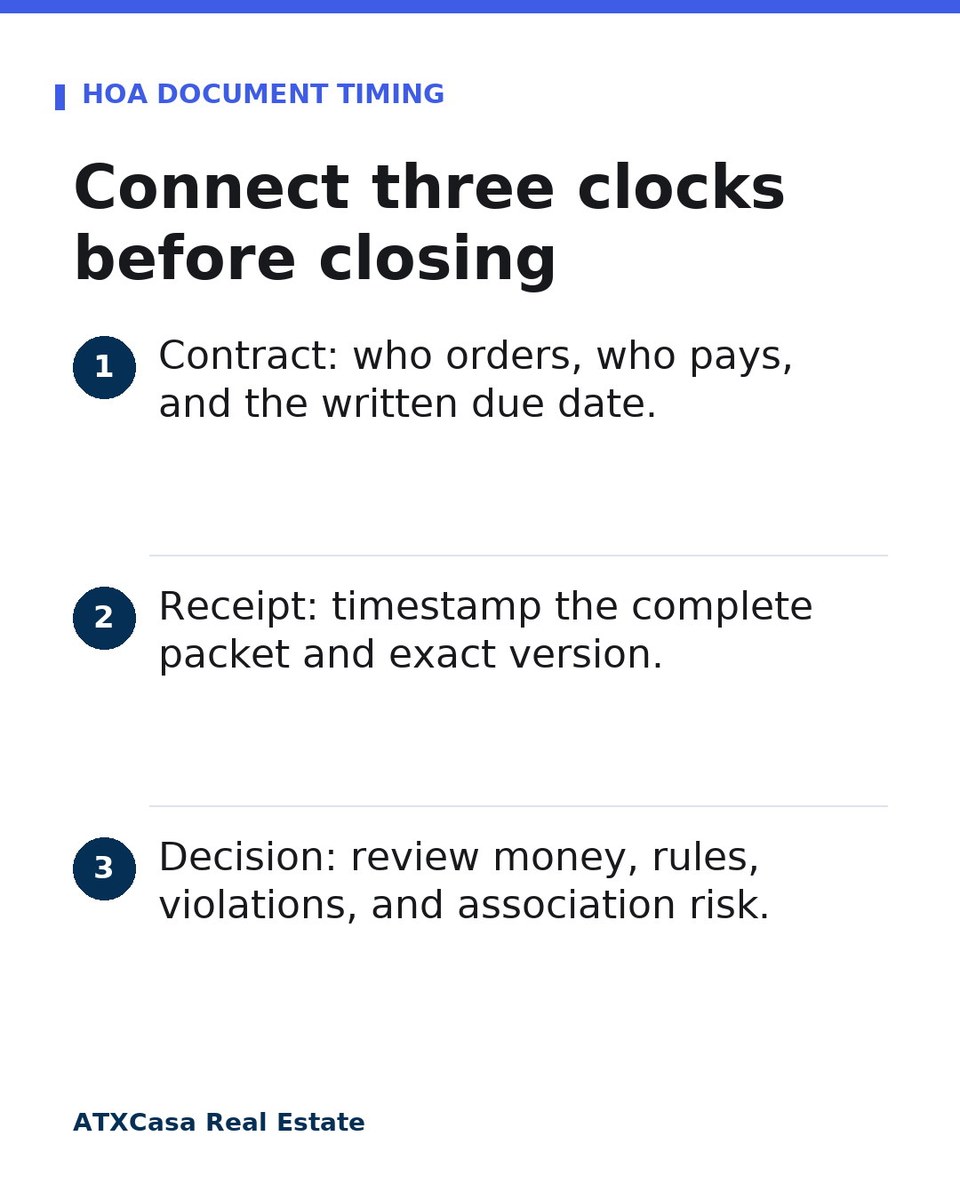
The HOA review clock and the option period are not the same clock
The option period in a typical Texas resale contract can give a buyer a broad right to terminate during a stated time. The HOA addendum creates a separate document-delivery and review path. Those periods may overlap, but they should not be treated as interchangeable.
Under the current Form 36-11, the parties select one of four approaches:
- The seller obtains and delivers the package within an agreed number of days. If it is delivered, the form provides a three-day review right after receipt or until closing, whichever occurs first. If it is not delivered, the selected provision states a separate remedy before closing.
- The buyer obtains the package within an agreed number of days and at the buyer’s expense. The form defines when the buyer is deemed to have received it and provides a three-day review period after receipt or until closing, whichever occurs first.
- The buyer already received and approved the package. The buyer can indicate whether an updated resale certificate is required; the form sets a delivery path tied to payment for that update.
- The buyer does not require the package. That choice gives up a source of information that may be difficult to reconstruct from a listing or monthly-dues figure alone.
These are contract choices, not automatic rights that work the same in every transaction. Read the completed addendum and the actual dates. If a deadline, notice, or termination decision is disputed, use the broker and a qualified Texas real-estate attorney rather than relying on a social-media answer.
What to check when the packet arrives
1. Match every association to the property
Confirm the legal name of each association, not just the community’s marketing name. A master-planned community can have a master association plus a sub-association. If one association is missing, the cost and rule review is incomplete.
2. Turn fees into a first-year cash list
Separate recurring dues from special assessments, transfer fees, reserve contributions, prepaid charges, and seller balances. In a hypothetical packet, $100 monthly dues, a $3,000 special assessment, and a $500 transfer fee add up to $4,700 of first-year charges if the buyer is responsible for all of them. The listing’s $100 dues figure would describe only $1,200 of that total. Check the contract’s allocation and due dates before deciding what cash you need.
3. Test the rules against the buyer’s real plan
Search the restrictions and rules for the use that matters: leasing, a work vehicle, street parking, a fence, solar equipment, a detached structure, pets, or exterior materials. A rule is actionable only when connected to the buyer’s intended use. For a proposed addition or detached living space, also run the separate city and property-record checks described in ATXCasa’s guide to Austin ADU potential.
4. Separate association risk from property-condition risk
The HOA package may identify litigation, insurance, reserves, violations, or responsibility for shared components. It does not replace a property inspection, title review, survey, or insurance quote. If the home itself has roof, plumbing, electrical, or water-loss concerns, use the HOA review alongside an insurance check before the option period ends.
5. Timestamp receipt and preserve the exact version
Save the email or portal notice showing when the package became available, download the complete file, and note whether it is current for this property. Contract review periods can turn on receipt and closing dates. A folder labeled only “HOA docs” is not enough if the parties later disagree about which version arrived and when.
What if the certificate will arrive after the option period?
First, read the completed HOA addendum or condominium contract. Do not assume the option deadline automatically ends every document-based right, and do not assume a late packet automatically extends the unrestricted option period.
Then answer four concrete questions:
- Who agreed to order and pay for the documents?
- What delivery date is written in the selected provision?
- What does that provision say happens after receipt or non-delivery?
- Will the buyer, lender, insurer, and any attorney have enough time to review the relevant information before closing?
If the existing timeline does not match the buyer’s decision needs, raise the timing issue while the parties can still negotiate a written solution. Do not wait for the certificate and hope the closing calendar will fix itself.
Condominium buyers need a separate checklist
The 2026 Residential Condominium Contract (Resale), Form 30-18, separates the condominium documents from the resale certificate. The form provides its own delivery choices and review language, including seven-day periods after receipt in specified selections. It also asks about association repair responsibility and can surface a right of first refusal.
A condo buyer also has a financing question that a detached-home buyer may not: the lender may review the condominium project, insurance, reserves, owner occupancy, litigation, and other project-level conditions. Receiving the certificate does not prove the project will satisfy a lender’s requirements.
A practical offer-to-closing sequence
- Before or with the offer: identify every mandatory association, choose the correct TREC form, assign who obtains and pays for the package, and set a realistic delivery period.
- Immediately after execution: order the package when the selected provision requires it. Do not wait for the physical inspection to finish if the association’s turnaround may consume the review window.
- At receipt: timestamp the package and review money, use restrictions, property violations, association risk, insurance, and repair responsibility.
- Before a notice deadline: convert concerns into decisions—accept the information, ask a focused question, negotiate a written change, or consult the appropriate professional about the contract remedy.
- Before closing: confirm that material changes, new assessments, violations, and transfer charges have not made the earlier review stale.
ATXCasa’s practical view: an HOA document is useful only if it arrives while the buyer can still act on it. The goal is not to collect a large PDF. It is to make the association’s money, rules, and obligations agree with the buyer’s intended use and closing plan.
Frequently asked questions
Is the resale certificate the same as the HOA bylaws?
No. The resale certificate is a property- and association-specific disclosure snapshot. The bylaws, restrictions, and rules are separate parts of the broader subdivision-information package.
Does receiving the HOA packet replace the inspection or title review?
No. The packet answers association questions. Inspection, survey, title, insurance, permit, and lender reviews address different risks.
Is Form 36-11 used for Austin condos?
No. Form 36-11 expressly says it is not for condominiums. TREC’s Residential Condominium Contract (Resale), Form 30-18, contains the condo document and certificate provisions.
Can the monthly dues alone show whether an HOA is healthy?
No. Dues are one input. Review the current budget, reserves, insurance, assessments, litigation, obligations, and the property’s own account and violation status.
Buying or selling an Austin-area home with mandatory association membership? Contact Vlad Baibus at ATXCasa to map the HOA document timeline to the property and transaction before a review date slips past.
This is general real-estate education, not legal, lending, insurance, tax, or association-management advice. Contract rights and deadlines depend on the completed forms and facts of the transaction.