
Lake Travis suits buyers who want water access, strong schools, and a resort feel within reach of Austin. Families tend to start with Steiner Ranch, while full-time lake access points toward Lakeway and Rough Hollow. Expect a price premium, a longer commute than central Austin, and a lake whose level rises and falls with drought and flood cycles.
TL;DR:
- Lakeway, Hudson Bend, and select Rough Hollow lots offer the most direct lake access, while Steiner Ranch and Bee Cave usually rely on marinas or public ramps.
- Confirm dock rights, HOA limits, and the nearest ramp’s operating threshold; lake levels fluctuate, and public ramps can close when water drops.
- Verify the assigned school for each address and ask about boundary changes, especially in rapidly growing Rough Hollow, where enrollment projections can shift.
- For a general residence-homestead exemption, April 30 is the usual filing deadline. Buyers who qualify after January 1 may receive a proportional current-year exemption if the prior owner did not receive the same exemption and they did not claim another homestead that year. Late filing may also be available; confirm eligibility and local exemption amounts with the appraisal district.
- Lago Vista has the longest drive, while Bee Cave and Lakeway are usually shorter; test your commute at peak hours and budget for car use.
Table of Contents
- Which Lake Travis neighborhoods should you tour first?
- What do Lake Travis homes cost, and how do property taxes work?
- How do Lake Travis schools and enrollment trends affect your move?
- What does daily life on the lake look like, and what rules apply?
- How long is the commute from Lake Travis to Austin?
- How do you pick the right Lake Travis neighborhood?
- What we tell buyers about Lake Travis
- Who actually lives around Lake Travis?
- Where do you go for healthcare and emergencies near Lake Travis?
- What development and zoning changes could affect Lake Travis?
- How is Lake Travis protected, and what should buyers know about the environment?
- Can you get around Lake Travis without a car?
- Our take: fit beats features when you choose a lake neighborhood
- How we can help you move to Lake Travis
- FAQ
- Sources
Which Lake Travis neighborhoods should you tour first?
Eight communities come up in almost every conversation about Lake Travis living. Think of this list as a way to pick two or three to visit in person, not as a ranking.
- Steiner Ranch
- Best for families who want trails, neighborhood amenities, and a master-planned feel.
- Mostly single-family homes in a mid-to-upper price tier, with lake views more common than direct water frontage.
- Lake access is mostly indirect: residents rely on nearby marinas and public ramps rather than private docks.
- Expect HOA fees and rules that come with a large planned community.
- Lakeway
- Best for buyers who want full-time lake access plus dining, golf, and a ready-made town center.
- A wide mix, from townhomes and condos to large waterfront estates, so prices span several tiers.
- Waterfront lots can carry private docks; interior neighborhoods trade that for lower prices.
- Golf clubs, marinas, and shopping sit close together, which cuts down on daily driving.
- Bee Cave
- Best for commuters and shoppers who want retail, restaurants, and quick access to Highway 71 and RM 620.
- Newer townhomes and single-family neighborhoods, generally priced at a premium for the convenience.
- Most homes are not on the water, so boaters usually use a marina or public ramp.
- The Hill Country Galleria area anchors dining and errands.
- Lago Vista
- Best for buyers who want more space or a quieter pace on the north shore.
- Housing ranges from modest older homes to lakefront and view properties, often at a lower entry point than Lakeway.
- Water access varies by street, so confirm dock rights and ramp distance before you fall for a view.
- Expect a longer drive to central Austin and plan for it.
- Hudson Bend
- Best for buyers who want an older, more relaxed lakeside feel without a gated-enclave price.
- A mix of established homes, some on the water, along winding lake roads.
- Several marinas and public access points sit nearby, which suits boat owners.
- Older lakeside areas tend to have fewer HOA rules than newer communities, so check each property.
- Rough Hollow
- Best for families and boaters who want newer construction and a built-in community.
- Newer single-family homes, with prices that reflect a master-planned setting and proximity to the lake.
- Direct water access is limited to certain lots and community facilities, so ask exactly what your address includes.
- Amenities and HOA structure matter more here than in older neighborhoods.
- The Hollows
- Best for buyers who want a gated, upscale enclave near Lakeway amenities.
- Larger custom and semi-custom homes at the higher end of the market.
- Lake views and access depend on the lot, so verify what comes with a specific home.
- Gated communities usually mean stricter architectural and HOA guidelines.
- The Reserve at Lake Travis
- Best for buyers who want a luxury, amenity-rich address with a clubhouse-style lifestyle.
- Higher-priced residences in a community built around shared amenities.
- Lake access is tied to community facilities and specific lots, so confirm it in writing.
- HOA dues and rules differ sharply from older lakeside neighborhoods.
A quick way to sort them: Lakeway, Hudson Bend, and select lots in Rough Hollow and The Hollows give the most direct full-time lake access. Steiner Ranch and Bee Cave offer views and convenience but lean on public ramps and marinas. If you want to see how other Austin-area suburbs stack up on parks and golf, our look at Kyle, TX homes and lifestyle is a useful comparison.
What do Lake Travis homes cost, and how do property taxes work?
Prices around the lake follow a few clear drivers. Waterfront lots and gated enclaves sit at the top, newer master-planned communities come next, and older interior neighborhoods generally offer the lowest entry points. Lago Vista and parts of Hudson Bend tend to start lower than Lakeway, Bee Cave, and The Hollows, though exact figures shift quickly. For recent sold-price patterns, our breakdown of Austin neighborhood prices shows how to read the numbers, and our market insights hub tracks broader trends near the lake.
Property taxes deserve as much attention as the listing price. A few things to build into your budget:
- Waterfront and newer homes carry higher appraised values, so the tax bill rises with them.
- Many master-planned communities add HOA dues on top of taxes.
- Insurance costs vary by lot. Homes near the shoreline or in flood-prone areas can cost more to insure, so get quotes before you make an offer.
- A homestead exemption lowers your taxable value, but only if you file on time.
The linked Tax Year 2025 Travis County statement describes a 20% homestead exemption on the appraised value for county taxation, not for every taxing unit. April 30 is the general residence-homestead filing deadline. A late residence-homestead application may be filed up to two years after that deadline. Qualifying buyers who acquire a home after January 1 may receive an exemption for the applicable part of the year if the prior owner did not receive the same exemption and the buyer did not claim another homestead that year.
Principal-residence owners may qualify on January 1 or, under the conditions above, after January 1 for the applicable part of the year. According to Travis County, there is no application fee. The appraisal district determines eligibility; approval should not be treated as an unconditional permanent reduction. Our guide on how to file for the Texas homestead exemption walks through the steps.
Veterans have a second option. Travis County offers disabled veteran exemptions in tiers tied to the VA disability rating, and a veteran with a 100% rating may qualify for a total exemption on a primary residence. If that is you, raise it early, because it can change how much house you can afford.
How do Lake Travis schools and enrollment trends affect your move?
Most of the communities above sit inside Lake Travis ISD, but district lines do not follow city names. Parts of some neighborhoods may fall in another district, so confirm the zoned school for any specific address before you make an offer.
Enrollment is the part families often miss. Lake Travis ISD grew quickly over the past decade, but enrollment growth has tapered, with slower elementary enrollment and revised projections that affect when new schools open and how capacity gets planned.
What that means for you in practice:
- Capacity: Slower growth eases some crowding pressure, but individual campuses can still be tight in fast-building areas.
- Redistricting risk: When new schools open or projections change, attendance boundaries can shift. Ask which campus a home is zoned for today and whether changes are under discussion.
- Timing: The timeline for new school openings has moved, so a neighborhood that looks underserved now may not stay that way, or may take longer to catch up than builders suggest.
- Newer communities: Fast-growing areas like Rough Hollow are the ones most exposed to boundary changes, so check district materials before you rely on a specific school.
Before you buy, look at the district’s own enrollment and boundary materials for the campus tied to the address you like. A great school nearby does not guarantee your street feeds it.
What does daily life on the lake look like, and what rules apply?
Recreation is the reason most people consider Lake Travis in the first place. Lake Travis is a highland reservoir on the Colorado River with 18,622 surface acres and a maximum depth of about 190 feet, and it is known for bass and spring white bass runs. Around it you will find:
- Marinas and boat clubs, concentrated around Lakeway, Hudson Bend, and the north shore.
- LCRA-managed parks and public boat ramps, some of which charge entry or launch fees. Access varies with lake level.
- Golf clubs and trail systems in Lakeway, Steiner Ranch, and Rough Hollow.
- Dining and shopping clusters near Lakeway and Bee Cave.
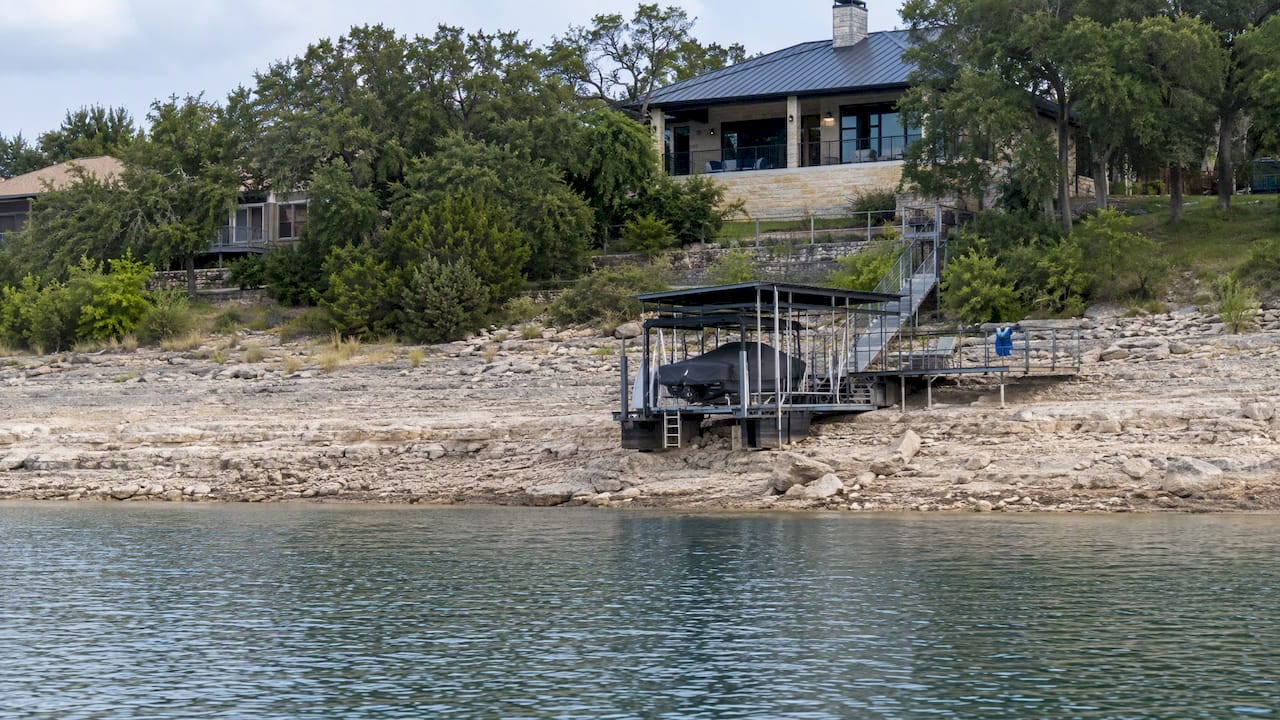
Lake access differs a lot between homes. Written access rights alone do not establish that a private dock is usable: verify water depth, physical condition, permissions, and the lot-specific access arrangement. A view lot may leave you driving to a public ramp. LCRA publishes boat ramp minimum operating levels, defining each listed minimum as the lowest lake elevation at which that ramp is usable. Check current status too: ramps can become unavailable for reasons other than low water. The Highland Lakes are designed to fluctuate as regional water-supply reservoirs, and storage and lake levels move with drought and flood cycles.
Two rules every boater and waterfront owner should know:
- Zebra mussels: They have invaded Lake Travis. Texas requires boaters to drain all water from boats and gear before approaching or leaving a public freshwater body. Failing to remove and lawfully dispose of attached harmful aquatic plants is also unlawful. TPWD recommends that boaters clean, drain, and dry their boats and gear before traveling from lake to lake; the full sequence is prevention guidance, not a blanket legal requirement.
- Water safety: LCRA’s guidance on recreation and safety advises never boating alone, designating a sober operator, wearing USCG-approved life jackets, and learning the local rules and markers.
Pro Tip: Before a showing, check LCRA’s current lake level and the nearest named public ramp’s listed minimum elevation and operating status. Compare the dock and shoreline with that water level, but verify the private dock separately: public-ramp information does not establish its usability.
How long is the commute from Lake Travis to Austin?
Plan on a longer drive than the map suggests. Rough ranges to central Austin and The Domain depend heavily on the time of day, and rush hour can stretch them well past the off-peak figure.
- Bee Cave and Lakeway: Often the shortest drives to central Austin among the lake communities, with the most direct road connections.
- Steiner Ranch and Hudson Bend: Reasonable off-peak, but dependent on RM 620 and nearby connectors, which back up at peak hours.
- Rough Hollow and The Hollows: Similar to Lakeway, with local roads adding a few minutes.
- Lago Vista: The longest haul of the group, so test the drive at your actual work hours.
The corridors that matter are RM 620, Highway 71, Ranch Road 620 intersections, and the FM roads that feed them. The common bottlenecks are the RM 620 and Highway 71 stretches near Bee Cave and the connectors leading toward Austin at the start and end of the workday.
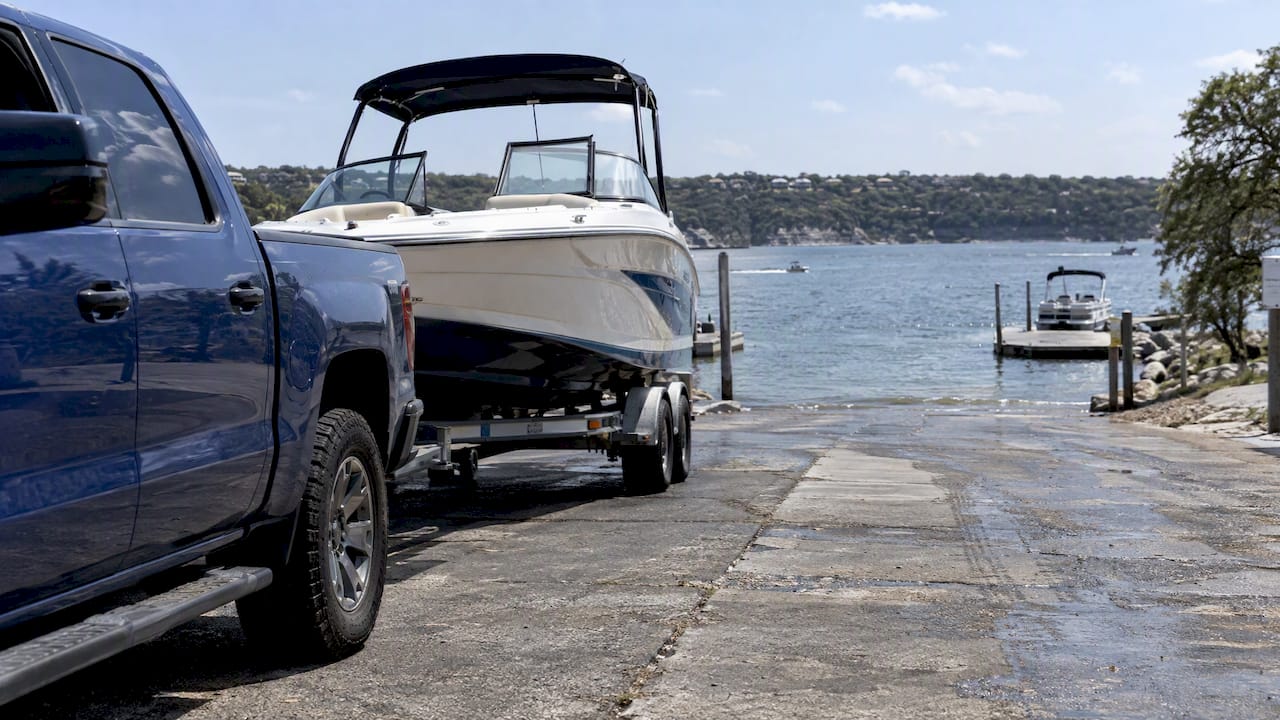
For boat owners, the logistics matter as much as the drive. Ask where a trailer can be stored, since many HOAs restrict visible trailers. Check ramp parking rules and any launch or parking fees at public ramps, and confirm whether your target community limits boat or trailer storage on the lot.
How do you pick the right Lake Travis neighborhood?
Work down this checklist in order, because each step narrows the field for the next:
- Budget: Set a ceiling that includes taxes, HOA dues, and insurance.
- Commute: Drive your real route at your real hours.
- School fit: Confirm the zoned campus for each address.
- Lake access: Decide between a private dock, a marina slip, or public ramp use.
- HOA rules and fees: Read the restrictions before you fall for a house.
- Resale: Consider how easy the home would be to sell later.
Then bring these questions to showings and to your agent:
- What is the minimum operating level at the nearest public ramp, and how often has the lake dropped below it?
- What are the current tax rates for this address, and is the owner’s exemption transferable or will I need to file my own?
- What does the HOA restrict, including docks, trailers, short-term rentals, and exterior changes?
- What water access rights come with this lot, and are they in writing?
- Which school campus is this home zoned for today?
- Are there new-build projects or road changes planned nearby that could affect views or traffic?
- What do insurance quotes look like for this specific address?
- What are the HOA dues, and what do they cover?
One note on timing: line up your homestead application and school enrollment after closing. April 30 is the usual homestead filing deadline, but late applications may be filed up to two years afterward. You may qualify after January 1 for the applicable part of the year if the prior owner did not receive the same exemption and you did not claim another homestead that year; ask the appraisal district to determine your eligibility.
What we tell buyers about Lake Travis
Our approach rests on local data and on walking neighborhoods with buyers. Vlad Baibus brings nearly two decades of IT experience to Austin-area real estate, and our guides cover neighborhood trends and the hidden pitfalls of homes, so buyers see tradeoffs before they commit. You can browse more in our neighborhoods and lifestyle section.
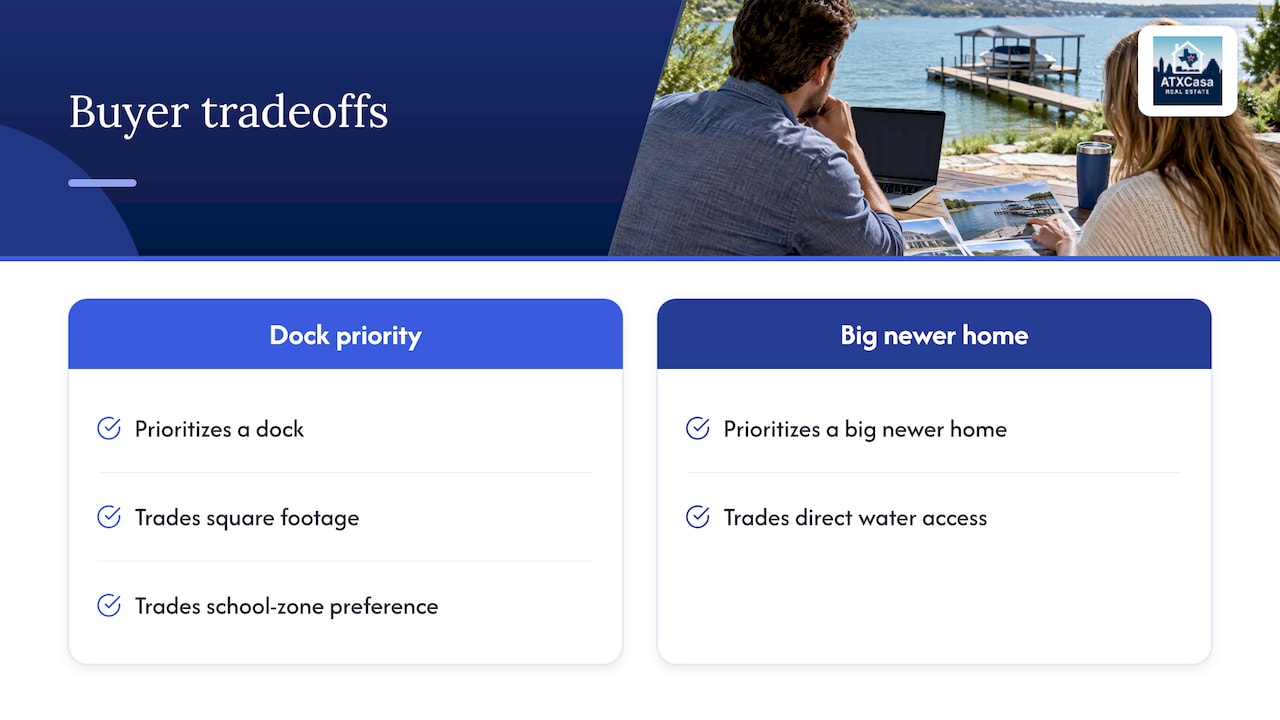
Two tips from our side of the table. First, check the LCRA ramp minimums the week you tour waterfront properties, and if you can, see the same home at different lake levels. Second, expect to trade something. Buyers who want a dock usually give up some square footage or a school-zone preference, and buyers who want a big newer home often give up direct water access. Decide which tradeoff you can live with before you start touring, and the search gets much shorter.
Who actually lives around Lake Travis?
The area draws a mix of households. Families gravitate to communities like Steiner Ranch and Rough Hollow for schools and neighborhood amenities, while Lakeway and Bee Cave attract professionals and move-up buyers who value dining and retail close to home. The established lakeside pockets of Hudson Bend and Lago Vista also draw longtime residents, second-home owners, and retirees who want a quieter pace.
The community vibe is outdoorsy and social. Weekends revolve around the water, golf, trails, and patio dining, and many neighborhoods run active HOA calendars and clubs. If you want a more urban feel with walkable nightlife, Lake Travis is not it. If you want a place where neighbors know each other and the lake sets the rhythm of the weekend, it fits well. We do not cite specific age or income figures here, because the best approach is to spend a Saturday in each neighborhood you are considering and see who is around.
Where do you go for healthcare and emergencies near Lake Travis?
The lake communities are served by a combination of local clinics, urgent care centers, and larger hospitals in the broader Austin area, so the short answer is that routine care is close and major hospital care is a drive. Bee Cave and Lakeway have the densest concentration of primary care, specialty offices, and urgent care, which suits families and retirees who want appointments nearby.
For emergencies, local fire and EMS agencies cover the lake communities, and response times depend on where you live, so ask about them for any remote or hillside lot. Water emergencies add a layer: LCRA’s recreation and safety guidance is the baseline for boaters, and any home with a dock should have a plan for getting someone to care quickly. Before you commit, map the drive from the address to the nearest emergency room, and confirm which hospitals your insurance network includes.
What development and zoning changes could affect Lake Travis?
Growth is the story of this region, and it affects both quality of life and home values. New master-planned communities, retail, and road projects continue around Bee Cave, Lakeway, and the surrounding corridors, and each adds convenience while also adding traffic and density.
Zoning and land-use rules differ by jurisdiction, because the lake communities include incorporated cities, extraterritorial areas, and unincorporated land. That matters for buyers. A vacant lot next to your target home could be zoned for a very different use than you assume, and a city’s rules may not apply in an unincorporated pocket.
Practical steps: ask the city or county planning office what is approved or proposed near any address you like, review plat and zoning maps, and ask the seller what they know about nearby construction. Where views or privacy are part of the appeal, a quick look at planned development can save you from buying into a view that disappears.
How is Lake Travis protected, and what should buyers know about the environment?
Lake Travis is a working reservoir, and that shapes what you see from your dock. The Highland Lakes serve as the region’s primary water-supply reservoirs, so water levels move with drought and flood cycles, and shoreline can change dramatically between seasons.
Conservation efforts focus on keeping the lake healthy and usable. With zebra mussels present, follow TPWD’s recommended clean, drain, and dry sequence before traveling from lake to lake. Texas requires draining all water from boats and gear before approaching or leaving a public freshwater body; failing to remove and lawfully dispose of attached harmful aquatic plants is also unlawful. Drying is part of the recommended prevention sequence, not a blanket legal mandate. Docks, intakes, and boat hulls are the places zebra mussels cause trouble, so owners should follow current guidance.
For buyers, the environmental checklist is short: understand how lake-level swings affect a specific waterfront lot, ask about shoreline and erosion conditions, and check any rules that govern construction or modification near the water. Hidden hazards like submerged trees and currents also make a good case for boating carefully and learning the lake before you take guests out.
Can you get around Lake Travis without a car?
Realistically, no. Public transit in the lake communities is limited, and most residents drive for nearly everything. Connections to the greater Austin area depend on road corridors such as RM 620 and Highway 71 more than on rail or frequent bus service, so a household here typically needs at least one reliable vehicle, and often two.
Some on-demand and ride-hailing options operate in parts of the area, and short trips within a walkable core like parts of Bee Cave can be done on foot, but this is not a transit-oriented market. If you commute downtown or to The Domain, plan for driving and consider park-and-ride or carpool arrangements to ease the load.
If you rely on transit today, test your actual daily route before you buy, because a service that looks workable on a map may not fit your hours. Treat car dependence as a real line item in your budget, alongside fuel, parking, and maintenance.
Our take: fit beats features when you choose a lake neighborhood
Buyers often chase the dock and then discover they wanted something else. The evidence in this guide points to a different order of priorities: the commute, the zoned school, and the tax and HOA picture shape daily life far more than a waterfront lot does, and the lake itself will not hold steady while you enjoy it. Water levels rise and fall by design, so a view that thrills you in spring may look very different in a dry summer.
Conventional advice says buy the most lake you can afford. I would flip that. Decide what you will do on a normal Tuesday, then choose the neighborhood that makes that Tuesday easy, and treat direct water access as the upgrade, not the foundation. A home five minutes from a good ramp and a good school often serves a family better than a dock on a lot that strains the budget.
Start with the numbers you can control. File your homestead exemption on time, confirm the zoned campus, and see any waterfront home at more than one lake level before you commit.
— Vladimir
How we can help you move to Lake Travis
If you want a local guide through a Lake Travis purchase, we offer:
- Local market data and pricing context built from recent Austin-area sales
- Neighborhood tours matched to your budget, commute, and lake goals
- Pricing and offer strategy for buyers and sellers
- Buyer support from first showing through closing
Our AI-powered approach to marketing and pricing is how we put listings and data to work for clients, and it sits alongside the local knowledge Vlad Baibus has built across Austin, Cedar Park, Round Rock, and Georgetown.

To get started, request a consultation or a neighborhood tour through ATXCasa. In a first meeting we talk through your budget, timeline, commute, and lake priorities, then build a shortlist of two or three neighborhoods to see in person.
FAQ
Is Lake Austin part of Lake Travis?
No. Lake Austin is a separate Highland Lake downstream of Lake Travis on the Colorado River. The Highland Lakes are a chain of reservoirs, and LCRA manages them as part of the region’s water supply.
Where does Matthew McConaughey live on Lake Austin?
We do not track the private residences of public figures, and we would not publish one if we did. If you want a lakefront address on Lake Austin or Lake Travis, we can walk you through available homes and what each comes with.
Is Lake Travis currently open?
Lake Travis is generally open for recreation, but conditions change with water levels. Check LCRA’s boat ramp information for current lake levels and ramp minimum operating levels before you head out.
Is Lake Travis affluent?
Many Lake Travis communities, including Lakeway, Bee Cave, The Hollows, and The Reserve at Lake Travis, sit at the higher end of the Austin housing market. Others, such as parts of Lago Vista and Hudson Bend, offer lower entry points, so the area spans a range rather than a single price tier.
Sources
- Fiscal Year 2026 – Tax Year 2025 Travis County Taxpayer Impact Statement | Travis County, Texas
- Apply for the General Homestead Exemption | Travis County
- Highland Lakes and Colorado River – LCRA – Energy, Water, Community
- Lake Travis ISD enrollment growth projected to slow amid smaller elementary classes | Lake Travis – Westlake | Community Impact
- Tpwd