

If you own and live in your Texas home as your primary residence, a residence homestead exemption reduces the value subject to property taxes. For 2026, school districts must provide qualifying homeowners an exemption of $140,000, with an additional $60,000 school exemption for qualifying owners who are 65 or older or disabled. Apply through the county appraisal district. April 30 is the ordinary application deadline, but residence-homestead late filing may be available up to 2 years after the taxes become delinquent.
TL;DR:
- Owners who own and occupy their principal residence on January 1 generally qualify for the $140,000 school exemption. A buyer who acquires and occupies afterward may qualify for a prorated exemption if the prior owner did not receive the general exemption that year and the buyer is not claiming one elsewhere that year.
- Qualifying owners who are 65 or older or disabled receive an additional $60,000 school exemption and a school tax ceiling. The ceiling can increase for qualifying improvements.
- April 30 is the ordinary deadline for most exemption applications. A residence-homestead application may be late-filed up to 2 years after the taxes become delinquent; follow your appraisal district’s application and documentation requirements.
- You cannot claim more than one residence homestead. Buying after January 1 does not automatically disqualify you: prorated relief may apply if you own and occupy the home, it had no general exemption that year, and you are not claiming one elsewhere that year.
- Homestead protections prevent creditors from forcing sale of your primary residence, up to certain acreage limits, but do not cover all debts like mortgages or property taxes.
Table of Contents
- Who qualifies for the residence homestead exemption in Texas
- Types of exemptions and the dollar amounts that matter
- What Texas law says about homestead protections
- Step-by-step: how to file your residence homestead exemption
- Deadlines, the five-year verification cycle, and how to respond
- Worked examples: how the exemptions change your tax bill
- Frequent errors and how to fix a rejected or removed exemption
- Steps to appeal or contest a denied homestead exemption application
- Interaction of homestead exemption with other local exemptions or tax relief programs
- What to do upon moving or selling the property regarding exemption status
- Local perspective: using the exemption when buying or selling in Austin
- ATXCasa: local help and resources
- FAQ
- Sources
Who qualifies for the residence homestead exemption in Texas
Owning and occupying the home as your principal residence on January 1 is the general eligibility rule, but recent buyers have a limited exception. According to the Texas Comptroller and Travis Central Appraisal District, a qualifying buyer who acquires and occupies after January 1 may receive a prorated general exemption for the applicable part of that year. The prior owner must not have received the general exemption that year, and the buyer must not claim one elsewhere that year.
You also cannot claim a homestead exemption on more than one property, whether the other home is in Texas or in another state. This trips up people who still technically own a previous residence, a vacation property they occasionally use, or a home they have not yet sold. Texas law treats your homestead as a single, specific place, not a portfolio.
For Travis County applications, Travis Central Appraisal District requires a completed application and a driver’s license or state personal ID certificate showing the property address. Use your property’s appraisal district requirements to prepare the application and supporting documents.
A few situations create confusion worth addressing directly:
- Active-duty military members stationed away from Texas may qualify for an exception to the ID address-match rule, since their official residence can remain their Texas homestead even when deployed elsewhere.
- Buying mid-year: you may qualify for a prorated general exemption when you buy and occupy the home after January 1. The property must not already have the general exemption for that year, and you must not claim a general exemption on another home that year. If those conditions are met, you need not wait until the following year to seek relief.
- Co-owned or trust-held property: shared ownership does not disqualify you, and many living trusts preserve homestead eligibility for the beneficiary who occupies the home, though the paperwork gets more detailed.
- Voluntary designation: some homeowners record a formal homestead designation with the county clerk, which can clarify intent in disputes but is not required to claim the tax exemption itself.
If your situation involves a recent purchase, a trust, or co-ownership with a non-occupying party, it is worth confirming your specific facts with your county appraisal district before you file, since small details can change the outcome.
Types of exemptions and the dollar amounts that matter
Texas stacks several exemptions on top of each other, and understanding which ones apply to you can mean the difference between modest savings and a substantially smaller tax bill.
The $140,000 mandatory school exemption. Every Texas school district must subtract $140,000 from your home’s appraised value before calculating school taxes, a figure set by the Texas Comptroller after a voter-approved constitutional amendment raised it from the previous $100,000. Since school taxes typically make up the largest share of a Texas property tax bill, this single exemption often delivers the bulk of your total savings.
The additional $60,000 for homeowners 65 or older or disabled. A qualifying owner who is 65 or older or disabled receives an additional $60,000 exemption for school taxes. A school tax ceiling limits qualifying school taxes even if the home’s value rises, but it is not an unconditional freeze. Travis Central Appraisal District notes that improvements, such as adding a garage or pool, can increase the ceiling.
The $140,000 school district exemption directly reduces the taxable value used for school taxes, which typically represent the largest line item on a Texas homeowner’s property tax bill.
Texas Comptroller, Property Tax Exemptions
Beyond the mandatory school exemption, other layers can apply:
- Local-option exemptions: each taxing unit decides whether to adopt a general residence-homestead exemption of up to 20% of appraised value. If adopted, the exemption cannot be less than $5,000. Each unit applies its exemption to its own portion of the tax bill; it does not reduce every taxing unit’s taxable value.
- Disabled veteran exemptions: qualifying veterans may receive partial exemptions based on their disability rating. A qualifying 100% service-connected disability or individual-unemployability determination can qualify a residence homestead for a total exemption. Provide the VA or service-branch documentation required for the applicable category.
- Surviving spouse exemptions: the Comptroller identifies separate eligibility rules for surviving spouses of certain disabled veterans, armed-services members killed or fatally injured in the line of duty, certain other qualifying veterans, and first responders. The applicable no-remarriage and residence-homestead conditions depend on the category; being a surviving spouse alone does not establish eligibility.
- Documentation for special categories: requirements depend on the exemption category and appraisal district. TCAD lists Texas ID as acceptable proof of age, disability documentation such as a current Social Security Administration determination, and VA documentation for veteran exemptions. Use your appraisal district’s list for the benefit you are claiming.
Because these exemptions interact differently with school, county, and city tax rates, your actual dollar savings depend heavily on where in the Austin area you live. Our breakdown of Austin-area property taxes by city walks through how these exemption amounts translate into real tax-rate differences across Cedar Park, Round Rock, Georgetown, and the rest of the metro.
What Texas law says about homestead protections
The homestead exemption is a property tax benefit, but the word “homestead” also carries a separate, older meaning rooted in the Texas Constitution: protection from forced sale to satisfy most debts. These two concepts often get confused, so it helps to separate them clearly.
Under the Texas Constitution and Property Code, a homestead is protected from seizure by most creditors, meaning a general unsecured debt, a credit card judgment, or most personal injury judgments typically cannot force the sale of your home. This protection is one of the strongest of its kind in the country, but it is not unlimited, and it does not erase every kind of debt tied to the property itself.
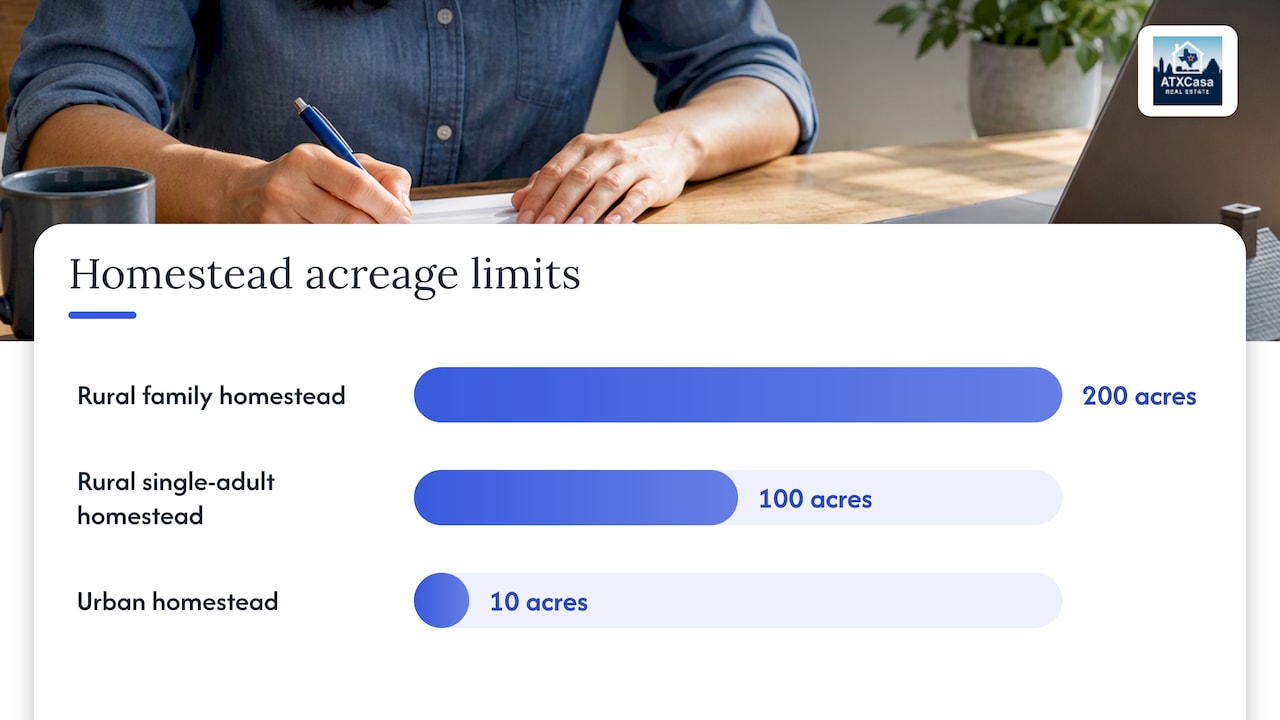
Acreage limits define how much land the protection covers:
- Urban homesteads are limited to 10 acres, which can include multiple contiguous lots as long as they are used for residential purposes.
- Rural family homesteads can extend up to 200 acres.
- Rural homesteads for a single adult are limited to 100 acres.
Certain encumbrances can still attach to a homestead property even with full constitutional protection in place:
- Purchase-money mortgages, meaning the loan used to buy the home, remain enforceable and can lead to foreclosure if payments stop.
- Property tax liens survive homestead protection, since unpaid property taxes can still result in foreclosure.
- Qualified home-equity liens, such as a properly structured home equity loan or line of credit, are enforceable under the specific rules governing those products.
- Certain court-ordered liens, including some mechanic’s liens for home improvements contracted and recorded correctly, can also attach.
One practical detail worth knowing: if you sell your homestead, the proceeds from that sale carry a six-month window of continued creditor protection, giving you time to reinvest in a new homestead without those funds becoming immediately exposed to collection. Voluntary designation instruments recorded with the county clerk can clarify boundaries in complex cases, but they are not required for the basic constitutional protection to apply.
Step-by-step: how to file your residence homestead exemption
Filing is free and more straightforward than many homeowners expect, provided you have the right documents ready before you start.
- Confirm your county appraisal district. The Texas Comptroller directs applicants to the appraisal district in the county where the property is located. Related filing guidance is available from TexasLawHelp.
- Download or access Form 50-114. The Texas Comptroller lists Form 50-114 as the Residence Homestead Exemption Application. In Travis County, Travis Central Appraisal District accepts applications by mail, online, or at its office. Check your own appraisal district’s submission options if the property is elsewhere.
- Gather your documents. For the general exemption, TCAD requires a completed application and a driver’s license or state personal ID certificate showing the property address. Check the applicable district’s instructions for any additional documents your situation requires.
- Check for special exemption eligibility. If you qualify for the age-65, disability, or disabled veteran exemptions, gather the supporting documentation, such as a disability determination letter or VA rating letter, before submitting.
- Aim to file by April 30. This is the ordinary deadline for most exemption applications. The Comptroller says a residence-homestead application may be late-filed up to 2 years after the taxes become delinquent. Do not assume that window applies to every special exemption.
- Watch for confirmation. TCAD says annual reapplication is unnecessary unless the chief appraiser requests it in writing, you move to a new residence, or your exemption qualifications change. Related guidance is available from TexasLawHelp.
Pro Tip: Apply after buying and moving into your home instead of assuming you must wait until the next tax season. TCAD accepts recent purchasers’ applications, with relief applying in the year they qualify. For prorated midyear relief, the property must not already have the general exemption that year, and you must not claim one elsewhere that year.
Missing April 30 does not necessarily end your opportunity to apply. A residence-homestead application may be filed up to 2 years after the taxes become delinquent, according to Harris County Tax Office blog. Special exemptions can have different late-filing periods. Ask the county appraisal district which tax years remain eligible and submit the application through its filing process.
For a full rundown of the paperwork and timing that matters most right after you buy a home in the Austin area, see our homestead exemption after closing checklist.
Deadlines, the five-year verification cycle, and how to respond
April 30 is the ordinary last day for most exemption applications. If you miss it, the Comptroller says a residence-homestead application may be filed up to 2 years after the taxes become delinquent. Check the applicable tax year and exemption category with your appraisal district.
According to Travis Central Appraisal District, state law requires appraisal districts to audit exemption records every 5 years. TCAD may ask an owner to reapply if it needs more information.
Common triggers for re-verification include:
- A change in ownership records or a recent sale nearby that prompts a broader review of the area.
- Mail returned as undeliverable from the address on file.
- Random selection as part of the district’s scheduled five-year cycle.
If you receive a Homestead Audit Verification letter, respond with a copy of your Texas driver’s license or ID showing the matching address, along with your deed or closing statement if you purchased the home recently. Districts generally expect a response within a stated window, often around 90 days, and failing to respond can result in the exemption being removed, which raises your taxable value and your bill going forward.
If you are ever unsure whether a notice is legitimate, calling your county appraisal district directly, using the number listed on their official website rather than one printed on the letter itself, is the safest way to confirm.
Worked examples: how the exemptions change your tax bill
Numbers make this easier to picture than percentages alone, so here are two illustrative examples using a hypothetical Austin-area home.
Assume a hypothetical home has an appraised value of $300,000 and qualifies for the $140,000 school exemption, with no other adjustments. Subtracting the exemption leaves $160,000 of school taxable value. This illustrates a reduction in taxable value, not a $140,000 reduction in the tax bill. The school tax rate determines the resulting tax dollars; other taxing units apply their own exemptions separately.
Now assume the same homeowner is 66 and qualifies for the additional $60,000 school exemption. With no other adjustments, school taxable value falls from $160,000 to $100,000. Qualifying school taxes are also subject to a tax ceiling, but TCAD notes that improvements can increase it. The ceiling is not an unconditional promise that school taxes can never rise.
Because actual dollar savings depend on your local school district, county, and city tax rates, the final figure varies by address. Travis Central Appraisal District and other county sites publish current rate schedules, and our Austin-area property tax breakdown by city walks through how those rates apply across different Austin-area communities.
Frequent errors and how to fix a rejected or removed exemption
Most rejections come down to a handful of avoidable mistakes.
- ID or address mismatch: your Texas driver’s license or ID lists a different address than the homestead property, which is consistently the most common cause of denial or verification trouble.
- Failure to update after a move: homeowners who relocate but do not notify the appraisal district can end up with an exemption improperly applied to a property they no longer occupy.
- Claiming more than one homestead: this includes forgetting to remove the exemption from a previous home before claiming a new one.
If your application is denied, correcting the underlying issue, usually updating your ID or submitting missing documents, and resubmitting promptly resolves most cases. Appraisal districts generally allow resubmission without penalty once the error is fixed.
Pro Tip: Update your Texas driver’s license or ID address before you file for the exemption, not after. Submitting a mismatched ID is the single easiest problem to avoid.
For situations involving a contested denial, a complex trust structure, or a dispute over acreage limits, consulting a property tax professional or a Texas-licensed attorney is worth the cost relative to the potential tax exposure.
Steps to appeal or contest a denied homestead exemption application
If your appraisal district denies your homestead exemption, you have the right to formally protest that decision rather than simply accepting it. The first step is to request a written explanation of the denial from the appraisal district, which will cite the specific reason, such as a documentation mismatch or an eligibility issue.
From there, you can file a protest with the county’s Appraisal Review Board, a citizen panel that hears disputes between homeowners and the appraisal district. This generally involves submitting a written protest form by the deadline listed on your denial notice, along with any corrected documentation, such as an updated Texas ID or proof of occupancy.
Many disputes resolve informally before a hearing is even needed, once the appraisal district reviews corrected paperwork. If the issue proceeds to a formal hearing, you can present your case directly to the Appraisal Review Board, bringing your deed, utility bills, or other proof tying you to the property as your principal residence.
If the board upholds the denial and you believe the decision is wrong, further appeal options exist through binding arbitration or the district courts, though most homeowners resolve exemption disputes well before reaching that stage. Keeping copies of every document you submit, along with dates and names of anyone you spoke with at the district, makes any later appeal considerably easier to support.
Interaction of homestead exemption with other local exemptions or tax relief programs
The residence homestead exemption does not exist in isolation. It stacks with several other programs, and understanding the order of operations helps you estimate your real tax bill rather than being surprised by it.
The $140,000 school exemption applies to school district taxes. Separately, each taxing unit may adopt a general residence-homestead exemption of up to 20% of appraised value; if adopted, that exemption cannot be less than $5,000. A county or city exemption applies to that unit’s portion of the bill, not automatically to the school portion.
Qualifying owners who are 65 or older or disabled receive the additional $60,000 school exemption and a school tax ceiling. TCAD notes that improvements can increase the ceiling. Veteran and surviving-spouse exemptions have separate eligibility rules; the exemption amount and whether it eliminates tax depend on the applicable category.
Homeowners recovering from property damage should also know that Texas offers a temporary exemption for homes damaged by a declared disaster, which can reduce the taxable value for the remainder of the tax year based on the extent of the damage. Our guide to disaster-related property tax exemptions in Austin covers how that program interacts with your existing homestead exemption if a storm affects your home.
Because these programs layer rather than replace one another, the smartest approach is to confirm with your appraisal district which exemptions currently apply to your account and whether you qualify for any you have not yet claimed.
What to do upon moving or selling the property regarding exemption status
TCAD requires owners to reapply when they move to a new residence. Plan to submit an application for the new home rather than relying on the previous home’s exemption record.
If you sell your home, notify the appraisal district so the exemption is removed from that property once the sale closes. Failing to do this can create confusion for the new owner and, in some cases, trigger a review if the district’s records show an exemption on a property where the original owner no longer resides.
Apply with the appraisal district where your new primary residence is located. If you buy and occupy after January 1, you may qualify for a prorated general exemption for the applicable part of that year, provided the property did not already receive the general exemption and you are not claiming one elsewhere that year. April 30 is the ordinary application deadline; if it has passed, check the residence-homestead late-filing window rather than assuming you must wait another year.
TCAD explains that an eligible owner age 65 or older who buys or moves to another Texas home may transfer the same percentage of school tax paid to a new qualified homestead. This does not simply carry over the old home’s dollar ceiling. County, city, or junior-college ceilings depend on whether those units adopted them, and transfers for those local units must remain within the same taxing unit. Ask the appraisal district to apply the transfer rules to the new address.
Keeping the appraisal district informed at every step, both when you leave a property and when you settle into a new one, is the simplest way to keep your tax records accurate and avoid a future verification headache.
Local perspective: using the exemption when buying or selling in Austin
Filing the homestead exemption is often one of the early tasks homeowners should consider after closing, alongside updating insurance and utility accounts. While it can be easy to overlook during a move, prioritizing it soon after closing can have meaningful financial benefits.
Homeowners should update their Texas driver’s license or ID to reflect their new address before filing, as address mismatches commonly cause delays; understanding closing costs can also help streamline this process during your home sale or purchase in Texas, as explained in Closing Cost In Miami: What Sellers Need to Know – Sunshine State Buyers. The exemption application should be submitted to the relevant county appraisal district, depending on the property’s location, and it’s wise to keep copies of all submitted documents.
Being aware of the five-year verification cycle can help residents prepare for future eligibility confirmations. For more complex situations such as trusts, recent inheritances, or shared ownership, consulting county resources or a property tax professional is recommended.
ATXCasa: local help and resources
Austin-area homeowners juggle a lot after closing, and the homestead exemption is one of several tasks that is easy to delay until a deadline or a tax bill forces the issue. ATXCasa approaches this differently: rather than generic checklists, we build our guides around the actual questions local clients ask, from which county appraisal district to file with to how local tax rates in Cedar Park compare to Round Rock or Georgetown.

- Our post-closing homestead checklist walks through exactly what to file and when, step by step.
- Our breakdown of Austin-area property tax rates by city helps you estimate your real savings before you file.
- If your situation involves a recent purchase, a trust, or a move between Austin-area counties, reach out directly for one-on-one guidance tailored to your closing timeline.
Visit ATXCasa to connect with a local agent who can help you plan your move, your budget, and your post-closing paperwork together.
FAQ
Who qualifies for a homestead exemption in Texas?
You qualify if you own the home and occupy it as your principal residence on January 1 of the tax year, and you cannot claim a homestead exemption on any other property. A Texas driver’s license or ID matching the property address is typically required, as outlined by the Texas Comptroller.
How much does a homestead exemption reduce your taxes in Texas?
The exemption reduces the taxable value used to calculate your bill rather than cutting your tax rate directly. For school taxes specifically, the mandatory exemption removes $140,000 from your home’s appraised value, with county and city savings depending on local-option exemptions in your area.
How much is the homestead exemption in Texas for 2026?
For 2026, the mandatory school district exemption is $140,000, with an additional $60,000 available for homeowners who are 65 or older or disabled. Local taxing units may offer further exemptions on top of these state-mandated amounts.
Should I claim homestead exemption?
If your home is your primary residence, claiming the exemption is almost always worthwhile since it is free to file and directly lowers your taxable value for school taxes. It also provides legal protections against most creditor claims under the Texas Constitution, making it one of the most straightforward tax benefits available to Texas homeowners.
Sources
For statute language, see the Texas Property Code on homesteads. For county-specific forms, visit Travis Central Appraisal District or Bexar Appraisal District.
This article is general information, not a substitute for advice from a qualified financial advisor. Consult a qualified financial professional about your own circumstances before acting on anything here.
- Property Tax Exemptions – Texas Comptroller
- Texas Constitution and Statutes: Homestead protections (PR.41)
- Property taxes and homestead exemptions – TexasLawHelp
- Homestead Exemptions | Travis Central Appraisal District