

Texas does not tax the profit on a home sale, because the state has no personal income tax. The federal government still can. Most Texas sellers owe nothing, since a qualifying primary residence lets you exclude up to $250,000 of gain, or $500,000 for married couples filing jointly. Whether you qualify depends on how long you owned and lived in the home, how you calculate your gain, and whether the property was ever a rental.
Below I walk through the rules, a worked example with real arithmetic, the situations where tax does show up, and the paperwork that trips up sellers who owe nothing.
TL;DR
- Texas has no state capital gains tax and no state personal income tax, so only federal tax can apply to your home sale.
- You can exclude up to $250,000 of gain (single) or $500,000 (married filing jointly) if you owned and lived in the home for at least 24 months of the last five years.
- Your gain is the sale price, minus selling costs, minus your adjusted basis (purchase price plus documented improvements). Your mortgage balance does not matter.
- Gain above the exclusion is taxed at 0%, 15% or 20% if you held the home more than a year. A property that was always an investment property generally does not qualify for the main-home exclusion. A former main home that was rented can still qualify if the owner meets the applicable requirements, but depreciation and periods of nonqualified use can affect the taxable result.
- A loss on your personal home is not deductible, and a Form 1099-S must be reported even when no tax is due.
Table of Contents
- Why Texas sellers only deal with federal tax
- The federal home sale exclusion
- How to calculate your taxable gain
- Federal rates on gain that is not excluded
- When you can still get a partial exclusion
- Situations where tax does show up
- Reporting the sale, even when you owe nothing
- Practical steps before you list
- Our perspective
- Selling in Austin, Cedar Park, Round Rock or Georgetown?
- FAQ
- Sources
Why Texas sellers only deal with federal tax
Texas is one of a handful of states without a personal income tax, which is why there is no state-level tax on the gain from selling a home. The Texas Comptroller describes this as part of the state’s tax structure. If you are relocating from a state that taxes capital gains, expect your Texas sale to be simpler on that side. If you are moving out of Texas, check the rules of your destination, since those apply to future income there, not to this sale.
Texas does collect property tax, which is a separate matter from the sale. If you still own the home on January 1, or you are buying your next place in the Austin area, our breakdown of Austin-area property taxes by city shows how Cedar Park, Round Rock, Leander and Georgetown compare.
The federal home sale exclusion
The IRS lets you exclude up to $250,000 of gain from your income when you sell your main home, and up to $500,000 if you file a joint return and meet the requirements. This is the rule that protects most sellers, and it is the reason a typical Austin-area owner who bought a decade ago and sold at a healthy profit still pays no capital gains tax.
The ownership and use tests
To claim the full exclusion, you must pass two tests during the five years ending on the sale date, as explained in IRS Publication 523:
- Ownership: you owned the home for at least 24 months.
- Use: you lived in it as your main home for at least 24 months.
The 24 months (730 days) do not need to be one continuous block, and the two tests do not have to be met over the same stretch of time. Someone who lived in a house for 18 months, moved out for a job, came back for another 8 months and then sold can still pass, as long as the total use falls inside the five-year window.
You also generally cannot claim the exclusion if you excluded gain on another home sale in the two years before this one.
Married couples: the detail that costs people $250,000
For the $500,000 exclusion, only one spouse needs to meet the ownership test, but both spouses must meet the use test. If the newer spouse has not used the home as a main home for at least 24 months in the five years before sale, the couple does not qualify for the joint $500,000 maximum. Whether either spouse can claim a separate exclusion depends on that spouse’s own eligibility and the sale facts. If this describes your situation, raise it with a CPA before you list.
What counts as your main home
Your main home is the one where you live most of the time. When the facts are unclear, the IRS looks at a facts and circumstances picture, including where you spend the most time and the address on your tax returns, driver’s license and voter registration, as noted in Publication 523. If you own two Texas properties, say a house in Round Rock and a lake house, do not assume the one you prefer qualifies. Your records should match the claim.
How to calculate your taxable gain
Many sellers start with the wrong number. The gain is not the difference between what you paid and what you were left with after paying off the mortgage. It is:
Amount realized (sale price minus selling costs such as agent commissions and closing costs paid by the seller) minus adjusted basis (what you paid plus capital improvements).
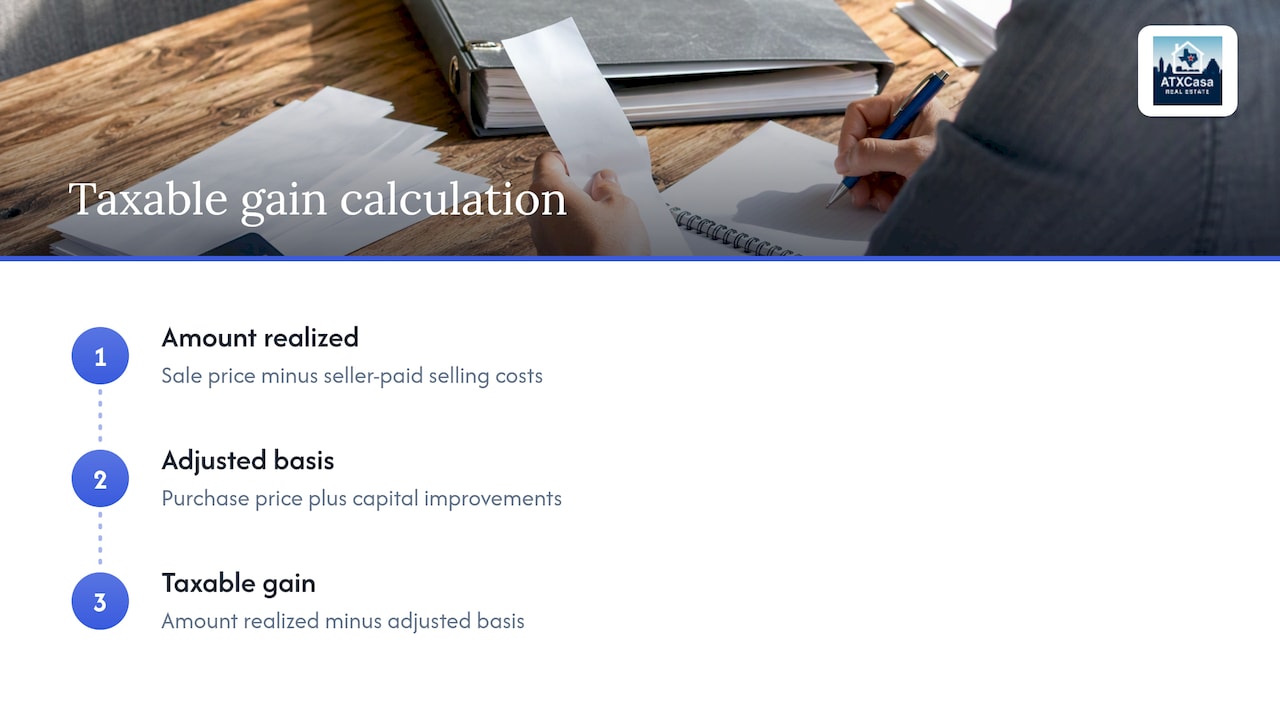
Your mortgage balance has no effect. The loan was borrowed money, and repaying it is not a cost of the property. Basis is the amount of your investment in the property for tax purposes, and IRS Publication 551 covers how it is figured and adjusted.
What raises your basis
Capital improvements add to your basis. Examples include a new roof, an added bedroom or bathroom, a remodeled kitchen, a pool, a new HVAC system and a new fence. Routine repairs and maintenance, such as repainting a room or fixing a leaky faucet, generally do not count. Publication 523 lists the adjustments to basis, including depreciation you took if part of the home was used for business or rental, which lowers basis.
My advice is simple: keep a folder, digital or paper, with contractor invoices, permits and receipts for every improvement from the day you buy. When a buyer’s inspection leads to a repair credit, note whether the work was a repair or an improvement. Eight years later, you will not remember the numbers.
Worked example: a $300,000 gain question
People often ask how much tax they pay on a $300,000 gain. Here is a hypothetical Austin-area sale to show how the pieces fit. These numbers are illustrative, not a forecast.
| Item | Amount |
|---|---|
| Original purchase price | $280,000 |
| Documented improvements (roof, kitchen, HVAC) | $30,000 |
| Adjusted basis | $310,000 |
| Sale price | $620,000 |
| Selling costs (commission, title, seller closing costs) | $40,000 |
| Amount realized | $580,000 |
| Gain | $270,000 |
Now apply the exclusion:
- Married couple, both meet the tests: the $500,000 exclusion covers the $270,000 gain. Taxable gain: $0.
- Single owner who meets the tests: the exclusion covers $250,000. Taxable gain: $20,000. If it is taxed at 15%, the federal tax is $3,000.
- Single owner, rented the house out for the last 3 years before selling: renting during the final 3 years does not by itself decide the result. Check whether the owner used the home as a main home for at least 24 months in the five years before sale; depreciation and nonqualified-use rules may still leave part of the gain taxable.
Notice how the improvements and selling costs changed the result. Without them, the gain would have been $340,000, and the single owner would have owed tax on $90,000 instead of $20,000.
Federal rates on gain that is not excluded
If your gain exceeds the exclusion, or you fail the tests, the taxable part depends on how long you held the home.
- Held one year or less: the gain is short-term and taxed as ordinary income at graduated rates, according to IRS Topic 409.
- Held more than one year: the gain is long-term and taxed at 0%, 15% or 20%, depending on your taxable income.
For tax year 2025, the 0% rate applies to single filers with taxable income up to $48,350 and joint filers up to $96,700, per IRS Topic 409. For tax years beginning in 2026, IRS Revenue Procedure 2025-32 lists a $49,450 maximum 0% capital-gain-rate amount for single filers and $98,900 for married filing jointly; the maximum 15% rate amounts are $545,500 and $613,700, respectively. These thresholds apply to taxable income, so the taxable portion of a home-sale gain can affect the applicable rate. The published summary of the 2026 brackets is a secondary reference. Confirm the figures for your sale year with your tax preparer; the IRS tax rates and brackets page provides broader income-tax guidance.
Higher earners may face additional federal taxes on investment income that this article does not cover. If your income is high and your gain is above the exclusion, a CPA can run the numbers before you accept an offer.
When you can still get a partial exclusion
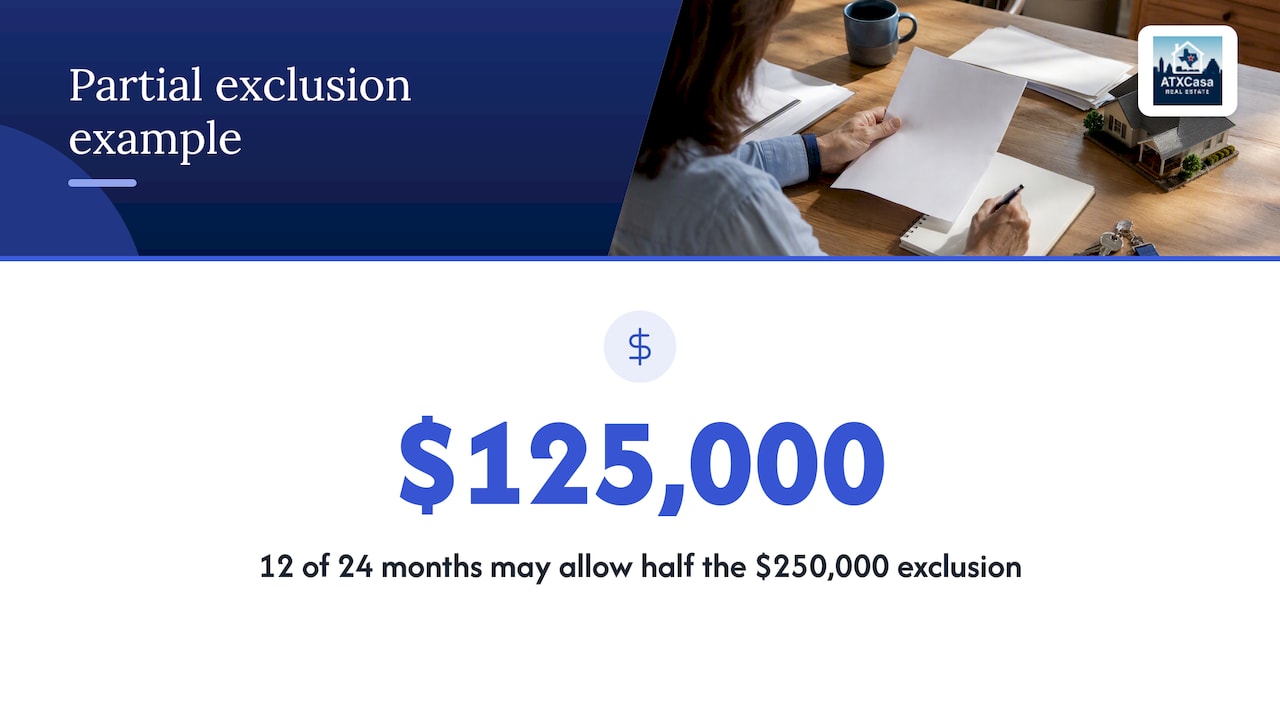
Moving before the two-year mark does not automatically mean a full tax bill. If you sell because of a change in employment, health or other unforeseen circumstances, you may qualify for a reduced exclusion. If you qualify because of work, health, or an unforeseen circumstance, the partial-exclusion limit is generally based on the shortest of your ownership period, residence period, or the time since a prior exclusion, measured against two years.
For example, if a single owner both owned and used the home as a main home for 12 months, has not claimed another home-sale exclusion in the preceding two years, and qualifies for the reduced-exclusion reason, the maximum partial exclusion would generally be $125,000 (12 months divided by 24 months, multiplied by $250,000). The IRS treats these cases on their facts, so document the reason for the move: a job offer letter, a doctor’s note, or similar records.
Families relocating to or from Austin for work are the most common case I see. If your timeline is tight, bring this up with your agent and tax professional at the start, not at closing.
Situations where tax does show up
Investment and rental properties
The exclusion applies only to your main home. Investors selling a rental generally owe tax on the gain and may also owe tax on depreciation they claimed or were allowed. One way to defer that tax is a like-kind exchange. We explain the mechanics and deadlines in our guide to the Austin 1031 exchange, including the 45-day and 180-day windows.
Publication 523 describes special rules for gains invested in Qualified Opportunity Funds and notes that the Opportunity Zone rules were revised by the One Big Beautiful Bill Act. Eligibility and timing require a separate analysis; ask a qualified tax adviser whether these rules apply to your sale before relying on a deferral.
Former rentals and mixed use
Renting a home or using part of it for business does not automatically eliminate the exclusion. Confirm the principal-residence ownership and use tests, then account for applicable nonqualified-use and depreciation rules; moving back in does not erase those considerations.
A very large gain
In parts of Austin, owners who bought before the 2020 to 2022 run-up can hold gains past $250,000, particularly in long-held homes. If you are single and near that line, the improvement records above can decide whether you owe tax.
Selling at a loss
If you sell your personal residence for less than your adjusted basis, you generally cannot deduct the loss, and it cannot offset gains from stocks or other investments. Sellers sometimes hope otherwise, so it is better to hear it before you price the home.
Reporting the sale, even when you owe nothing
If you receive a Form 1099-S from the title company, report the sale on your return even if your whole gain is excluded, per IRS Topic 701. The IRS matches the form against your return, and an unreported sale can lead to a notice. The IRS instructions for Form 1099-S note that a sale of a main home may be reportable even when the gain is excludable. For Form 1099-S reporting, the closing-side reporting person may rely on timely written seller certifications only when all stated conditions are met, including full excludability of the gain. The exception generally applies to sales of $250,000 or less; it can use $500,000 when the certification states the seller is married, and joint sellers each need certification or the noncertifying seller must be reported.
Keep your closing disclosure, your improvement records and proof of residence for at least as long as your tax adviser recommends.
Practical steps before you list
- Count your months. Confirm you meet 24 months of ownership and use within the last five years, and note the exact dates.
- Add up your basis. Gather the closing statement from your purchase and every improvement invoice.
- Estimate your gain. Use a realistic sale price. Our guide on how to use Austin sold-home data to price your home shows how to set that number from closed sales, not asking prices.
- Compare gain to your exclusion. Being below the $250,000 or $500,000 maximum is not conclusive: depreciation, rental or business use, nonqualified use, and other eligibility rules can affect what remains taxable. Ask a tax professional if any apply.
- Talk to a CPA before accepting an offer if you are near or above the limit, if you have rented the home, or if only one spouse has lived there for two years.
- Plan the next home. If you stay in Texas, ask about the homestead exemption. Our homestead exemption guide covers the filing deadline, and the post-closing checklist covers what to do after you close.
Our perspective
We built ATXCasa around a simple observation: sellers worry about the wrong number. Most conversations start with the sale price and the tax rate, when the facts that decide the outcome are the ones that already exist: your dates, your basis and your records. After nearly two decades in IT, I approach this like a data problem. The inputs are knowable, and the sooner you collect them, the more options you have.
Our view is that a seller should walk into the listing appointment with three things: a rough adjusted basis, a clear picture of their residency dates, and a question list for their CPA. Pricing strategy and tax strategy are connected. A $20,000 difference in sale price can matter a lot to a single owner near the $250,000 line, and almost nothing to a couple far below $500,000.
We also think the web makes this topic sound scarier than it is. For most primary-residence sellers in Texas, the answer is no tax. The risk is not the rate, it is missing paperwork, a misread residency test, or a rental history nobody mentioned until the title company asked. We are real estate professionals, not tax advisers, so we give you the framework and send the tax-specific questions to a licensed CPA.
— Vladimir
Selling in Austin, Cedar Park, Round Rock or Georgetown?
If you are planning a sale, we can help you set a price from local closed-sale data, estimate your net proceeds, and line up the dates so your tax professional has what they need. Start at ATXCasa and tell us about your home, your timeline and your next move.
FAQ
Is there capital gains tax in Texas?
No. Texas has no personal income tax, so it does not tax capital gains, including gains from a home sale. Federal capital gains tax can still apply to the part of your gain that exceeds the home sale exclusion or to a property that does not qualify.
Do I pay capital gains on my primary residence?
Only if your gain is above the exclusion or you fail the ownership and use tests. Single sellers can exclude up to $250,000 and joint filers up to $500,000 when they owned and lived in the home for 24 of the last 60 months. Gain above those limits is taxed federally.
How much capital gains tax do I pay on $300,000?
It depends on your filing status and basis. A married couple who qualifies could owe nothing on a $300,000 gain, because it is under $500,000. A single seller who qualifies would have $50,000 taxable above the $250,000 exclusion, taxed at the 0%, 15% or 20% rate that matches their income.
What if I lived in the house less than two years?
You may still get a partial exclusion if you moved because of a job change, health reasons or another unforeseen event. Otherwise the gain can be taxable, at ordinary income rates if you held the home a year or less. Talk to a CPA with your dates in hand.
Do I have to report the sale if I owe no tax?
Yes, if you receive a Form 1099-S. Report the sale on your return and claim the exclusion, because the IRS matches the form to your filing.
Sources
- Texas Comptroller: Texas is open for small business
- IRS Topic no. 701, Sale of your home
- IRS Publication 523, Selling Your Home
- IRS Publication 551, Basis of Assets
- IRS Topic no. 409, Capital gains and losses
- IRS: Federal income tax rates and brackets
- IRS: Capital gains, losses, and sale of home
- IRS: Instructions for Form 1099-S
- Taxstra: Capital gains tax rate 2026