

TL;DR
- Assistance may make buying sooner feasible when the down payment is the obstacle and the ongoing housing costs already fit your budget.
- Zillow’s September 2026 Austin-metro model shows 3.9 years to save without assistance versus 2.5 years with a 3.5% contribution toward a 10% down payment. This is a historical planning scenario, not a program offer. Source: Zillow Research.
- Time saved and payment savings are different comparisons. Reaching 10% down sooner does not establish a cheaper loan than saving the same 10% yourself.
- Before relying on assistance, obtain the specific program documents and lender confirmation, then compare required funds, loan costs and any repayment or shared-equity obligations.
If you’re an Austin-area first-time buyer still saving for a down payment, assistance could change when you can buy. The useful question is whether it closes your savings gap while leaving you with affordable housing costs and acceptable obligations.
Start investigating assistance if cash for the purchase is your main obstacle. Keep saving, or consider a lower-priced home, if the ongoing cost would still strain your budget. A contribution toward the down payment cannot by itself establish that a home is affordable.
What a 3.5% contribution changes in a concrete example
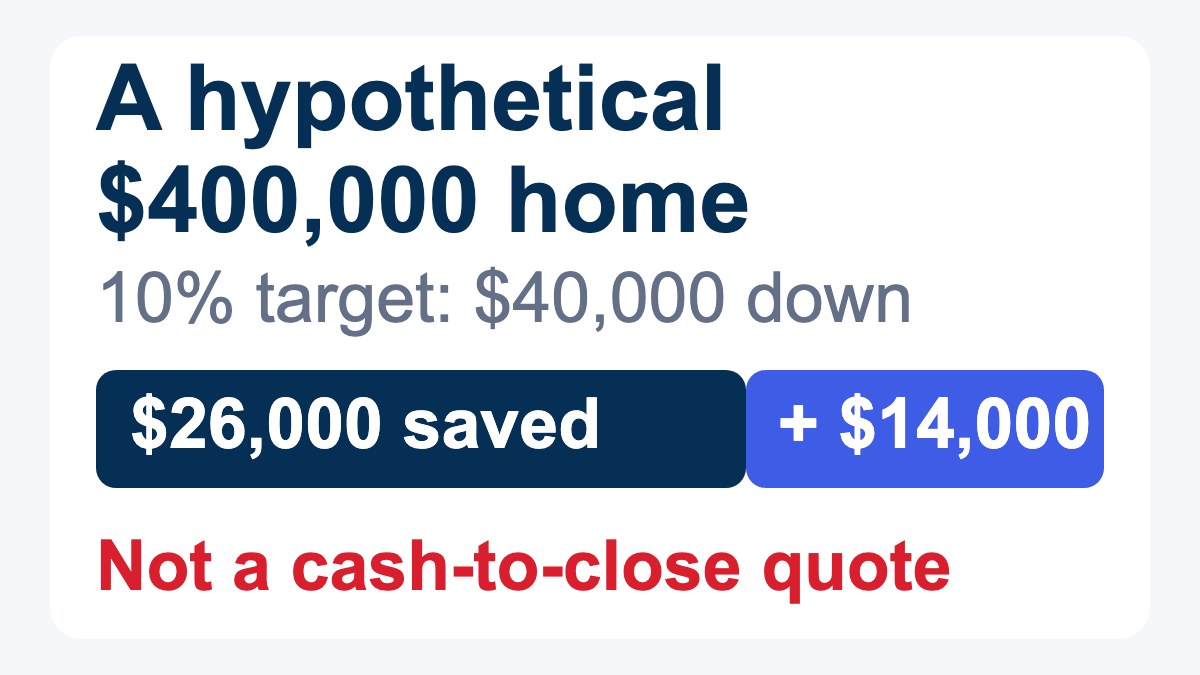
Suppose you’re considering a hypothetical $400,000 home and have saved 6.5%, or $26,000, toward a 10%, or $40,000, down-payment target. This price is an illustration, not an Austin market estimate.
- Continue saving toward 10%: You still need $14,000 for the down payment.
- Use assistance toward the same target: If a verified program contributes 3.5%, or $14,000, and your lender accepts it, your $26,000 plus that contribution reaches $40,000.
The benefit is concrete: assistance could fill the down-payment gap without requiring you to save that remaining $14,000. The trade-off depends on the actual program and loan. A contribution with repayment or shared-equity obligations may affect your finances later; different lender fees or loan terms may change the cost today.
$26,000 is not a cash-to-close quote. To determine the buyer’s required funds, add the lender’s quoted closing costs, prepaid items and required reserves, then apply only documented assistance that the lender accepts. Have the lender distinguish cash due at closing from reserves you must retain, and confirm where the contribution is applied so it is not counted twice. This example establishes only the down-payment arithmetic.
What Zillow’s Austin model actually compares
In research published October 28, 2026, Zillow reports that its Austin, TX metro scenario takes 3.9 years to save a 10% down payment without assistance and 2.5 years with a 3.5% assistance boost. That is 1.4 years sooner under the model’s assumptions. Zillow’s analysis uses September 2026 inputs, not today’s mortgage quotes.
The scenario assumes a median-income household saves 10% of income each month and buys the typical metro home measured by the September 2026 Zillow Home Value Index. It uses an FHA loan—a mortgage insured by the Federal Housing Administration—and a 6.78% average FHA rate for September. Its affordability measure limits total monthly housing costs to 30% of household income; its cost estimates include taxes, insurance and maintenance. Those assumptions describe the research, not a lender’s approval standard for your application.
Zillow also reports $1,224 in annual modeled total-housing-cost savings for Austin, equivalent to $102 per month. For that cost comparison, the buyer’s 6.5% down payment becomes 10% total down through the 3.5% assistance contribution. These are modeled costs, not a guaranteed reduction in your mortgage payment. Source and methodology: Zillow Research.
The distinction matters. The saving-time comparison asks how soon the household can reach 10% down. The cost comparison asks what changes when assistance raises the total down payment from 6.5% to 10%. It does not establish that an assisted loan costs less than an otherwise identical loan after you have saved the full 10% yourself.
Compare the actual offer before changing your timeline
The model becomes useful when you replace its assumptions with program documents and a lender’s written terms. Before relying on assistance, obtain the specific program documents and lender confirmation, then compare the buyer’s required funds, program contribution, repayment/forgiveness or shared-equity provisions, lender fees and acceptance, closing costs and reserves, and the Loan Estimate.
A Loan Estimate sets out estimated loan terms and closing costs. Use it alongside the assistance documents; the mortgage quote alone does not answer every question about the contribution.
- Establish whether the contribution is usable. Verify actual program eligibility, including applicable income or purchase-price limits, and lender participation and acceptance. If the household, property or loan does not qualify, leave that contribution out of the purchase plan.
- Separate the down payment from total required funds. Get the buyer contribution, documented assistance, closing costs, prepaid items and required reserves in writing. If assistance fills the down-payment gap but the remaining required funds exceed your savings, the purchase still needs a different funding plan or more saving.
- Compare ongoing costs on the same basis. Ask for assisted and unassisted loan comparisons using the same property, price and quote timing, with differences in down payment, rate and fees identified. Compare the full housing budget, including taxes, insurance and maintenance, rather than subtracting Zillow’s $102 from a quoted payment.
- Follow the obligation beyond closing. Establish whether assistance must be repaid, what conditions govern forgiveness, or whether shared equity gives the provider a share of future value or appreciation. Ask what the documents require if you sell or refinance. If those terms conflict with a likely move or future financing plan, the earlier purchase may not be worth the obligation.
Zillow’s research does not identify a particular Austin assistance program or establish that the contribution is a grant. It cannot tell you which costs assistance covers or what you would owe later.
When assistance or continued saving makes sense
Investigating assistance makes sense when the missing down-payment funds are delaying an otherwise manageable purchase. Proceed only after eligibility, lender acceptance, required funds and future obligations are documented and the resulting housing budget works for you.
Continuing to save makes sense when the available assistance has terms you do not want, the remaining cash requirement is too high, or the monthly cost is still uncomfortable. Saving the contribution yourself takes longer but avoids that program’s obligations. It does not lock in today’s home price or financing terms.
A lower-priced home is another comparison worth making if both cash and ongoing costs are obstacles. Test that option with a property-specific quote. Neither waiting nor assistance guarantees a better future rate or price; base the choice on funds and obligations you can verify.
Frequently asked questions
Does the model mean I have 2.5 years left to save?
No. Zillow’s figure is a modeled saving period under its stated income, saving-rate and home-price assumptions. It is not a countdown based on your existing savings. Your remaining timeline depends on the funds you still need and the amount you can consistently add after other expenses.
Can I use the $102 monthly figure for the $400,000 example?
No. The $400,000 example demonstrates only how the down-payment contributions add up. Zillow’s cost figure comes from its separate September 2026 typical-home scenario. A payment estimate for the hypothetical home would require documented loan and assistance terms, plus property-specific costs that are not supplied here.
Sources
- Zillow Research: Down Payment Assistance Could Cut the Time to Save for a Home by a Year and a Half or More — published October 28, 2026; September 2026 model and Austin, TX metro table. Source checked October 31, 2026.
Recommended reading
- Austin Down-Payment Assistance: When a Bigger Grant Can Mean a Bigger Decision Later
- Mortgage Quote Higher Than the Headlines? Compare the Loan, Not Just the Rate
Deciding whether assistance could move your Austin-area home search forward? Contact Vladimir Baibus at ATXCasa, LPT Realty for help matching your purchase timeline and home search to the cash requirements and housing budget your lender verifies.