

A 1031 exchange can help Austin investors defer federal tax on gain when exchanging qualifying investment property. For 2018 and later, Section 1031 generally covers real property held for business or investment, not primarily for sale, exchanged for like-kind real property. A personal residence generally does not qualify; mixed use or changes in use require a closer eligibility review. Receiving money or other non-like-kind property can make some gain taxable. In a delayed exchange, identify replacement property in writing within 45 days after transferring the property you sell. Receive the replacement by the earlier of 180 days after that transfer or the federal tax-return due date for the transfer year, including extensions.
TL;DR:
- In a delayed 1031 exchange, identify replacement property in writing within 45 days after transferring the property you sell. Receive the replacement by the earlier of 180 days after transfer or the federal tax-return due date for that year, including extensions.
- Use a qualified intermediary that is independent, holds funds in a segregated escrow, and requires dual signatures for outbound wires to avoid disqualification.
- Costs include a flat QI fee, typical title and escrow charges on both transactions, with reverse exchanges incurring roughly double the standard fees.
- Missing deadlines or touching sale proceeds disqualifies the exchange, while related-party swaps or skipping due diligence can trigger IRS scrutiny.
- Local market conditions and inventory data are crucial to identify suitable replacement properties quickly within the tight 45-day window.
Table of Contents
- Quick primer: IRS mechanics, like-kind requirement, and Form 8824
- Step-by-step checklist Austin investors should follow
- Choosing and working with a qualified intermediary: checklist and red flags
- Costs and fees: realistic expectations for Austin exchanges
- Texas and Austin considerations
- Reverse exchanges and the Rev. Proc. 2000-37 safe harbor
- Top pitfalls and how to avoid them
- ATXCasa perspective: how Austin market conditions shape 1031 strategy
- How ATXCasa can help with your exchange
- Authoritative forms, regs, and practitioner resources to bookmark
- Sources
- FAQ
Quick primer: IRS mechanics, like-kind requirement, and Form 8824
Most Austin exchanges follow a delayed structure: you sell the relinquished property, a qualified intermediary holds the proceeds, you identify replacement property within the window, then close through the same intermediary. The transaction gets reported on Form 8824, which calculates deferred gain and any taxable boot.
For 2018 and later, Section 1031 generally applies only to qualifying real-property exchanges, subject to IRS definitions and applicable exceptions. Real property in the United States is not considered like-kind to real property located abroad.
Both periods run from the transfer of the relinquished property—the property you sell—and overlap. Written identification is due within 45 days; receipt of replacement property is due by the earlier of day 180 or the federal tax-return due date for the transfer year, including extensions. You do not get another 180 days after identification. If the return deadline comes first, a filing extension may allow more time to complete the exchange, but cannot extend it beyond day 180. Missing the applicable deadline means the transaction does not meet the federal deferred-exchange timing requirement.
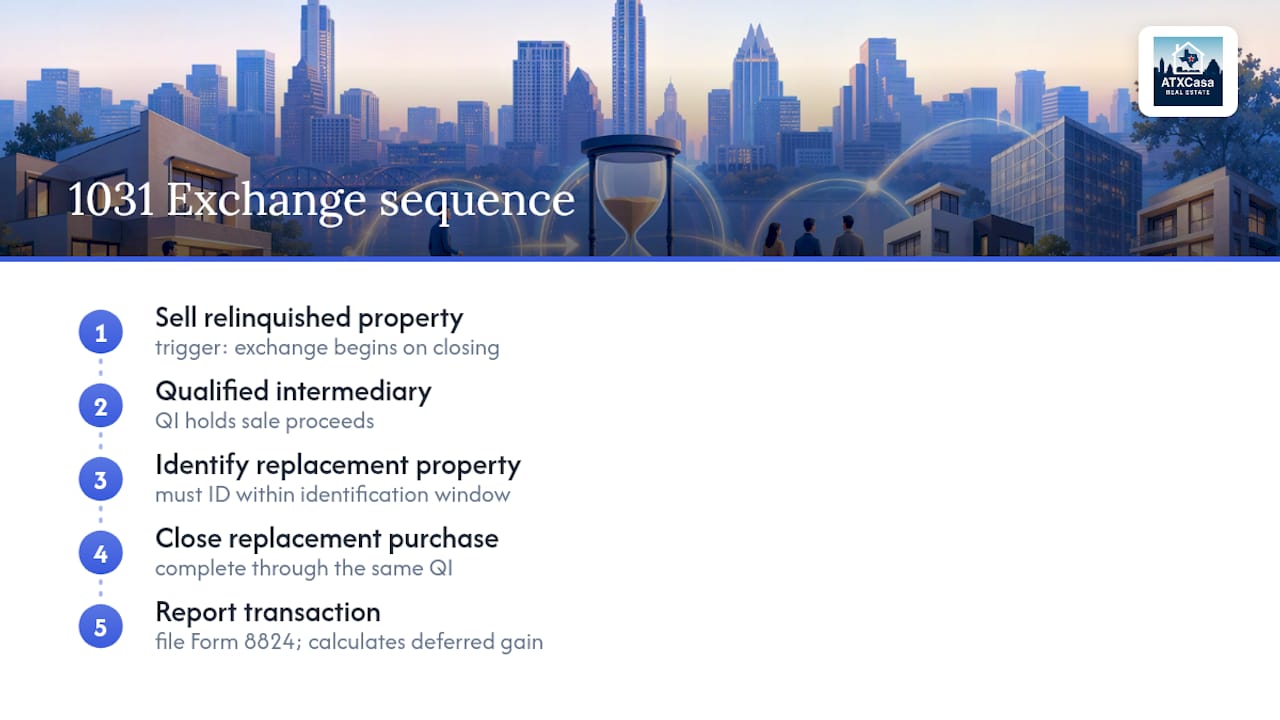
Step-by-step checklist Austin investors should follow
Before you list your Austin property, line up your team. Here’s the order that keeps an exchange on track:
- Engage a tax adviser and a qualified intermediary before signing a listing agreement, so exchange language is built into your sale contract from the start.
- At closing, route sale proceeds directly from title to the QI’s escrow account, never through your own hands, to avoid constructive receipt.
- Identify replacement property within 45 days, using the three-property rule, the 200% rule, or the 95% rule depending on how many properties you’re targeting.
- Identify replacement property in writing within 45 days, clearly describing it by legal description, street address, or distinguishable name. Send the identification to the person obligated to transfer the replacement property or another person involved in the exchange who is not disqualified, such as an eligible QI. Alternatively, include the designation in a written agreement signed by all exchange parties within that period.
- Receive replacement property by the applicable completion deadline: the earlier of the 180th day after transferring the relinquished property or the federal tax-return due date for the transfer year, including extensions. Confirm that date with your tax adviser, then coordinate title, lender, and QI so closing and receipt occur on time.
- Keep every agreement, wire confirmation, and identification letter in one file for at least three years after filing.
Whether the property qualifies at all often comes down to intent. If you’ve been weighing renting versus selling a property, that decision shapes whether it counts as held for investment.
Choosing and working with a qualified intermediary: checklist and red flags
Your QI cannot be your attorney, accountant, real estate agent, or anyone who has acted as your agent in the two years before the exchange. Independence matters because the QI holds your money for months, and Texas courts have seen disputes arise when that separation, or the escrow language protecting the funds, wasn’t clearly documented.
Before hiring one, ask:
- Where are exchange funds held, and are they in a segregated, qualified escrow account?
- What fidelity bond or errors-and-omissions insurance covers client funds?
- How many Texas closings has the company handled, and can it name title companies it works with regularly?
- What written authorization is required before any funds move?
Pro Tip: Require dual signatures or written verification calls on every outgoing wire from your QI, and confirm the receiving account by phone before closing, not by email alone.
Red flags include reluctance to provide segregated account statements, pressure to skip written identification, or a QI that also wants to broker your replacement property purchase.
Costs and fees: realistic expectations for Austin exchanges
A standard delayed exchange typically involves a flat QI fee, plus your usual title, escrow, and closing costs on both transactions. Add attorney or CPA review time if your exchange involves multiple properties or complex allocations.
- QI fees are generally a flat charge per exchange, sometimes with a per-additional-property surcharge.
- Title and closing costs apply twice, once on the sale and once on the purchase, just as they would in any transaction.
- Reverse exchanges cost more because they require an accommodation titleholder to hold property temporarily.
Reverse exchanges can roughly double transactional costs compared to a standard forward exchange, based on comparative practitioner guidance on cost and complexity trade-offs. Fees themselves don’t create boot, but any cash left over after the QI pays them can.
Texas and Austin considerations
Texas has no state income tax, so federal deferral under Section 1031 is the entire benefit for a Texas-only exchange. If either property sits in another state, check that state’s conformity rules and withholding requirements before you close.
Locally, Austin closings run into predictable friction points: municipal utility district liens, HOA transfer requirements, and permit records that haven’t been closed out. A property with an expired or open permit can stall a title company right when your 180-day clock is running. Loop your title company in early enough to run lien and permit searches before you’re deep into your identification window, not after.
Reverse exchanges and the Rev. Proc. 2000-37 safe harbor
A reverse, or parked, exchange lets you acquire replacement property before selling the relinquished one, useful in Austin’s tighter submarkets where a desirable property won’t wait for your current sale to close. Rev. Proc. 2000-37 provides the safe harbor: an exchange accommodation titleholder holds legal title, a written qualified exchange accommodation agreement is signed within five business days, and the same 45- and 180-day clocks apply from the parking transaction.
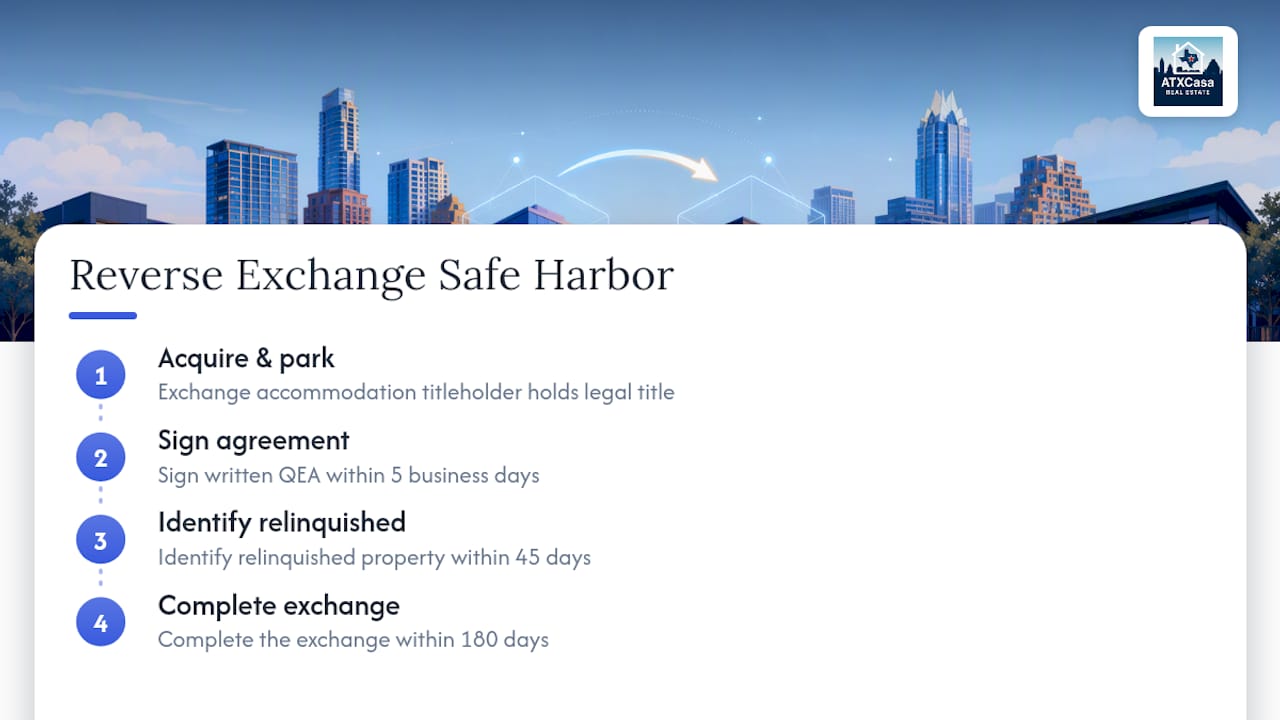
Reverse exchanges solve a timing problem forward exchanges can’t. They’re worth the added cost mainly when bridge financing or seller negotiation can’t bridge the gap.
Top pitfalls and how to avoid them
Most failed exchanges trace back to a handful of preventable mistakes.
- Constructive receipt: touching sale proceeds, even briefly, disqualifies the exchange. Route funds directly from title to your QI.
- Missed identification: the 45-day window is calendar days, not business days. Mark it the day you close.
- Related-party exchanges: special rules apply to direct and indirect exchanges with related parties. If either party disposes of the exchanged property before 2 years after the last transfer, deferred gain generally must be reported. Exceptions can apply for death, an involuntary conversion after the exchange, or proof that tax avoidance was not a principal purpose. Have your tax adviser assess the relationship and any planned disposition before proceeding.
- Weak due diligence: rushing replacement property under deadline pressure can mean skipping inspections or permit checks you’d normally insist on.
Pro Tip: Build a standing shortlist of acceptable replacement properties before you list your relinquished property, so identification day isn’t a scramble.
ATXCasa perspective: how Austin market conditions shape 1031 strategy
Austin’s submarkets don’t move at the same pace, and that changes how I’d approach identification. Data-driven pricing and inventory alerts shorten the search phase considerably when 45 days feels tight. That said, a 1031 exchange isn’t always the right move. If your Austin property has appreciated modestly or you’re planning to eventually convert it to a primary residence, a straight sale with standard capital gains treatment can sometimes make more sense than the cost and constraint of an exchange.
— Vladimir
How ATXCasa can help with your exchange
Finding qualifying replacement property inside a 45-day window is the hardest part of most exchanges, and it’s where local sourcing makes the biggest difference. Our service tracks inventory and pricing trends across the Austin metro area, which helps investors move faster on identification without settling for a weaker property.
- We provide market data and guidance to help widen your replacement property options.
- We offer coordination advice to keep identification and closing timelines aligned with your qualified intermediary and tax adviser.
- Guidance on rental yield by suburb to help you target replacement property that fits your investment goals.
If you’re planning a 1031 exchange in the Austin area, reach out to ATXCasa for a consult and a copy of our exchange coordination checklist.
Authoritative forms, regs, and practitioner resources to bookmark
- Instructions for Form 8824, covering reporting requirements and the regulations defining like-kind real property.
- IRS like-kind exchange tax tips, summarizing identification rules and the TCJA limitation to real property.
- Rev. Proc. 2000-37, the safe harbor governing reverse exchanges and exchange accommodation titleholders.
- For ongoing Austin closing and permit checks, see our homestead exemption checklist and permit due diligence guide.
Sources
- Instructions for Form 8824 (2025) | Internal Revenue Service
- Like-kind exchanges – Real estate tax tips | Internal Revenue Service
FAQ
How much should a 1031 exchange cost?
Costs vary by structure: a standard delayed exchange typically involves a flat QI fee plus normal title and closing costs on both properties. A reverse exchange costs meaningfully more because it requires an accommodation titleholder and added legal documentation.
What is the 95% rule in a 1031 exchange?
The 95% rule lets you identify any number of replacement properties as long as you acquire at least 95% of their combined value. It’s an alternative to the three-property and 200% rules, useful when you’re targeting several smaller properties rather than one or two larger ones.
What are the rules for a 1031 exchange in Texas?
Texas follows federal Section 1031 rules exactly, since the state has no income tax of its own to conform or diverge. The same 45-day identification and 180-day completion deadlines, qualified intermediary requirement, and Form 8824 reporting apply as they would anywhere else in the United States.
What are the downsides of a 1031 exchange?
The biggest downside is the rigid timeline: missing the 45-day identification or 180-day closing deadline turns the transaction into a fully taxable sale. Exchanges also add QI fees, restrict how you can use sale proceeds, and carry deferred, not eliminated, tax liability that eventually comes due unless you exchange again or hold until death.