

An appraisal gap is the difference between the price you agreed to pay and the value the lender’s appraiser assigns to the home. If the lender reduces the loan because of the appraisal, TREC Form 49-1 says the cash portion of the sales price increases by that reduction. Whether the lender reduces the loan and what financing remains available depend on underwriting—the lender’s review of the loan. The parties can negotiate a price change, and the buyer can ask the lender about other financing options. In Austin the risk is a pricing problem as much as a contract problem, and the buyers and sellers who handle it well decide the plan before the appraisal arrives. This guide covers how the gap works, what the Texas contract forms say, and how to negotiate it.
TL;DR
- If a lender reduces the loan because of a low appraisal, the cash portion of the sales price increases by that reduction; lender underwriting determines the available financing.
- In Texas, TREC Form 49-1 addresses waiver or additional termination rights tied to the lender’s appraisal. It is used only with the Third Party Financing Addendum and not for FHA-insured or VA-guaranteed financing.
- You can renegotiate the price, split the gap, bring more cash, request a reconsideration of value, or terminate if your contract allows it.
- Austin inventory is high compared with recent years, which gives buyers leverage on price but also makes comparable sales more conservative for appraisers.
- Decide your maximum gap number before you write the offer, not after the appraisal comes back.
Table of Contents
- What an appraisal gap is and how it happens
- A worked example: what the gap costs in cash
- What the Texas contract says
- Why Austin conditions shape the gap
- What to do when the appraisal comes in low
- Appraisal gap coverage: how buyers and sellers should read it
- Prevent the gap before it starts
- Our point of view
- Work with us on your Austin purchase or sale
- FAQ
- Sources
What an appraisal gap is and how it happens
When you finance a home, the lender orders an appraisal, an independent opinion of the property’s value based on recent sales of similar homes nearby, called comparables or comps. If the lender reduces the loan because the appraisal value does not satisfy its underwriting requirements, TREC Form 49-1 provides that the cash portion of the sales price increases by that reduction. Fannie Mae, which sets rules for much of the conventional mortgage market, says that if the appraised value is below the purchase price, the lender may not approve the full loan. It lists the usual options: negotiate a lower price, request a reconsideration of value, increase the down payment, or walk away, with earnest money at risk depending on your contract.
A gap happens for a few common reasons. A Fannie Mae and Kansas State University white paper studying appraisals from September 2011 to August 2012 found that 8.2% came in 2% or more below the contract price. It tied low values to a lack of comparable sales, appraisers lagging a changing market, and atypical property features. The same study found that a low appraisal raised the chance of a renegotiated lower price from 8% to 51%, and the chance of a delayed or canceled sale from 25% to 32%.
That last point matters for planning. A low appraisal is common enough that you should assume it can happen on any financed purchase, and it usually ends in a conversation about price rather than a dead deal.
A worked example: what the gap costs in cash
The size of the cash problem is larger than the gap itself in some cases and smaller in others, depending on how you restructure the loan. Here is the arithmetic, using a lender’s worked example for a $500,000 purchase with 10% down that appraises at $485,000:
| Choice | What changes | Cash you add |
|---|---|---|
| Keep the original $450,000 loan | Loan-to-value (LTV) rises to 92.8% | No extra cash for the loan, but a higher LTV |
| Keep 90% LTV | Loan drops to 90% of $485,000 | $13,500 (90% of the $15,000 gap) |
LTV is the loan amount divided by the lower of the price or the appraised value. The same source notes that under Fannie Mae conventional rules, mortgage-insurance coverage increases above 90% LTV on standard loans, and loan-level price adjustments vary by LTV and other factors. So a gap affects your monthly cost as well as your closing cash. After any change, confirm the new figures with your lender, because closing costs, mortgage insurance, and loan limits all feed into the cash you must bring.
A Texas attorney’s example shows the simplest version: a $400,000 purchase that appraises at $375,000 with an 80% loan plan produces a $300,000 loan instead of $320,000. The buyer covers the difference in cash unless the price or financing changes.
What the Texas contract says
In Texas, the standard residential forms come from the Texas Real Estate Commission (TREC), the state agency that licenses agents and publishes the forms most contracts use. The form that matters here is TREC 49-1, the Addendum Concerning Right to Terminate Due to Lender’s Appraisal. The form may be used only when the Third Party Financing Addendum is attached and the transaction does not involve FHA-insured or VA-guaranteed financing. For eligible transactions, it offers three choices:
- Full waiver. The buyer waives the termination right under Paragraph 2B of the Third Party Financing Addendum when property approval is not obtained because the appraisal value does not satisfy the lender’s underwriting requirements. This waiver concerns that specific termination right, not every contractual right or obligation.
- Partial waiver. The buyer waives that Paragraph 2B termination right if property approval is not obtained because of the appraisal value and the value is at least the stated threshold. Below that threshold, this partial waiver does not waive that right; any termination still depends on the contract’s terms. If the lender reduces the loan because of the appraisal value, the form says the cash portion of the sales price increases by the loan reduction.
- Additional right to terminate. The buyer may terminate within the stated number of days after the contract’s Effective Date if the lender-obtained appraisal is below the stated amount and the buyer delivers a copy of that appraisal to the seller. Earnest money is refunded when termination is under this paragraph.
Review these choices when making the offer. The additional termination period runs from the contract’s Effective Date, not from the day the appraisal arrives, so calendar it when contracting. Before signing, review the selected option and the financing addendum with your agent; other financing-related termination rights depend on your contract.
The CFPB, the federal consumer finance regulator, warns that buying a home for more than its appraised value is very risky. It adds that a lower appraised value is strong evidence for negotiating a price reduction, and that if the seller will not reduce the price, you may want to cancel. Because canceling can carry contract costs, the CFPB advises consulting an attorney. If you are considering termination, a Texas real estate attorney is the right person to read your specific contract.
Why Austin conditions shape the gap
The appraisal gap follows the market, so the local trend matters more than a national headline.
Texas A&M’s Real Estate Center studied 15 years of Austin MLS data from 1998 to 2012 and found that the larger the inventory of homes for sale, the larger the spread between list price and sale price. In plain terms, when there are more homes for sale, sellers settle for less relative to their asking price, and appraisers see lower comps.
The recent Austin numbers fit that pattern. Austin Board of REALTORS research found that since April 2024 active listings have been higher than in any comparable month since early 2011, which gave buyers more negotiating power and pushed sellers to adjust prices. The same report notes the median price peaked at $550,000 in April and May 2022, then fell 12% from 2022 to 2024 while staying more than 40% above 2019 levels.
For a more recent snapshot, ABOR data for the Austin-Round Rock-San Marcos metro, as summarized by a local appraisal firm, showed these figures for the first quarter of 2026:
- Median sales price: $415,300, down 3.4%
- Months of inventory: 5.5
- Average close-to-list price: 92.6%, versus 93.3% in the first quarter of 2025
The firm describes appraisers producing more conservative, comp-supported values, especially where a home was listed above what recent sales support. These figures are quarterly readings that move with each monthly ABOR release, so check the latest report before you rely on them. For how to read the inventory number itself, see what 4.5 months of Austin housing inventory means and the latest Austin inventory update.
Two practical conclusions follow for Austin:
- Homes priced off a stale comp are the risk. A list price anchored to 2022 or 2023 sales invites a low appraisal in a market where recent closed sales sit lower. This is where data-driven pricing pays off.
- Rising values can also cause a gap in reverse. Appraisals can come in higher than expected in a cooling market, as we explain in why an Austin home appraisal can rise in a cooler market. Do not assume the direction.
For the bigger picture on pricing and negotiating room, see our look at Austin home prices in 2026.
What to do when the appraisal comes in low
Here is the sequence I would follow as a buyer, in order.
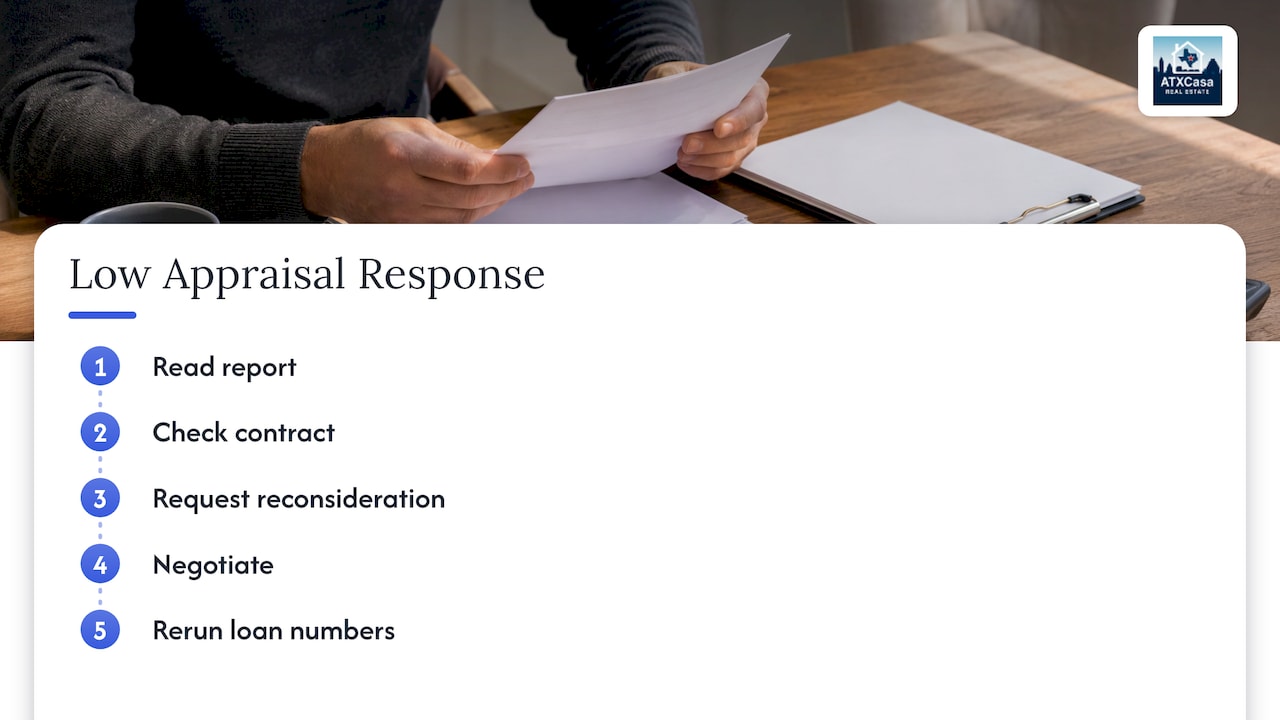
1. Get the report and read it
For a covered credit application secured by a first lien on a dwelling, the lender must provide a copy of each appraisal or written valuation promptly upon completion or 3 business days before credit consummation, whichever is earlier, unless you validly waive that timing. Credit consummation means becoming contractually obligated on the loan, not signing the home purchase contract. A timing waiver generally must be obtained at least 3 business days before consummation, with a limited exception for certain clerical changes; you must still receive the copy at or before consummation. Read the comps the appraiser used. Look for sales that are older, in a different school zone or subdivision, or with a different lot, condition, or size.
2. Check your contract position
Identify which TREC 49-1 option, if any, you selected. At contracting, calendar the additional termination period from the contract’s Effective Date; it does not start when the appraisal arrives. To use that additional right, the lender-obtained appraisal must be below the stated value, and you must terminate within the stated period and deliver the appraisal copy to the seller. Review any other applicable financing deadlines separately.
3. Ask your lender about a reconsideration of value
A reconsideration of value (ROV) is a request, routed through the lender, asking the appraiser to review the value with additional comparable sales. Fannie Mae lists it as one of the options. To make it worth the lender’s time, bring recent closed sales that are truly comparable, not listings and not pending sales. Treat it as a possibility rather than an expectation, and run it in parallel with a negotiation so you do not lose days.
4. Negotiate with the evidence
The appraisal is documentation. A seller who sees a lender-ordered value below the price has a harder time arguing for the full number, because the next buyer’s lender will face the same appraiser logic. Put the proposal in writing and document any agreed change in a written amendment.
Common structures:
- Price reduction to the appraised value. The cleanest outcome for the buyer.
- Split the gap. On a $500,000 contract appraising at $480,000, the parties might reduce the price to $490,000 and the buyer brings cash for the rest.
- Buyer covers the gap in cash. Reasonable only when you have reserves left after closing and you believe the home is worth the price to you.
- Increase the down payment if the lender reduces the loan due to the appraisal and you choose to proceed at the same price. Under Form 49-1, the cash portion of the sales price increases by that reduction. Ask the lender what loan structure, approval, and cash-to-close figures remain available.
- Terminate, if your contract gives you the right and the seller will not move.
5. Re-run the numbers with the lender
After any change, get an updated loan estimate. Mortgage insurance, rate pricing, and cash to close all shift with LTV, and a small gap can change your monthly payment more than you expect.
Appraisal gap coverage: how buyers and sellers should read it
What buyers and sellers call gap coverage needs a careful reading of the contract. In TREC 49-1, the partial waiver uses an appraisal-value threshold: if the value meets that threshold, the buyer waives the specified Paragraph 2B termination right when property approval fails because of the appraisal value. The threshold is not an automatic cap on the buyer’s cash obligation. If the appraisal falls below it, the partial waiver does not waive that right, but termination still depends on the contract’s terms. The form does not require the buyer to close in every circumstance regardless of other contractual rights.
If you are buying
Choose a partial-waiver threshold only after checking what you could afford if the lender reduced the loan. A lender may reduce the loan when the appraisal value does not satisfy underwriting; under Form 49-1, that reduction increases the cash portion of the sales price by the same amount. Ask the lender to model the available financing and cash needed at different appraisal values before you agree to a threshold. Set your limit so you can still keep the reserves you need after closing.
Buyers in Austin have more room to avoid gap coverage than they did in the peak years. A local market piece is not needed to see why: with high inventory and sellers cutting prices, many offers can stand on price, terms, and timing instead of an uncapped waiver. Our write-up on whether it is easier to buy in Austin in 2026 covers where the leverage sits.
If you are selling
When you compare offers, look past the headline price at four things:
- The cap and the floor. A $15,000 gap commitment on a $450,000 offer is a different strength than an open-ended one.
- The cash behind it. Proof of funds beyond the down payment shows the buyer can actually pay the gap.
- The termination rights left. An offer with coverage but a broad termination window is weaker than it looks.
- The loan type. TREC 49-1 is used only with the Third Party Financing Addendum and for transactions that do not involve FHA-insured or VA-guaranteed financing. Review the governing forms for other loan types.
If an appraisal still comes in low, your levers are to reduce to the appraised value, meet in the middle, hold firm and let the buyer cover it, join the buyer in a reconsideration request, or offer a closing-cost credit within lender limits. Under Fannie Mae conventional rules the maximum seller concession falls when the LTV rises. In the lender’s example, the 6% cap on a $485,000 value is $29,100, dropping to $14,550 at 3%. Which is better, a price cut or credit, depends on your net proceeds and the buyer’s cash; we compare them in price cut or closing-cost help for Austin sellers.
Prevent the gap before it starts
Most gaps are cheaper to prevent than to repair.
- Price with closed sales, not asking prices. Pull sold comps within the last few months, in the same subdivision or similar streets, adjusted for size, lot, and condition.
- Set your own value estimate first. A buyer who has a comp-backed number before offering knows what price they can defend.
- Check your budget against a real lender quote. An online estimate is not a loan approval; our guide to a lender quote versus an online budget estimate shows the difference.
- Keep a cash reserve large enough to cover a modest gap, and decide the number before the offer.
- Document improvements. Sellers who have renovated should keep permits, invoices, and a list of upgrades to hand the appraiser.
- Budget for ownership costs. A larger loan or lower equity affects the monthly picture, and property taxes matter too, so see the 2026 Austin property tax and utility changes.
Our point of view
Appraisal gaps are a pricing story first and a paperwork story second. When a home appraises low, it is almost always because the price and the recent closed sales told different stories, and the contract only decides who absorbs the difference.
My background is nearly two decades in IT, so I look at this with data. Before an offer, we pull recent closed sales, check months of inventory for the specific area, and compare the list price with what comps support. That tells a buyer whether a gap is likely and tells a seller whether the price will hold up with a lender’s appraiser.
For buyers, my advice is to choose the gap number as a budget decision, not a bidding reflex. For sellers, I would rather see a well-supported price at the start than a negotiation over a low appraisal in week three. Our approach to marketing and pricing is designed around that: maximum exposure, and a price built on data.
The goal is a transaction without surprises, and that starts with knowing the numbers early.
Vladimir
Work with us on your Austin purchase or sale
ATXCasa helps clients buy, sell, and invest across the Austin area, including Cedar Park, Round Rock, and Georgetown. Our AI-powered marketing and data-driven pricing are designed to keep a price grounded in local comparable sales, and our guidance covers everything from neighborhood trends to hidden home pitfalls. If you are writing an offer and want to size your gap exposure, or listing a home and want a price that will hold at appraisal, start at ATXCasa.

You can also follow our regular Austin market insights and the local housing market data we publish for buyers, sellers, and investors.
FAQ
Who pays the appraisal gap in Texas?
The contract, lender decision, and negotiation determine the result. Under Form 49-1’s partial waiver, the stated amount is an appraisal-value threshold for waiver of a specified termination right, not a cash cap. If the lender reduces the loan due to the appraisal, the form increases the cash portion of the sales price by that loan reduction. The parties may negotiate a price change, and any right to terminate depends on the contract’s terms.
Can I get my earnest money back if the appraisal is low?
Possibly. Under Form 49-1’s additional termination right, you must terminate within the inserted number of days after the contract’s Effective Date, the lender-obtained appraisal must be below the stated value, and you must deliver a copy of the appraisal to the seller. Earnest money is refunded when termination is under that paragraph. A full waiver concerns the specified Paragraph 2B financing-addendum right; it does not waive every contractual remedy. Have a Texas real estate attorney read your contract before you terminate.
Can a low appraisal be challenged?
Yes. You can ask your lender for a reconsideration of value, supported by recent closed comparable sales. The lender decides whether to submit it and the appraiser decides whether to change the value, so use it alongside a price negotiation.
Are appraisal gaps common in Austin right now?
Gaps are more likely where a home is priced above recent closed sales. With Austin inventory elevated since April 2024 and the first quarter of 2026 showing a 92.6% average close-to-list price, appraisers have had conservative comps to work with. The picture differs by neighborhood and moves monthly.
Does a cash offer avoid the appraisal gap?
A cash purchase has no lender, so no lender appraisal sets the loan amount. A cash buyer can still order an appraisal to check the price, and sellers often view a cash offer as having less valuation risk.
Sources
- CFPB: My appraisal is less than the sale price
- Fannie Mae: Understanding Home Appraisals
- TREC Form 49-1: Addendum Concerning Right to Terminate Due to Lender’s Appraisal
- Fannie Mae white paper on housing market effects of low appraisals
- Texas A&M Real Estate Center: Closing the Gap
- Austin Board of REALTORS: A Reappraisal on Rates, Unlock MLS Research 2025
- Austin Appraisal Factory: Austin appraisal trends, Q1 2026
- Tomo Mortgage: What Is an Appraisal Gap?
- Anthony Ortega Law: What happens when a Texas home appraises below the purchase price