

TL;DR
- Austin’s Citywide Density Bonus Program can offer added height, modified site-development standards and specified uses in exchange for community benefits, including affordable housing.
- The City says developers interested in the program “must first seek zoning approval.” The applicant guide does not establish what a particular parcel can support.
- Keep a proposed bonus scenario separate from your base assumptions until the zoning path and project requirements are verified. More potential units do not establish a better financial result.
If you are evaluating land or a residential or mixed-use project in the City of Austin, do not let potential density-bonus capacity become the assumption that makes the purchase work. First establish which zoning approval the project would need and what community benefits it would have to provide. The program may create a worthwhile development option, but that option comes with requirements that belong in the feasibility analysis.
Austin Housing’s Citywide Density Bonus Applicant Guide announcement, checked November 4, 2026, says developers interested in developing under the program “must first seek zoning approval.” That prerequisite is the starting point for deciding how much weight to give a bonus scenario.
What Austin’s density-bonus program can offer
Austin Housing says City Council approved new density-bonus combining districts through Ordinance No. 20260521-056. Its program overview describes additional building height, modified site-development standards—including compatibility, or rules governing how development relates to nearby properties—residential uses and some non-residential uses “in exchange for community benefits, including affordable housing.”
For a developer, those features could make a different building design or mix of uses worth investigating. The trade-off is that the community-benefit requirements must be evaluated alongside the development opportunity. The overview does not establish a parcel’s eligibility, the exact obligations or an approval outcome.
Underwriting means testing whether a project works financially under stated assumptions. Here, that requires more than estimating what additional space might earn: you need the applicable program terms before deciding what that space is worth to the project.
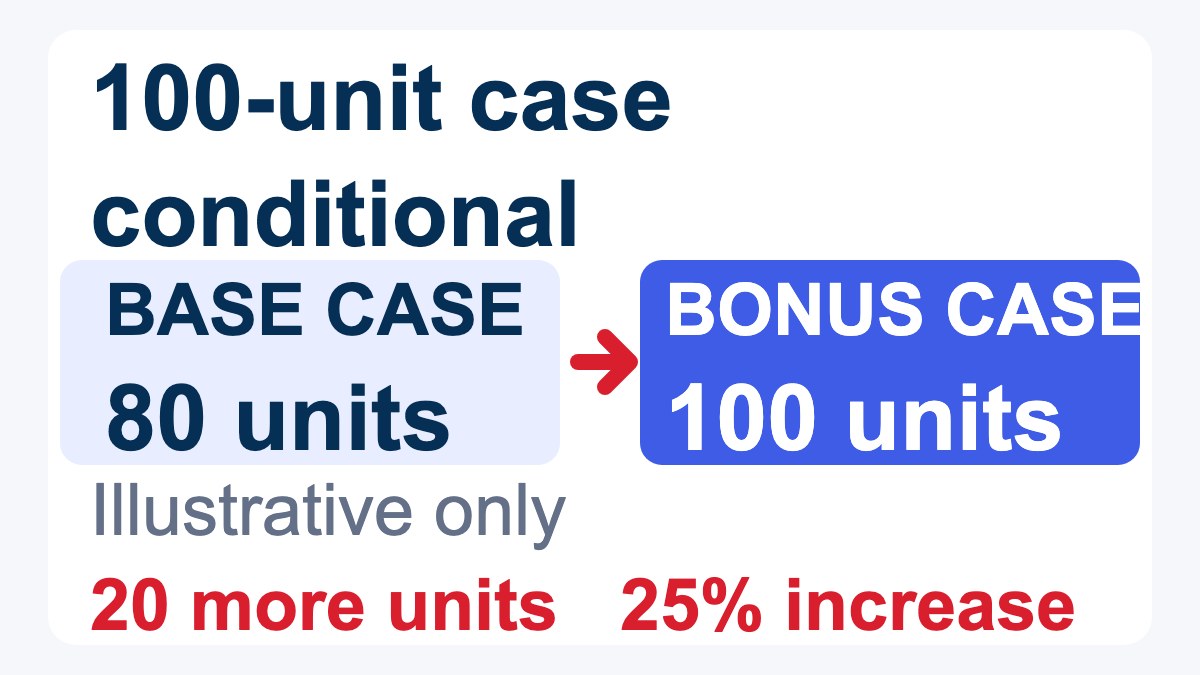
An 80-unit base case and a conditional 100-unit case
Consider an illustrative team evaluating an Austin residential site. Its initial model assumes 80 units. It also explores a separate 100-unit scenario, conditional on confirmation of the Citywide Density Bonus zoning path and community-benefit obligations. Neither number is an Austin zoning yield, an approved capacity or a program requirement; the base assumptions need their own verification.
The bonus scenario contains 20 more units, a 25% increase over the illustrative base. That is a comparison of unit counts, not a forecast of revenue, profit or land value. The example supplies no rents, construction costs, financing terms or benefit costs, so it cannot establish which scenario is more profitable.
The useful decision is how to handle that uncertainty. If the acquisition works only with 100 units, treat the purchase decision as dependent on the unconfirmed bonus scenario. Do not call those units entitled—allowed under the applicable approvals—merely because the guide describes potential program benefits.
If the 80-unit case remains workable after its own assumptions are verified, the team can compare it with the bonus option without depending on bonus approval to justify the purchase. Pursuing the bonus becomes more attractive when the confirmed development flexibility and project economics justify the associated obligations and approval process. If they do not, a feasible base project may be the better choice.

What to resolve before relying on bonus capacity
Austin Housing says staff are available for a pre-application meeting. Use that conversation to resolve the facts that would change your model. Bring the parcel location, proposed uses and the specific feature you want to rely on, such as added height.
- Identify the zoning path. Ask which zoning approval the proposed project would need and how to seek it. Keep the bonus case conditional while that path and its outcome remain unresolved.
- Identify the usable development features. Ask which proposed height, site-standard changes and uses could apply to this project. Revise the design assumptions if the available features differ from the concept.
- Identify the community-benefit obligations. Ask what this project would need to provide, including the applicable affordable-housing requirements. Establish the terms before assigning a financial advantage to the bonus case.
- Carry the obligations through the project timeline. Ask when each requirement must be satisfied, how long it lasts and whether compliance responsibilities continue after construction or occupancy. Include any confirmed continuing obligations in the operating model.
These are project-review questions, not a statement that every project has the same obligations. The supplied City overview does not specify affordability levels, required amounts, durations or review timelines. Leaving those items blank in a model is a reason to keep the result provisional, not to assume they have no cost.
When to pursue the bonus—and when to pause
Continue evaluating the program when the proposed flexibility solves a specific design or use constraint and the project can accommodate the confirmed community-benefit terms. Before relying on the scenario as approved capacity, verify that the required zoning approval has actually been obtained and that the model reflects its terms.
Keep evaluating a base project when it can meet the investment goal under independently verified assumptions. Pause or reconsider an acquisition when it depends on bonus capacity that remains uncertain and you cannot accommodate that uncertainty in the purchase decision.
Frequently asked questions
Does “Citywide” mean this guidance applies throughout the Austin metro?
The source is City of Austin guidance for its own program. It does not establish eligibility in neighboring municipalities or unincorporated areas. Confirm the parcel’s jurisdiction before using this program in a development analysis.
Does a pre-application meeting approve the project?
The City describes staff availability for a pre-application meeting separately from its instruction to seek zoning approval. Treat the meeting as a way to clarify requirements and next steps; the supplied overview does not describe it as an approval.
Sources
- City of Austin / Austin Housing: Citywide Density Bonus Applicant Guide announcement — checked November 4, 2026; program features, community-benefit exchange, zoning prerequisite and staff meeting availability. This overview is not a parcel-specific determination.
Recommended reading
- Austin ADU Potential: What Buyers Must Verify Before Paying Extra — for the separate property-purchase question of paying for potential added housing.
- Austin Renters and Rental Owners: Is a Redevelopment Project Subject to Tenant-Relocation Notice Rules? — for a separate issue to investigate when considering redevelopment of rental housing.
Evaluating an Austin property whose asking price depends on future development potential? Contact Vladimir Baibus · ATXCasa, with LPT Realty, for help comparing the property options and identifying which development assumptions need City confirmation before you commit to a purchase.