

If your Travis County home was damaged in the severe storms that began June 14, 2026, do not treat the September 28 deadline as an insurance deadline. Travis Central Appraisal District says it is the deadline to apply for a temporary property-tax exemption tied to that disaster. The possible benefit is a temporary reduction in taxable value for qualifying damage—not cash for repairs and not an automatic reduction for every affected home.
For a homeowner deciding whether to file, the useful first question is simple: Can I document at least 15% disaster-related damage to qualifying property? If yes, preserve the damage record and ask TCAD how it applies to your account. If no, still pursue the repair, insurance, and financing paths that fit your situation; this particular exemption may not be the right tool.
What this September 28 deadline is—and is not
TCAD lists September 28, 2026 as the application deadline for a temporary exemption related to severe storms that began June 14. Texas Tax Code Section 11.35 allows a temporary exemption when qualifying property in a governor-declared disaster area sustained at least 15% damage. The application goes to the local appraisal district, not the Texas Comptroller.
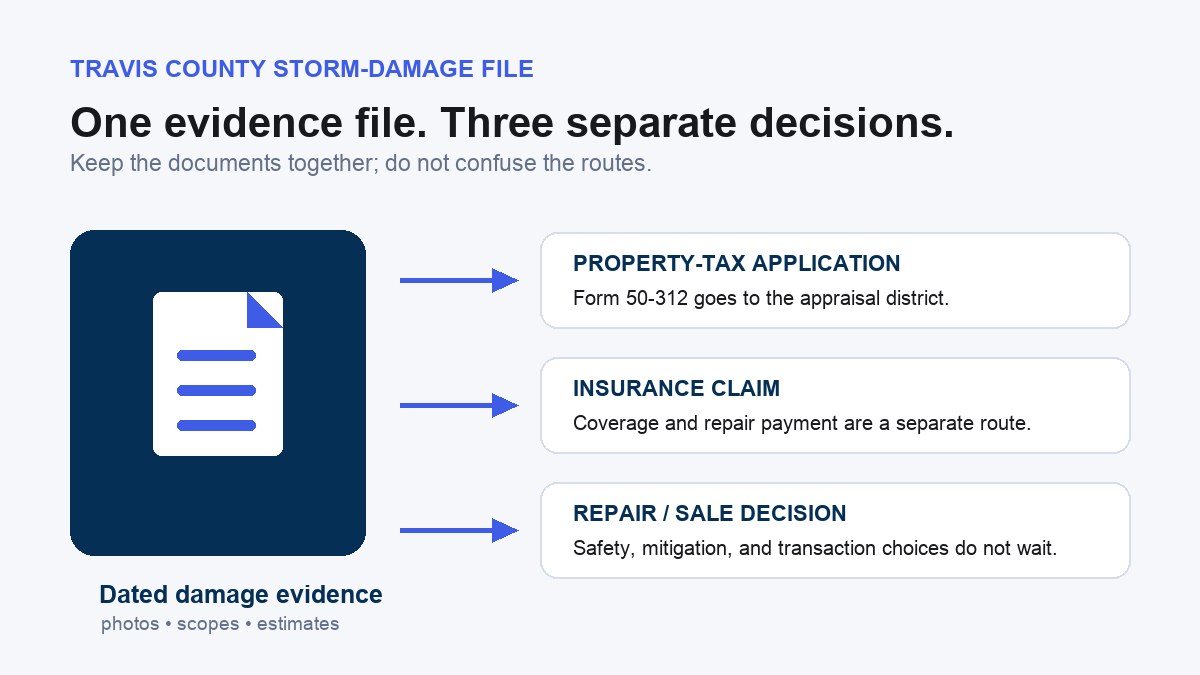
That is different from a routine value protest. The usual protest asks whether the appraisal district’s market value is correct. This disaster exemption asks whether physical disaster damage reaches the statutory threshold. It is also different from an insurance claim: an insurer may evaluate covered repair costs under a policy, while the appraisal district determines the tax exemption under its own rules.
For context, Travis County homeowners have been actively discussing appraisal evidence and hearings this year. That public conversation is a demand signal, not evidence that any individual property qualifies. The property-specific damage record controls.
The 15% threshold changes the first move
The Comptroller says the temporary exemption applies to qualifying property that is at least 15% damaged by a disaster in a governor-declared area. “Qualifying property” can include improvements to real property, certain manufactured homes, and income-producing tangible personal property. A damaged fence, roof, interior, detached structure, or business equipment can raise different questions; do not assume one visible problem describes the whole application.
If the damage is substantial, document it now because the evidence helps answer the threshold question. Keep dated photos and video, contractor scopes, adjuster material, invoices, repair estimates, and any local emergency or inspection records. Those records do not guarantee approval, but they make it easier to explain what was damaged, when, and how seriously.
Two examples show why that distinction matters:
- A home with a small roof repair may have an important insurance claim but may not meet the 15% damage threshold for this exemption.
- A home with extensive wind or water damage to the structure may have a stronger reason to ask TCAD about the exemption, even while insurance, temporary housing, and rebuilding decisions continue on separate tracks.
How the temporary reduction is calculated
The chief appraiser assigns a damage assessment level based on physical damage. The Comptroller describes four levels: 15% for damage of at least 15% but less than 30%; 30% for damage of at least 30% but less than 60%; 60% for damage of at least 60% but less than total loss; and 100% for total loss when repair is not feasible.
The exemption is not simply that percentage of the annual tax bill. State guidance says the calculation applies the damage level to the property’s appraised value and then prorates it for the portion of the tax year remaining after the disaster declaration. The exact result depends on the property, declared date, damage assessment, and taxing entities. Do not use a contractor estimate or a neighbor’s tax result as a prediction of your own.
A four-step Travis County check
1. Confirm that this is the right relief path
Start with TCAD’s disaster page and the temporary-exemption form. If your concern is the regular 2026 appraisal rather than physical storm damage, that is a different process. If the home is uninhabitable, ask the appropriate agency or qualified adviser whether a homestead-continuation rule or another disaster-relief provision may also matter.
2. Build one dated damage file
Group the pre-loss condition, event date, damaged components, and repair evidence. For example, pair dated photos of a storm-damaged roof with the roofer’s itemized repair scope and any adjuster report. That lets TCAD connect the claimed damage to the property and event instead of relying on a general statement that a storm occurred.
3. File with the appraisal district—not the insurer or Comptroller
Use Texas Comptroller Form 50-312 and file it with the appraisal district for the county where the property is located. TCAD says the deadline for the June 14 storm event is September 28. A property outside Travis County may have a different local deadline or declaration, so verify the county before relying on this date.
4. Keep the tax decision separate from the repair decision
Approval can affect taxable value, but it does not decide whether to repair, sell as-is, negotiate with a contractor, or make an insurance election. A homeowner preparing to sell should disclose and document material conditions as appropriate, then assess the transaction with the same care used for an unresolved Austin permit: make the property record, the physical condition, and the next responsibility agree before pricing the risk.
Questions to ask before September 28
- Is the property in Travis County and within the applicable disaster declaration?
- What evidence supports at least 15% disaster-related damage to qualifying property?
- Which components were damaged, and which documents establish the condition and date?
- Has the Form 50-312 application been sent to TCAD with time to correct an incomplete submission?
- Is there a separate insurance, repair, financing, homestead, or sale decision that should not wait on the tax determination?
That last question matters. A tax application is one piece of a recovery file. It should not delay safety work, emergency mitigation, or professional advice that your situation requires.
For buyers and sellers, document before assigning blame
A buyer looking at a recently damaged home should not assume that a pending or approved exemption proves the repair scope, insurance coverage, or current condition. Request the damage documentation, repairs, permits where applicable, and the seller’s disclosure. A seller should avoid promising a tax outcome that TCAD has not issued.
ATXCasa’s practical view: classify the issue before negotiating it. A clearly documented, repairable event with a defined next step is different from an unclear loss with missing records. The deadline is a reason to organize the file; it is not a shortcut around the underlying property decision.
Frequently asked questions
Is September 28 the deadline for every Texas homeowner with storm damage?
No. This article addresses the TCAD deadline it lists for the severe storms beginning June 14, 2026. Eligibility and deadlines depend on the declaration, county, property, and applicable rules.
Does a temporary disaster exemption pay for repairs?
No. It is a property-tax exemption mechanism. Insurance coverage, contractor payment, and repair choices are separate matters.
What if the damage does not reach 15%?
The temporary exemption described here requires at least 15% damage to qualifying property. Preserve records anyway, then use the insurance, repair, and appraisal options that fit the facts of the property.
Sorting a storm-damage question before an Austin-area purchase or sale? Contact Vlad Baibus at ATXCasa to organize the property records and decision points before they become a pricing or contract surprise.
This is general real-estate education, not tax, legal, insurance, or engineering advice. Confirm eligibility, deadlines, and property-specific requirements with TCAD and appropriate qualified professionals.