

TL;DR
- FHA generally excludes a property resold 90 days or fewer after the seller acquired legal ownership, unless a listed exception applies.
- The resale date is when all parties execute the sales contract. Scheduling closing later does not change that date.
- For a resale between 91 and 180 days, a price 100% or more above the seller’s acquisition price triggers a required second appraisal.
- Before an offer or a financing/option deadline, have the lender verify the dates, applicable exceptions and required title history. Passing the timing check alone is not loan approval.
If you plan to use a Federal Housing Administration (FHA)-insured mortgage for an Austin-area home, a seller’s recent purchase can affect whether your financing works. Check the ownership timeline before committing: the key dates are the seller’s legal acquisition and the fully executed sales contract. These are federal requirements, applying locally because of the financing you choose. HUD’s Handbook 4000.1, printed pages 164–165, sets out the rules summarized here.
What changes between a contract at 75 days and one at 120 days?
Consider a hypothetical Austin-area resale. The seller paid $200,000 to acquire legal ownership and now wants $400,000. You intend to obtain a new FHA-insured mortgage. Assume no Handbook-listed exception applies, and compare these alternative contract timelines for the same property:
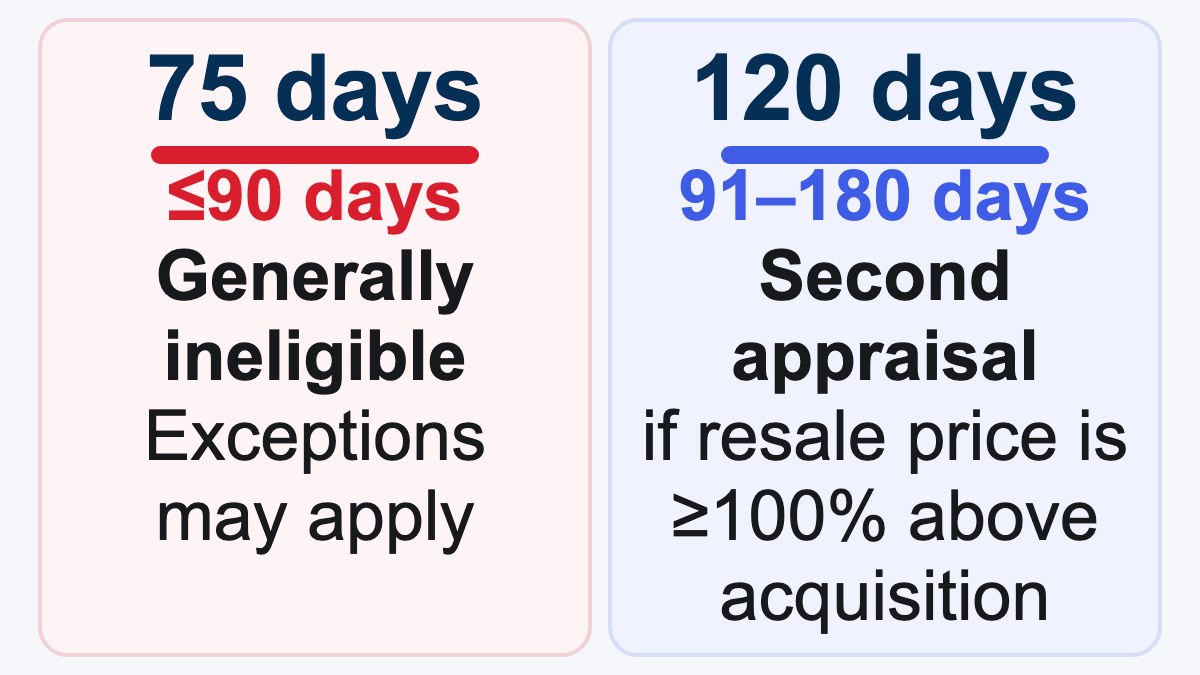
- All parties execute the contract 75 days after acquisition: the property falls within the restriction on resales at 90 days or fewer. It is generally ineligible for FHA financing. A closing scheduled beyond that window does not change the contract’s resale date.
- All parties execute the contract 120 days after acquisition: the property falls within the 91–180-day window. The $400,000 resale price is twice the $200,000 acquisition price—a 100% increase—so the lender must obtain a second appraisal by another appraiser.
The practical difference is eligibility versus an additional appraisal requirement. The later contract avoids the initial timing restriction, but the second appraisal can affect the value used for financing. Neither scenario establishes that the borrower or property otherwise qualifies. These are illustrative prices and elapsed times, not Austin market data or a determination about an actual home. The governing thresholds come from HUD’s property-flipping section.
Count legal ownership to the fully executed contract
HUD defines the seller’s acquisition date as the date the seller acquired legal ownership. The resale date is the date all parties have executed the sales contract that will result in the FHA-insured mortgage. That makes the fully executed contract—not the listing date or future closing date—the relevant endpoint. Source: HUD Handbook, printed page 164.
The lender must also obtain a 12-month chain of title: the ownership history documenting compliance with the resale-time restrictions. Give the lender available title information so it can establish the relevant transfer and dates; a listing description alone does not supply that required documentation. Source: HUD Handbook, printed page 165.
If you already have a fully executed contract that falls within the restricted period, do not assume extending closing makes it eligible. Have the lender evaluate that contract and have your agent or attorney address the available contractual choices before you rely on a change.
When waiting, proceeding or changing homes makes sense
Waiting before executing a contract may fit when FHA is your preferred financing, the seller is willing to wait and your move allows it. The benefit is a chance to structure a future contract outside the initial restriction. The cost is uncertainty: the home may not remain available, and a later contract can still trigger the second-appraisal requirement. Have the lender confirm the proposed execution date before relying on it.
Proceeding with the FHA application may fit when the lender confirms that the timing requirement is satisfied or a specific exception applies, and the appraisal and documentation work can fit your contract deadlines. Keep those deadlines in view until the remaining underwriting and property requirements are resolved.
Considering another home may fit when your move cannot wait or the required review cannot be completed within acceptable contract terms. Use the Home search to compare alternatives, then send the lender the same ownership-timeline questions for each candidate. A different property needs its own review.
If you want to keep the same home and consider other financing, first obtain a lender’s assessment of your eligibility, cash needed and payment. Changing loan programs is only useful if the actual terms work for your budget and timeline.
What to send your FHA lender before an Austin-area offer
For an Austin-area buyer, the useful local application is to connect the federal review to the offer and financing/option deadlines you actually have. Send the lender:
- The seller’s legal-acquisition date and available title history. Ask what documentation the lender needs for the required 12-month chain of title.
- The proposed date when all parties will have executed the contract—or the actual date if already signed. Ask whether the transaction falls within the restricted period.
- The resale price and seller’s acquisition price. For a resale between 91 and 180 days, ask whether the price is 100% or more above acquisition and therefore requires a second appraisal.
- Any claimed exception and your contract deadlines. Ask the lender to identify the applicable Handbook provision and confirm the supporting facts before you rely on it.
The benefit of this review is knowing whether to proceed, adjust the proposed timing or pursue another home before your choices narrow. FHA timing clearance does not resolve the home’s condition, title, appraisal or your contractual protections. If the property also has an expired permit, the expired-permit buyer guide addresses that separate decision.
Frequently asked questions
Does a foreclosure history automatically create an exception?
No. HUD lists specific exceptions, and foreclosure history by itself does not establish that the current transaction meets one. The lender needs to review the facts and title chain against the applicable provision. Avoid treating a seller label or a statement that the home was “bank-owned” as confirmation. See HUD’s exceptions on printed page 165.
Who pays for the required second appraisal, and what if its value is lower?
The cost of that second appraisal may not be charged to the borrower. If the second appraisal is more than 5% below the first appraisal, HUD requires the lower value to determine Adjusted Value, a value used in FHA loan calculations. That can change the financing available for the purchase; ask the lender to explain the effect on your loan and cash needed before deciding whether the deal still works. Source: HUD Handbook, printed page 165.
Sources
- U.S. Department of Housing and Urban Development: Handbook 4000.1, Update 17, II.A.1.b.iii(B)(3), Restrictions on Property Flipping, printed pages 164–165. Source verified October 7, 2026. Federal FHA policy; property-specific applicability requires lender review.
Considering a recently resold Austin-area home? Contact Vladimir Baibus · ATXCasa for help organizing the property’s ownership timeline and your offer questions so you can coordinate the FHA review with your lender before committing. Brokerage: LPT Realty.