

TL;DR
- Before setting an offer budget, add recurring debt payments to the complete proposed housing payment.
- Compare that total with take-home pay and actual spending. A qualifying debt ratio does not guarantee a comfortable budget.
- Keep cash after closing as a separate check. Lower monthly debt can help, but paying it off with savings leaves less cash available.
If you are buying an Austin-area home, a mortgage payment that looks manageable can leave little room once your car loan, student loan and credit-card minimums come due. Before setting an offer budget or removing a financing contingency, list the proposed all-in housing payment beside those recurring obligations. Review the actual quote and obligations with your lender, then separately check everyday cash flow and the money you intend to keep after closing.
What changes when you add the other debt?
Consider a hypothetical buyer earning $9,000 a month before taxes and payroll deductions. The proposed housing payment is $3,000 a month, including principal, interest, property taxes, homeowners insurance and any association dues. For this illustration, assume no separate mortgage-insurance charge; include it in your own worksheet if applicable.
Housing alone uses 33.33% of gross monthly income. But this buyer also owes $900 a month in recurring car, student-loan and credit-card minimum payments. Housing plus those debts totals $3,900 a month, or 43.33% of gross income.
The house has not become more expensive. The second calculation simply includes bills the buyer must still pay after moving. Neither percentage predicts loan approval or tells us whether this household can comfortably afford the purchase.
What a debt-to-income ratio leaves unanswered
A debt-to-income ratio, or DTI, compares monthly debt payments with monthly income before taxes and deductions. In its discussion of Texas borrower data, the Texas Real Estate Research Center explains that reported debt includes housing costs, car loans, student loans and minimum credit-card payments.
That is the useful principle here: looking only at housing leaves out other obligations. The Center’s analysis concerns Texas-wide borrower data for 2025. It is not an Austin affordability study, an individual lender’s approval standard or a safe-payment recommendation.
For your personal budget, use the money that actually reaches your bank account. Then account for groceries, utilities, transportation, childcare, other ordinary spending, maintenance and the savings you intend to continue. A ratio using gross income does not perform that spending check for you.
Follow the same buyer through the monthly budget
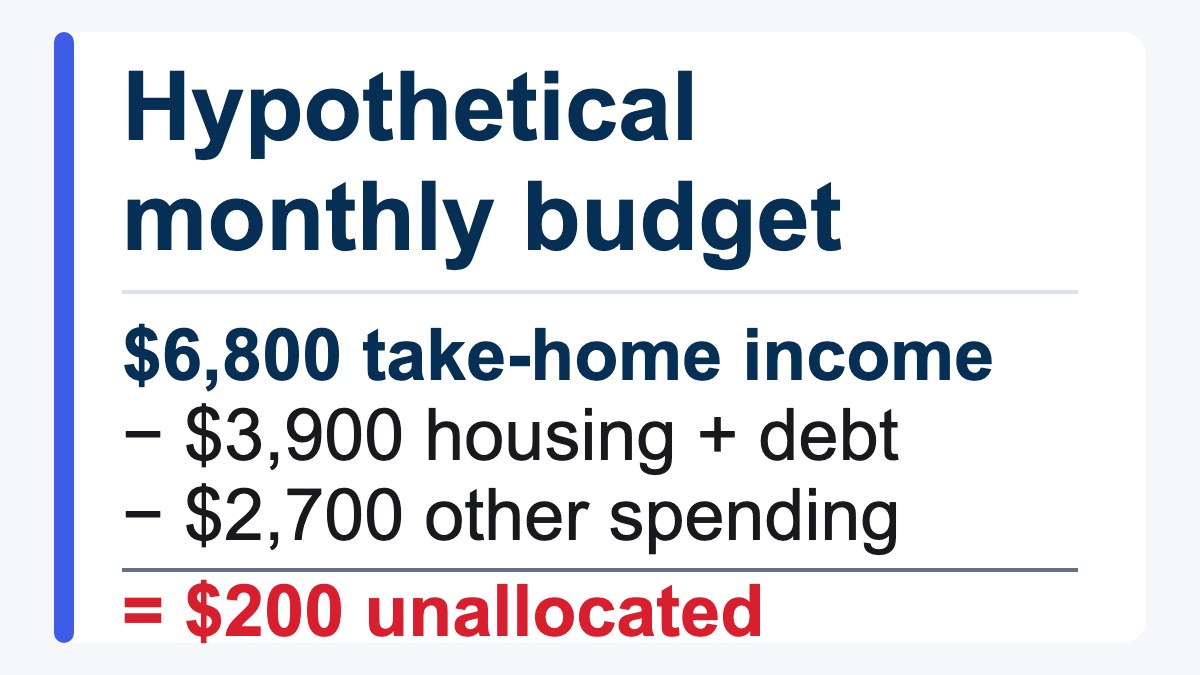
Assume the same hypothetical buyer takes home $6,800 a month. Their planned ordinary spending, maintenance allowance and ongoing savings together use $2,700 a month, separate from housing and the debt payments already listed.
| Monthly budget item | Amount |
|---|---|
| Take-home income | $6,800 |
| Complete housing payment | $3,000 |
| Recurring nonhousing debt payments | $900 |
| Other spending, maintenance allowance and savings | $2,700 |
| Unallocated money remaining | $200 |
That $200 is the room left for anything missing from the plan or costing more than expected. It is not a universal pass-or-fail threshold.
Separately, assume the buyer intends to retain $18,000 in cash after the down payment, closing costs and planned moving expenses. This is a hypothetical goal, not a recommended reserve amount. The buyer must check that the closing plan actually leaves it available and decide whether it covers their likely needs. That cash is not monthly income; repeatedly using it to cover a recurring shortfall would erode it.

Choose the adjustment that solves the actual problem
Proceed with the proposed payment when the lender has reviewed the actual quote and obligations, your take-home budget supports spending and savings, and closing leaves the cash you intend to retain. The benefit is moving forward with the home you want. The commitment is continuing to carry housing and other debts together, including after moving expenses are behind you.
Choose a lower housing payment if the recurring budget is too tight. This can leave more money available each month, but may require a different home, property type or search area. For an Austin-area search, compare each candidate’s property-specific tax, insurance and association-dues estimates alongside the loan payment. Do not assume a different city or a lower asking price alone resolves the budget.
Reduce debt or wait if a particular obligation is the obstacle. Debt payoff can improve monthly room if it reduces the required payment, but it also consumes cash that might otherwise remain available after closing. Before using savings, have the lender confirm how the payoff would affect the loan review and required payment, then redo the cash-after-closing check. Waiting may fit when you need time to build cash or finish an obligation; it does not guarantee a better future home price or mortgage rate.
Build a worksheet you can use before an offer
- Write out the housing payment. List principal, interest, property taxes, homeowners insurance and any association dues. Add any applicable mortgage insurance or other required housing payment, and mark estimates that still need confirmation.
- List recurring debts beside it. Use current car, student-loan and credit-card statements, plus any other recurring debt obligations. Give the lender the complete list so the loan review uses the relevant obligations.
- Check take-home cash flow. Subtract housing, debt payments, ordinary spending, maintenance and planned savings from dependable take-home income. A shortfall calls for a specific change to the plan.
- State the cash you want left after closing. Compare that goal with the expected down payment, closing costs and planned move-in expenses. Keep this separate from the monthly calculation.
Repeat the check when the property, quote, income or obligations change. After closing, revisit it when a tax estimate, insurance renewal, association bill or loan term changes what you pay. If a debt is scheduled to end, keep it in the current budget until its payoff timing and final obligation are confirmed; do not spend the expected relief early.
Frequently asked questions
What if part of my income comes from bonuses or overtime?
For your own spending plan, start with income you can depend on and show variable income separately. If the purchase needs every uncertain bonus to cover routine bills, a lower payment or more time to prepare is the more resilient choice. Ask the lender separately which income it can use for qualification; that answer does not replace your cash-flow decision.
Should I budget only the minimum if I usually pay more toward a credit card?
Keep the required minimum visible for the debt review, but include your intended extra repayment in the personal budget. Otherwise, the home may appear affordable only because your plan silently stops paying down the balance as quickly. Avoid counting the same card purchases both as ordinary spending and as repayment of those purchases; track repayment of older balances separately.
Sources
- Texas Real Estate Research Center: Interview—Underlying Factors Driving the Housing Market. Texas-wide discussion of 2025 borrower data and the debts included in reported DTI; evidence checked November 6, 2026.
Recommended reading
- Mortgage Quote Higher Than the Headlines? Compare the Loan, Not Just the Rate
- Putting Less Than 20% Down on an Austin Home? Compare Mortgage Insurance Before You Choose a Loan
Before you set an Austin-area offer budget, contact Vladimir Baibus · ATXCasa, LPT Realty for help comparing homes against your monthly payment target and identifying property-cost estimates to confirm with your lender. Bring your proposed housing budget and preferred search areas so the next step connects the numbers to homes that fit your plan.