
TL;DR
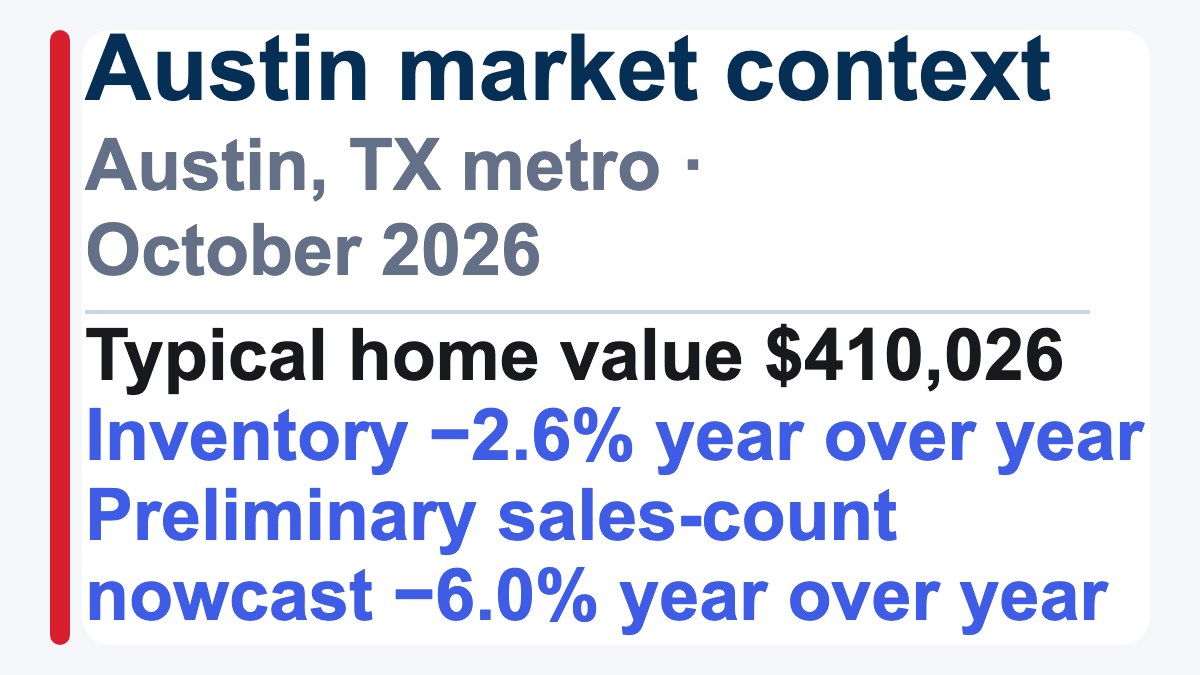
- Zillow’s October 2026 Austin metro inventory was down 2.6% year over year; its preliminary sales-count estimate was down 6.0%.
- Those changes do not require a seller to cut a price, guarantee a buyer concessions, or establish that waiting will help.
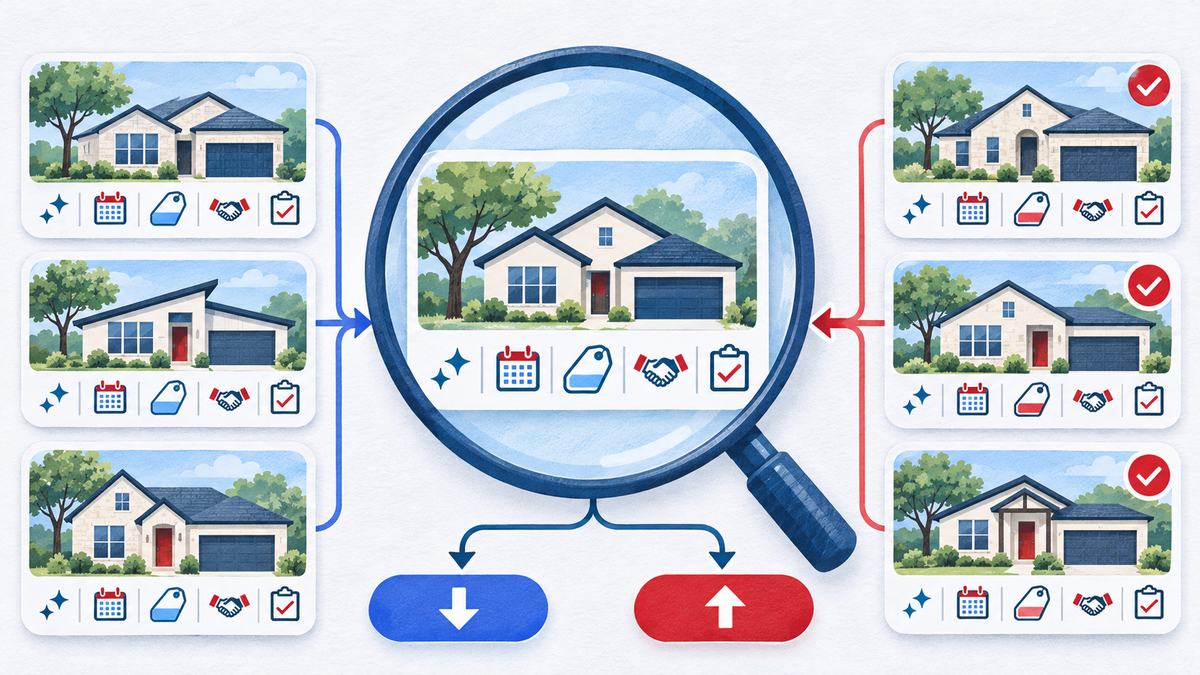
- Before acting, compare the subject home’s current active comparables, recent relevant closed sales, days on market, condition, price band, contract terms, and the buyer’s financing readiness.
If you’re preparing an Austin-area offer or reconsidering your asking price, October’s market figures are a reason to check your property’s competition. They are not a reason, by themselves, to rush, discount, or wait. The useful answer depends on what buyers can choose instead and what comparable homes actually sold for.
In its November 5 release covering October 2026, Zillow reported lower Austin metro inventory and a lower preliminary sales estimate than a year earlier. Crucially, that Austin estimate is not an Austin pending-listing count. Source: Zillow’s October Market Report.
Why a 1.0% metro decline is not your price-cut instruction
Here is a concrete illustration. Zillow reports an Austin typical home value of $410,026, down 1.0% month over month. Applying 1.0% to $410,026 gives $4,100.26. That calculation shows the scale of a percentage; it does not establish how much a different home’s asking price should change. It also does not reconstruct the index’s actual dollar decline from the previous month. Source: Zillow’s Austin metro row.
Suppose, hypothetically, a seller sees that figure and considers subtracting $4,100.26 from an asking price. Before revising, compare that home’s active alternatives and recent genuinely comparable closed sales. If similar homes in better condition are available at the same asking price, and relevant closed sales also suggest the subject home is overpriced, a reduction has a property-specific rationale. The right amount still comes from those comparisons, not the metro percentage.
If the asking price already fits relevant closed sales and the home compares favorably with available alternatives, holding it may be sensible when the seller’s timeline allows. Cutting could make the home more competitive, but it also means accepting a lower asking price without evidence that the full reduction was needed. Holding preserves the asking price while taking the risk of more time on the market.
What October’s Austin figures actually measure
Zillow’s Austin, TX metro table reports these October 2026 measures:
- Typical home value: $410,026, down 1.0% month over month and 3.9% year over year.
- Inventory: down 2.6% year over year.
- Sales-count nowcast: down 6.0% year over year.
A nowcast is a preliminary estimate of current activity. Zillow says its October existing-home-sales nowcast will be revised mid-month. Treat this release as an early reading, not a final closed-sales record. Source: Zillow’s report and methodology notes.
The release’s national headline concerns newly pending listings: homes that changed from for-sale to pending, rather than completed sales. Zillow calls those a leading indicator of the following month’s closed sales. The supplied Austin row does not report an Austin pending-listing count, so the national pending decline should not be presented as Austin’s result.
Build the comparison that can change your decision
For an Austin-area buyer or seller, keep the search focused on homes that are realistic substitutes for the subject property. Do not assume the metro result describes every neighborhood or suburb equally.
- Check current active comparables. Identify homes a buyer could reasonably choose instead, considering location, property type, size, condition, and price band. Asking prices show the alternatives being offered; they do not establish completed-sale values.
- Compare recent relevant closed sales. Use Recently sold homes to begin identifying candidates, then verify their relevance and the available transaction details before treating them as price evidence.
- Review days on market alongside condition and price history. A long listing period is a prompt to investigate the home’s pricing and drawbacks. It does not, by itself, establish what the seller will accept.
- Compare contract terms and the buyer’s financing readiness. Look at the offer price, requested concessions, contingencies, and closing timing together. A contingency is a contract condition that must be addressed for the purchase to proceed under its terms. A buyer should confirm financing readiness for the specific purchase before making an offer.
These checks should happen before changing a list price, offer, or timing. They turn a broad market observation into evidence about the actual choice in front of you.
When to change course—and when holding makes sense
For sellers: if active alternatives and relevant closed sales both show that the home is poorly positioned on price, revising the price may help it compete. If the evidence supports the price but the home has a condition disadvantage, consider whether addressing that issue fits your budget and timeline. Neither response guarantees a sale. Before accepting an offer, weigh its terms and the buyer’s financing readiness alongside the price.
For buyers: if comparable alternatives are available and recent relevant closed sales support a lower offer, make the case using those properties. The seller may decline, and a lower price is not automatically worth less suitable contract terms. If the home fits your needs, its price is supported, and financing is ready, the metro report alone is not a reason to delay. A buyer should likewise compare the offer’s price and contingencies with the specific property’s competition and confirm financing readiness.
For anyone considering waiting: waiting is sensible when you need to resolve financing, clarify your moving timeline, or find a property that fits. The benefit is time to solve a specific problem. The trade-off is that available homes, competing listings, and transaction terms may change while you wait. This report does not establish that the later outcome will be better.
After an offer is rejected or a listing strategy changes, revisit the comparison when relevant competing homes enter the market or close. If Zillow revises its nowcast, update the market context too. Neither the first price change nor the first report should end the decision process.
Frequently asked questions
Does $410,026 mean most Austin homes sold for that amount?
No. Zillow labels that figure a typical home value, not a median closed-sale price. It is a metro-level measure, not a valuation of your home or a description of what most individual transactions achieved.
Does this report show how often Austin sellers agreed to concessions?
No. The verified Austin data do not include offer terms, an above-list share, or a price-cut share. Those omissions matter when negotiating: a national statistic from the release cannot supply the missing Austin or property-specific evidence.
Sources
- Zillow: October 2026 Market Report, released November 5, 2026; verified evidence checked November 13, 2026. Austin metro table and definitions; the sales nowcast is preliminary and subject to revision.
Recommended reading
- Austin Home Shoppers: An Active-Listings Headline Is Not a Real-Time Availability Count
- Austin Sellers: A Price-Cut Statistic Is Not the Same as a Close-to-List Result
Preparing an Austin-area offer or reconsidering your list price? Contact Vladimir Baibus · ATXCasa, LPT Realty with the property address and your moving timeline for help comparing the home’s active competition and relevant closed sales before choosing a pricing or offer strategy.