
The Austin rental market is recovering from an oversupply, not collapsing. Vacancy has come down from its 2024 peak, asking rents are roughly flat to slightly lower than a year ago, and concessions such as free weeks are still common. If you rent, that means room to negotiate. If you own or plan to invest, it means the worst of the supply wave looks to be behind us, though not evenly across the metro.
I wrote this guide for renters comparing leases, owners deciding whether to hold or sell, and investors looking at cash flow. Everything below is dated, and where sources disagree I say so.
TL;DR
- Multifamily vacancy in the Austin area fell to roughly 10.3% to 12.3% in Q2 2026, depending on the data set, down from a 15.8% peak in Q3 2024.
- Asking rents depend heavily on the source: Zillow lists an average of $1,995, while Zumper reports $1,614 as of October 17, 2026. Compare methods before comparing numbers.
- Concessions of 6 to 8 weeks free are still common, so effective rent matters more than the advertised rent.
- The City of Austin’s Rental Fee Transparency Ordinance applies on and after October 1, 2026 to a person who rents, leases, or manages 50 or more dwellings used as residences.
- Downtown is tighter than outlying submarkets that took the heaviest construction, so metro averages can mislead.
Table of Contents
- Where Austin rents stand in October 2026
- The vacancy rate: peak, decline and what it means
- Concessions and effective rent
- New fee transparency rules
- Submarkets: why metro averages mislead
- How rentals connect to the Austin housing market
- What this means for renters
- What this means for owners and investors
- Our perspective
- Thinking about moving from renting to owning or investing?
- FAQ
- Sources
Where Austin rents stand in October 2026
There is no single “Austin rent.” Each platform measures a different pool of listings, so the figures differ by hundreds of dollars.
| Source | Figure | Date or note |
|---|---|---|
| Zillow | $1,995 average, all bedrooms and property types | Updated July 12, 2026; monthly 2026 readings ran below the same months of 2025 |
| Zumper | $1,614 average | As of October 17, 2026, based on listings from the past 30 days |
The gap is not an error. Zillow’s figure covers all property types, including single-family rentals, which skew higher. Zumper’s reflects its own recent listings. Neither is the rent you will pay for a specific unit, and I would treat both as a direction, not a quote.
The direction is consistent. Zillow’s monthly series shows 2026 readings below 2025 in each month from January through May (for example $1,856 in April 2026 against $1,995 in April 2025). Northmarq’s Q2 2026 report describes the quarter as the point where a 12-quarter stretch of rent declines that began in 2023 came to an end. That is a turning point in the data, not a rebound yet.
HUD Fair Market Rents as a benchmark
For a government yardstick, HUD’s FY 2026 Fair Market Rents for the Austin-Round Rock area are $1,474 for a studio, $1,562 for a one-bedroom, $1,852 for a two-bedroom, $2,347 for a three-bedroom and $2,760 for a four-bedroom. These are gross figures, meaning rent plus utilities, and they set payment limits for programs such as Housing Choice Vouchers. The two-bedroom figure is down 5% from $1,949 in FY 2025.
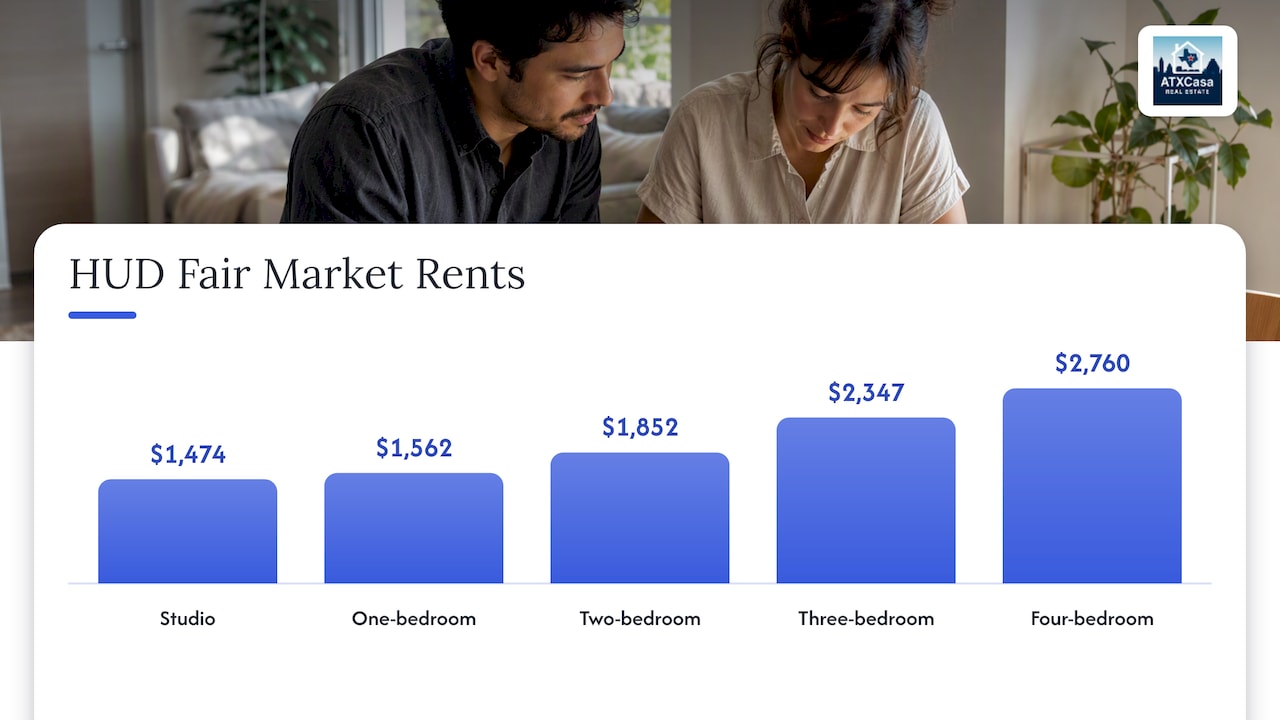
Fair Market Rents are not market asking rents. HUD defines them as annual estimates of 40th-percentile gross rents for standard-quality units in a metropolitan area or nonmetropolitan county. I would use them as broad context when comparing prices: if a standard unit costs more, ask what the premium buys, such as location, newer finishes or amenities. That comparison does not determine voucher eligibility.
The vacancy rate: peak, decline and what it means
Vacancy is the number most people search for, and it is the clearest sign of where the market is heading.
- Q3 2024: the peak, near 15.8%, after a record wave of new apartments.
- Q4 2025: 14.2% in Matthews’ data, with strong absorption beginning to ease the pressure.
- Q2 2026: 12.29% in Matthews’ report, a drop of 289 basis points year over year, and 10.3% in Northmarq’s.
The two Q2 numbers differ because the firms track different sets of properties. Use either one, but do not mix them in the same comparison.
The cause of the improvement is mostly supply. Trailing 12-month deliveries fell 51.5% to 12,737 units in Q2 2026, and units under construction dropped from nearly 20% of inventory in 2023 to under 5%. Newmark’s Q1 2026 snapshot likewise notes that the under-construction pipeline has contracted since the 2024 peak. Analysts at Matthews and Northmarq read this as a supply-driven correction, not a loss of demand, because job growth and population fundamentals stayed healthy enough to absorb record deliveries.
My read: a vacancy rate above 10% is still higher than what most landlords consider comfortable, so I would not expect rents to jump. What changes is leverage. With fewer new buildings competing for tenants over the next couple of years, the room for deep concessions should narrow gradually.
Concessions and effective rent
The advertised rent is often not what you pay. According to the research I used for this guide, concessions in Austin commonly run 6 to 8 weeks of free rent, and 10 to 12 weeks in some submarkets. Treat that as a typical range, not a promise from any one property.
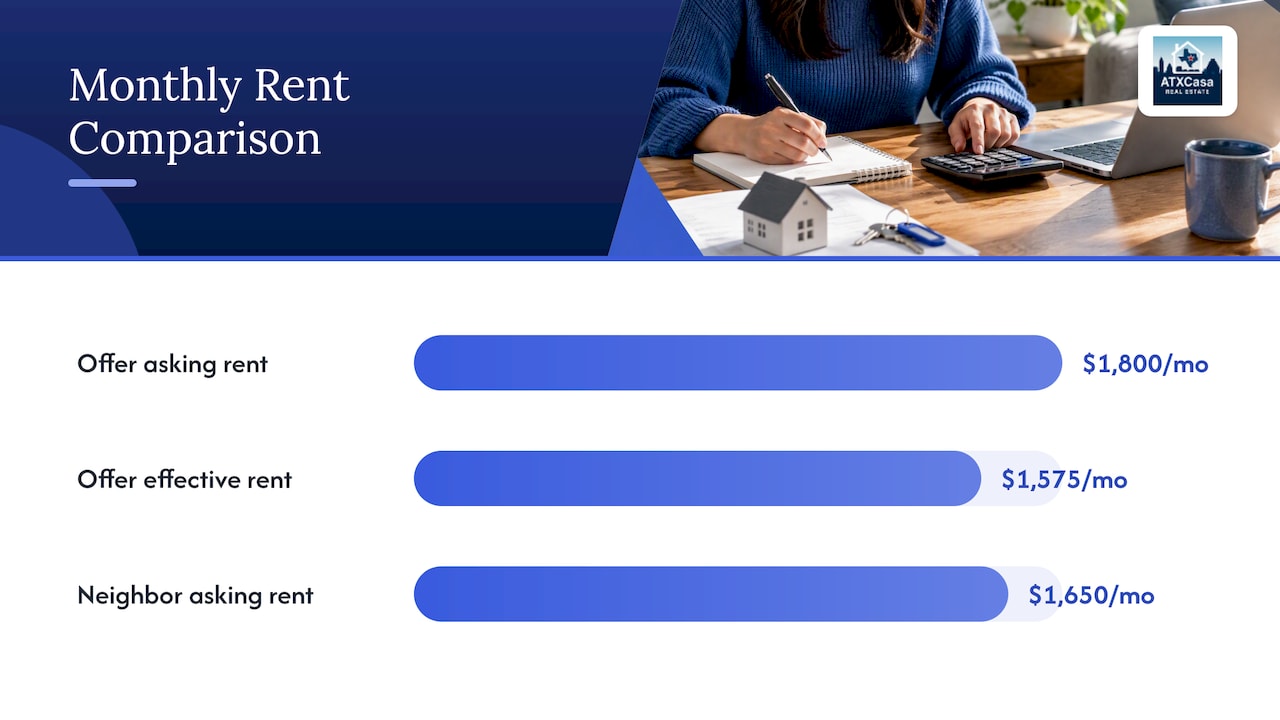
Here is a hypothetical comparison: take a 12-month lease at $1,800 a month with a $2,700 total concession credit confirmed in the lease.
- In this hypothetical, the stated credit is $2,700. Confirm the dollar amount and when it is applied in the lease; a “free weeks” offer does not by itself establish a universal monthly-credit conversion.
- At $1,800 for 12 months, scheduled rent is $21,600. Subtracting the hypothetical $2,700 credit gives $18,900 for the initial lease term, before fees and moving costs.
- Averaged over 12 months, that hypothetical initial-term cost is $1,575 a month: ($1,800 × 12 − $2,700) ÷ 12. This is an averaged effective rent, not necessarily the cash due each month.
Compare that with a neighboring building asking $1,650 a month with no concession for the same 12-month term. With the lease-confirmed $2,700 credit, the first costs less in rent over the initial term, before fees and moving costs. Those other costs could change which offer is cheaper overall. Check when the credit is applied and the payment schedule: once the credit is used up, scheduled rent is due without that discount. Check any lease-length conditions and renewal terms too; renewal pricing may differ, and a new concession is not guaranteed.
If you are already in a lease, my guide on comparing your real renewal options walks through using market benchmarks in a renewal conversation.
New fee transparency rules
The City of Austin’s Rental Fee Transparency Ordinance (20260528-045) was approved May 28, 2026. For covered providers, it requires a written, itemized disclosure of mandatory, optional, and estimated variable fees before quoting rent or accepting an application; advertisements that state rent must also state recurring fixed fees.
The timing is phased:
- October 1, 2026: in the City of Austin, the ordinance applies to a person who rents, leases, or manages 50 or more dwellings used as residences.
- January 1, 2027: in the City of Austin, it extends to providers of 5–49 residential dwellings and to providers of mobile-home or RV spaces used as residences.
If you are touring rentals offered by covered City of Austin providers this month, ask for the itemized disclosure. Add up trash, pest control, package, parking and pet fees before deciding that one building is cheaper than another. The ordinance does not apply to landlords with fewer than 5 dwellings, and it does not apply to fees for damage, lease violations, or other tenant-caused issues during the lease term.
If an old credit problem is slowing your applications, some renters look into credit clearance for home rentals before applying. Rules differ by country, so check what applies to you in Texas with a local attorney or housing counselor.
Submarkets: why metro averages mislead
The Dallas Fed’s analysis of Texas multifamily says the recovery is uneven: submarkets with the most aggressive new development are still working through excess supply. Matthews’ Austin report points the same way. Downtown has shown resilience, with tighter vacancy and rent growth, while suburban areas that absorbed much of the 2024 to 2025 construction, including parts of Northeast Austin, Hays County and San Marcos, still show higher vacancy and deeper rent pressure.
There is also a difference by building class. Newer Class A properties still in lease-up carry much of the remaining inventory, while Class B buildings have often held occupancy better.
What this means in practice:
- Renters: the best concessions are likely in newer buildings still filling up, often in outlying areas. Downtown units may negotiate less.
- Landlords of small properties: price against nearby comparable listings, not the metro average.
- Investors: look at absorption and pipeline in the specific submarket before trusting a citywide headline.
How rentals connect to the Austin housing market
Rent and ownership costs pull on each other. As of July 2026, the median sales price was $435,000 in the Austin-Round Rock-San Marcos metro and $577,000 in the City of Austin, with about 4.7 and 4.5 months of inventory respectively. That is a balanced market, with more room to negotiate than a few years ago.
For a household paying $1,900 a month in rent, the question “should I buy?” now has a more open answer than in 2022. I cover the numbers in whether it is easier to buy a home in Austin in 2026 and explain what 4.5 months of inventory means for negotiation. Renting longer is also a reasonable choice if you need flexibility or a bigger down payment. The right answer depends on how long you will stay, which is usually the deciding factor.
What this means for renters
- Shop in the shoulder of the year. Negotiating power is generally stronger when buildings have vacant units to fill, and current vacancy gives you plenty of choice.
- Ask for the effective rent. Request the lease price after concessions and the full fee list in writing.
- Compare lease lengths. Some concessions apply only to longer terms. Check renewal terms before signing.
- Check HUD benchmarks if you use a voucher. Do not use the FY 2026 Fair Market Rents alone to decide whether a unit qualifies. Check the current HUD fiscal-year FMR and then confirm the applicable housing authority’s payment standard, utility allowance, and unit approval rules. HUD says FMRs are used to determine payment-standard amounts; they are not by themselves the payment standard or a unit-eligibility decision.
- Budget for utilities and other charges. HUD defines FMRs as gross-rent estimates, but the amount a voucher household can use depends on the applicable housing authority’s rules, including utility allowances.
What this means for owners and investors
If you own a rental, the supply slowdown is good news, but do not underwrite a sharp rent rebound. Q2 2026 ended a long run of declines in Northmarq’s data, which is a turning point, not a boom. Underwrite flat to modest growth, include concessions in your numbers, and stress-test vacancy at current levels.
For yield comparisons across Austin-area suburbs, see my 2026 suburb rental yield analysis. For a broader view of prices and inventory, the Austin housing market overview is updated with local data.
Our perspective
We built ATXCasa because most rental and housing coverage is either promotional or too generic to act on. Our view is shaped by two things: nearly two decades of IT experience on the data side, and working with buyers, sellers and investors in Austin, Cedar Park, Round Rock and Georgetown.
First, headline numbers need context. A “soft market” average can hide a tight downtown and an oversupplied edge of the metro, so we check the submarket before giving advice. Second, effective rent is the number that counts, not the listing price. Third, a renter who has a plan to buy within a few years should track both rents and purchase prices together, because the balance has shifted toward buyers having more room to negotiate.
We do not predict where rents will be in 2027. We do think the data shows a market moving from supply-driven pain toward recovery, and that decisions made with local detail beat decisions made on national headlines.
— Vladimir
Thinking about moving from renting to owning or investing?
If you are weighing a purchase or an investment property in Greater Austin, we can walk through your numbers: current rent versus ownership cost, neighborhood trends and the due diligence that matters for new construction or resale homes. Start at ATXCasa, or read our Austin homebuyer strategy guide first.
FAQ
What is the vacancy rate in Austin right now?
In Q2 2026, Austin’s multifamily vacancy was 10.3% in Northmarq’s data and 12.29% in Matthews’. Both are well below the peak near 15.8% in Q3 2024. The difference comes from which properties each firm tracks.
Are Austin rents going down in 2026?
Asking rents have generally been below last year’s levels. Zillow’s 2026 monthly readings through May sit under the same months of 2025. Northmarq says Q2 2026 ended a 12-quarter run of declines, so the trend is flattening.
What is the average rent in Austin?
It depends on the source. Zillow lists $1,995 across all bedroom counts and property types, while Zumper reports $1,614 as of October 17, 2026. For a specific unit, compare buildings of the same size and class in the same neighborhood.
Do Austin landlords have to disclose fees?
In the City of Austin, the fee transparency ordinance is phased: providers with 50 or more residential dwellings must comply from October 1, 2026; providers with 5–49 dwellings, plus providers of mobile-home or RV spaces used as residences, from January 1, 2027. Covered providers must give written fee disclosure before quoting rent or accepting an application; landlords with fewer than 5 dwellings are excluded.
Sources
- Austin Multifamily Market Report Q2 2026, Matthews
- Austin Multifamily Market Report Q4 2025, Matthews
- Northmarq Austin Market Insights Q2 2026
- Newmark Austin Multifamily Market Snapshot Q1 2026
- Dallas Fed: Texas multifamily housing yet to stabilize
- HUD FY 2026 Fair Market Rents, Austin-Round Rock
- Unlock MLS July 2026 Central Texas Housing Report
- City of Austin memorandum on rental fee disclosure, April 7, 2026
- City of Austin Rental Fee Transparency Ordinance
- Zillow average rent in Austin
- Zumper average rent in Austin