
TL;DR
- Realtor.com classified 32.7% of Austin metro listings as starter-priced in August 2026. Its price threshold is relative to the metro, not your personal budget.
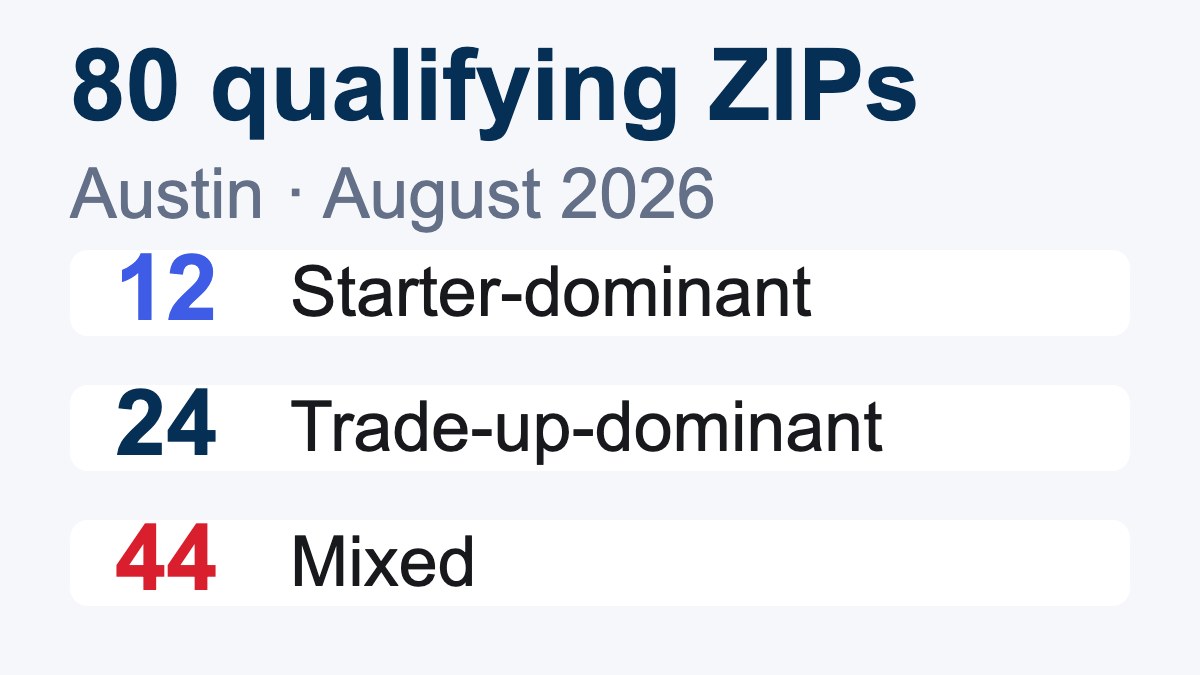
- The listings were unevenly distributed: qualifying ZIPs included 12 starter-dominant, 24 trade-up-dominant and 44 mixed.
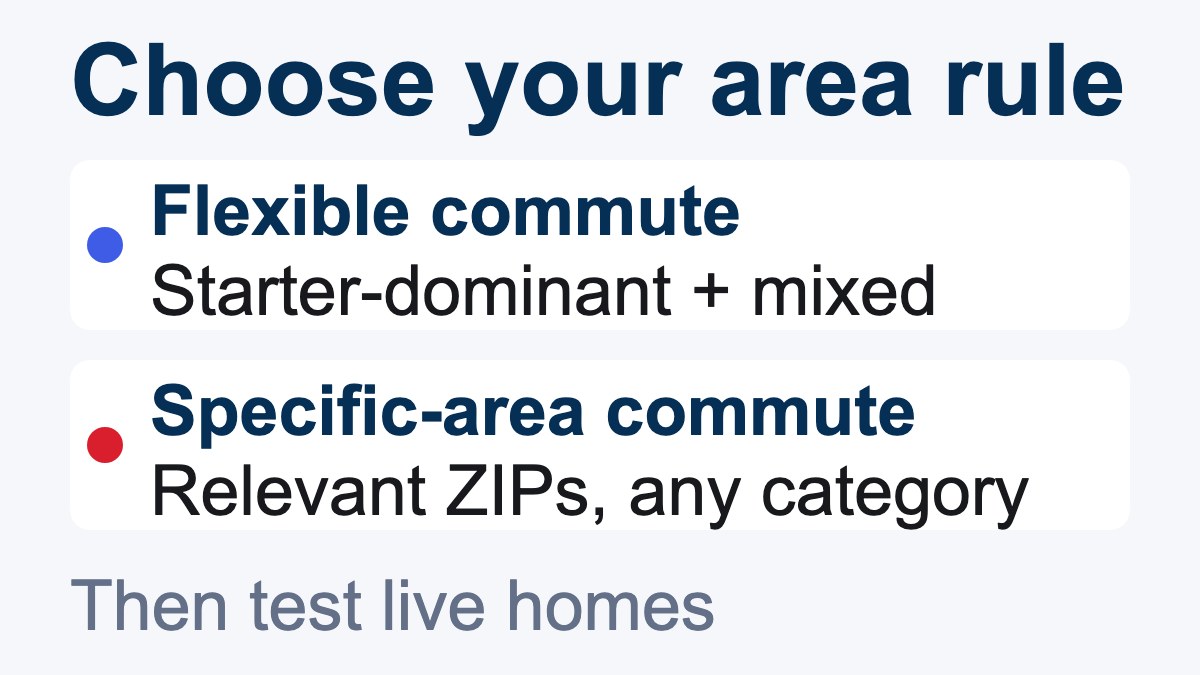
- If your commute is geographically flexible, begin by testing starter-dominant and mixed areas. If you must stay near a specific area, test its live listings regardless of category.
- Keep a home on your shortlist only after checking your approved all-in payment, property type, commute, condition, taxes, insurance and HOA costs.
For an Austin-area first-time buyer, a promising affordability headline can leave the practical question unanswered: where should you set home-search alerts? Start with the areas that fit your daily life, then use the listing-price pattern to decide where to investigate first. A metro-wide share cannot tell you whether a particular neighborhood has a suitable home today.
Realtor.com’s October 8, 2026 analysis reports a 32.7% starter-priced share for the Austin metro in August 2026. That is a dated active-listing snapshot. It is neither a current inventory count nor a finding that those homes are affordable for every first-time buyer.
A flexible commute changes where to begin
Consider a hypothetical search. Buyer A can accept a geographically flexible commute. Buyer B must remain near a specific area. Both keep their own approved all-in payment and property requirements fixed while testing locations.
Buyer A begins alerts in starter-dominant and mixed qualifying ZIPs, using the August classifications only to organize the investigation. Suppose a home in a starter-dominant area fits the payment but fails the actual commute test, while a home in a mixed area fits both. Buyer A should advance the mixed-area home. The category helped order the search; it did not override the buyer’s requirements.
Buyer B begins in the relevant constrained ZIPs regardless of category. Suppose that area is trade-up-dominant, but a current listing meets Buyer B’s payment, property type, commute, condition, tax, insurance and HOA requirements. The category alone is no reason to reject it. If no listing meets those requirements, Buyer B must decide whether to change an acceptable property feature, revisit the location constraint or keep waiting.
These are hypothetical outcomes, not reports of available homes. Geographic flexibility creates more places to investigate but requires checking each location’s practical fit. A constrained search preserves the location requirement but may take longer or require a property compromise. Neither strategy guarantees a match.
What “starter-priced” measures
In this analysis, a starter-priced home is listed at or below 80% of its metro’s median list price for that period. The median is the middle listing price. The threshold describes a home’s price relative to its local market; it is not a fixed national dollar amount or a buyer-specific approval determination. Source: Realtor.com methodology.
The ZIP classifications apply only to ZIPs with at least 50 qualifying listings in that month:
| ZIP category | Source definition | Austin ZIPs, August 2026 |
|---|---|---|
| Starter-dominant | 60% or more of listings are starter-priced. | 12 |
| Trade-up-dominant | 60% or more of listings are above 125% of the metro median list price. | 24 |
| Mixed | Neither of those category thresholds is met. | 44 |
These are counts of qualifying ZIPs, while 32.7% describes the metro’s starter-priced listing share. The two measurements answer different questions. Realtor.com reports 80 qualifying Austin ZIPs in total.
What the Austin pattern changes about your search
Realtor.com places Austin’s starter-dominant ZIPs mostly in the eastern and southeastern parts of the metro. It describes trade-up-dominant ZIPs as concentrated around Lake Travis and West Lake Hills. Those are source-level metro and ZIP patterns, not descriptions of every neighborhood or home within them. Source: Austin findings.
A trade-up-dominant label describes concentration; it does not say every listing exceeds the starter threshold. The evidence does not establish a particular suburb, block or property as affordable for you, and it supplies no reason to assume a workable commute.
Turn the pattern into useful search alerts
- Set the payment boundary before comparing areas. Establish your approved all-in payment with your lender, then choose a personal spending ceiling within it. For each candidate, check the loan payment, taxes, insurance and HOA costs rather than treating a listing-price label as a payment estimate. Keep condition and potential repair needs in the decision too.
- Choose the area rule that fits your circumstances. If your commute is geographically flexible, begin with starter-dominant and mixed qualifying ZIPs. If you must remain near a specific area, begin in the relevant constrained ZIPs regardless of category. In either case, confirm the commute for the actual property.
- Test current inventory. Use the Home search to compare active listings against your payment, property type, commute and condition requirements. Verify current price and availability before planning around a listing; the August snapshot cannot supply those answers.
- Record why homes fail your filters. If the recurring problem is commute, adjust the search geography where possible. If it is property size or condition, decide which requirement you can realistically change. If every suitable home exceeds your payment ceiling, keep waiting or revise a genuine constraint rather than stretching the budget because the area is labeled starter-dominant.
Repeat the property-level check as new listings appear and as candidate-home cost estimates become clearer. Finding a promising home is the beginning of that verification, not the end. Waiting preserves your current limits, but this report gives no basis for promising that prices or availability will improve.
Frequently asked questions
Does an unclassified ZIP mean there are no starter-priced homes there?
No. The methodology omits ZIPs without at least 50 qualifying listings in the snapshot month. An omitted ZIP has no classification under that rule; omission does not establish that every home is expensive. Check current listings if the area fits your needs. Source: classification criteria.
Does “mixed” mean half the listings are starter-priced?
No. Mixed is the category for qualifying ZIPs that meet neither dominance threshold. It does not specify an even split or tell you how many listings will match your own price range. Source: ZIP methodology.
Sources
- Realtor.com Economic Research: Where Starter Homes Still Exist: A Metro-by-Metro Look — published October 8, 2026; Austin figures used here reflect August 2026 active for-sale listings. The broader study covers the 100 largest U.S. metros by household count and compares August 2019, August 2022 and August 2026.
Recommended reading
- Mortgage Quote Higher Than the Headlines? Compare the Loan, Not Just the Rate
- Buying an Older Austin Home? Get the Insurance Quote Before the Option Period Ends
Want help turning your budget and commute requirements into a focused Austin-area search? Contact Vladimir Baibus · ATXCasa, LPT Realty, to compare current listings and identify which areas deserve your attention.