
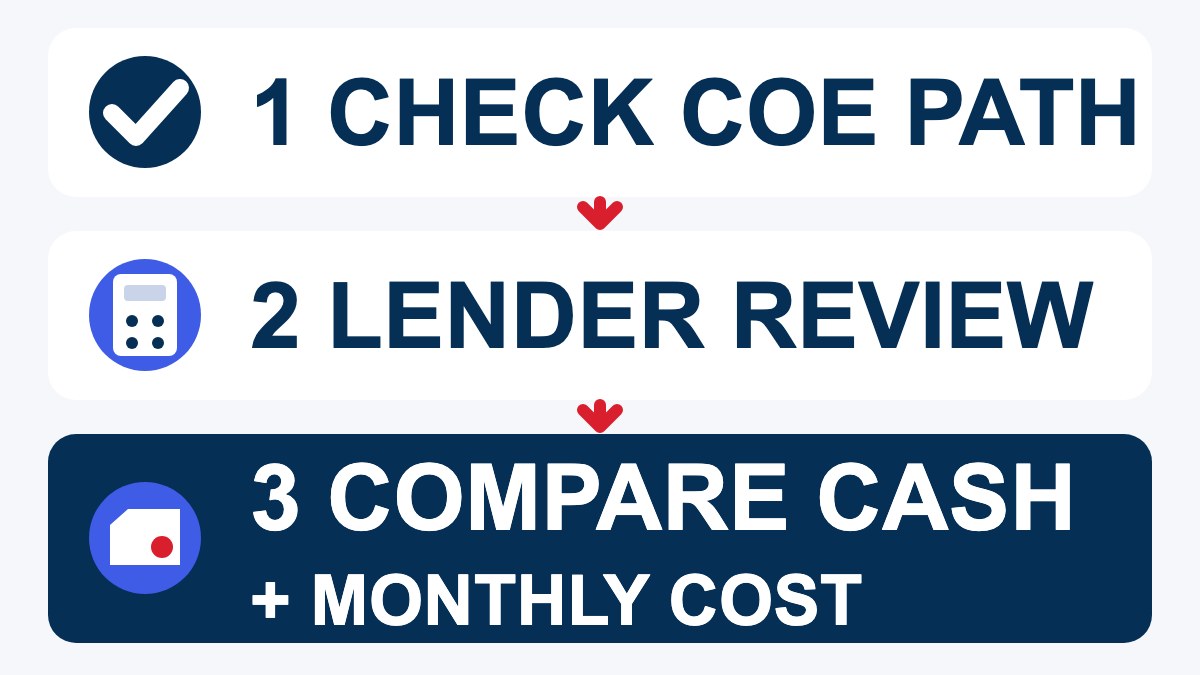
TL;DR
- A VA Certificate of Eligibility (COE) shows a lender that you qualify based on service history and duty status; it does not settle your loan approval.
- You’ll still need to have the required credit and income for the loan amount you want to borrow, according to VA guidance.
- Compare complete, property-specific terms: rate, points, lender fees, monthly costs and cash to close. A lower payment can require much more cash upfront.
If you’re a veteran, service member or surviving spouse planning an Austin-area purchase, VA-backed financing may be worth exploring before you choose a mortgage. Start by checking whether you can obtain a Certificate of Eligibility, then have lenders assess your finances and the proposed property. Treating eligibility as settled financing can leave you planning an offer around a loan amount or payment you cannot obtain.
The useful choice is the loan that fits both your monthly budget and the cash you can commit. The example below shows why a smaller loan balance and lower principal-and-interest payment do not answer that question by themselves.
What a VA Certificate of Eligibility tells you
The U.S. Department of Veterans Affairs describes a COE as a way to show your lender that you qualify for a VA direct or VA-backed home loan based on your service history and duty status. The same guidance says: “You’ll still need to have the required credit and income for the loan amount you want to borrow.”
That distinction gives you a practical sequence: establish the VA eligibility path, then ask a lender to evaluate the amount and terms you could actually use. Underwriting is the lender’s review of whether your application meets its lending requirements. A COE does not establish a particular rate, payment or property’s eligibility.
A hypothetical purchase: compare cash and monthly costs together
Suppose you are considering the same $400,000 Austin-area home under two financing paths. Both are hypothetical 30-year fixed loans, not lender quotes or recommendations. Path A models a possible VA-backed purchase after the eligibility check, assuming the lender permits the stated loan. Its assumed zero down payment, rate and costs are not promises of VA benefits or approval.
Principal and interest (P&I) is the payment toward the loan balance and interest. Mortgage insurance, when applicable, is a separate cost to identify. Points are an upfront charge expressed as a percentage of the loan; this example uses 1 point as 1%. Neither P&I nor P&I plus mortgage insurance is the complete housing payment.
| Item | Path A | Path B |
|---|---|---|
| Down payment | $0 assumed | 10%, or $40,000 |
| Loan amount | $400,000 | $360,000 |
| Fixed interest rate | 6.25% | 6.50% |
| Points | 0 | 1 point, or $3,600 |
| Lender fees | $1,500 | $1,200 |
| Monthly P&I | $2,462.87 | $2,275.44 |
| Monthly mortgage insurance | $0 assumed | $180 assumed |
| Monthly P&I plus assumed mortgage insurance | $2,462.87 | $2,455.44 |
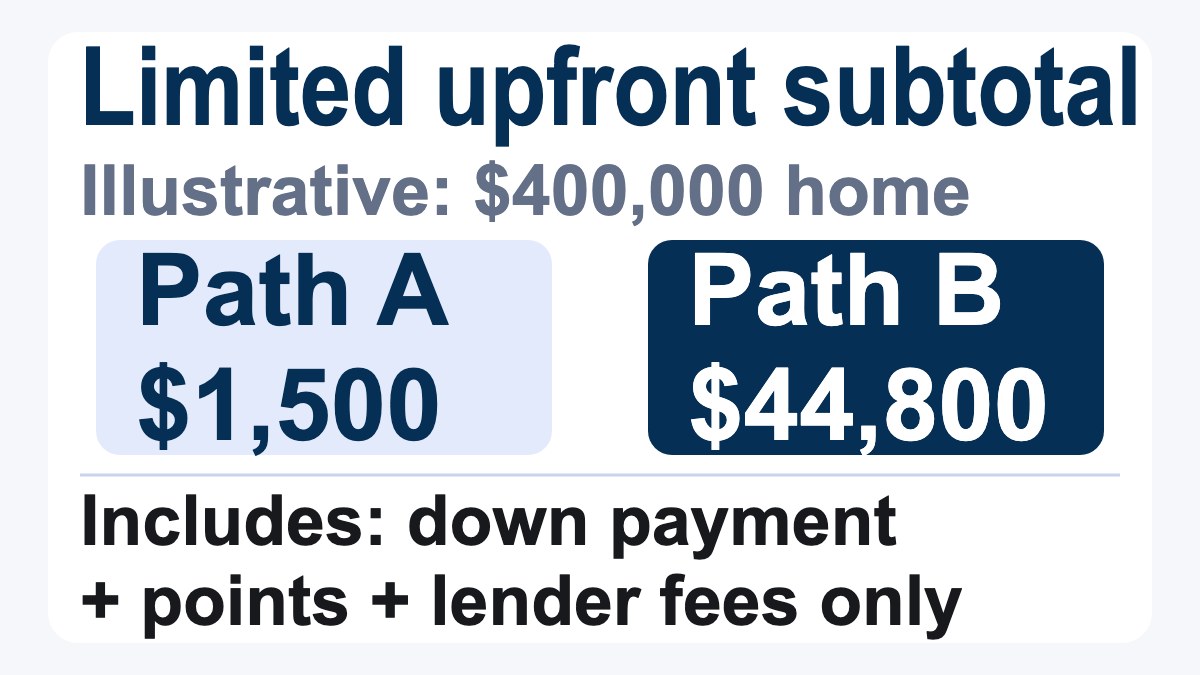
| Down payment, points and lender fees only | $1,500 | $44,800 |
These are incomplete cost figures. They exclude the VA funding fee, if applicable, prepaid interest, escrow, title/settlement charges, taxes, insurance, inspections and seller credits. Escrow is money collected to pay items such as property taxes and insurance. The last row is a limited subtotal, not cash to close. Verify those actual costs, the property, and all eligibility/underwriting conditions with the lender. If a fee is added to the loan, request a revised loan amount and payment before comparing.
Path B’s smaller balance produces lower P&I even with its higher interest rate. But after the assumed mortgage insurance is included, the displayed monthly costs are close, while Path B requires substantially more cash for the listed upfront items. That makes Path A worth investigating for a buyer who needs to retain cash—provided the full costs, lender approval and property requirements work.
Path B may fit someone who can comfortably commit the down payment and prefers a smaller balance. That choice needs the complete figures too: the example does not establish which loan costs less over the time you will own the home. Ask whether and when any mortgage-insurance charge could end; do not assume this illustrative monthly charge lasts for the full loan term or disappears on a particular date.
Turn the eligibility check into a usable financing decision
- Check the COE path. Start with the eligibility and COE options on the official VA home-loans page. If your eligibility is unresolved, keep the VA option provisional while you clarify it.
- Ask for the amount supported by your application. Have lenders assess credit and income for the loan amount you want to borrow. Ask which conditions remain unresolved. If the amount is insufficient, revise the price range or compare another financing path before relying on it for an offer.
- Request complete comparisons for the same property and purchase price. Ask for Loan Estimates—the lender’s itemized estimates of loan terms and costs—and identify any assumptions still subject to verification. Compare rate, points, lender fees, P&I, any mortgage insurance and cash to close. Ask whether a VA funding fee applies and how it would be paid.
- Test both budgets. Check whether cash needed at closing leaves money for your other obligations, then check the full monthly cost. If either fails, consider a lower purchase price, another loan structure or waiting. A benefit you qualify for does not require you to buy now.
Apply the comparison to the Austin-area home you would buy
Use the actual address from your home search when you move from screening to loan comparison. Ask for the property’s tax and insurance figures and identify any association costs. Keep those inputs consistent across lender comparisons, and ask the lender to identify any unresolved property requirements.
This is an Austin-area purchase application of national VA guidance. The source does not establish local prices, lender availability, appraisal results, taxes or insurance costs. A national eligibility answer cannot supply an address-specific budget.
Continue the budget past closing. In this fixed-rate illustration, scheduled P&I stays level; that does not make every ownership expense fixed. Leave room for changes in property costs and upkeep, and revisit the budget when actual bills or insurance quotes arrive. Choose a payment that works without depending on a future refinance.
Frequently asked questions
Can a surviving spouse use this as an eligibility answer?
No individual eligibility determination is made here. VA includes survivors among the people its home-loan programs may help, but that does not establish eligibility for every surviving spouse. Use the survivor-related information on the VA home-loans page to check the applicable path before planning around the benefit.
Does the purchase example tell me whether to refinance?
No. VA says its programs can also help eligible borrowers refinance, but this example compares a purchase with alternative down payments. A refinance decision needs your current loan, proposed replacement terms, transaction costs and expected time keeping the loan. Those inputs are outside this purchase guide.
Sources
- U.S. Department of Veterans Affairs: VA-backed Veterans home loans. National guidance; page updated December 17, 2024; verified evidence checked November 3, 2026. Supports program purpose, the COE’s role and the continuing credit-and-income requirement.
Recommended reading
- Mortgage Quote Higher Than the Headlines? Compare the Loan, Not Just the Rate
- Putting Less Than 20% Down on an Austin Home? Compare Mortgage Insurance Before You Choose a Loan
Planning an Austin-area purchase with a possible VA loan? Contact Vladimir Baibus · ATXCasa for help matching your lender-reviewed budget to homes and identifying property details to resolve before an offer. Financing approval and loan terms remain with your lender. LPT Realty.