
The best rental neighborhood in Austin depends on what you trade for rent. Downtown, East Austin, North Loop and Hyde Park cost more but save you a car. North Austin, Georgian Acres and North Lamar cost less and put you in traffic. Northern suburbs such as Round Rock and Pflugerville add space and a different supply picture for investors. Below I sort the main areas by what they give you, with 2026 rent figures and the market context behind them.
TL;DR
- Walkable, central areas (Downtown, East Austin, North Loop, Hyde Park) carry the highest listed rents. Budget areas such as North Austin, Georgian Acres and North Lamar run about $888 to $1,130 for a one-bedroom.
- Austin rents are softer than a few years ago: the citywide average apartment rent was $1,643 in RentCafe’s 2026 data, down 1.26% year over year.
- Residential areas such as Brentwood, Allandale and Tarrytown give you parks and space, but you will usually need a car.
- Investors should judge a rental property by submarket and cash flow, not by a citywide rent recovery story.
Table of Contents
- How to read Austin rent numbers before you pick an area
- Best Austin neighborhoods for renters, by lifestyle
- Cheaper rental neighborhoods in Austin
- Suburbs north of Austin: Round Rock, Pflugerville, Georgetown, Leander
- Best Austin rental property neighborhoods for investors
- Renting first, then buying: families and first-time buyers
- A simple method to choose your neighborhood
- Talk to ATXCasa about your next move
- FAQ
- Sources
How to read Austin rent numbers before you pick an area
Rent figures in Austin vary by source because each one measures something different. Some use asking rents on new listings, some use averages across a whole building, and some include or exclude fees. Compare numbers only within the same source and the same month.
Here is the citywide picture. RentCafe’s Austin page, updated November 13, 2026, shows an average apartment rent of $1,643, down 1.26% from a year earlier. By size, that is $1,291 for a studio, $1,425 for a one-bedroom, $1,818 for a two-bedroom and $2,423 for a three-bedroom. Neighborhood averages on the same page run from $875 in Mesa Park to $3,500 in West University, so the neighborhood you choose matters far more than the city average.
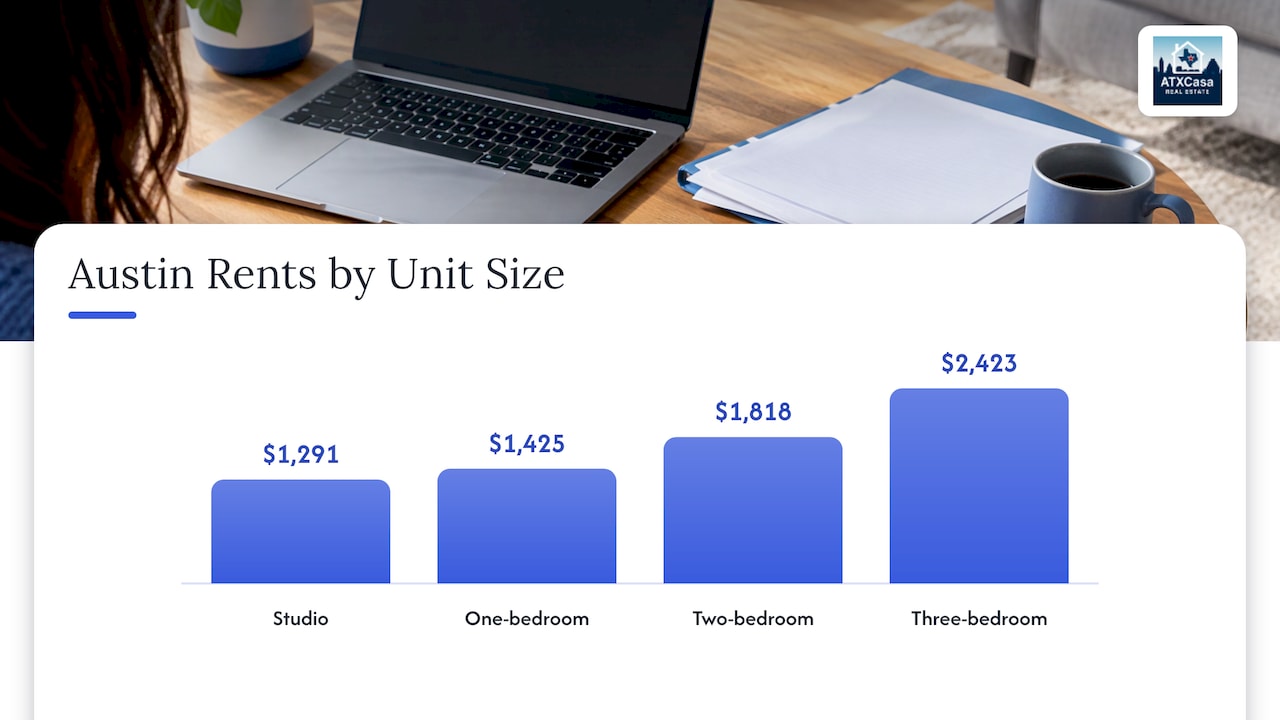
These averages change monthly as new listings come and go, so treat them as a snapshot and check the live tables before you sign anything.
The softness has a cause. Matthews’ Q2 2026 multifamily report put metro vacancy at 12.29%, down 289 basis points from a year earlier, with effective rent of $1,414, down 3.88% year over year. A basis point is one hundredth of a percentage point. The report attributes the vacancy improvement to sharply fewer completed apartments, not a spike in demand. These are metro multifamily measures, not a promise of concessions at a particular building; compare current availability, fees and lease terms for the address you are considering.
Best Austin neighborhoods for renters, by lifestyle
A neighborhood that suits a graduate student will not suit a family of four. I group the main areas by what you get in return for the rent.
| Area | Best for | What stands out | Typical trade-off |
|---|---|---|---|
| Downtown | Walkability, no-car living | Highest walkability in the city | Steepest listed rents |
| East Austin | Nightlife, dining, central access | Diverse mix of old and new housing | Rent growth was negative in Q2 2026 |
| North Loop | Quirky, comparatively affordable central living | 93 Bike Score | Smaller older buildings |
| Hyde Park | Proximity to UT | Close to campus and central Austin | Higher rents than most central neighbors |
| Brentwood, Allandale, Tarrytown | Space, parks, schools | Quieter residential streets | More car reliance |
| The Domain (North Austin) | Modern, all-in-one convenience | Mixed-use retail, dining and apartments | Premium pricing for new buildings |
The descriptions of these areas follow Apartment List’s 2026 neighborhood guide, which recommends Downtown for walkability, East Austin and North Loop for nightlife and central access, Hyde Park for UT proximity, and Brentwood, Tarrytown and Allandale for residential space and parks.
Downtown, East Austin and North Loop
If you want to live without a car most days, start here. Downtown is the most walkable. East Austin and North Loop trade some of that for restaurants, bars and a short ride to the center. North Loop tends to be the cheaper of the central options.
East Austin also shows the range of new construction. One recent listing, The Arnold near Plaza Saltillo Station, lists a 447-square-foot studio from $1,638, one-bedrooms from $1,843 and two-bedrooms from $2,550, and offers both market-rate and income-restricted homes. It is one building, not an area average, but it shows what new East Austin product costs.
On the east side of I-35, the Apartments.com guide to East Congress reported November 2026 average rents of $1,246 for a studio, $1,466 for a one-bedroom and $2,143 for a two-bedroom, with rents down 3.6% year over year.
Walkability is more than a score. Our piece on why Austin’s walkable neighborhoods need more than a 92 score explains what to check on foot before you commit to a lease.
Hyde Park, Rosedale and Allandale
These central-north neighborhoods mix older homes with apartments. RentCafe’s February 2025 neighborhood guide reported averages of $1,467 in Rosedale, $1,483 in Allandale and $1,649 in Hyde Park, and describes Rosedale’s housing as classic bungalows alongside modern apartment complexes. Those figures are from early 2025, so use them to compare the three areas with each other, not as a current quote.
If you are weighing safety, our guide on how to judge the safest neighborhoods in Austin shows which data to look at rather than relying on a ranking.
South Lamar and South Austin
South Austin is more suburban in parts, with shopping centers and offices, according to ApartmentAdvisor’s Austin guide. South Lamar is the part of it that many renters want, because it connects quickly to I-35 and Highway 290.
Building amenities there are strong. South Lamar Village lists studios through two-bedrooms from 398 to 978 square feet, with a pool, fitness center, dog park and in-unit washers and dryers. MAA South Lamar lists monthly prices of $1,482 to $4,665 including fees for homes of 401 to 1,252 square feet. The spread shows how much floor plan and fees move the number.
For a broader view of the split between the two halves of the city, see our comparison of North versus South Austin and six buyer trade-offs.
The Domain and North Austin
The Domain is a planned mixed-use district. Simon Property Group describes it as a 1.2-million-square-foot complex with more than 100 brands, more than 20 dining and entertainment venues and more than 800 luxury apartments. If you want to walk to dinner and shopping but still have a car, it is the standard choice in the north.
Cheaper rental neighborhoods in Austin
If rent is your first constraint, the lower-cost areas are well documented. Apartment List’s August 7, 2026 snapshot put average listed one-bedroom rents across nine budget areas between $888 in North Austin and $1,130 in Franklin Park. Georgian Acres was $908 and North Lamar $916. The guide’s other lower-cost picks include Gracywoods and Parker Lane, according to its 2026 neighborhood guide.
In Apartment List’s August 7, 2026 snapshot, North Austin’s average listed rents were $888 for a one-bedroom and $1,246 for a two-bedroom, excluding fees. The guide estimated downtown trips at about 55 minutes by transit or 20–25 minutes by car from North Austin; about 45 minutes by transit or 15 minutes by car from Georgian Acres; and about 50 minutes by transit or 15–20 minutes by car from North Lamar. These are snapshot estimates, not fixed travel times. Test the route at your travel hours and check how you would reach groceries and other regular errands before deciding whether you need a car.
A simple way to compare: take the rent saved against a central one-bedroom, then subtract what a car costs you each month (payment, insurance, fuel, parking). If the savings disappear, a central neighborhood is the better value.
If you are renting on a specific income, our breakdown of what a $100K household income can rent in Austin shows how different budgets map to neighborhoods.
Suburbs north of Austin: Round Rock, Pflugerville, Georgetown, Leander
Many renters and investors look past the city line. TexasCostOfLiving’s Austin neighborhood cost guide notes that Leander is the end of the MetroRail Red Line, and that Georgetown and Round Rock are served by their own school districts, Georgetown ISD and Round Rock ISD. The school district is worth confirming for any address, because it follows the property, not the city name.
For rental property investors, the north has a specific supply story. IPA’s 2026 forecast notes that late-2025 vacancy was near 7% in Pflugerville and Round Rock and expects those suburbs may benefit as new supply pressure recedes. That is lower than the 12.29% metro figure above, though Matthews’ Q2 report says rents in Round Rock were still negative.
Best Austin rental property neighborhoods for investors
Investors should read the data differently from renters. A renter asks what a neighborhood costs. An investor asks what it earns after costs, and how steady that income is.
Three points from the research shape my view:
- Supply drove the softness. IPA’s forecast says Austin apartment inventory grew 33% from 2020 to 2025 while employment grew about 25%. It expects construction to slow and vacancy to ease as deliveries pull back.
- The recovery is early. In Q2 2026, Matthews reported year-over-year rent growth of +0.1% in Downtown, -2.4% in East Austin and -2.2% in Round Rock. The negative figures mean rents declined from a year earlier. Matthews described the metro as a market in recovery, not a recovered market: vacancy had improved and fewer apartments were being completed, but vacancy remained elevated. That assessment does not guarantee future rent growth.
- Asset-level numbers matter most. Matthews’ Q1 2026 report recorded a $1,500 average asking rent and 13.5% vacancy, with 3,800 units absorbed against 2,000 delivered. It advises investors to assess stabilized cash flow, acquisition basis, submarket positioning and long-term rent recovery.
IPA names Midtown and North Austin as likely investment targets because they sit near employment centers, and points to transit-oriented projects and connectivity as strategic considerations. Those are large multifamily views. If you are buying a single house or small building, the same logic applies at a smaller scale: buy where renters already want to live, and price the purchase on what rent the property will actually collect today.
For a deeper look at specific areas, read our best Austin neighborhoods for investment in 2026. To see how prices differ block by block, what sold homes reveal about Austin neighborhood prices is the data behind it.
If you already own a home and are deciding whether to keep it as a rental, a rent versus sell decision guide lays out the general framework: compare the monthly rent after costs with the proceeds you would have from selling.
Renting first, then buying: families and first-time buyers
Many people who search for rental neighborhoods are also deciding where they will eventually buy. Renting in an area for a year is a low-risk way to learn its commute, noise and school options. Pay attention to the parts a listing does not show.
- Amenities that follow the neighborhood. A community such as Legend Oaks in Southwest Austin has just over 350 homes, a recreation center, swimming and toddler pools, a playground, a tennis court and greenbelts. That kind of association-run amenity set is typical of family neighborhoods, and it affects both rent and resale.
- Commute, tested at your hours. Drive the route at rush hour before you sign.
- School district. Confirm it from the district, not the listing.
When you are ready to move from renting to buying, see our guide to Austin starter homes and how to focus your search and the area guide to where to live in the Austin metro. For the more expensive side of town, there is also a buyer’s guide to West Austin neighborhoods. If you want to browse everything in one place, the neighborhoods and lifestyle section collects it.
If you are a landlord or a renter wanting a broader sense of how local housing types differ, a free rental listings resource shows how listings can be organized by property type.
A simple method to choose your neighborhood
- Set a total housing budget, including utilities, parking and fees, not just the advertised rent.
- Decide the commute you will accept in minutes, at your own hours.
- Pick two or three areas from the table above that fit both numbers.
- Compare asking rents in the same month from one data source so the figures are consistent.
- Visit at night and on a weekday morning. Noise, parking and traffic show up then.
- Ask for the full fee schedule before you apply.
My read on Austin rental neighborhoods
When we look at Austin neighborhoods, we start from the numbers and then check them against the street. A listing average tells you where rent sits. It does not tell you whether the commute works, whether the block is quiet or whether the building is priced fairly against the one next door.
For tenants, the market is working in your favor in 2026: vacancy is high, and rents have drifted down. For investors, that same softness is a reason to be selective, not to stay away. We would look at submarkets where vacancy is already lower, such as parts of the north, and underwrite each property on the rent it collects now.
Our approach combines nearly two decades of IT experience with local market knowledge. We use data to set pricing and marketing strategy, then pair it with neighborhood-level detail that a portal average cannot show.
Whether you rent now and buy later or buy a rental property directly, the right neighborhood is the one whose numbers and daily life both fit you.
Vladimir
Talk to ATXCasa about your next move
ATXCasa, led by Realtor Vlad Baibus, helps clients buy, sell and invest across the Austin area, including Cedar Park, Round Rock and Georgetown. If you are moving from renting to owning, or you want a rental property in the right submarket, we bring AI-powered marketing and data-driven pricing to the work, along with personalized guidance on neighborhood trends and hidden home pitfalls.
Tell us your budget, your commute and your timeline, and we will map out the Austin neighborhoods that fit. Start at ATXCasa.
FAQ
What are the best neighborhoods in Austin for renters?
For walkability, choose Downtown. For nightlife and central access, East Austin and North Loop fit best, and Hyde Park suits people who want to be near UT. If you want parks and quiet streets, look at Brentwood, Allandale and Tarrytown. Expect to pay more for the central areas and to need a car in the residential ones.
What is the cheapest part of Austin to rent in?
In Apartment List’s August 2026 snapshot, average listed one-bedroom rents among nine budget areas ran from $888 in North Austin to $1,130 in Franklin Park. Georgian Acres ($908) and North Lamar ($916) were among the lowest. Rents change monthly, so check the live listings before you decide.
Is Austin rent going up or down in 2026?
RentCafe’s November 2026 data showed the citywide average apartment rent down 1.26% from a year earlier, at $1,643. Matthews’ Q2 2026 report showed effective rent down 3.88% with vacancy at 12.29%. Both reports describe a market where supply grew faster than demand, and Matthews noted the vacancy improvement as a sign of recovery.
Which Austin areas look good for rental property investors?
IPA’s 2026 forecast names Midtown and North Austin as likely targets near employment centers, and sees Pflugerville and Round Rock benefiting as new supply recedes. Matthews advises investors to underwrite each asset on cash flow, purchase price and submarket position. Run the numbers on the specific property, not the metro average.
Sources
- Average Rent in Austin, TX: 2026 Rent Prices by Neighborhood
- Austin’s Best Affordable Neighborhoods for Renters
- The Best Austin Neighborhoods for Every Lifestyle in 2026
- Cheapest Neighborhoods in the Austin Area
- Austin Multifamily Market Report Q2 2026
- Q1 2026 Austin Multifamily Market Report
- 2026 Multifamily Investment Forecast
- East Congress, Austin TX local guide
- The Arnold, East Austin
- South Lamar Village
- MAA South Lamar
- The Domain mixed-use overview
- Austin neighborhood costs 2026
- Austin, TX guide
- Legend Oaks neighborhood association