

Most Austin buyers should budget about 2% to 5% of the purchase price for closing costs, on top of the down payment. For a home near the area’s $475,000 median price, one local lender estimate puts closing costs and prepaid items at roughly $11,000 to $16,000. Below, I break down where that money goes, what Texas customs say the buyer pays versus the seller, and which items you can actually change.
TL;DR
- Plan on 2% to 5% of the price for closing fees, a range Freddie Mac gives as typical guidance, and expect Austin to sit within it.
- Closing costs do not include your down payment. Your “cash to close” is the total due minus what you have already paid or been credited.
- In Texas, the seller customarily pays the owner’s title policy and the buyer pays the lender’s policy, but the contract can change that.
- Texas title premiums are set by the state, so shop lenders and your contract terms, not title premiums.
- Compare your Loan Estimate with your Closing Disclosure line by line before you sign.
Table of Contents
- What buyer closing costs are, and what they are not
- How much to expect at Austin price points
- The line items that make up the total
- Who pays what in Texas
- Reading your Loan Estimate and Closing Disclosure
- Ways to bring the number down
- A worked example
- Our perspective
- Work with a local agent on your numbers
- FAQ
- Sources
What buyer closing costs are, and what they are not
The Consumer Financial Protection Bureau describes closing costs as the upfront costs of obtaining your loan and transferring ownership, excluding the down payment. That distinction matters because buyers often compare quotes that mix the two.
Three terms get blurred in conversation:
- Down payment: your equity contribution toward the price.
- Closing costs: fees for the loan, title work, recording and related services.
- Cash to close: the number on your final paperwork. The Closing Disclosure calculates it by subtracting amounts already paid or credited from the total due from you. Earnest money and seller credits therefore reduce it.
Prepaid items, such as the first year of homeowners insurance and money set aside for taxes, are not fees in the usual sense. They are your own future expenses paid early. Many Austin estimates fold them into one total, which is why you will see different figures depending on who is quoting.
How much to expect at Austin price points
The 2% to 5% range is wide because loan type, rate, insurance costs and tax timing differ for each buyer. Here is the arithmetic applied to a few prices. These are simple illustrations of the percentage range, not quotes.
| Purchase price | 2% | 5% |
|---|---|---|
| $350,000 | $7,000 | $17,500 |
| $475,000 | $9,500 | $23,750 |
| $600,000 | $12,000 | $30,000 |
The local lender estimate I mentioned above, $11,000 to $16,000 at the median price, sits in the lower half of that band. My read: if your down payment is small and your lender prepaid reserves are standard, the low-to-middle part of the range is realistic. The top of the range tends to show up when a buyer pays discount points, buys with a higher insurance premium, or closes at a time of year when property tax reserves are large.
A practical rule: ask your lender for a Loan Estimate early, then use the 2% to 5% range only as a planning cushion until you have it.
The line items that make up the total
Buyer costs in Austin fall into five groups. A title company’s fee reference guide lists the typical buyer-side items: the lender’s title policy, half the escrow fee, recording charges for documents in the buyer’s name, first-year homeowners insurance, contract-based inspection fees, new-loan charges, tax prorations and interim interest.
Lender and loan charges
These include origination and underwriting fees. Third-party costs tied to your loan, such as the appraisal and credit report, also fall here. Lenders price these differently, which is why comparing itemized estimates pays off.
Title and escrow
Title insurance is the biggest single Texas-specific item. The Texas Department of Insurance says premiums are regulated and uniform among title companies. Buyers and sellers can negotiate who pays, while extra charges for escrow, recording, tax certificates and delivery can differ by agent.
For policies effective March 1, 2026, the state’s basic premium formula for a $500,000 policy is $780 plus 0.00494 times the amount above $100,000. That produces $2,756 before any additional charges. In most Texas deals the seller covers the owner’s policy, so that figure is usually the seller’s line, not yours. Our separate guide to title insurance costs in Texas walks through the lender’s policy in more detail.
Recording charges
Travis County lists deed and real-property recording fees at $25.00 for the first page and $4.00 for each additional page. A typical buyer’s share is small compared with the loan and prepaid items, but it is a real line on your disclosure. Texas also has no state real estate transfer tax, so you will not see one in Austin.
Inspections, survey and appraisal
Inspection and survey fees are driven by your contract, not by a fixed schedule. Many Austin buyers pay for a general inspection and often add specialty reports. If the roof is a concern on an older home, it helps to understand roof inspection contingency options before you write your offer, since the report and any negotiation it triggers can change what you pay or ask for at closing.
Prepaids and escrow reserves
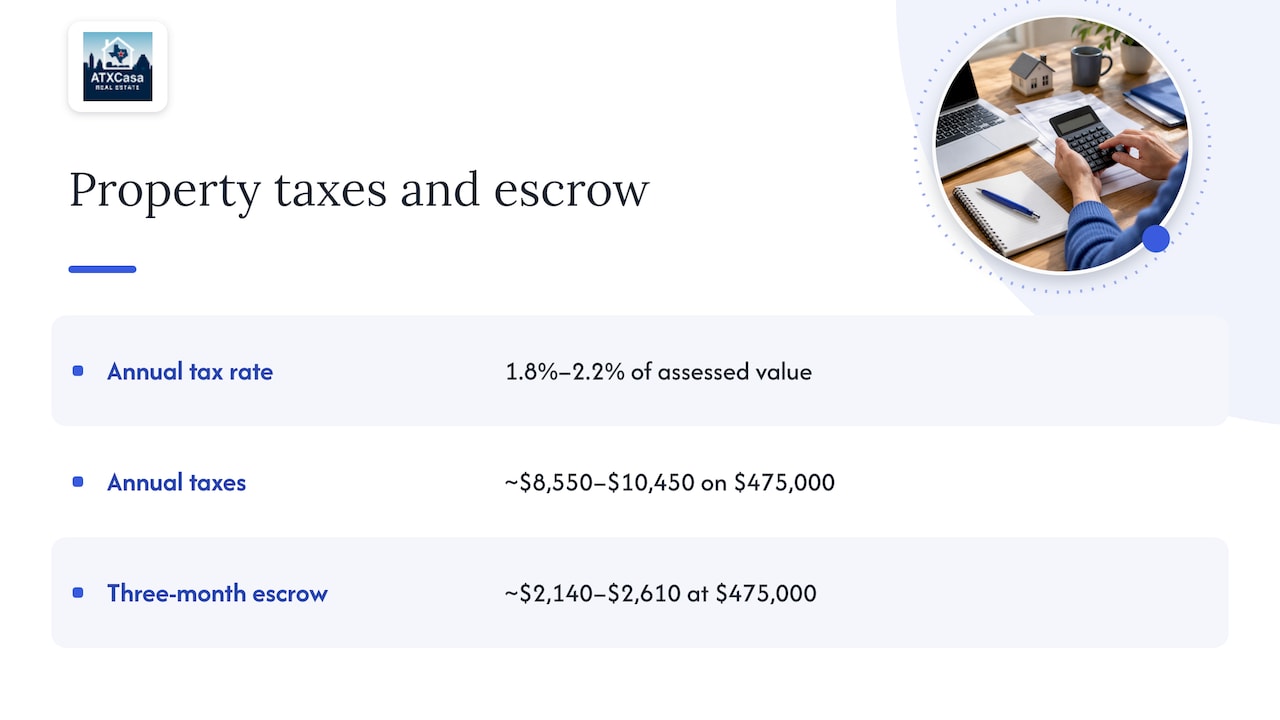
This group is where Austin differs most from many other markets. The combined property-tax rate in the Austin area often lands near 1.8% to 2.2% of assessed value per year, and lenders collect several months of taxes in advance for escrow.
Here is a simple illustration using the $475,000 median price. At 1.8% to 2.2%, annual taxes would be about $8,550 to $10,450. If your lender collected three months into escrow (the number of months varies, so treat this as an example), that is roughly $2,140 to $2,610 at closing. Add a year of homeowners insurance and a few days of prepaid interest, and the prepaid group alone can reach several thousand dollars.
Tax rates differ by city and district, so check our comparison of Austin-area property taxes by city. If you are buying new construction, where the assessed value may not yet reflect the finished home, read our new-build property tax escrow check before you trust the first estimate.
One more point: a homestead appraisal cap does not follow the home to you. According to one county tax calculator, the cap ends when the home changes hands and the new owner is taxed on the full appraised value. I would confirm this with the Travis Central Appraisal District for your specific address, and I would never base your escrow estimate on the seller’s current tax bill.
Who pays what in Texas
Texas follows customs that the contract can override. The title company guide above says sellers normally pay the owner’s title policy and the real-estate commission, while buyers normally pay the lender’s title policy, recording charges for documents in their names, and half the escrow fee. Another Texas summary of contract allocations places these with the buyer:
- Appraisal, loan application, origination, credit and underwriting fees
- Loan-document and wire charges
- Prepaid interest
- The lender’s title policy and loan-related inspections
- One-half of the escrow fee
- Prepaid insurance and initial tax and insurance reserves
- Required mortgage-insurance or government-loan fees
The same Texas allocation summary puts lien releases, seller-loan payoff, tax statements or certificates, deed preparation, half the escrow fee and any specifically agreed seller expenses with the seller. It also notes that the contract controls and customary items remain negotiable.
In a table, the typical split looks like this:
| Item | Usually paid by |
|---|---|
| Owner’s title policy | Seller |
| Lender’s title policy | Buyer |
| Escrow fee | Split, half each |
| Recording of buyer’s documents | Buyer |
| Lender origination, underwriting, appraisal, credit report | Buyer |
| Prepaid insurance, tax and insurance reserves | Buyer |
| Lien releases, seller payoff, tax certificates | Seller |
| Commission | Seller (as customarily agreed in the listing) |
Treat the table as a starting point. Read the paragraph of your contract that covers expenses, because that is what decides who pays.
Reading your Loan Estimate and Closing Disclosure
Your lender gives you a Loan Estimate early in the process and a Closing Disclosure before closing. The Closing Disclosure states your final loan terms and closing costs, and the CFPB’s practical advice is to compare it with the Loan Estimate, verify the closing costs and cash to close, and ask the lender to explain any material change.
When I review these with a client, I check these items in order:
- Interest rate and loan amount. They should match what you locked.
- Lender fees. Look for any new charge that was not on the estimate.
- Title and escrow charges. Confirm the lender’s policy is on your side and the owner’s policy is on the seller’s side, unless you negotiated otherwise.
- Prepaids and reserves. Check that the tax figure is based on the right assessed value and the right number of months.
- Credits. Confirm any seller concession or lender credit appears exactly as agreed.
- Cash to close. Make sure it matches the amount you plan to wire, and wire only after confirming instructions by phone with a number you already trust.
If a number moved and no one can explain why, ask before the closing date, not at the table.
Ways to bring the number down
The CFPB recommends comparing multiple Loan Estimates. Ways to reduce cash needed at closing include seller concessions, comparing itemized lender fees, or taking a lender credit. Seller-paid costs must fit your loan rules and contract. A lender credit offsets closing costs but may come with a higher interest rate. Compare quotes for the same loan type, and ask how each option affects the rate and total loan cost.
Negotiate seller concessions
A seller can agree to pay part of your costs. In practice this becomes a trade-off against the price. Whether a seller prefers a lower price or a closing-cost contribution depends on their numbers, which we cover from the other side in price cut or closing-cost help for Austin sellers. Your lender must also accept the credit: each loan program caps how much a seller can contribute, so confirm that limit before you write the offer.
Compare lender estimates
Title premiums are fixed by the state, so the variable part is the lender’s own fees and rate. Get written Loan Estimates from at least three lenders on the same day, with the same loan type and the same lock period, then compare the total of lender charges and the rate together.
Consider a lender credit carefully
Credits from the lender generally offset costs in exchange for a higher interest rate, according to the CFPB. If the credit comes with a higher rate, you need less cash at closing but pay more each month while you keep the loan. Request a comparable quote without the credit, using the same loan amount, loan type and term. Ask the lender to show the interest rate and total loan cost for each option, including the extra cost over the time you expect to keep the loan. Compare that extra cost with the upfront credit: immediate cash relief may be useful, but keeping the loan longer can make the higher rate more expensive overall.
Look at assistance programs
If cash to close is your main obstacle, down payment assistance may cover part of it. Our guide to Austin down payment assistance explains why lender experience with these programs matters, and the piece on time saved versus housing costs shows how an assistance program changes your monthly payment.
A worked example
To make this concrete, take a $475,000 purchase with 5% down. The down payment is $23,750 and the loan is $451,250. Using the 2% to 5% planning range, closing costs and prepaids would fall between $9,500 and $23,750. At the lender estimate for this price tier, $11,000 to $16,000, your total cash need, before any credits or earnest money already paid, would be roughly $34,750 to $39,750.
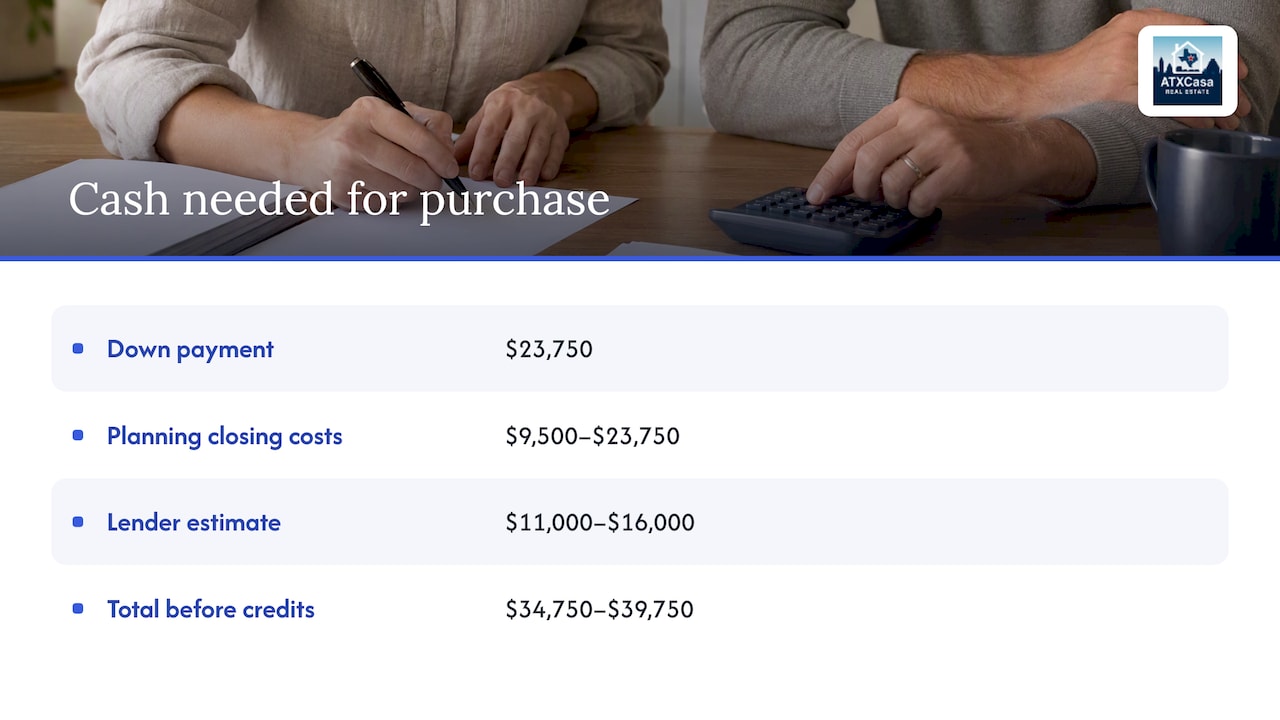
Those are planning numbers I built from the sources above, not a quote. Your own Loan Estimate will replace them. If a seller contributed $10,000 and the loan program allowed it, your cash to close would fall by that amount, and the figure on your Closing Disclosure would show it.
Our perspective
Closing costs are the part of a purchase where buyers feel the least informed, and it is the part where data helps the most. We built ATXCasa around local, current information and plain explanations, because a generic national estimate rarely matches an Austin settlement statement.
Our approach is simple. We start with the actual price range a buyer is shopping, convert it to a realistic cash-to-close range, and then test it against the property tax rate for the exact city and district. That last step is where Austin surprises people, since tax reserves can change the total by thousands of dollars.
We also treat negotiation as a numbers exercise. Before an offer goes in, we compare what a price reduction would save in monthly payment with what a seller credit would save in cash at closing, and we check that the loan program allows the credit. With nearly two decades of IT experience behind our market analysis, we want every client to see their numbers before they commit, not after.
Vladimir
Work with a local agent on your numbers
If you are planning a purchase in Austin, Cedar Park, Round Rock or Georgetown, we can help you turn a price range into a realistic cash-to-close estimate, compare how seller credits and price reductions affect your costs, and review your disclosures with you. Start on the ATXCasa home page to tell us about your plans.
For more market updates and buyer guides, browse our buying, selling and financing articles.
FAQ
Do buyers pay closing costs in Texas, or does the seller?
Both do, but for different items. Customarily the buyer pays the lender’s title policy, loan fees, recording charges for their documents, prepaids and half the escrow fee. The seller usually pays the owner’s title policy and the commission. Your contract can shift any of these.
Is there a transfer tax when buying a home in Austin?
Texas has no state real estate transfer tax, so you will not see one on your disclosure. That does not make closing free: loan fees, title charges, recording fees, insurance and tax reserves still apply.
Can I roll closing costs into my loan?
Some loan programs allow limited ways to cover costs, such as a seller concession or a lender credit, but a lender credit usually means a higher interest rate. Ask your lender which options your specific loan type permits and what each does to your monthly payment.
When will I know my exact closing costs?
You receive a Loan Estimate soon after applying and a Closing Disclosure with your final figures before closing. Compare the two line by line, and ask your lender to explain any material change before closing day.
How much should I save beyond the down payment?
A planning range of 2% to 5% of the purchase price is standard guidance, and the Austin estimates I cited fit inside it. Replace that range with the actual Loan Estimate as soon as you have one.
Sources
- Closing Costs in Austin by Price Tier
- What Are Closing Costs and How Much Will I Pay? (Freddie Mac)
- Closing disclosure explainer (Consumer Financial Protection Bureau)
- Closing Disclosure form (CFPB)
- Closing Disclosure, blank form (CFPB)
- Closing Fee Reference Guide
- Who Pays Which Closing Cost in Texas
- Title insurance FAQ (Texas Department of Insurance)
- Texas Title Insurance Basic Premium Rates (Texas Department of Insurance)
- Travis County, Texas closing costs
- Travis County property tax calculator
- Roof contingency options in a home purchase