

If you are considering an Austin-area home near a data center—a facility that houses computing equipment—should you offer less? Proximity alone does not establish a discount or a premium. Before setting your offer or completing due diligence, compare the home with realistic alternatives and check what the neighboring facility could mean for your daily use.
The National Association of REALTORS® (NAR), in its September 9, 2026 coverage of its Data Center Impact research, cautions that county-level numbers cannot tell what happens to an individual home next to a facility. A broad pattern cannot tell you whether this particular house has an acceptable setting or an appropriate asking price.
Start with a comparison you can actually use
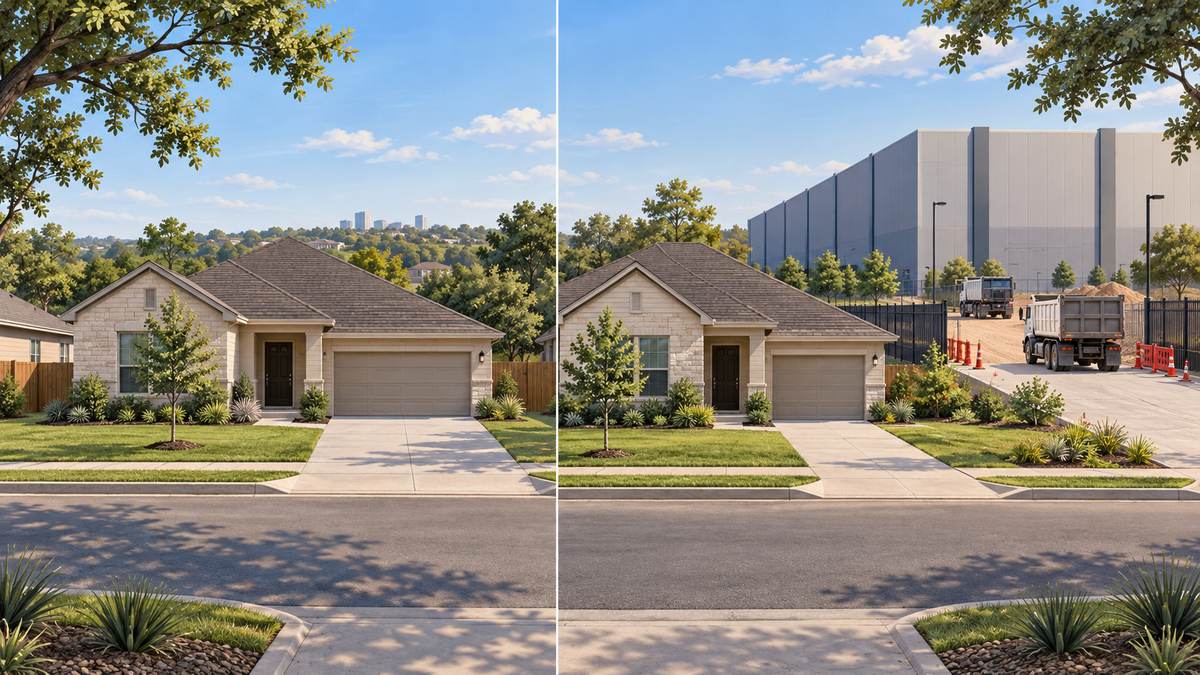
Consider a hypothetical Austin-area search with two otherwise similar homes at similar asking prices. One faces a data center’s construction entrance, where you observe trucks during your visit. The other has no direct exposure to that entrance. You expect to work from home and use the front room throughout the day.
The second home may be the better choice if the observed activity would disrupt your routine. A lower price on the first home could reduce your purchase cost, but it would not remove the disruption. There is no supported percentage to subtract simply because the neighbor is a data center.
Now follow the situation beyond construction. If available records indicate that the entrance is temporary, that could change your view of the inconvenience. It still leaves a separate question: what will face the home once the facility operates? Check the planned layout and any later phases. A quieter visit after construction would answer a different question from a visit while trucks are arriving.
If the expected setting suits you and the first home offers a layout or location you prefer, it may remain a sensible choice. If the uncertainty would make you uncomfortable living there, the alternative may be worth choosing even if you could negotiate a lower price.
Three checks before your decision deadline
If your purchase contract includes an option period, use that agreed period for the checks that could change your decision. Confirm the applicable deadline and contract rights; do not assume you can extend the investigation indefinitely.
1. Establish what is there now
Identify whether the facility is proposed, under construction, operating, or expanding. For an operating site, visit the home at different times and listen from the bedrooms, yard, and work areas you would use. Note what you actually hear or see. A quiet visit to an unbuilt site cannot establish how future operations will sound.
NAR identifies noise, water use, power infrastructure, utility costs, and future expansion as subjects buyers may want to investigate. Treat these as questions about the specific facility. Ask whether equipment locations, generator testing, lighting, construction access, or utility work could affect this property; do not assume each is present.
Ask the seller for known notices, easements, and project correspondence. If the home belongs to a homeowners association (HOA), request relevant association correspondence as well. Keep the association’s transaction documents on a separate track: our Austin HOA resale-certificate guide explains why that review window deserves attention too.
2. Compare realistic alternatives
Use recent comparable sales—completed transactions involving similar homes—to help assess price. Also compare active listings to see what you could buy instead. An asking price shows a seller’s current position; it is not evidence of what a buyer ultimately paid.
Keep the comparison close on location, size, condition, lot, fees, and other features that matter to your search. Then describe facility exposure separately: direct view, access route, intervening buildings, and conditions observed at each home.
A documented drawback can support negotiating a lower offer, particularly when a similarly priced alternative avoids it. But first check whether the asking price already reflects that difference. Without relevant sales evidence, an exact data-center adjustment would create certainty the comparison does not support.
3. Check what could change after closing
For an Austin-area address, identify the applicable city or county and the utility serving the property. Look for the neighboring project’s planning and permitting records rather than assuming an Austin mailing address identifies the authority responsible for it.
Ask whether available records show additional construction phases, expansion, utility infrastructure, road changes, or measures intended to reduce impacts. These measures are often called mitigation. If screening, noise controls, or traffic measures are described, establish whether they are proposed, required, installed, or still awaiting implementation. Those answers carry different weight.
Records help explain a project’s public status and planned changes; they do not guarantee the future experience at your home. For utility concerns, seek information specific to the serving utility and project. The supplied national research does not establish an increase in this home’s bill or a local water-service problem.
Also keep the neighboring project’s approvals separate from permits for work on the home itself. If the house has an unresolved permit, the Austin expired-permit guide addresses that distinct purchase question.
Decide what would change your offer
Proceed at a price supported by the home comparison when the observed setting suits your routine, available plans leave you comfortable with likely changes, and the home compares well with alternatives. The presence of a facility alone does not require a special adjustment.
Negotiate when you can name the compromise. For example, the construction exposure in the hypothetical comparison may make the first home less appealing to you. A lower offer expresses what you would pay to accept that inconvenience; it does not prove a market-wide discount or predict resale value.
Choose another home, or defer committing, when a material unknown remains unresolved. This fits when future access or operating conditions could undermine the way you intend to use the property. Waiting may cost you the current opportunity. Proceeding means accepting the uncertainty that remains, even if the price is lower.
Make the decision specific to the home
My approach for an Austin-area buyer would be to separate observed conditions, documented plans, and unanswered questions, then compare the home with properties that buyer would actually choose instead. That makes the trade-off visible: what you gain from this home, what you accept from its setting, and what fact would change your answer. This is a decision framework, not a finding that Austin homes near data centers sell for more or less.
If you are weighing a particular property, email Vladimir Baibus · ATXCasa with the address, the nearby facility’s name if known, and your decision deadline. I can help organize the home comparison and identify the unanswered questions that matter to your offer strategy.
Vladimir Baibus · ATXCasa · LPT Realty