

A special assessment is a one-time charge an Austin condo association levies on owners, on top of regular monthly dues, to pay for a specific expense such as a major repair, storm damage the insurance does not cover, or a capital project. You can find out whether one exists before you buy by reading the resale certificate and the board’s recent records. You can also protect yourself by settling, in writing, who pays it at closing.
I wrote this guide for buyers, sellers and investors weighing an Austin condo. It covers how assessments work under Texas Property Code Chapter 82, what to review before you sign, and what happens when one goes unpaid.
TL;DR
- A special assessment is a one-time charge for a specific purpose, separate from regular dues. Common triggers are major repairs, casualty damage above insurance proceeds and underfunded reserves.
- Under Chapter 82, common expenses are generally split by each unit’s allocated common-expense liability, so your share depends on your unit’s percentage in the declaration.
- Except as provided by §82.157(c), a seller must furnish a resale certificate listing unpaid special assessments currently due and payable and capital expenditures approved for the next 12 months. The certificate must have been prepared no earlier than 3 months before delivery to the purchaser. Read it, then ask what has been discussed but not yet adopted.
- Unpaid assessments are a personal obligation of the owner and are secured by a continuing lien, so settle responsibility in the contract and get a payoff statement before closing.
Table of Contents
- What a special assessment is and why Austin associations levy them
- How the cost is split and who decides
- Reserves: why they predict assessments
- How to find out whether a unit has an assessment
- Questions to put to the association or the seller’s agent
- What happens if an assessment goes unpaid
- How an assessment affects a sale
- Perspective: how we read a condo’s assessment risk
- Work with ATXCasa on your Austin condo purchase or sale
- FAQ
- Sources
What a special assessment is and why Austin associations levy them
Regular assessments, usually called dues, fund the annual budget: insurance, landscaping, management, utilities for common areas and contributions to reserves. A special assessment covers something the budget did not. The Texas State Law Library’s guide to property owners’ associations describes it as a one-time charge for a specific reason, such as major repairs, unexpected events or property-enhancement projects.
In Austin, the reasons I see most often fall into a few groups:
- Major building repairs. Roofs, balconies, stucco or siding, elevators, parking structures, plumbing risers and HVAC for shared systems all have limited lifespans. When the reserve fund does not cover the bill, owners are asked to cover the difference.
- Casualty damage. Hail, wind and winter freezes are real risks here. Texas Property Code §82.111(i) makes repair or replacement costs above insurance proceeds a common expense and authorizes the board to levy an assessment according to each owner’s common-expense liability.
- Underfunded reserves or budget shortfalls. A Texas property management firm’s overview lists underfunded reserves, budget shortages, special projects, capital improvements and unexpected expenses as typical uses.
- Capital improvements. Upgrading a lobby, adding security systems or modernizing amenities can be funded this way, depending on what the governing documents allow.
Insurance is part of this picture for owners too. Many individual condo policies include loss assessment coverage, which can help with certain assessments tied to covered losses, and the limit is often modest. This condo agent checklist on loss assessment coverage explains how to think about whether the limit on your policy is enough. If your premium or deductible has moved recently, our guide to comparing Texas home insurance quotes is a good companion.
How the cost is split and who decides
Texas Chapter 82 is the Uniform Condominium Act. The State Law Library notes that it applies to condominiums recorded on or after January 1, 1994, that some earlier condominiums may elect to be governed by it, and that specified provisions also reach earlier ones. That matters in Austin, where condo buildings range from recent downtown towers to older small complexes in South and East Austin. Which rules apply to a given building is one of the first things to confirm.
Two statutory points shape how a charge reaches your unit:
- What counts as a common expense. §82.102(7) defines common expenses as association expenditures or financial liabilities, including allocations to reserves.
- How it is divided. §82.112 generally requires common expenses to be assessed according to each unit’s allocated common-expense liability.
Here is an illustrative example, not a real building. Suppose a board approves a $500,000 roof and exterior repair project funded entirely by a special assessment, with no reserves, insurance proceeds, loan or other funding offset. Under §82.112(c), common expenses are assessed according to each unit’s allocated common-expense liability. If your unit’s allocation is 2%, your share would be $10,000; a unit at 0.8% would owe $4,000. Check the percentage in the declaration and the payment schedule. If you agree to pay the assessment as the buyer, you need that money when payment is due, in addition to your other purchase and ownership costs.
The question of who approves it, and whether owners vote, turns on the specific declaration and bylaws together with the statute. Texas association-law practitioners advise that a board first determine whether the expense is a common expense rather than an individual owner expense, then check the declaration, the statutory authority and available financing or insurance. As a buyer, you do the same exercise from the other side: read the documents instead of assuming a vote or a cap exists, because some declarations set limits or procedures and others say little.
Reserves: why they predict assessments
Reserves are money set aside for large, predictable replacements. Chapter 82 treats allocations to reserves as part of common expenses, and the governing documents and the board’s budgeting decide how much is actually set aside. That means two buildings of the same age can have very different exposure.
When I review a condo for a client, I look at these items together:
- The reserve balance compared with the age and condition of the roof, elevators, paint, parking structure and mechanical systems.
- Whether the budget shows regular contributions to reserves or none.
- Whether a reserve study or similar capital plan exists, and how recent it is.
- Whether dues have been flat for years while costs rose, which can mean the shortfall is being deferred.
- Whether the minutes mention bids, engineering reports or contractor proposals.
A building with healthy reserves and rising dues is often in better shape than a building with low dues and an empty reserve account. Low monthly dues are not a bargain if they are paid for with a large future bill. Our article on downtown Austin condos goes deeper on that tradeoff for high-rise buildings.
How to find out whether a unit has an assessment
Texas gives buyers a specific tool. Under Property Code §82.157, except as provided by subsection (c), a seller who is not the declarant—the party that established the condominium—must furnish the specified documents and a current resale certificate before executing a contract or conveying the unit. The certificate must have been prepared no earlier than 3 months before delivery to the purchaser. It lists unpaid special assessments currently due and payable from the seller, capital expenditures approved for the next 12 months, reserves, and the association’s current operating budget and balance sheet. It does not necessarily report proposed but unapproved work.
That list tells you what has been adopted. It does not always tell you what is being discussed. So I treat the certificate as the starting point and add these steps:
- Read the resale certificate closely. Check for assessments due, approved capital spending and the balance sheet. Our guide to Austin HOA resale certificates covers the review window and what to look at.
- Request the governing documents. The declaration, bylaws and rules show the allocation percentages, insurance responsibilities and any procedures for assessments.
- Read recent board minutes. Look for engineering reports, bids, litigation, insurance claims, deductible discussions and loan proposals.
- Review the budget and reserve information. Compare reserves with the major systems.
- Review the insurance provisions. Find the master policy’s deductible and who is responsible for it, since a large deductible after a storm can become an assessment.
- Ask direct questions. Has an assessment been adopted or discussed? What is the amount, the payment schedule and the project it funds? How much is in reserves, and how much insurance is expected?
- Ask about the contract. Who is responsible if an assessment is adopted before closing but payable afterward?
If the building has had recent storm damage, also see our note on Austin storm damage and the property-tax deadline, since repairs and tax relief can overlap.
Questions to put to the association or the seller’s agent
| Topic | What to ask |
|---|---|
| Current assessments | Is anything adopted, due or being paid in installments? |
| Proposed projects | What has the board discussed, bid out or received an engineer’s report on? |
| Payment terms | Is the amount due in a lump sum or over time, and is there interest? |
| Reserves | What is the balance, and what major items does it need to cover? |
| Insurance | What is the master policy deductible, and who pays it after a loss? |
| Allocation | What is this unit’s common-expense percentage? |
| Closing | Will the seller pay, or will the buyer assume the remaining installments? |
Put the answers in writing. A verbal comment from a neighbor is helpful for context but is not a substitute for the association’s own statement.
What happens if an assessment goes unpaid
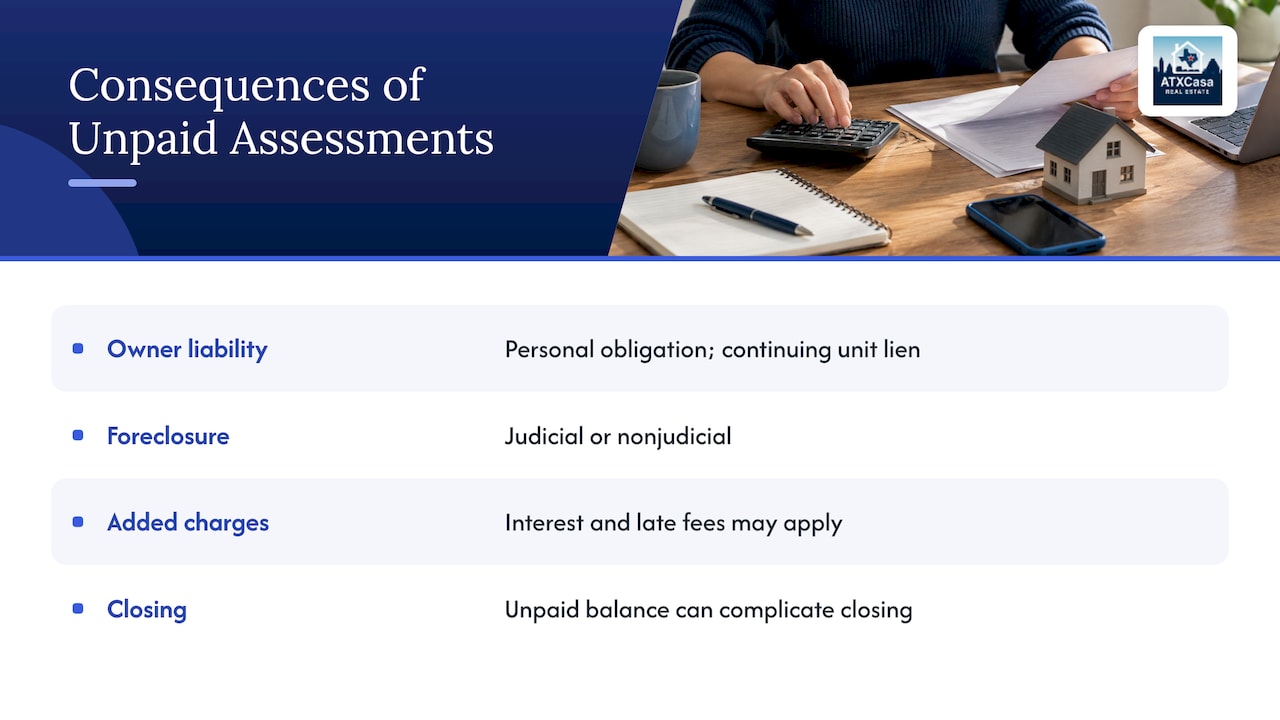
This is the point where an assessment turns from a budgeting issue into a legal one. Under Property Code §82.113, assessments are a personal obligation of the unit owner and are secured by a continuing lien on the unit. The association may foreclose judicially or nonjudicially, subject to procedural requirements, and assessments may carry interest and late fees.
For a buyer, the practical meaning is simple: an unpaid balance attached to the unit can complicate closing. For an owner, it means that a missed installment is not a minor matter. If you are struggling with a large assessment, contact the management company or board early, ask what payment plan options the governing documents and board policy allow, and speak with a Texas real estate attorney before a collection step is taken.
How an assessment affects a sale
An assessment can change who pays what at closing. The statute makes it the owner’s personal obligation and secures it with a lien, so a balance may need to be paid at closing or allocated between the parties. A few habits keep the transaction clean:
- Get a payoff or status statement from the association shortly before closing.
- Address responsibility in the contract. The governing documents and the terms of the adoption determine the final allocation, so write down who covers adopted but unpaid installments and anything adopted before closing.
- Know your contract form. Our guide on when TREC’s resale contract fits explains scope and addenda.
- Use your title company. They will collect the association information needed at closing. Our title insurance cost guide explains what that involves in Texas.
Sellers have their own strategy. If a project is likely, I advise sellers to understand the timing: an assessment adopted before listing is easier to explain and price than one that surfaces mid-contract. Buyers will ask, and a clear answer protects your negotiating position.
Perspective: how we read a condo’s assessment risk
We approach every condo purchase as a documents-and-data exercise. A listing photo tells you little about a building’s roof, and the monthly dues alone tell you less about its finances than most buyers think.
Our background is in technology, so we lean on data. Before a client makes an offer, we line up the resale certificate, the budget, the reserve picture, the insurance deductible and the minutes, and we look for the same pattern: does the building’s spending plan match its age? Where it does not, we price the risk into the offer or advise walking away.
For buyers, we recommend a written list of assessment questions before the option period ends. For investors, we model an assessment as a cash-flow event, not a surprise. For sellers, we recommend gathering the same documents before listing, so a buyer’s questions are answered quickly and your price holds.
Our aim is a transparent, stress-free purchase or sale, with locally sourced facts rather than generic portal content.
Vladimir
Work with ATXCasa on your Austin condo purchase or sale
If you are comparing Austin condos or preparing to sell one, we can help you read the association documents, flag assessment risk and compare buildings neighborhood by neighborhood across Austin, Cedar Park, Round Rock and Georgetown. Start at ATXCasa and tell us what you are buying or selling.

We pair local market insight with data-driven pricing, so the cost of a possible assessment is reflected in your offer or your list price rather than discovered after you sign.
FAQ
Can an Austin condo association levy a special assessment without an owner vote?
It depends on the declaration, bylaws and the statute that applies to your building. Chapter 82 covers condominiums recorded on or after January 1, 1994, and some earlier ones. Read your governing documents for the approval process and any limits, and ask a Texas real estate attorney if the language is unclear.
Does a buyer inherit the seller’s special assessment?
The assessment is the owner’s personal obligation and is secured by a lien on the unit. Who pays an adopted assessment at closing is settled by the contract, the governing documents and the terms of the adoption. Get an association payoff or status statement and put responsibility in writing.
Where will I see an assessment before I buy?
Subject to the exception in §82.157(c), the resale certificate under §82.157 lists unpaid special assessments currently due and payable from the selling owner, as well as capital expenditures approved for the next 12 months. It does not itself establish every future claim or assessment. Add the board minutes and budget, and ask directly about any assessment that has been discussed.
What happens if I do not pay?
An unpaid assessment can include interest and late fees, and the association holds a continuing lien. It may foreclose judicially or nonjudicially, subject to procedural requirements. Contact the association early and speak with a Texas real estate attorney before collection begins.
Can storm damage lead to an assessment?
Yes. When repair costs exceed insurance proceeds, §82.111(i) makes the excess a common expense and allows the board to assess owners by their common-expense liability. Check the master policy deductible and your own loss assessment coverage.
Sources
- Texas State Law Library: Assessments in property owners’ associations
- Texas State Law Library: Property owners’ associations, general information
- Texas Property Code Chapter 82
- Texas Property Code §82.157
- Texas Property Code §82.113
- Special assessments to fund a capital improvement
- Levying assessments to fund repairs and maintenance in Texas