
A duplex can be a sound way to start investing in Austin, because one purchase gives you two rent streams and, in many cases, a way to live in one unit while a tenant helps with the payment. The deal only works when the price, the rents, the loan terms and the lot’s rules line up. This guide covers each of those checks in the order I would run them for a client.
TL;DR
- A duplex is two rent streams on one purchase, but it is priced and financed differently from a single-family rental, so run the numbers on the property, not the neighborhood average.
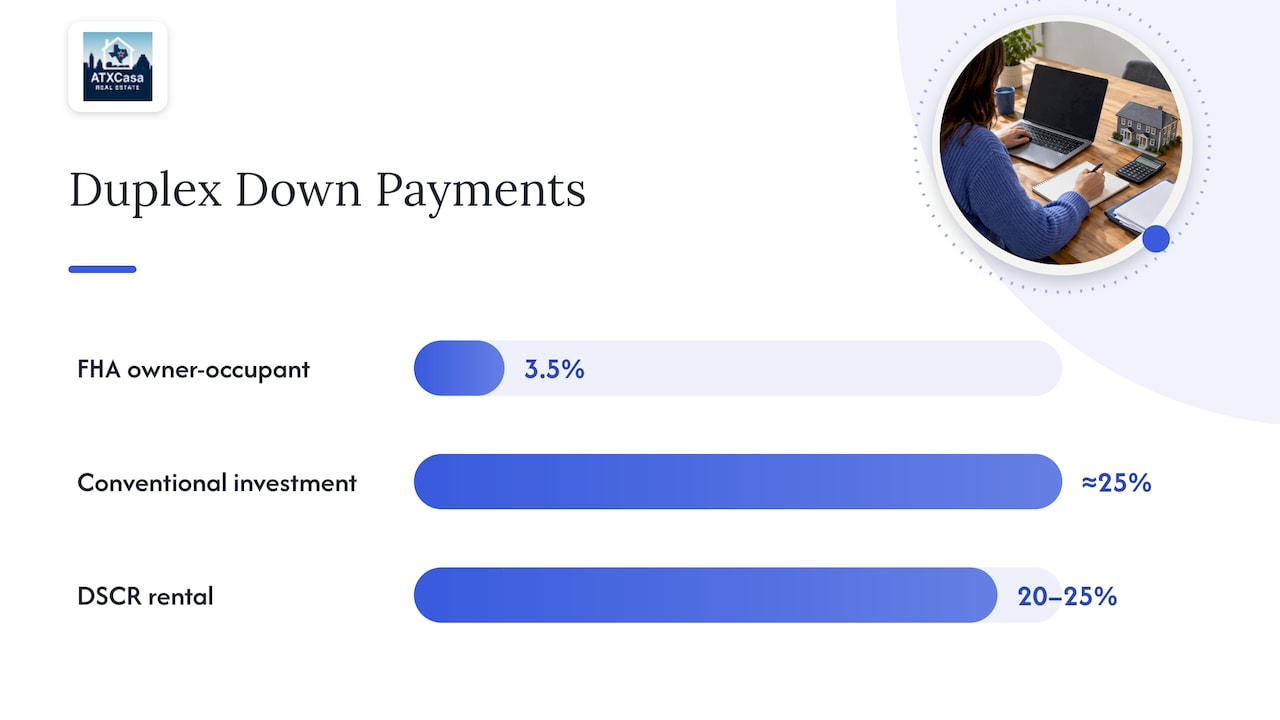
- Living in one unit can open lower down payment options (FHA, VA). Buying purely as an investor typically starts at 20% to 25% down.
- Austin’s HOME amendments changed what you can build or keep on a single-family lot, so verify zoning and lot standards before you count on a second or third unit.
- Calculate net operating income first, then subtract debt service. A deal that only works before the mortgage is not yet a deal.
- Check floodplain, historic, tree and utility constraints before you budget a renovation.
Table of Contents
- How a duplex differs from a single-family rental
- What Austin zoning allows after HOME
- Financing a duplex: owner-occupant versus investor
- Running the numbers: income, expenses and cash flow
- Choosing the area and the property
- Due diligence before you buy or renovate
- Value-add plays and what to watch
- Perspective
- Work with ATXCasa on your duplex search
- FAQ
- Sources
How a duplex differs from a single-family rental
A single-family rental is usually valued against comparable sales of similar houses. A duplex sits between residential and small-scale income property: buyers and lenders look at what the two units earn, not only at what neighboring homes sold for. That changes three practical things.
- Income matters as much as condition. Two leases, two sets of tenants and two turnover cycles mean your vacancy assumption needs to be built per unit.
- Financing depends on how you use it. An owner-occupied purchase and a non-owner-occupied purchase are underwritten differently, with different down payments and reserves.
- Rules are tied to the lot. Austin allows more units on many single-family lots than it did a few years ago, so the right question is what this specific lot allows, and what the existing structure’s permits actually cover.
We publish the broader market view on our market insights page, and a duplex purchase should always be read against that backdrop, then tested on its own numbers.
What Austin zoning allows after HOME
The City of Austin’s HOME amendments, Phase 1, allow up to three housing units on a property zoned SF-1, SF-2 or SF-3, change the regulations for properties with two units, and remove limits on the number of unrelated adults living in a unit, according to the city’s HOME summary. For duplex, two-unit and three-unit uses, the same page lists a maximum building coverage of 40% and a maximum impervious cover of 65%.
For an investor this has two consequences:
- A lot with an existing duplex may have room for more. Whether it does depends on lot area, coverage, impervious cover, utilities and any overlay. Do not price a third unit into your offer until a permit path is confirmed.
- Tenant mix rules are less restrictive in the city. The removal of unrelated-adult limits under HOME applies to the city’s zoning. Texas law still has its own occupancy rule: Section 92.010 of the Property Code generally limits landlords to three adults per bedroom unless a statutory exception applies. Know both before you write a lease.
If you are weighing a backyard unit on a lot you already own or are about to buy, our guide to Austin ADU rules and five lot checks walks through the lot-level questions in more detail.
Financing a duplex: owner-occupant versus investor
This is where the strategy splits. The two paths below produce very different cash requirements.
| Path | Typical down payment | What the lender focuses on |
|---|---|---|
| Live in one unit, FHA | 3.5% with a credit score of 580 or higher | Your income, credit and the property’s condition |
| Live in one unit, VA (eligible borrowers) | Often no down payment when the borrower is eligible, will occupy the home, meets VA and lender standards, and the sales price does not exceed appraised value. A VA funding fee, interest and closing fees may still apply. | Your eligibility and the property’s appraisal |
| Conventional, 2 to 4 units, investment | Generally starting around 25% | Credit, reserves, property income |
| DSCR loan, non-owner-occupied | Often around 20% to 25% | The property’s income against its debt payments |
The FHA and VA figures come from Experian’s duplex buying guide. The conventional 2-to-4-unit figure, and the common expectation of about six months of reserves, come from a Texas lender’s unit-rules overview. The DSCR range comes from a Texas mortgage broker’s FHA versus DSCR comparison. These are general ranges. Lenders set their own overlays, so get a written quote on your actual scenario before you make an offer.
If you plan to hold the property as a pure rental, it helps to understand how DSCR lender options for investors compare, since qualification is based mainly on property income rather than salary. If you are comparing a house-hack with an investor loan, this overview of down payment requirements by loan type shows how much the range can differ depending on how you will occupy the property.
My read: if you are a first-time buyer and willing to live in one unit for the required occupancy period, the lower down payment is usually the biggest advantage a duplex offers. It lets you keep more cash for reserves and repairs, which matters more than most buyers expect.
Running the numbers: income, expenses and cash flow
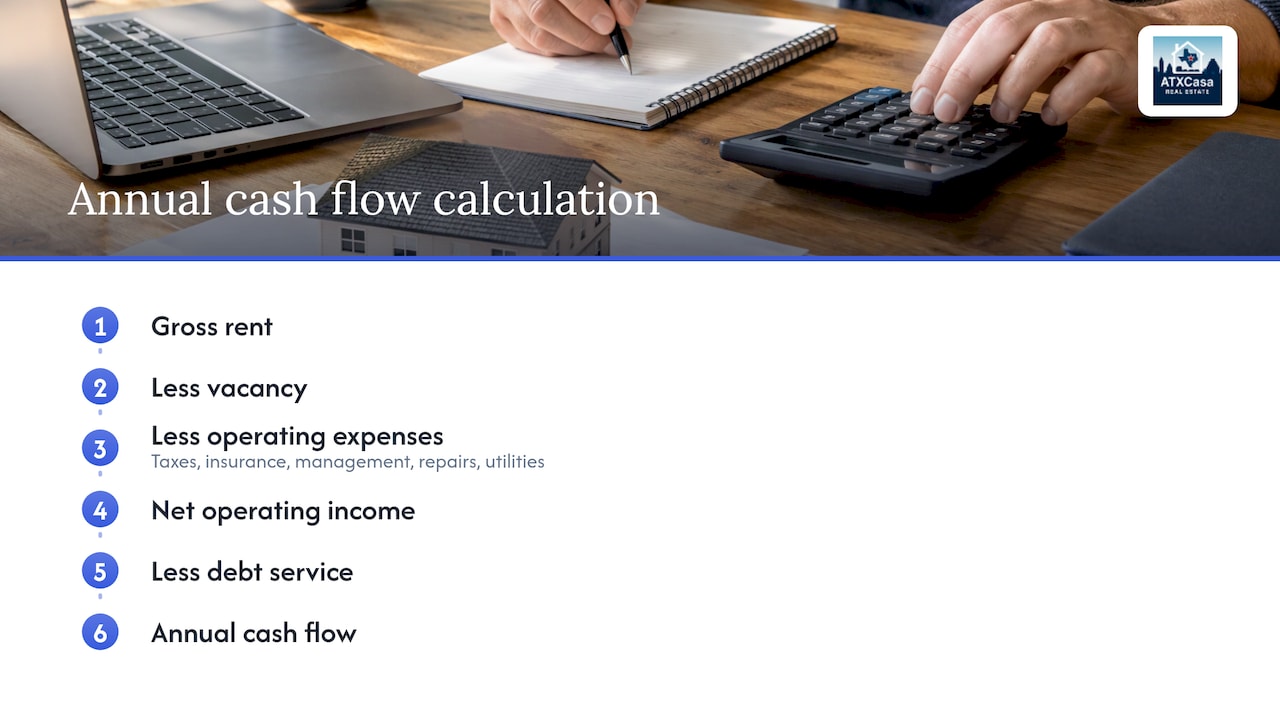
The method is simple, and it is where most weak deals reveal themselves. Start with gross rent, subtract vacancy, subtract all operating expenses (taxes, insurance, management, repairs, utilities) to reach net operating income, then subtract debt service to reach actual annual cash flow. That sequence is laid out in this CPA firm’s reporting guidance.
A worked example
The figures below are illustrative assumptions for the method, not a market quote or a specific listing.
| Line | Assumption | Annual |
|---|---|---|
| Purchase price | $550,000 | |
| Rent, two units | $2,300 each per month | $55,200 |
| Vacancy | 5% | -$2,760 |
| Rent collected | $52,440 | |
| Property taxes | About 1.8% of price (assumption) | -$9,900 |
| Insurance | -$2,400 | |
| Repairs and reserves | -$3,000 | |
| Management | 8% of rent collected | -$4,195 |
| Net operating income | $32,945 | |
| Loan | 25% down ($137,500), $412,500 at 7%, 30 years | -$32,933 |
| Cash flow before tax | about $12 |
This hypothetical deal produces a net operating income of about 6% of the price and breaks even after the mortgage. That is useful information: at that price and rate, you would need higher rents, a lower price, a larger down payment or a value-add plan to make it work. Use the current tax bill as a starting record, then estimate taxes for your own ownership and exemption status. Travis CAD says a general residence-homestead exemption requires ownership and occupancy and an application; limited early eligibility may apply. Verify projected appraised value, taxing-unit rates and exemptions for the address.
Keep each property on its own report
If you own more than one property, produce a monthly profit-and-loss statement for each one. Portfolio-level reporting can hide a weak asset behind a strong one, a point the same CPA guidance makes. A simple real estate CRM approach or even a well-built spreadsheet works, as long as each unit has its own rent roll and expense log.
Choosing the area and the property
Price per unit, rent per unit and the quality of the tenant pool vary a great deal across Austin and the surrounding suburbs. I would sort the decision into three layers:
- Location fundamentals. Commute access, employer proximity, schools, and the mix of renters in the area. Our best Austin neighborhoods for investment guide covers the city, and our suburb rental yield comparison looks at Cedar Park, Round Rock, Georgetown and others on yield.
- Physical layout. Separate entrances, separate meters for electricity and water where possible, off-street parking and laundry hookups. Units that look and live like independent homes rent more easily and keep tenants longer.
- Property condition. Foundation, roof, HVAC, plumbing and electrical in both units. Older duplexes often have one unit renovated and one not, which is both a risk and an opportunity.
When you review active listings, look at days on market and price reductions, not only the asking price. A duplex that has sat for months may tell you more about the real ceiling than a recent sale of a different building.
Due diligence before you buy or renovate
A duplex inspection is two inspections. Ask for both units to be accessible, and ask for the rent roll, lease copies, the last twelve months of utility and repair records, and any permit history.
Then check the lot. Austin’s residential permit application asks about zoning, historic status, floodplain proximity, erosion zones, trees, utilities, overlays and setbacks, and it lists the reviews and documents required. That list is a good checklist for a buyer even before any construction is planned. The city’s own permit materials show how a project can be routed through floodplain, historic, tree, fire, utility and erosion reviews depending on the address and scope, as another city permit document describes.
In practice, before you go under contract:
- Pull the zoning and overlay for the address and confirm the current use is legal.
- Check the floodplain status and whether the insurance quote reflects it.
- Ask whether any past additions, garage conversions or second units were permitted.
- Confirm that the electric and water setup matches how the units are rented.
- Get repair estimates from licensed contractors, not only the inspector’s general comments.
The option period in a Texas contract exists for this reason. Use it to complete the inspections and lender requirements, and use the findings to renegotiate price or repairs where it is appropriate.
Value-add plays and what to watch
Value-add duplexes are the ones listed below the neighborhood norm because one or both units need work. The upside comes from raising rent after renovation, repositioning the unit, or adding a unit where the lot and zoning permit it. Four things decide whether the plan works:
- Scope clarity. Cosmetic updates (flooring, paint, fixtures, kitchens) are easier to price than structural, plumbing or electrical work.
- Permits. If the work needs a permit, it may trigger reviews tied to the lot. Budget time as well as money.
- Tenant situation. A unit with a long-term tenant on a below-market lease cannot be renovated on your schedule. Read the lease and the notice requirements before you assume you can raise rent or vacate.
- Financing for the work. Some loans fund renovation, others do not. Decide before you contract, not after the inspection.
If you later sell or exchange a rental, taxes matter. Under IRS guidance on like-kind exchanges, Section 1031 generally defers gain or loss on qualifying exchanges of business or investment real property. Depreciation can also be recaptured at sale, as IRS Publication 523 describes. Speak to a CPA before you buy so the structure fits your plan.
Perspective
When a client tells me they want a duplex, I start with the question of how they will use it. A buyer who will live in one unit and a buyer who will own it from out of state need different loans, different reserves and different expectations for cash flow.
We build our approach on data. Nearly two decades in IT taught me to test an assumption before relying on it, so we run every duplex through the same sequence: verified rents, real expense lines, a financing quote, and the lot’s rules. We would rather show you a deal that is thin and let you decide than present a rosy projection.
Our AI-supported marketing and pricing tools help sellers reach investors and price against current data, and they help buyers compare properties on the same footing. The point is a transparent process in which you know the numbers at every step.
Vladimir
Vladimir
Work with ATXCasa on your duplex search
If you are buying, selling or investing in the Austin area, including Cedar Park, Round Rock and Georgetown, we can help you compare properties, test rent and expense assumptions, and understand the neighborhood before you commit. We offer personalized guidance on everything from neighborhood trends to hidden home pitfalls.

Tell us your budget, your timeline and whether you plan to live in one unit, and we will start from there. Start at ATXCasa, or read more in our new construction and investment section.
FAQ
How much do I need to put down on an Austin duplex?
It depends on occupancy. If you will live in one unit, FHA financing may allow 3.5% down with a credit score of 580 or higher, and eligible VA borrowers may qualify with nothing down. As a pure investor, conventional 2-to-4-unit loans generally start around 25% down, and DSCR loans often run in the 20% to 25% range. Confirm with a lender for your scenario.
Can I add a unit to an Austin duplex lot?
Possibly. Under HOME Phase 1, up to three units are allowed on SF-1, SF-2 and SF-3 lots, subject to building coverage of 40% and impervious cover of 65%. Whether your lot can accommodate it depends on its size, utilities, overlays and permit review, so confirm with the city before you count on it.
What is a good cash flow target for a duplex?
There is no universal figure. Calculate net operating income from rent collected minus taxes, insurance, management, repairs and utilities, then subtract debt service. Choose a target that leaves a cushion for vacancy and major repairs, and test it against higher interest and insurance costs.
Should I buy a duplex to live in or to rent out?
A house-hack uses lower owner-occupant down payments and offsets the cost of living with rent from the other unit. A full rental can scale faster but needs more cash and reserves. Our guide on choosing to buy, sell or rent can help you decide based on your life stage.
Sources
- HOME Amendments, City of Austin
- Texas Property Code, Chapter 92
- How To Buy a Duplex: A Step-by-Step Guide, Experian
- Investment Property Financing Austin: Unit Rules
- Texas House-Hack: FHA vs. DSCR Loan for a Multi-Family?
- Best DSCR Lenders for Real Estate Investors in 2026
- Down Payment Requirements Range from 0%
- Monthly Financial Reporting for Real Estate Investors
- Real estate CRM: Benefits, features, and best practices
- Residential New Construction and Addition Permit Application, City of Austin
- Residential permit materials, City of Austin
- Like-kind exchanges: Real estate tax tips, IRS
- Publication 523, Selling Your Home, IRS